Bikinis Panties Market Size
According to Deep Market Insights, the global bikinis panties market size was valued at USD 18.42 billion in 2025 and is projected to grow from USD 19.60 billion in 2026 to reach USD 26.73 billion by 2031, expanding at a CAGR of 6.4% during the forecast period (2026–2031). The market growth is primarily driven by increasing consumer preference for comfortable and fashionable intimate apparel, rising penetration of e-commerce platforms, growing demand for seamless and sustainable underwear, and continuous product innovation by leading lingerie manufacturers.
Key Market Insights
- Seamless and sustainable bikini panties are witnessing strong consumer adoption, driven by increasing demand for comfort, eco-friendly fabrics, and premium everyday essentials.
- North America dominates the global market, supported by high consumer spending on branded intimate apparel and widespread retail availability.
- Asia-Pacific is the fastest-growing regional market, fueled by rapid urbanization, rising disposable income, expanding online retail, and growing fashion awareness.
- Offline retail continues to account for the largest sales share, while online channels are expanding rapidly through direct-to-consumer platforms and digital marketplaces.
- Product innovation in moisture-wicking, seamless, stretchable, and body-contouring fabrics is creating premium growth opportunities across developed and emerging economies.
- Technology integration, including AI-based size recommendations, digital fitting solutions, and automated manufacturing, is improving customer experience and operational efficiency.
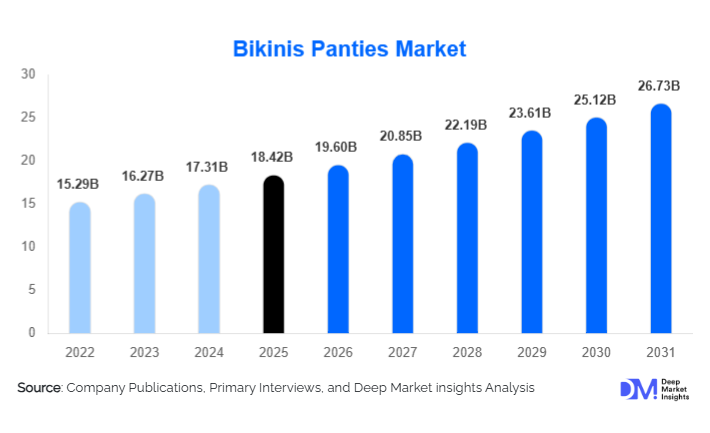
Bikinis Panties Market Trends
Growing Preference for Sustainable and Seamless Products
Manufacturers are increasingly introducing bikini panties made from recycled nylon, organic cotton, bamboo fibers, and biodegradable fabrics to address growing environmental concerns. Consumers are showing higher preference for seamless designs that provide improved comfort, invisibility under clothing, and enhanced flexibility. Sustainable collections are becoming a strategic priority for premium lingerie brands as environmentally conscious purchasing behavior continues to rise. Companies are also investing in recyclable packaging, ethical sourcing, and carbon reduction initiatives, strengthening long-term sustainability across the intimate apparel industry.
Digital Transformation Reshaping Consumer Purchasing Behavior
The rapid expansion of online retail platforms has transformed the way consumers purchase intimate apparel. AI-powered size recommendation tools, virtual fitting technologies, personalized product recommendations, and subscription-based lingerie services are improving customer engagement while reducing product returns. Brands are increasingly leveraging social media marketing, influencer collaborations, and direct-to-consumer business models to strengthen customer loyalty. Advanced manufacturing technologies such as automated knitting and laser-cut seamless production are also enhancing product quality while improving manufacturing efficiency.
Bikinis Panties Market Drivers
Increasing Demand for Premium Comfort Wear
Growing disposable income, rising fashion consciousness, and increasing awareness regarding comfort-oriented intimate apparel are significantly driving market expansion. Consumers are increasingly shifting toward premium bikini panties featuring breathable fabrics, moisture management, stretchable waistbands, and ergonomic designs. Product innovations focused on softness, durability, and skin-friendly materials continue encouraging replacement purchases while supporting higher average selling prices. Rising participation of women in the workforce and increasing preference for premium everyday essentials further contribute to steady market expansion.
Rapid Growth of Online Fashion Retail
The continuous expansion of e-commerce platforms has significantly improved product accessibility across both developed and emerging economies. Consumers benefit from wider product selections, competitive pricing, convenient home delivery, personalized recommendations, and flexible return policies. Direct-to-consumer strategies adopted by leading brands are improving profit margins while strengthening customer relationships through subscription services, loyalty programs, and exclusive online product launches.
Bikinis Panties Market Restraints
Volatility in Raw Material Prices
Fluctuating prices of cotton, elastane, synthetic fibers, and transportation costs continue creating pricing challenges for manufacturers. Rising labor expenses and supply chain disruptions further increase production costs, limiting profitability for both established companies and smaller regional manufacturers. These pricing pressures often result in higher retail prices, reducing affordability in price-sensitive markets and intensifying competition among value-oriented brands.
Highly Competitive Industry Structure
The market remains highly fragmented with the presence of numerous international, regional, and private-label brands competing on pricing, product quality, design innovation, and distribution reach. Frequent promotional campaigns, seasonal discounts, and rapidly changing fashion preferences create constant pressure on manufacturers to introduce new collections while maintaining competitive pricing and operational efficiency.
Bikinis Panties Market Opportunities
Expansion of Sustainable Lingerie Collections
Increasing consumer awareness regarding environmentally responsible products presents substantial opportunities for manufacturers to expand sustainable bikini panties portfolios. The adoption of recycled materials, biodegradable fabrics, water-efficient manufacturing, and ethical sourcing practices is expected to strengthen premium product demand. Brands emphasizing environmental transparency and certified sustainable production are likely to gain competitive advantages in global markets.
Growth of Personalized Shopping Experiences
Digital technologies such as AI-powered size recommendations, virtual fitting rooms, customized product suggestions, and data-driven customer engagement are creating new revenue opportunities. Personalized subscription services, limited-edition collections, and direct consumer interaction through digital platforms are helping brands improve customer retention while expanding premium product adoption across multiple regions.
Report Scope
| Report Metric | Details |
|---|---|
| Market Size in 2025 | USD 18.42 Billion |
| Market Size in 2026 | USD 19.60 Billion |
| Market Size in 2031 | USD 26.73 Billion |
| CAGR | 6.4% (2026-2031) |
| Base Year for Estimation | 2025 |
| Historical Data | 2022-2024 |
| Forecast Period | 2026-2031 |
| Report Coverage | Revenue Forecast, Competitive Landscape, Supply Chain Disruption, Growth Factors, Environment & Regulatory Landscape and Trends |
| Geographies Covered | North America, Europe, APAC, Middle East and Africa, LATAM |
| Countries Covered | U.S., Canada, U.K., Germany, France, Spain, Italy, Russia, Nordic, Benelux, Rest of Europe, China, Korea, Japan, India, Australia, Singapore, Taiwan, South East Asia, Rest of Asia-Pacific, UAE, Turky, Saudi Arabia, South Africa, Egypt, Nigeria, Rest of MEA, Brazil, Mexico, Argentina, Chile, Colombia, Rest of LATAM |
Explore more data points, trends and opportunities Download Free Sample Report
Product Type Insights
Traditional bikini panties continue to dominate the market owing to their affordability, versatility, and widespread consumer acceptance across diverse age groups and income segments. Their balanced combination of comfort, moderate coverage, and compatibility with everyday clothing makes them the preferred choice for daily wear. Continuous product improvements, including softer cotton blends, moisture-wicking fabrics, antimicrobial finishes, and enhanced elasticity, have further strengthened consumer preference. In addition, the extensive availability of traditional bikini panties across supermarkets, department stores, specialty retailers, and e-commerce platforms supports high sales volumes, reinforcing their leadership within the global market.
Seamless bikini panties represent the fastest-growing product category as consumers increasingly prioritize invisible undergarments suitable for body-fitting apparel, activewear, and professional clothing. Manufacturers are investing heavily in laser-cut technology, bonded seams, lightweight microfiber fabrics, and stretch engineering to improve comfort while minimizing visible panty lines. The growing popularity of athleisure, rising female workforce participation, increasing online lingerie purchases, and demand for premium comfort-focused intimate wear continue accelerating adoption of seamless products globally.
High-waist bikini panties are witnessing robust growth driven by rising consumer preference for enhanced coverage, body shaping, and superior comfort. Increasing awareness of body-positive fashion, demand for post-partum support garments, and the popularity of vintage-inspired lingerie collections are encouraging manufacturers to expand premium high-waist product offerings. The integration of breathable fabrics, contouring waistbands, and seamless construction further supports the growing popularity of this segment among consumers seeking both functionality and aesthetics.
Application Insights
Offline retail continues to account for the largest market share as consumers prefer physically evaluating fabric quality, comfort, fit, and elasticity before purchasing intimate apparel. Department stores, supermarkets, branded retail outlets, lingerie boutiques, and hypermarkets remain key sales channels due to their broad product availability, personalized customer assistance, and immediate product accessibility. Frequent promotional campaigns, seasonal discounts, and exclusive in-store collections further strengthen the dominance of offline retail, particularly across developing economies where physical shopping continues to influence purchasing decisions.
Online retail is emerging as the fastest-growing application segment owing to rapid digitalization, increasing smartphone penetration, secure digital payment infrastructure, and expanding direct-to-consumer business models. Leading brands are utilizing AI-powered size recommendations, virtual fitting tools, personalized product suggestions, subscription services, and influencer-driven marketing campaigns to improve customer engagement and reduce return rates. Growing consumer preference for convenient shopping, wider product selection, and competitive pricing continues supporting strong growth across online platforms.
Specialty lingerie stores continue serving premium consumer segments by offering exclusive collections, luxury brands, personalized fitting consultations, and premium customer service. These retailers increasingly differentiate themselves through customized shopping experiences, limited-edition collections, and premium fabric innovations, making them particularly attractive to consumers seeking high-quality intimate apparel and personalized styling assistance.
Distribution Channel Insights
Direct-to-consumer (DTC) distribution channels continue gaining significant momentum as lingerie brands strengthen their digital presence through company-owned websites and mobile applications. The DTC model enables manufacturers to establish stronger customer relationships, collect valuable consumer insights, launch exclusive collections, and improve profit margins by reducing intermediary dependence. AI-powered merchandising, predictive analytics, subscription-based purchasing models, and personalized marketing campaigns are further enhancing customer retention and brand loyalty.
Multi-brand retailers remain an essential distribution channel by offering consumers access to a wide portfolio of domestic and international lingerie brands under one platform. Their extensive retail networks, attractive promotional pricing, and diversified product offerings continue attracting price-sensitive as well as premium consumers. Additionally, omnichannel retail strategies that integrate physical stores with digital commerce, click-and-collect services, and real-time inventory management are significantly improving shopping convenience while strengthening overall market penetration.
Social commerce, influencer marketing, live-stream shopping, and digital community engagement are becoming increasingly important distribution tools, particularly among younger consumers. Brands are leveraging social media platforms to showcase product launches, styling recommendations, and personalized promotions, accelerating consumer awareness and improving conversion rates across online sales channels.
Consumer Group Insights
Women aged between 18 and 45 years represent the largest consumer segment due to high purchasing frequency, evolving fashion preferences, increasing disposable income, and growing awareness regarding comfort-oriented intimate apparel. This demographic actively seeks products that combine functionality, aesthetics, and premium fabric performance while remaining suitable for both everyday wear and professional lifestyles. The increasing participation of women in higher education and organized employment continues supporting consistent replacement purchases and premium product adoption.
Young professionals increasingly favor seamless, breathable, lightweight, and sustainable bikini panties that complement active lifestyles, athleisure clothing, and hybrid work environments. Meanwhile, mature consumers are placing greater emphasis on enhanced comfort, body support, durability, and premium-quality materials, encouraging manufacturers to diversify product portfolios with ergonomic designs and inclusive sizing. Growing body positivity movements and increasing demand for personalized sizing are further expanding opportunities across multiple consumer demographics.
Material Insights
Cotton remains the most widely utilized material due to its superior breathability, softness, moisture absorption, skin-friendly properties, and affordability. Cotton-based bikini panties continue to dominate mass-market demand because they provide excellent comfort for prolonged daily wear while maintaining cost competitiveness. Continuous improvements in combed cotton, organic cotton, and blended cotton technologies are further enhancing product durability and consumer satisfaction.
Microfiber fabrics continue gaining strong market acceptance owing to their lightweight construction, moisture management capabilities, quick-drying characteristics, wrinkle resistance, and smooth texture. The material is particularly preferred for seamless and performance-oriented intimate apparel designed for active lifestyles. Meanwhile, recycled nylon, bamboo fibers, modal, TENCEL™, and organic cotton are rapidly emerging as preferred sustainable alternatives as manufacturers increasingly invest in environmentally responsible production practices. These advanced materials provide enhanced elasticity, durability, antibacterial performance, and improved wearer comfort while supporting corporate sustainability initiatives and evolving consumer preferences.
Explore more data points, trends and opportunities Download Free Sample Report
Bikinis Panties Market Segmentations
By Product Type
- Traditional Bikini Panties
- Seamless Bikini Panties
- High-Waist Bikini Panties
By Application
- Offline Retail
- Online Retail
- Specialty Stores
By Distribution Channel
- Direct-to-Consumer (DTC)
- Multi-Brand Retailers
- Department Stores
- Specialty Lingerie Stores
- Online Marketplaces
Regional Insights
North America
North America remains the largest regional market for bikini panties, supported by strong consumer purchasing power, well-established premium lingerie brands, and a highly organized retail ecosystem. The United States accounts for the majority of regional demand due to high replacement rates, increasing preference for premium intimate apparel, and widespread adoption of seamless and sustainable products. Strong penetration of e-commerce platforms, subscription-based lingerie services, and direct-to-consumer business models further support market expansion. Continuous product innovation, rising demand for inclusive sizing, and increasing consumer awareness regarding comfort, fabric quality, and sustainability continue driving regional growth. Additionally, extensive marketing through social media influencers and celebrity collaborations has significantly enhanced consumer engagement across North America.
Europe
Europe represents a mature but innovation-driven market characterized by high demand for premium-quality lingerie, sustainable manufacturing, and ethically sourced materials. Germany, the United Kingdom, France, Italy, and Spain continue leading regional consumption owing to strong purchasing power and established fashion industries. The region's stringent environmental regulations and growing consumer preference for organic cotton, recycled fibers, and eco-certified production are accelerating product innovation. Furthermore, increasing investments in circular fashion initiatives, premium lingerie collections, and advanced textile technologies continue strengthening Europe's competitive position. The presence of globally recognized lingerie manufacturers and rising consumer awareness regarding sustainable fashion remain key drivers supporting long-term regional growth.
Asia-Pacific
Asia-Pacific is projected to register the fastest market growth during the forecast period due to rapid urbanization, expanding middle-class populations, increasing disposable income, and improving living standards. China remains the world's largest manufacturing hub, while India, Japan, South Korea, and Southeast Asian countries continue witnessing rising domestic consumption driven by increasing fashion awareness and digital commerce expansion. Growing female workforce participation, increasing smartphone penetration, rapid adoption of online shopping platforms, and rising influence of international fashion trends are significantly boosting premium lingerie demand. The availability of cost-effective manufacturing facilities, expanding retail infrastructure, and favorable government support for textile industries further position Asia-Pacific as the primary growth engine of the global market.
Latin America
Latin America continues witnessing steady market expansion supported by improving retail infrastructure, increasing urbanization, and rising consumer expenditure on fashion apparel. Brazil and Mexico remain the leading regional markets owing to growing female workforce participation, expanding middle-income populations, and increasing penetration of organized retail and e-commerce platforms. Rising awareness regarding premium intimate apparel, expanding availability of international brands, and growing adoption of social commerce are further strengthening market demand. Local manufacturers are also introducing affordable premium collections specifically designed to meet evolving consumer preferences across the region.
Middle East & Africa
The Middle East & Africa market is experiencing steady growth driven by increasing urbanization, rising disposable income, expanding organized retail, and greater exposure to international fashion brands. Premium lingerie demand is particularly strong across Gulf Cooperation Council countries, where luxury retail development, high purchasing power, and increasing female workforce participation continue supporting market expansion. South Africa remains one of the largest markets within Africa due to improving retail accessibility and growing demand for branded intimate apparel. In addition, expanding e-commerce penetration, increasing internet accessibility, and rising investments by international apparel companies are improving product availability across emerging markets, creating new opportunities for sustained regional growth.
Key Players in the Bikinis Panties Market
- Victoria's Secret & Co.
- Hanesbrands Inc.
- Jockey International Inc.
- Triumph International
- Calvin Klein
- PVH Corp.
- Wacoal Holdings Corp.
- Fruit of the Loom Inc.
- Marks & Spencer plc
- Aerie
- La Senza
- Etam Group
- Hunkemöller International
- COSMO LADY
- Sloggi