Blue Light Blocking Glasses Market Size
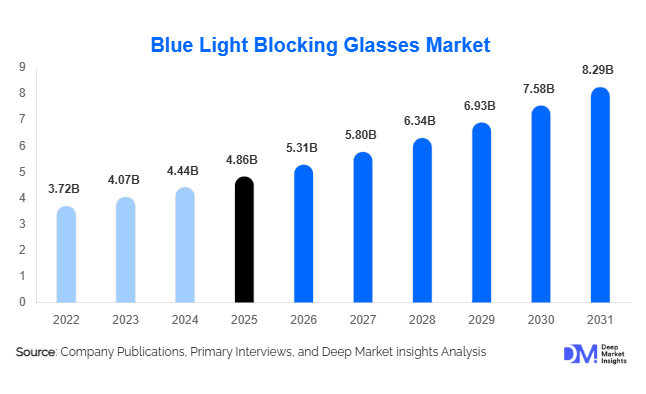
According to Deep Market Insights, the global blue light blocking glasses market size was valued at USD 4.86 billion in 2025 and is projected to grow from USD 5.31 billion in 2026 to reach USD 8.29 billion by 2031, expanding at a CAGR of 9.3% during the forecast period (2026–2031). The blue light blocking glasses market growth is primarily driven by the increasing prevalence of digital device usage, growing awareness regarding digital eye strain, and rising adoption of preventive eye care solutions among professionals, students, and gamers. Continuous innovation in lens coating technologies, lightweight frame materials, and omnichannel retail strategies is further accelerating product adoption across both developed and emerging economies. In addition, the expansion of hybrid work environments and prolonged screen exposure are encouraging consumers to invest in blue light filtering eyewear as a long-term vision protection solution.
Key Market Insights
- Non-prescription blue light blocking glasses dominate the global market, accounting for nearly half of total revenue due to affordability, easy availability, and increasing consumer awareness.
- North America remains the leading regional market, supported by high digital device penetration, premium eyewear adoption, and strong purchasing power across the United States and Canada.
- Asia-Pacific is projected to witness the fastest growth, driven by expanding smartphone adoption, rapid digitalization, growing online education, and increasing disposable income across China, India, Japan, and South Korea.
- E-commerce continues transforming product distribution, with online optical retailers, direct-to-consumer brands, and virtual try-on technologies significantly improving consumer accessibility and purchasing convenience.
- Advanced lens technologies, including anti-reflective coatings, UV400 protection, AI-assisted lens customization, and lightweight polycarbonate materials, are becoming key competitive differentiators among leading manufacturers.
- Corporate wellness initiatives and remote working trends are expanding institutional demand as organizations increasingly provide digital eye protection solutions to employees experiencing prolonged screen exposure.
Blue Light Blocking Glasses Market Trends
Premium Lens Technologies and Smart Eyewear Innovation
Manufacturers are increasingly focusing on advanced optical technologies to differentiate their product portfolios. Multi-layer anti-reflective coatings, UV400 protection, scratch-resistant finishes, hydrophobic coatings, and precision-engineered blue light filters are becoming standard features in premium eyewear collections. Artificial intelligence is also being integrated into digital eye assessments and personalized lens recommendations, enabling consumers to purchase customized eyewear through online platforms. Premium lightweight materials such as TR90, titanium alloys, and eco-friendly acetate frames are gaining popularity among consumers seeking both comfort and durability. These technological improvements are strengthening consumer confidence while encouraging replacement purchases and premium product upgrades across multiple age groups.
Rapid Expansion of Online Optical Retailing
Digital commerce continues reshaping the competitive landscape of the blue light blocking glasses industry. Online optical retailers are expanding through virtual try-on applications, facial recognition technologies, AI-powered frame recommendations, and simplified prescription uploads. Direct-to-consumer brands are leveraging influencer marketing, social media campaigns, subscription programs, and personalized customer experiences to increase market penetration. Consumers increasingly prefer online purchasing due to competitive pricing, wider product selection, and convenient home delivery. At the same time, manufacturers are strengthening omnichannel strategies by integrating digital storefronts with traditional optical retailers, creating seamless purchasing experiences while improving customer retention and brand loyalty.
Blue Light Blocking Glasses Market Drivers
Increasing Digital Screen Exposure Across Consumer and Professional Applications
The widespread adoption of smartphones, laptops, tablets, gaming consoles, and digital workstations has significantly increased average daily screen exposure worldwide. Remote work, online education, digital entertainment, and cloud-based collaboration platforms require consumers to spend prolonged hours using electronic devices, leading to increased awareness of digital eye strain and visual fatigue. Employers are increasingly incorporating vision wellness programs into employee healthcare initiatives, while parents are investing in protective eyewear for children engaged in digital learning. Growing awareness campaigns by healthcare professionals, optical retailers, and eyewear manufacturers are further encouraging preventive eye care, supporting sustained demand for blue light blocking glasses across residential, educational, and commercial environments.
Growing Consumer Preference for Preventive Eye Healthcare
Consumers are becoming increasingly proactive regarding long-term eye health, creating favorable conditions for preventive optical products. Rising disposable income, expanding health consciousness, and greater accessibility to premium eyewear have encouraged customers to adopt blue light filtering glasses before experiencing severe digital eye discomfort. Healthcare practitioners and optometrists are recommending protective lenses for individuals working in technology-intensive occupations, while gaming communities and content creators continue promoting blue light eyewear as part of everyday digital lifestyles. Continuous product innovation and fashionable frame designs are also improving consumer acceptance among younger demographics.
Blue Light Blocking Glasses Market Restraints
Limited Scientific Consensus and Price Sensitivity
Although consumer awareness continues expanding, varying clinical opinions regarding the effectiveness of blue light blocking technology remain a challenge for market penetration. Some healthcare professionals recommend alternative methods such as screen-time management and ergonomic workplace practices, creating uncertainty among potential buyers. Additionally, premium blue light filtering eyewear often commands higher prices than conventional spectacles, limiting adoption among price-sensitive consumers. The growing availability of counterfeit and low-quality products through online marketplaces also affects consumer trust, making product standardization and certification increasingly important for reputable manufacturers.
Competition from Integrated Digital Display Technologies
Modern smartphones, laptops, tablets, and monitors increasingly feature built-in blue light reduction modes, adaptive brightness controls, and night display settings that reduce blue wavelength emissions. As these software-based solutions become more sophisticated, some consumers perceive less need for dedicated protective eyewear. Device manufacturers continue investing in display technologies designed to minimize eye fatigue, potentially reducing reliance on external vision protection products. Nevertheless, many consumers continue combining display settings with specialized eyewear to maximize visual comfort during prolonged digital usage.
Blue Light Blocking Glasses Market Opportunities
Expansion into Corporate Wellness and Educational Institutions
Organizations are increasingly recognizing the importance of employee vision health as hybrid working models become permanent across numerous industries. Large enterprises, information technology companies, financial institutions, and educational organizations are beginning to incorporate blue light blocking glasses into workplace wellness initiatives. Bulk procurement agreements, customized corporate branding, and employee health benefit programs present significant opportunities for eyewear manufacturers. Educational institutions are also emerging as attractive customer segments as students continue spending substantial time using digital learning platforms, tablets, and computers both inside and outside classrooms.
Sustainable Eyewear Manufacturing and Premium Fashion Integration
Environmental sustainability is creating new growth opportunities within the blue light blocking glasses industry. Consumers increasingly prefer products manufactured using recycled plastics, biodegradable acetate, renewable packaging materials, and environmentally responsible production processes. Simultaneously, eyewear is evolving from purely functional protection into a fashion accessory, encouraging collaborations between optical manufacturers and lifestyle brands. Limited-edition collections, designer partnerships, customizable frame colors, and premium aesthetics are expanding consumer interest while enabling manufacturers to improve average selling prices and strengthen brand differentiation.
Report Scope
| Report Metric | Details |
|---|---|
| Market Size in 2025 | USD 4.86 Billion |
| Market Size in 2026 | USD 5.31 Billion |
| Market Size in 2031 | USD 8.29 Billion |
| CAGR | 9.3% (2026-2031) |
| Base Year for Estimation | 2025 |
| Historical Data | 2022-2024 |
| Forecast Period | 2026-2031 |
| Report Coverage | Revenue Forecast, Competitive Landscape, Supply Chain Disruption, Growth Factors, Environment & Regulatory Landscape and Trends |
| Geographies Covered | North America, Europe, APAC, Middle East and Africa, LATAM |
| Countries Covered | U.S., Canada, U.K., Germany, France, Spain, Italy, Russia, Nordic, Benelux, Rest of Europe, China, Korea, Japan, India, Australia, Singapore, Taiwan, South East Asia, Rest of Asia-Pacific, UAE, Turky, Saudi Arabia, South Africa, Egypt, Nigeria, Rest of MEA, Brazil, Mexico, Argentina, Chile, Colombia, Rest of LATAM |
Explore more data points, trends and opportunities Download Free Sample Report
Product Type Insights
Non-prescription blue light blocking glasses represent the largest product category, accounting for nearly 49.4% of the global market revenue in 2025. This segment has gained widespread acceptance due to affordable pricing, easy availability through online platforms, and suitability for consumers without corrective vision requirements. More than 38 million units of non-prescription blue light filtering glasses were produced globally during 2025, with strong demand from students, gamers, remote workers, and frequent digital device users. These products typically feature lightweight polycarbonate lenses, blue wavelength filtering coatings, anti-reflective technology, and UV protection. Increasing consumer awareness regarding digital eye strain and the availability of fashionable frame designs are encouraging younger demographics to adopt non-prescription variants as daily-use accessories.
Prescription blue light blocking glasses represent a high-value segment, contributing approximately 35% of total market revenue. Production exceeded 27 million units in 2025, driven by increasing demand among professionals requiring vision correction combined with digital eye protection. These glasses integrate prescription lenses with specialized blue light filtering coatings, anti-glare technology, scratch-resistant surfaces, and customized optical specifications. Increasing adoption among corporate employees, healthcare professionals, designers, programmers, and individuals spending more than 6–8 hours daily on digital devices is supporting segment expansion. Premium optical retailers are increasingly offering personalized prescription blue light solutions, improving customer experience and strengthening demand.
Clip-on blue light blocking glasses account for nearly 15.6% market share and are gaining popularity due to affordability and compatibility with existing prescription eyewear. Global production reached approximately 13 million units in 2025. These products allow users to convert traditional spectacles into blue light filtering eyewear without purchasing a complete new frame. Clip-on products are manufactured using lightweight materials and advanced filtering films capable of reducing exposure to harmful blue wavelengths. Demand is increasing among budget-conscious consumers, office workers, and students seeking cost-effective digital eye protection solutions.
Application Insights
Individual consumers represent the largest application segment, accounting for approximately 56% of global blue light blocking glasses market demand. More than 43 million units were purchased by individual users in 2025 for applications including personal computers, smartphones, gaming, streaming, and remote work. Growing awareness of digital eye fatigue, increased smartphone penetration, and changing lifestyle patterns are encouraging consumers to integrate protective eyewear into everyday routines. Younger demographics, especially millennials and Generation Z users, are increasingly adopting blue light glasses as both functional and fashion-oriented accessories. The availability of affordable online products and influencer-driven marketing campaigns is further accelerating consumer adoption.
Corporate employees represent another significant application category, contributing nearly 28% of market revenue. Organizations operating in technology, finance, consulting, healthcare, and customer service sectors are increasingly adopting employee wellness programs focused on digital eye protection. More than 160 million remote and hybrid workers globally represent a major opportunity for manufacturers targeting enterprise customers. Blue light blocking glasses are increasingly distributed as workplace benefits to employees spending extended periods using computers and digital collaboration platforms. Corporate procurement programs, customized eyewear packages, and partnerships with optical providers are expected to strengthen this segment throughout the forecast period.
Students represent approximately 16% of the global market, supported by the expansion of digital classrooms, online learning platforms, and tablet-based education systems. Millions of students worldwide spend several hours daily using digital learning devices, increasing awareness among parents and educational institutions regarding screen-related eye discomfort. Schools and universities are gradually incorporating digital wellness initiatives, creating opportunities for bulk purchasing programs. Lightweight frames, durable materials, affordable pricing, and child-friendly designs are becoming important factors influencing purchasing decisions within this segment.
Distribution Channel Insights
Online distribution channels dominate the blue light blocking glasses market, accounting for more than 58% of global sales volume in 2025. E-commerce platforms, direct-to-consumer websites, and online optical retailers have transformed consumer purchasing behavior by offering extensive product variety, competitive pricing, virtual try-on tools, and convenient home delivery. More than 44 million units were sold through digital platforms during 2025, supported by increasing internet penetration and mobile commerce adoption. Online channels are particularly popular among younger consumers who rely on digital reviews, influencer recommendations, and personalized shopping experiences before purchasing eyewear products.
Optical stores and specialty eyewear retailers continue maintaining a strong position, particularly for prescription blue light blocking glasses. These channels provide professional eye examinations, customized lens recommendations, and personalized fitting services that are difficult to replicate online. Premium consumers often prefer physical stores due to expert guidance and the ability to evaluate frame comfort and lens quality. Traditional optical retail networks remain important in developed markets, where consumers prioritize product reliability and professional consultation.
Supermarkets, pharmacies, and lifestyle retail outlets represent emerging distribution channels, particularly for affordable non-prescription blue light glasses. These channels attract impulse purchases and increase accessibility among mainstream consumers. Retail expansion across developing economies is expected to improve product availability as manufacturers seek broader consumer reach beyond specialized optical channels.
End User Insights
Professionals working in technology-intensive industries represent one of the fastest-growing end-user groups within the blue light blocking glasses market. Software developers, designers, analysts, financial professionals, and customer support employees frequently spend extended periods in front of computer screens, increasing demand for digital eye protection solutions. Enterprises are increasingly investing in employee wellness programs, resulting in higher adoption rates among office workers. The growing prevalence of hybrid work arrangements is expected to continue supporting demand from this user category.
Gamers and digital entertainment consumers represent an emerging high-growth segment due to prolonged exposure to gaming monitors, streaming platforms, and high-resolution displays. Gaming communities increasingly recognize blue light filtering eyewear as part of performance and comfort accessories. Specialized products featuring gaming-focused designs, enhanced contrast optimization, and lightweight frames are gaining popularity among professional and recreational gamers.
Healthcare and elderly users represent a niche but valuable segment due to increasing sensitivity toward eye comfort and preventive vision care. Aging populations in developed economies are showing growing interest in protective eyewear solutions that reduce discomfort associated with prolonged screen usage. Prescription-based products with advanced coatings and customized optical features are particularly relevant for this demographic.
Explore more data points, trends and opportunities Download Free Sample Report
Blue Light Blocking Glasses Market Segmentations
By Product Type
- Prescription Blue Light Blocking Glasses
- Non-Prescription Blue Light Blocking Glasses
- Clip-on Blue Light Blocking Glasses
By Application
- Individual Consumers
- Corporate Employees
- Students
- Gamers and Digital Entertainment Users
- Healthcare and Professional Users
By Distribution Channel
- Online Retail
- Optical Stores and Specialty Eyewear Retailers
- Supermarkets and Pharmacies
- Direct-to-Consumer Platforms
Regional Insights
North America
North America dominated the global blue light blocking glasses market, accounting for approximately 36.8% of total revenue in 2025. The United States represents the largest contributor, generating nearly 81% of regional demand due to high digital device penetration, strong consumer purchasing power, and widespread awareness regarding eye health. More than 21 million units were produced or distributed across North America during 2025, supported by established optical retailers, e-commerce platforms, and direct-to-consumer eyewear brands.
The region benefits from strong adoption among corporate employees, remote workers, gamers, and students. Technology companies and large enterprises increasingly include digital eye protection products within employee wellness programs. Premium prescription blue light glasses remain highly popular among professionals, while affordable non-prescription variants continue gaining traction among younger consumers. The United States leads innovation through AI-powered eyewear customization, virtual fitting technology, and sustainable frame development.
Europe
Europe accounted for approximately 28.4% of global blue light blocking glasses market revenue in 2025, supported by strong optical retail infrastructure and rising consumer awareness regarding preventive eye care. Germany, the United Kingdom, France, Italy, and Spain collectively contribute more than 74% of regional sales. Annual regional production and distribution exceeded 17 million units, with increasing demand for premium prescription lenses and sustainable eyewear products.
European consumers demonstrate strong preference for environmentally responsible manufacturing, recycled materials, and high-quality optical solutions. Workplace wellness adoption is expanding across industries, while educational institutions are increasingly recognizing the importance of digital eye protection for students. Growing online optical retail penetration is further improving accessibility, particularly among younger consumers seeking affordable and fashionable blue light filtering products.
Asia-Pacific
Asia-Pacific is projected to be the fastest-growing region, expanding at approximately 10.8% CAGR through 2031. The region accounted for nearly 24.7% of global revenue in 2025, with China, India, Japan, and South Korea driving demand. Regional production exceeded 29 million units, supported by large manufacturing capabilities, expanding consumer markets, and increasing digital adoption.
Key Players in the Blue Light Blocking Glasses Market
- EssilorLuxottica
- Carl Zeiss AG
- HOYA Corporation
- JINS Holdings Inc.
- Warby Parker Inc.
- Zenni Optical
- GUNNAR Optiks
- Felix Gray
- Cyxus
- Pixel Eyewear
- Vision Ease
- Bollé Brands
- Spektrum Glasses
- Blueberry Eyewear
- Swiss Eyewear Group