Modest Clothing Market Size
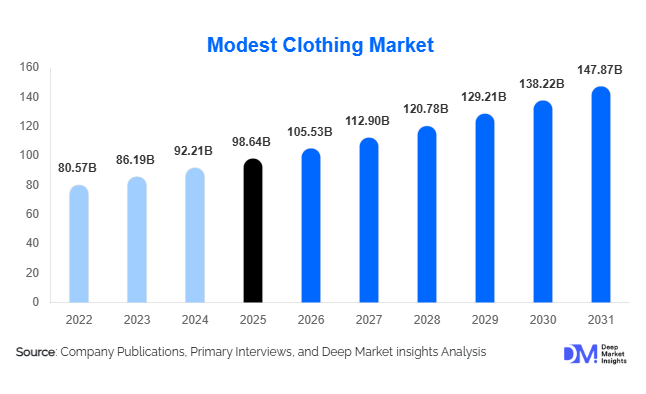
According to Deep Market Insights, the global modest clothing market size was valued at USD 98.64 billion in 2025 and is projected to grow from USD 105.53 billion in 2026 to reach USD 147.87 billion by 2031, expanding at a CAGR of 6.98% during the forecast period (2026–2031). The modest clothing market growth is primarily driven by the rising global demand for culturally inclusive fashion, increasing consumer preference for sustainable and premium apparel, expanding e-commerce penetration, and the growing influence of modest fashion among both religious and mainstream consumers. Fashion brands are increasingly launching innovative collections that combine style, comfort, and functionality, while digital retail platforms continue to improve accessibility across developed and emerging markets.
Key Market Insights
- Sustainable and ethically produced modest apparel is becoming a major purchasing criterion, encouraging brands to invest in eco-friendly fabrics, transparent supply chains, and responsible manufacturing practices.
- Online retail continues to dominate product distribution, supported by AI-driven personalization, social commerce, influencer marketing, and improved cross-border e-commerce capabilities.
- The Middle East & Africa remains the largest regional market, driven by strong cultural demand, premium fashion adoption, and expanding luxury modest fashion collections.
- Asia-Pacific is the fastest-growing regional market, supported by rising disposable income, expanding Muslim populations, and rapid digital retail adoption across Indonesia, Malaysia, India, and Pakistan.
- Luxury and contemporary modest fashion collections are gaining popularity among younger consumers, broadening the customer base beyond traditional religious buyers.
- Artificial intelligence, digital fashion technologies, and omnichannel retail strategies are transforming product personalization, inventory management, and customer engagement across the global market.
Modest Clothing Market Trends
Sustainable Fashion Becomes a Core Industry Focus
Fashion manufacturers are increasingly integrating sustainable materials including organic cotton, bamboo fibers, recycled polyester, and biodegradable packaging into modest apparel collections. Consumers are becoming more conscious of environmental impact and are actively seeking brands that emphasize ethical sourcing and responsible production. Premium labels are expanding eco-friendly product lines while investing in carbon reduction initiatives and circular fashion programs. Sustainable certification, recyclable packaging, and transparent manufacturing practices are strengthening brand loyalty and improving long-term competitiveness within the modest clothing industry. These developments are encouraging both established companies and emerging designers to prioritize sustainability as a key differentiator.
Digital Commerce and Personalized Shopping Experiences
Rapid expansion of digital commerce continues to reshape the modest clothing industry. Fashion retailers are implementing AI-powered recommendation engines, virtual fitting technologies, and personalized shopping experiences to improve customer satisfaction. Social media platforms, live-stream shopping, and influencer collaborations are accelerating product discovery among younger consumers worldwide. Mobile commerce, omnichannel retailing, and direct-to-consumer business models are allowing brands to reach international customers more efficiently while improving inventory optimization and customer retention. Technology-driven retail strategies are expected to remain one of the strongest long-term growth catalysts for the market.
Modest Clothing Market Drivers
Growing Demand for Inclusive and Cultural Fashion
The increasing acceptance of modest fashion across diverse consumer groups continues to drive market expansion. Consumers are seeking apparel that combines cultural values with contemporary fashion trends, encouraging international brands to expand their modest fashion portfolios. Growing Muslim populations, rising purchasing power, and broader acceptance of inclusive fashion have significantly increased global demand. Fashion weeks dedicated to modest apparel, celebrity endorsements, and collaborations between luxury designers and modest fashion brands are further strengthening consumer awareness and supporting long-term market development.
Expansion of Premium and Luxury Fashion Collections
Luxury fashion houses are increasingly introducing premium modest apparel collections featuring high-quality fabrics, designer craftsmanship, and limited-edition releases. Consumers are demonstrating greater willingness to invest in premium clothing offering superior comfort, exclusivity, and sustainable production. High-income consumers across the Middle East, Europe, and Asia-Pacific continue to drive demand for luxury modest apparel, encouraging brands to expand premium product offerings and enhance customer experiences through personalized retail services.
Modest Clothing Market Restraints
Fluctuating Raw Material Costs
Volatility in cotton, synthetic fibers, and other textile raw materials continues to affect manufacturing costs across the global modest clothing industry. Rising transportation expenses, labor costs, and supply chain disruptions also influence product pricing and profit margins. These challenges may limit affordability in price-sensitive markets while increasing operational pressure for manufacturers attempting to balance premium quality with competitive pricing.
Intense Competition from Fast Fashion Brands
The growing presence of fast fashion retailers has intensified competition within the modest clothing market. Low-cost alternatives, rapid product launches, and aggressive promotional strategies create pricing pressure for premium and specialized brands. Counterfeit apparel and unauthorized product imitations further affect brand reputation and reduce revenue opportunities for established manufacturers operating in organized retail channels.
Modest Clothing Market Opportunities
Growing Adoption Beyond Religious Consumers
Modest clothing is increasingly being embraced by consumers seeking comfortable, elegant, and versatile apparel regardless of religious affiliation. Loose-fitting silhouettes, minimalist fashion trends, and workplace-friendly clothing styles are expanding the industry's customer base. This broader acceptance creates significant opportunities for international fashion brands to diversify collections and target new demographic segments across North America and Europe.
Expansion of Sustainable Digital Fashion Brands
Digital-first fashion companies are leveraging advanced technologies to launch customized modest apparel collections with shorter production cycles and reduced environmental impact. AI-based demand forecasting, on-demand manufacturing, and direct-to-consumer sales channels are improving operational efficiency while minimizing inventory waste. These innovations create attractive opportunities for startups and established fashion companies pursuing sustainable long-term growth.
Report Scope
| Report Metric | Details |
|---|---|
| Market Size in 2025 | USD 98.64 Billion |
| Market Size in 2026 | USD 105.53 Billion |
| Market Size in 2031 | USD 147.87 Billion |
| CAGR | 6.98% (2026-2031) |
| Base Year for Estimation | 2025 |
| Historical Data | 2022-2024 |
| Forecast Period | 2026-2031 |
| Report Coverage | Revenue Forecast, Competitive Landscape, Supply Chain Disruption, Growth Factors, Environment & Regulatory Landscape and Trends |
| Geographies Covered | North America, Europe, APAC, Middle East and Africa, LATAM |
| Countries Covered | U.S., Canada, U.K., Germany, France, Spain, Italy, Russia, Nordic, Benelux, Rest of Europe, China, Korea, Japan, India, Australia, Singapore, Taiwan, South East Asia, Rest of Asia-Pacific, UAE, Turky, Saudi Arabia, South Africa, Egypt, Nigeria, Rest of MEA, Brazil, Mexico, Argentina, Chile, Colombia, Rest of LATAM |
Explore more data points, trends and opportunities Download Free Sample Report
Product Type Insights
Abayas dominate the global modest clothing market owing to their strong cultural significance, widespread acceptance across Middle Eastern and Islamic countries, and growing demand for premium and designer collections. Luxury fashion brands are increasingly introducing abayas featuring lightweight fabrics, sustainable textiles, intricate embroidery, and contemporary silhouettes that appeal to both traditional and fashion-conscious consumers. Rising disposable income, expanding luxury retail, and the increasing influence of modest fashion weeks have further strengthened demand for premium abayas. Additionally, digital customization services, limited-edition collections, and collaborations between international designers and regional fashion houses continue to drive innovation, reinforcing the segment's leadership across global markets.
Hijabs represent the fastest-growing product segment as consumers increasingly seek versatile, breathable, and performance-oriented headwear suitable for everyday wear, work, travel, and sports activities. Manufacturers are investing in moisture-wicking fabrics, wrinkle-resistant materials, bamboo fibers, recycled textiles, and seamless knitting technologies to improve comfort and durability. The growing popularity of modest activewear, expanding online retail availability, and increasing demand among younger consumers for fashionable color palettes and premium fabric options continue to accelerate segment growth. Social media influencers and modest fashion creators are also playing a significant role in increasing global awareness and consumer adoption.
Modest dresses continue to experience strong market growth as consumers increasingly prefer stylish yet comfortable apparel suitable for professional workplaces, educational institutions, casual gatherings, formal occasions, and international travel. Fashion brands are expanding seasonal collections featuring premium cotton, linen, satin, and eco-friendly fabrics while introducing contemporary cuts that blend modesty with modern fashion aesthetics. Growing workplace inclusivity, increasing demand for multifunctional wardrobes, and the expansion of premium ready-to-wear collections are encouraging wider adoption across both religious and mainstream consumer groups.
Application Insights
Everyday wear accounts for the largest share of the modest clothing market due to increasing consumer preference for comfortable, versatile, and functional apparel that can be worn across daily activities including work, education, shopping, and leisure. Consumers are increasingly investing in high-quality wardrobe essentials that offer durability, breathable fabrics, and timeless designs. The growing adoption of hybrid working models, rising demand for minimalist fashion, and increasing acceptance of modest clothing among mainstream consumers continue to strengthen this segment. Fashion retailers are also expanding capsule collections and sustainable basics to meet evolving consumer expectations for comfort and long-term usability.
Formal and occasion wear is witnessing significant growth, driven by increasing demand for premium modest apparel designed for weddings, religious celebrations, corporate events, and social gatherings. Luxury designers are introducing embellished gowns, designer abayas, elegant kaftans, and customized evening wear featuring premium craftsmanship and sustainable materials. Rising spending on special occasions, increasing destination weddings, and growing consumer preference for personalized fashion experiences continue to support the expansion of this segment.
Sportswear and active modest apparel are emerging as one of the fastest-growing applications as increasing health awareness and female participation in fitness activities drive demand for performance-based clothing. Manufacturers are developing lightweight, stretchable, moisture-management fabrics with ergonomic designs that provide both functionality and modest coverage. Growing participation in yoga, running, gym workouts, and outdoor recreational activities, together with increasing product innovation from global sportswear brands, continues to create substantial opportunities within this application segment.
Distribution Channel Insights
Online retail dominates the modest clothing market owing to expanding global e-commerce infrastructure, greater product accessibility, and the ability to reach consumers across multiple geographic regions. Digital platforms provide extensive product selections, competitive pricing, virtual styling assistance, customer reviews, AI-powered recommendations, and convenient cross-border shipping, making online shopping the preferred purchasing channel for many consumers. The rapid growth of mobile commerce, social commerce, influencer marketing, and direct-to-consumer business models has further accelerated online sales while enabling emerging brands to establish a global customer base with relatively lower operational costs.
Specialty fashion stores continue to maintain a strong market presence by offering premium shopping experiences, personalized customer service, exclusive designer collections, and customized styling consultations. Consumers purchasing luxury modest apparel often prefer physical stores where they can evaluate garment quality, fabric texture, fit, and craftsmanship before making high-value purchases. Designer boutiques and dedicated modest fashion retailers continue expanding their premium product portfolios to strengthen customer loyalty.
Hypermarkets and supermarkets remain an important distribution channel, particularly across emerging economies where affordability and accessibility significantly influence purchasing decisions. These retail outlets offer convenient access to everyday modest apparel, private-label collections, and value-oriented product ranges that appeal to price-sensitive consumers. The continuous expansion of organized retail infrastructure and private-label fashion offerings is expected to support steady long-term growth within this channel.
Explore more data points, trends and opportunities Download Free Sample Report
Modest Clothing Market Segmentations
By Product Type
- Abayas
- Hijabs
- Modest Dresses
- Modest Tops & Tunics
- Modest Bottom Wear
By Application
- Everyday Wear
- Formal & Occasion Wear
- Sportswear & Activewear
- Travel & Seasonal Wear
By Distribution Channel
- Online Retail
- Specialty Fashion Stores
- Hypermarkets & Supermarkets
- Department Stores
- Brand-Owned Retail Stores
Regional Insights
Middle East & Africa
The Middle East & Africa dominates the global modest clothing market, supported by strong cultural acceptance, high consumer spending on premium fashion, established textile industries, and increasing investments in luxury apparel manufacturing. Saudi Arabia, the United Arab Emirates, Turkey, Egypt, and South Africa remain key contributors to regional revenue, with fashion retailers continuously expanding designer collections and sustainable product offerings. Government initiatives promoting domestic textile manufacturing, the rapid expansion of luxury shopping destinations, and the growing popularity of international modest fashion events continue to strengthen regional market leadership. Rising tourism, increasing disposable income, and the presence of globally recognized modest fashion brands are expected to sustain long-term regional growth.
Asia-Pacific
Asia-Pacific is projected to register the fastest market growth during the forecast period owing to rapid urbanization, rising middle-class income, expanding Muslim populations, and the strong presence of textile manufacturing hubs across Indonesia, Malaysia, India, Pakistan, and Bangladesh. Increasing smartphone penetration, rapid e-commerce adoption, and expanding cross-border fashion trade are significantly improving product accessibility throughout the region. Government support for textile exports, continuous investment in apparel manufacturing infrastructure, and growing influence of social media-driven fashion trends are encouraging both domestic consumption and international exports, positioning Asia-Pacific as the fastest-growing regional market.
Europe
Europe continues to experience steady market expansion driven by multicultural consumer demographics, increasing acceptance of inclusive fashion, and rising demand for sustainable apparel. Countries including the United Kingdom, Germany, France, and the Netherlands are witnessing growing consumer preference for ethically manufactured clothing and premium designer collections. The expansion of modest fashion retailers, increasing collaborations between luxury fashion houses and modest fashion designers, supportive diversity initiatives, and strong online retail penetration continue to drive regional growth. Growing awareness of sustainable fashion and premium-quality garments is also encouraging long-term consumer adoption across European markets.
North America
North America represents a rapidly expanding market supported by increasing cultural diversity, growing consumer awareness of modest fashion, and strong digital retail infrastructure. The United States and Canada are witnessing rising demand for premium, sustainable, and fashion-forward modest apparel across both religious and mainstream consumer segments. Expansion of direct-to-consumer brands, increasing influencer marketing campaigns, greater product availability through leading online marketplaces, and growing workplace demand for versatile professional attire continue to strengthen regional growth. Continuous product innovation and increasing investment by international fashion brands are expected to further accelerate market expansion.
Latin America
Latin America is emerging as a promising growth market, driven by expanding e-commerce infrastructure, rising fashion awareness, increasing female workforce participation, and growing demand for comfortable everyday apparel. Brazil, Mexico, Argentina, Chile, and Colombia are witnessing gradual adoption of modest fashion through international fashion retailers, local designers, and digital marketplaces. Improvements in retail infrastructure, increasing internet penetration, rising disposable income among urban consumers, and growing exposure to global fashion trends through social media are creating favorable conditions for future market expansion across the region.
Key Players in the Modest Clothing Market
- Aab
- Modanisa
- Haute Hijab
- East Essence
- SHUKR Islamic Clothing
- Inayah
- Veiled Collection
- Annah Hariri
- Niswa Fashion
- Boksha
- Bella Hijabs
- Silq Rose