Skin Whitening Product Market Size
According to Deep Market Insights, the global skin whitening product market size was valued at USD 11.85 billion in 2025 and is projected to grow from USD 12.70 billion in 2026 to reach USD 17.98 billion by 2031, expanding at a CAGR of 7.2% during the forecast period (2026–2031). The skin whitening product market growth is primarily driven by increasing consumer awareness regarding skincare and pigmentation management, rising disposable incomes across emerging economies, and growing demand for multifunctional beauty products that combine brightening, anti-aging, hydration, and UV protection benefits.
The market has evolved significantly from traditional fairness creams toward advanced skin brightening and pigmentation-correction solutions. Consumers are increasingly preferring dermatologist-approved formulations that contain vitamin C, niacinamide, glutathione, alpha-arbutin, and botanical extracts. The rapid influence of social media beauty trends, celebrity endorsements, and K-beauty innovations is accelerating global adoption of premium skincare products.
Asia-Pacific continues to dominate the market due to high product penetration across China, India, Japan, South Korea, Thailand, and Indonesia, while North America and Europe are witnessing strong growth in clean-label and clinical skincare categories. E-commerce platforms, influencer-led marketing, and direct-to-consumer skincare brands are reshaping global purchasing behavior. In addition, increasing male grooming trends, rising penetration of dermatology clinics, and expanding medical aesthetics infrastructure are further supporting long-term global market expansion.
Key Market Insights
- Skin whitening products are increasingly shifting toward skin brightening and pigmentation-correction positioning, replacing traditional fairness-focused marketing strategies.
- Natural and clean-label formulations are gaining rapid traction globally, driven by consumer preference for safer and dermatologist-tested skincare ingredients.
- Asia-Pacific dominates the global market, led by strong consumer demand in China, India, Japan, and South Korea.
- E-commerce remains the fastest-growing distribution channel, supported by influencer marketing, AI-driven personalization, and social commerce platforms.
- Dermatology-grade and clinical skincare solutions are expanding rapidly, particularly in developed economies and premium urban markets.
- Technological innovation in skincare ingredients, including peptide complexes, nano-encapsulation, and biotechnology-based formulations, is transforming product efficacy and consumer adoption.
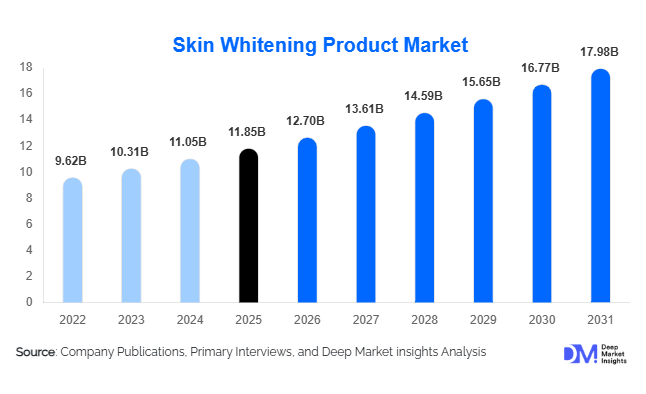
Skin Whitening Product Market Trends
Clean Beauty and Natural Ingredient Adoption Rising Rapidly
The global skincare industry is witnessing a strong shift toward clean-label and naturally derived skin whitening products. Consumers are increasingly scrutinizing ingredient transparency and preferring formulations free from harsh chemicals such as hydroquinone, parabens, mercury compounds, and steroids. Botanical ingredients including turmeric, aloe vera, licorice extract, green tea, and vitamin-based actives are becoming mainstream across premium and mass-market skincare categories.
Brands are heavily investing in vegan formulations, cruelty-free certifications, recyclable packaging, and sustainable sourcing practices to strengthen consumer trust. Younger consumers, particularly millennials and Gen Z demographics, are driving demand for environmentally responsible skincare products that combine efficacy with ethical positioning. This trend is accelerating innovation across natural serums, brightening creams, and dermatologist-tested pigmentation correction products globally.
Technology-Driven Personalized Skincare Expanding
Artificial intelligence, biotechnology, and digital skin analysis tools are increasingly transforming the skin whitening product market. Companies are integrating AI-powered skincare diagnostics, mobile skin scanners, and personalized ingredient recommendations to improve customer engagement and treatment effectiveness. Personalized skincare subscriptions and direct-to-consumer platforms are becoming important growth channels.
Advanced delivery technologies such as nano-encapsulation, microbiome-friendly formulations, and peptide-based actives are significantly improving ingredient penetration and product performance. Social commerce platforms and influencer-driven marketing campaigns are further accelerating consumer awareness regarding personalized skincare regimens. Virtual consultations with dermatologists and AI-assisted skincare recommendations are becoming increasingly common across premium beauty brands globally.
Skin Whitening Product Market Drivers
Growing Global Focus on Skincare and Appearance Enhancement
Rising consumer awareness regarding skincare, beauty routines, and pigmentation management is one of the major drivers supporting market growth. Consumers are increasingly prioritizing skincare products over traditional cosmetic makeup, particularly among younger demographics influenced by social media platforms and beauty influencers. The popularity of Korean beauty trends and Japanese skincare rituals has further accelerated demand for advanced brightening products globally.
Urbanization, rising disposable incomes, and increased exposure to digital beauty content are significantly boosting premium skincare adoption across emerging economies. Consumers increasingly seek products that provide brighter, healthier, and even-toned skin while also addressing anti-aging and UV protection concerns.
Rapid Expansion of E-Commerce and Digital Beauty Retail
The rapid growth of online beauty retail platforms is significantly enhancing global accessibility to skin whitening products. E-commerce channels provide consumers with extensive product variety, personalized recommendations, consumer reviews, subscription services, and direct access to international skincare brands. Social commerce and influencer-led beauty retailing are particularly impactful in Asia-Pacific markets.
Direct-to-consumer skincare brands are leveraging digital marketing strategies to expand rapidly while reducing dependency on traditional retail infrastructure. AI-powered customer engagement tools, live-stream product demonstrations, and virtual skin consultations are strengthening online consumer conversion rates and repeat purchases.
Skin Whitening Product Market Restraints
Increasing Regulatory Restrictions on Cosmetic Ingredients
Regulatory scrutiny regarding potentially harmful ingredients remains a major challenge for manufacturers operating in the skin whitening product market. Several countries have imposed restrictions or bans on ingredients such as hydroquinone, mercury compounds, and high-concentration steroids due to health concerns and adverse skin reactions.
Manufacturers must increasingly invest in regulatory compliance, clinical testing, and reformulation activities to maintain international product approvals. These regulatory pressures are increasing production costs and limiting product launches in highly regulated markets such as Europe and North America.
Ethical Concerns and Social Criticism Around Fairness Positioning
Growing global criticism regarding colorism and fairness-focused marketing practices is impacting traditional skin whitening product branding strategies. Consumers increasingly prefer terms such as “skin brightening,” “radiance enhancement,” and “pigmentation correction” instead of fairness-oriented messaging.
Brands failing to reposition their products toward inclusivity and skin health risk reputational damage and declining consumer trust. This transition requires substantial rebranding investments and marketing adjustments across multiple geographies, especially within Asia-Pacific markets historically associated with fairness-based skincare advertising.
Skin Whitening Product Market Opportunities
Expansion of Clinical and Dermatology-Based Skincare
The increasing demand for scientifically validated skincare products presents significant opportunities for dermatology-grade and clinical skin whitening solutions. Consumers are increasingly seeking multifunctional products capable of addressing hyperpigmentation, acne scars, melasma, uneven skin tone, and aging concerns simultaneously.
Dermatology clinics and medical aesthetic centers are rapidly expanding across countries such as South Korea, India, the UAE, Japan, and the United States. Professional treatments including laser therapy, chemical peels, glutathione-based solutions, and advanced brightening facials are generating new revenue streams for manufacturers and service providers. Partnerships between cosmetic brands and dermatologists are also becoming increasingly common globally.
Untapped Demand in Emerging Urban and Semi-Urban Markets
Emerging economies across Asia-Pacific, Africa, and Latin America continue to offer substantial untapped growth opportunities due to rising internet penetration, growing middle-class populations, and increasing beauty awareness among younger consumers. Tier-2 and tier-3 cities are becoming important consumption centers for affordable and mid-premium skincare products.
Companies expanding localized product offerings, affordable packaging formats, and digital retail strategies are expected to gain strong competitive advantage in these markets. Social media penetration and mobile-first shopping behavior are further accelerating product accessibility among previously underserved consumer groups.
Report Scope
| Report Metric | Details |
|---|---|
| Market Size in 2025 | USD 11.85 Billion |
| Market Size in 2026 | USD 12.70 Billion |
| Market Size in 2031 | USD 17.98 Billion |
| CAGR | 7.2% (2026-2031) |
| Base Year for Estimation | 2025 |
| Historical Data | 2022-2024 |
| Forecast Period | 2026-2031 |
| Report Coverage | Revenue Forecast, Competitive Landscape, Supply Chain Disruption, Growth Factors, Environment & Regulatory Landscape and Trends |
| Geographies Covered | North America, Europe, APAC, Middle East and Africa, LATAM |
| Countries Covered | U.S., Canada, U.K., Germany, France, Spain, Italy, Russia, Nordic, Benelux, Rest of Europe, China, Korea, Japan, India, Australia, Singapore, Taiwan, South East Asia, Rest of Asia-Pacific, UAE, Turky, Saudi Arabia, South Africa, Egypt, Nigeria, Rest of MEA, Brazil, Mexico, Argentina, Chile, Colombia, Rest of LATAM |
Explore more data points, trends and opportunities Download Free Sample Report
Product Type Insights
Creams and moisturizers dominate the skin whitening product market, accounting for the largest revenue share globally due to their widespread consumer familiarity, daily application frequency, and affordability across both developed and emerging markets. These products increasingly integrate multifunctional benefits such as SPF protection, anti-aging properties, hydration, and pigmentation correction, improving repeat purchase rates and long-term consumer engagement.
Serums and concentrated formulations represent one of the fastest-growing product categories, particularly vitamin C, niacinamide, and glutathione-based products that offer targeted treatment benefits. Facial masks, toners, and brightening cleansers are also gaining strong momentum due to increasing consumer interest in multi-step skincare routines inspired by Korean and Japanese beauty regimens. Professional clinical treatments including chemical peels, laser procedures, and dermatology-grade brightening systems are expanding rapidly within premium skincare markets. In addition, oral beauty supplements containing glutathione and collagen are emerging as niche growth categories within holistic skincare and wellness-oriented beauty trends.
Ingredient Type Insights
Vitamin-based ingredients, particularly vitamin C and niacinamide, hold the largest market share globally due to their clinically validated efficacy, lower irritation risks, and compatibility across multiple skin types. These ingredients are increasingly replacing harsh bleaching chemicals within premium skincare formulations. Natural and herbal ingredients are experiencing rapid growth driven by rising consumer preference for clean-label skincare products. Botanical extracts such as turmeric, aloe vera, licorice extract, and green tea are widely incorporated into brightening creams, serums, and face masks targeting sensitive skin consumers.
Biotechnology-based ingredients and peptide complexes are emerging as high-value innovation areas within premium skincare segments. Manufacturers are investing significantly in encapsulated delivery systems and microbiome-friendly formulations to improve product penetration and efficacy while minimizing side effects.
Distribution Channel Insights
E-commerce platforms dominate the modern skin whitening product retail landscape due to growing digital beauty commerce and influencer-driven purchasing behavior. Consumers increasingly rely on online reviews, personalized recommendations, social media tutorials, and AI-powered skincare assessments before making purchase decisions. Direct-to-consumer skincare brands are rapidly expanding by leveraging subscription models, targeted digital marketing campaigns, and consumer data analytics. Online beauty marketplaces enable international product accessibility while reducing operational dependency on traditional retail channels.
Pharmacies and dermatology clinics remain important channels for clinical-grade and prescription-based skincare products, particularly in developed markets. Specialty beauty retailers continue to perform strongly in premium urban markets where consumers seek personalized consultations and product demonstrations before purchasing.
Consumer Group Insights
Women continue to represent the dominant consumer segment within the skin whitening product market, accounting for the majority of global demand due to higher skincare spending and greater product adoption across all age groups. Female consumers increasingly prefer multifunctional skincare products that combine brightening effects with hydration, anti-aging, and UV protection benefits. Male grooming represents one of the fastest-growing segments globally, particularly across India, China, South Korea, and Middle Eastern countries. Rising social acceptance of male skincare routines and increasing appearance consciousness among younger men are significantly contributing to market growth.
Teenagers and younger adults are increasingly adopting preventative skincare routines, driving demand for acne-control brightening products and social media-promoted skincare regimens. Aging populations are also contributing strongly to premium anti-aging brightening product demand, particularly in Japan, Europe, and North America.
Explore more data points, trends and opportunities Download Free Sample Report
Skin Whitening Product Market Segmentations
By Product Type
- Creams & Moisturizers
- Serums & Concentrates
- Cleansers & Face Washes
- Facial Masks
- Toners & Essences
- Soaps & Bath Products
- Oral Skin Whitening Supplements
- Sun Protection Products
- Professional & Clinical Treatments
- Makeup with Whitening Properties
By Ingredient Type
- Vitamin-Based Ingredients
- Natural & Herbal Ingredients
- Chemical Actives
- Peptide & Biotechnology Ingredients
- Glutathione-Based Formulations
By Consumer Group
- Women
- Men
- Teenagers
- Aging Population (40+ Consumers)
- Gender-Neutral/Unisex Consumers
By Distribution Channel
- Supermarkets & Hypermarkets
- Pharmacies & Drug Stores
- Specialty Beauty Stores
- Department Stores
- E-commerce Platforms
- Direct-to-Consumer (DTC) Channels
- Dermatology Clinics & Medical Spas
- Social Commerce & Influencer Commerce
By Application Area
- Facial Whitening
- Body Whitening
- Underarm Brightening
- Intimate Area Brightening
- Pigmentation & Spot Correction
Regional Insights
North America
North America accounts for a significant share of the global skin whitening product market, led primarily by the United States and Canada. Consumer demand in this region is increasingly focused on pigmentation correction, anti-aging brightening products, and dermatologist-approved clinical skincare rather than traditional fairness positioning.
Clean-label skincare, vegan formulations, and sustainable beauty products are highly popular among North American consumers. Strong e-commerce penetration and growing medical aesthetics infrastructure continue to support regional market expansion.
Europe
Europe remains an important premium skincare market driven by countries such as Germany, France, the United Kingdom, Italy, and Spain. European consumers strongly prioritize regulatory-compliant formulations, natural ingredients, and environmentally sustainable skincare products.
France continues to serve as a major exporter of luxury skincare products globally, while Germany and the U.K. are witnessing increasing demand for clinical skincare and anti-pigmentation solutions. Stringent cosmetic safety regulations across the region are encouraging safer product innovation.
Asia-Pacific
Asia-Pacific dominates the global skin whitening product market with the largest market share, supported by strong consumer demand across China, India, Japan, South Korea, Thailand, Indonesia, and the Philippines. Cultural emphasis on skincare, rising disposable incomes, and rapid urbanization continue to drive market growth.
South Korea leads innovation in advanced skincare technologies and K-beauty product development, while China and India remain among the fastest-growing consumption markets globally. Expanding e-commerce ecosystems and social commerce platforms are significantly accelerating product accessibility across the region.
Latin America
Latin America is witnessing gradual growth in skin whitening product demand, particularly in Brazil and Mexico. Rising beauty consciousness, social media influence, and increasing female workforce participation are supporting skincare consumption trends.
Consumers increasingly prefer multifunctional products combining brightening, anti-aging, and sun protection benefits suitable for tropical climates. International skincare brands are also expanding regional presence through digital beauty retail channels.
Middle East & Africa
The Middle East & Africa region is emerging as a promising market for premium skincare and dermatology-based whitening products. Countries such as the UAE, Saudi Arabia, and South Africa are witnessing rising beauty expenditures and increasing adoption of advanced skincare treatments.
Luxury skincare consumption, expanding dermatology clinics, and growing medical aesthetics tourism are contributing significantly to regional market growth. In Africa, rising urbanization and increasing internet penetration are gradually improving skincare product accessibility across emerging consumer segments.