Shrimp Paste Market Size
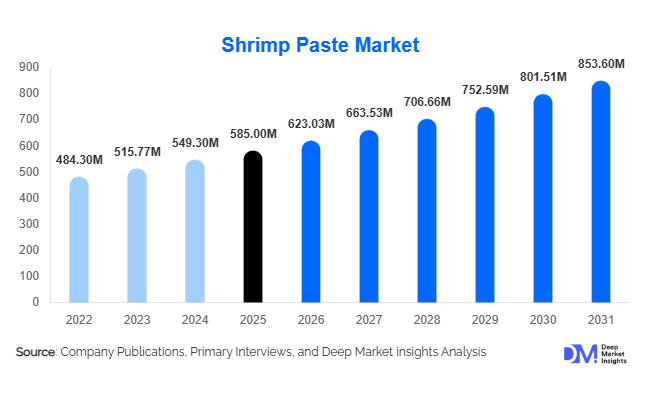
According to Deep Market Insights, the global shrimp paste market size was valued at USD 585 million in 2025 and is projected to grow from USD 623.03 million in 2026 to reach USD 853.60 million by 2031, expanding at a CAGR of 6.5% during the forecast period (2026–2031). The shrimp paste market growth is primarily driven by increasing consumption of fermented seafood products, rising global popularity of Southeast Asian cuisine, and growing utilization of shrimp paste as a flavor-enhancing ingredient in processed foods, sauces, seasonings, and ready-to-eat meals. Expanding ethnic food retail channels, premiumization of traditional condiments, and rising exports from major producing countries such as Thailand, Vietnam, Indonesia, and Malaysia are further supporting market expansion. The market continues to benefit from growing consumer interest in authentic umami flavors, clean-label food products, and traditional fermented ingredients that enhance taste without relying heavily on artificial additives.
Key Market Insights
- Fermented shrimp paste accounts for approximately 68% of global revenue, supported by widespread culinary applications across Southeast Asian cuisines and growing demand from food manufacturers.
- Household consumption remains the largest end-use segment, contributing nearly 52% of total market demand due to established usage patterns in major consuming countries.
- Asia-Pacific dominates the global market with nearly 74% share, led by Thailand, Indonesia, Vietnam, Malaysia, the Philippines, and China.
- North America is the fastest-growing regional market, supported by increasing consumption of Asian cuisine, immigration-driven demand, and expansion of ethnic food retail channels.
- Food processing applications are expanding rapidly, with manufacturers increasingly incorporating shrimp paste into sauces, instant noodles, seasoning blends, frozen meals, and snack products.
- Premium and clean-label shrimp paste products are gaining traction, creating opportunities for organic, low-sodium, preservative-free, and sustainably sourced offerings.
- Modern packaging technologies and food safety improvements are enabling manufacturers to expand exports into highly regulated markets across Europe and North America.
Shrimp Paste Market Latest Trends
Premiumization of Traditional Fermented Condiments
The shrimp paste industry is increasingly witnessing premiumization as consumers seek authentic, artisanal, and high-quality fermented seafood products. Manufacturers are introducing aged shrimp paste, organic variants, and specialty formulations that emphasize traditional production methods and superior flavor profiles. Premium products are attracting both domestic consumers and international buyers who value authenticity, traceability, and sustainable sourcing. Packaging innovations, including glass jars and premium retail formats, are further strengthening the positioning of shrimp paste as a gourmet culinary ingredient. The trend is particularly evident in developed markets where consumers are willing to pay premium prices for ethnic food products with strong origin stories and clean-label credentials.
Industrial Adoption in Processed Food Manufacturing
Shrimp paste is increasingly being adopted by food processing companies as a natural flavor enhancer capable of delivering complex umami profiles. Manufacturers of instant noodles, prepared sauces, frozen meals, snack seasonings, and ready-to-cook products are incorporating shrimp paste into formulations to create authentic regional flavors. Industrial demand is growing faster than traditional household consumption in several markets due to the expansion of convenience food industries. Standardized production techniques and improved quality control systems are enabling ingredient suppliers to meet the consistency requirements of large-scale food manufacturers. This trend is expected to create significant opportunities for bulk packaging and industrial-grade shrimp paste suppliers over the forecast period.
Shrimp Paste Market Drivers
Growing Popularity of Asian Cuisine Worldwide
The increasing global popularity of Thai, Vietnamese, Indonesian, Malaysian, and Filipino cuisine continues to be a major driver for the shrimp paste market. Restaurant chains, independent foodservice establishments, meal-kit providers, and packaged food manufacturers are incorporating authentic ingredients to meet rising consumer demand for international flavors. Shrimp paste serves as a foundational ingredient in numerous traditional dishes and is becoming increasingly recognized by consumers outside Asia. The expansion of Asian restaurant chains throughout North America, Europe, and the Middle East is contributing substantially to global demand growth.
Rising Consumer Interest in Fermented Foods
Fermented foods are gaining popularity due to their association with traditional food preparation methods, natural flavor development, and perceived nutritional benefits. Consumers increasingly prefer products that deliver authentic taste while minimizing artificial additives. Shrimp paste benefits from this trend as one of the oldest fermented seafood condiments used globally. Growing awareness of fermentation-based products has expanded the customer base beyond traditional consumers, particularly in developed markets where specialty and ethnic foods continue to gain mainstream acceptance.
Expansion of Convenience and Processed Food Industries
The rapid growth of the global convenience food sector is creating significant demand for shrimp paste as an ingredient. Food manufacturers are utilizing shrimp paste to enhance flavor profiles in instant noodles, seasoning blends, sauces, soups, and ready meals. The expansion of urban populations, busy lifestyles, and increasing demand for packaged foods across Asia-Pacific are supporting industrial procurement of shrimp paste. Large food processing companies are increasingly seeking standardized flavor solutions that can deliver authentic regional taste profiles at scale.
Shrimp Paste Market Restraints
Volatility in Shrimp Raw Material Prices
The shrimp paste industry remains highly dependent on shrimp availability and pricing. Disease outbreaks in aquaculture farms, climate-related disruptions, fishing restrictions, and seasonal variations can significantly affect raw material supply. Since shrimp often accounts for 40–55% of total production costs, fluctuations in raw material prices directly impact profitability and pricing strategies for manufacturers. Smaller producers are particularly vulnerable to supply chain disruptions and cost inflation.
Stringent Food Safety and Export Regulations
Manufacturers targeting international markets must comply with increasingly stringent food safety regulations, labeling requirements, and traceability standards. Regulatory compliance often requires substantial investments in testing laboratories, quality management systems, packaging upgrades, and certification programs. These requirements can increase operational costs and create barriers for smaller producers seeking entry into North American and European markets. Ensuring consistency in fermentation quality and food safety remains a critical challenge across the industry.
Shrimp Paste Industry Key Opportunities
Expansion into Premium and Clean-Label Categories
Consumer demand for natural, organic, and minimally processed food products presents a significant growth opportunity for shrimp paste manufacturers. Premium products featuring organic certification, sustainable sourcing, low-sodium formulations, and preservative-free ingredients are increasingly attracting higher-income consumers. Producers that invest in traceability systems and sustainability certifications can command higher margins while strengthening their brand positioning in developed markets. The clean-label movement is expected to remain a long-term growth catalyst for premium shrimp paste categories.
Growing Demand from Food Processing Applications
The increasing use of shrimp paste in industrial food manufacturing presents one of the largest untapped opportunities within the market. Processed food companies continue to seek authentic flavor ingredients capable of enhancing regional and ethnic product offerings. Shrimp paste suppliers that develop standardized industrial formulations can establish long-term partnerships with major food manufacturers. Applications in instant noodles, seasoning blends, frozen foods, and sauces are expected to generate substantial revenue opportunities over the forecast period.
Rising Export Demand from Emerging Markets
Export opportunities continue to expand as awareness of Southeast Asian cuisine increases globally. Markets such as the United States, Canada, Australia, Germany, the United Kingdom, and the Gulf countries are experiencing rising demand for authentic ethnic ingredients. Investments in export-oriented manufacturing facilities, packaging technologies, and food safety compliance systems are enabling producers to access new international markets. Governments in several producing countries are also supporting seafood exports through infrastructure development and trade promotion initiatives.
Report Scope
| Report Metric | Details |
|---|---|
| Market Size in 2025 | USD 585.00 Million |
| Market Size in 2026 | USD 623.03 Million |
| Market Size in 2031 | USD 853.60 Million |
| CAGR | 6.5% (2026-2031) |
| Base Year for Estimation | 2025 |
| Historical Data | 2022-2024 |
| Forecast Period | 2026-2031 |
| Report Coverage | Revenue Forecast, Competitive Landscape, Supply Chain Disruption, Growth Factors, Environment & Regulatory Landscape and Trends |
| Geographies Covered | North America, Europe, APAC, Middle East and Africa, LATAM |
| Countries Covered | U.S., Canada, U.K., Germany, France, Spain, Italy, Russia, Nordic, Benelux, Rest of Europe, China, Korea, Japan, India, Australia, Singapore, Taiwan, South East Asia, Rest of Asia-Pacific, UAE, Turky, Saudi Arabia, South Africa, Egypt, Nigeria, Rest of MEA, Brazil, Mexico, Argentina, Chile, Colombia, Rest of LATAM |
Explore more data points, trends and opportunities Download Free Sample Report
Product Type Insights
Fermented shrimp paste remains the dominant product category in the global shrimp paste market, accounting for approximately 68% of total revenue in 2025. The segment’s leadership is primarily attributed to its long-established role in traditional culinary practices across Southeast Asia, where it serves as a key flavor-enhancing ingredient in a wide range of regional dishes. Fermentation enhances umami intensity, aroma complexity, and product shelf life, making fermented variants highly preferred among both household consumers and foodservice operators. The segment also benefits from strong cultural acceptance, widespread availability, and continued demand from restaurants seeking authentic regional flavor profiles. In addition, growing consumer preference for natural fermentation processes and traditional food products continues to reinforce market demand. Manufacturers are increasingly investing in improved fermentation technologies, quality standardization, and packaging innovations to enhance product consistency and extend shelf stability.Specialty shrimp paste products, including organic, premium-aged, artisanal, clean-label, and low-sodium variants, are emerging as the fastest-growing category within the market. Rising health consciousness, increasing demand for premium food ingredients, and growing consumer willingness to pay for authentic and differentiated products are supporting segment expansion. These products are particularly gaining traction among urban consumers, gourmet food enthusiasts, and export markets where premium Asian ingredients are witnessing increasing demand. Meanwhile, non-fermented shrimp paste continues to maintain a niche presence in selected regional markets and industrial applications, although its market share remains substantially lower than fermented alternatives due to comparatively limited flavor complexity and consumer preference for traditional fermented products.
Form Insights
Paste form continues to dominate the global shrimp paste market, representing approximately 72% of total demand in 2025. The segment's leadership is driven by its traditional consumption format, ease of incorporation into household cooking, and widespread familiarity among consumers across major producing and consuming countries. Paste products offer superior flavor concentration and authenticity, making them the preferred choice for preparing traditional dishes, soups, curries, sambals, marinades, and sauces. Strong demand from households and foodservice establishments, coupled with entrenched culinary traditions across Southeast Asia, continues to support segment growth.Powdered shrimp paste is witnessing significant growth due to increasing adoption by food manufacturers seeking ingredients that offer easier handling, transportation, storage, and formulation flexibility. The powdered format enables greater consistency in industrial food production and is increasingly utilized in seasoning blends, snack coatings, instant noodles, and processed food applications. Liquid concentrates are also gaining traction, particularly within industrial food processing environments where precise flavor standardization and efficient dosing are critical. Additionally, block and cake formats maintain stable demand in traditional retail markets throughout Southeast Asia, particularly among consumers who continue to prefer conventional preparation methods and culturally familiar product formats.
Application Insights
Cooking ingredient applications account for approximately 43% of total market revenue, making them the largest application segment globally. The segment's dominance is supported by the extensive use of shrimp paste as a foundational ingredient in numerous traditional dishes across Southeast Asia and increasingly in international cuisines. Shrimp paste plays a critical role in enhancing flavor, aroma, and umami intensity in soups, curries, stir-fries, sambals, dipping sauces, and regional condiments. Growing consumer demand for authentic ethnic cuisines, combined with increasing home cooking trends and the popularity of traditional recipes, continues to strengthen demand within this segment.Sauces and condiments represent another major application area, benefiting from rising global interest in Asian flavors and premium culinary experiences. Manufacturers are increasingly incorporating shrimp paste into specialty sauces, seasoning bases, and condiment formulations to cater to evolving consumer preferences for bold and authentic taste profiles. Ready meals and processed foods are emerging as one of the fastest-growing application categories, driven by rapid urbanization, changing lifestyles, and increasing demand for convenience-oriented food products. The growing penetration of frozen meals, instant foods, and packaged culinary solutions is creating substantial opportunities for shrimp paste suppliers. Additionally, snack seasoning manufacturers are incorporating shrimp paste into flavor systems to develop differentiated savory products that appeal to consumers seeking unique and regionally inspired taste experiences.
Distribution Channel Insights
Modern retail channels, including supermarkets and hypermarkets, account for approximately 31% of global shrimp paste sales and remain the leading distribution segment. The growth of organized retail infrastructure across emerging and developed economies has significantly improved product visibility, accessibility, and consumer awareness. Large retail chains offer extensive product assortments, stronger brand exposure, and convenient purchasing experiences, making them an increasingly important channel for both domestic and imported shrimp paste products. Rising urbanization and increasing consumer preference for organized shopping environments continue to strengthen the segment’s position.Traditional grocery stores and wet markets remain highly relevant, particularly in rural and semi-urban areas across Southeast Asia where conventional purchasing patterns continue to dominate. These channels maintain strong consumer trust and remain important points of access for locally produced shrimp paste products. Specialty ethnic food stores are also gaining prominence in North America and Europe, serving growing immigrant populations and consumers interested in authentic Asian ingredients. Meanwhile, online retail channels are experiencing rapid expansion, supported by increasing internet penetration, growth of e-commerce platforms, direct-to-consumer business models, and wider availability of specialty food products through digital marketplaces. The convenience of home delivery and access to premium imported products are further accelerating online channel growth.
End User Insights
Household consumers account for approximately 52% of global shrimp paste demand, making them the largest end-user segment. The segment's dominance is driven by the widespread incorporation of shrimp paste into everyday cooking across Southeast Asian households, where it remains an essential pantry ingredient. Strong cultural attachment to traditional cuisines, continued preparation of home-cooked meals, and growing consumer preference for authentic regional flavors continue to support household demand. In addition, rising disposable incomes and increasing availability of packaged and branded products are contributing to greater consumer spending within the segment.Foodservice operators represent the second-largest end-user category and continue to benefit from the global expansion of Asian restaurants, street food outlets, quick-service restaurants, and premium dining establishments. Rising consumer interest in authentic Southeast Asian cuisine is driving procurement demand from restaurants seeking traditional flavor ingredients. The food processing industry is emerging as the fastest-growing end-user segment, supported by increasing utilization of shrimp paste in sauces, seasoning blends, instant noodles, frozen foods, ready meals, and snack products. Growing demand for natural flavor enhancers, clean-label ingredients, and authentic taste solutions is encouraging food manufacturers to incorporate shrimp paste into a broader range of packaged food products. As industrial food production continues to expand globally, demand from food processors is expected to outpace overall market growth during the forecast period.
Explore more data points, trends and opportunities Download Free Sample Report
Shrimp Paste Market Segmentations
By Product Type
- Fermented Shrimp Paste
- Non-Fermented Shrimp Paste
- Organic Shrimp Paste
- Low-Sodium Shrimp Paste
- Premium Aged Shrimp Paste
By Form
- Paste
- Powder
- Block/Cake
- Liquid Concentrate
By Application
- Cooking Ingredient
- Sauces & Condiments
- Marinades & Seasonings
- Ready Meals & Processed Foods
- Snack & Instant Food Flavoring
By End User
- Household Consumers
- Restaurants
- Hotels
- Catering Services
- Food Processing Industry
By Distribution Channel
- Supermarkets & Hypermarkets
- Traditional Grocery Stores
- Specialty Food Stores
- Online Retail
- Foodservice & B2B Distribution
Regional Insights
Asia-Pacific
Asia-Pacific dominates the global shrimp paste market, accounting for approximately 74% of total revenue in 2025. The region's leadership is deeply rooted in centuries-old culinary traditions that position shrimp paste as a staple ingredient in daily cooking and food preparation. Thailand remains the largest individual market, contributing nearly 18% of global demand, supported by strong domestic consumption, well-established seafood processing infrastructure, and significant export activity. Indonesia, Vietnam, Malaysia, and the Philippines also represent major consumption centers due to widespread use of shrimp paste in traditional dishes and condiments. China and Japan are increasingly important markets, particularly for premium products and processed food applications.Regional growth is being driven by rapid urbanization, rising disposable incomes, expanding middle-class populations, increasing consumption of packaged and convenience foods, and continued growth of the foodservice industry. Strong cultural acceptance of fermented seafood products, expanding modern retail networks, technological advancements in seafood processing, and increasing exports of Asian food ingredients are further supporting market expansion. Additionally, growing demand for premium and branded shrimp paste products among younger consumers is creating new opportunities for manufacturers across the region.
North America
North America accounts for approximately 8% of global market demand and represents the fastest-growing regional market. The United States dominates regional consumption, supported by a large and growing Asian immigrant population, increasing popularity of Southeast Asian cuisine, and expanding availability of specialty ingredients through mainstream retail channels. Canada is also experiencing steady growth due to its multicultural demographic profile and rising consumer interest in international culinary experiences.Regional growth is being driven by increasing consumer exposure to global cuisines, expansion of Asian restaurant chains, rising demand for authentic ethnic food ingredients, and growing adoption of Asian flavors in packaged food products. The continued development of specialty food retail networks, increasing penetration of e-commerce platforms, and growing demand from food manufacturers seeking unique umami-rich ingredients are further contributing to market expansion. Additionally, consumer interest in premium, artisanal, and internationally sourced food products continues to support long-term demand growth across the region.
Europe
Europe contributes approximately 7% of global shrimp paste demand, with the United Kingdom, Germany, France, and the Netherlands serving as the primary markets. Demand is supported by expanding Southeast Asian restaurant sectors, increasing ethnic food consumption, and broader availability of imported Asian ingredients through specialty retailers and mainstream supermarkets. The region has also witnessed growing consumer awareness of authentic international cuisines, creating favorable conditions for shrimp paste adoption.Key growth drivers include rising multicultural populations, increasing tourism-related food exposure, growing consumer willingness to experiment with international flavors, and the continued expansion of ethnic food retail categories. Demand for premium, sustainably sourced, and traceable seafood products is particularly strong within the region, encouraging manufacturers to focus on quality certifications and transparency initiatives. Furthermore, growth in ready meal production and premium condiment categories is creating additional opportunities for shrimp paste applications within the European food industry.
Latin America
Latin America represents approximately 5% of global market revenue, with Brazil and Mexico accounting for the majority of regional demand. Although the market remains relatively small compared to Asia-Pacific, increasing exposure to international cuisines and evolving consumer preferences are gradually expanding market opportunities. Urban consumers are increasingly exploring ethnic food products, while specialty retailers are broadening access to imported culinary ingredients.Regional growth is being supported by rapid urbanization, expansion of modern retail infrastructure, increasing disposable incomes, and growing influence of global food trends. Rising popularity of international dining experiences, growth in tourism-related food consumption, and increasing availability of imported Asian food products through supermarkets and online channels are also contributing to demand. Furthermore, expanding foodservice industries and greater culinary experimentation among younger consumers are expected to support long-term market development.
Middle East & Africa
The Middle East & Africa region accounts for approximately 6% of global shrimp paste demand. The United Arab Emirates, Saudi Arabia, and South Africa represent the most significant markets, supported by large expatriate populations, expanding hospitality sectors, and growing demand for international cuisines. Imports remain the primary source of supply across most countries, creating substantial opportunities for exporters from Southeast Asia.Regional growth is driven by rising disposable incomes, increasing urbanization, strong expansion of tourism and hospitality industries, and growing penetration of international restaurant chains. The presence of large Asian expatriate communities continues to support steady demand for authentic shrimp paste products, while broader consumer interest in ethnic cuisine is expanding the potential customer base. Additionally, improvements in retail infrastructure, growing food import volumes, and increasing availability of premium imported food products through supermarkets and online platforms are expected to support sustained market growth throughout the forecast period.
Key Players in the Shrimp Paste Market
- Lee Kum Kee
- Pantai Norasingh
- Mae Pranom
- Tra Chang
- Healthy Boy
- Tean's Gourmet
- Huy Fong Foods
- Chubang Food
- Jincaidi
- Sui Ma Ma
- Double Heroes
- Shusheng Food
- Dalian Qianri
- Jinda Food
- Huiming Food