Rollator Walker Market Size
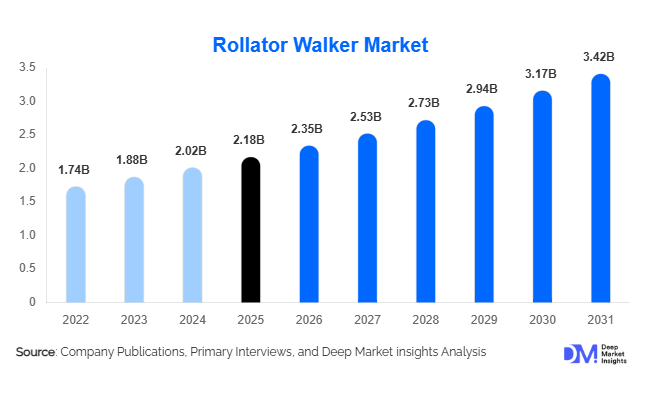
According to Deep Market Insights, the global rollator walker market size was valued at USD 2.18 billion in 2025 and is projected to grow from USD 2.35 billion in 2026 to reach USD 3.42 billion by 2031, expanding at a CAGR of 7.8% during the forecast period (2026–2031). The rollator walker market growth is primarily driven by the rapidly aging global population, increasing prevalence of mobility-related disorders, and growing preference for home healthcare and independent living solutions among elderly individuals.
Rollator walkers have become an essential category within the mobility assistance and rehabilitation equipment industry due to their enhanced safety, portability, ergonomic support, and multifunctional capabilities compared to conventional walkers. The increasing incidence of orthopedic disorders, arthritis, neurological diseases, obesity-related mobility limitations, and post-surgical rehabilitation needs is significantly boosting product demand globally. Healthcare providers are increasingly recommending rollator walkers to improve mobility outcomes, reduce fall risks, and enhance quality of life among aging populations.
Technological advancements are further transforming the market landscape, with manufacturers introducing lightweight aluminum and carbon-fiber frames, foldable designs, shock-absorbing wheels, smart sensor integration, GPS-enabled tracking, and telehealth-connected mobility systems. Growing digital healthcare penetration and the expansion of e-commerce medical equipment platforms are improving product accessibility across developed and emerging economies.
North America currently dominates the global market due to advanced healthcare infrastructure and high elderly care expenditure, while Asia-Pacific is emerging as the fastest-growing regional market driven by expanding geriatric populations in China, Japan, and India. Increasing investments in rehabilitation healthcare, elderly care facilities, and home-based recovery services are expected to further accelerate market growth over the forecast period.
Key Market Insights
- 4-wheel rollator walkers dominate the market, accounting for the largest revenue share due to superior stability, seating support, and outdoor usability.
- Home healthcare is emerging as the fastest-growing end-use segment, supported by rising preference for aging-in-place and decentralized patient care models.
- North America leads the global market, driven by strong reimbursement systems, high healthcare spending, and growing elderly demographics.
- Asia-Pacific is witnessing the fastest growth, fueled by rapid healthcare modernization, increasing chronic disease prevalence, and expanding middle-class healthcare expenditure.
- Smart rollators integrated with GPS tracking, fall detection, and telehealth monitoring are gaining traction in premium healthcare segments.
- Lightweight aluminum and carbon-fiber rollators are increasingly preferred due to improved portability, durability, and ergonomic handling.
Rollator Walker Market Trends
Smart and Connected Rollators Gaining Momentum
The integration of smart healthcare technologies into mobility devices is emerging as one of the most significant trends within the rollator walker market. Manufacturers are increasingly introducing smart rollators equipped with GPS tracking, fall detection systems, obstacle sensors, emergency alert mechanisms, and telehealth-enabled monitoring solutions. These advanced products are designed to enhance user safety, improve mobility independence, and support remote healthcare supervision for elderly populations. Smart mobility devices are becoming particularly attractive in developed healthcare markets where aging populations require connected care solutions. Integration with mobile applications and caregiver monitoring platforms is also expanding, enabling real-time health tracking and improved emergency response capabilities. As healthcare systems continue emphasizing preventive care and remote patient management, smart rollators are expected to witness accelerated adoption globally.
Rising Demand for Lightweight and Ergonomic Mobility Solutions
Consumer preference is increasingly shifting toward lightweight, portable, and ergonomically designed rollator walkers. Aluminum and carbon-fiber rollators are experiencing strong demand growth due to their improved maneuverability, foldability, and transportation convenience. Elderly consumers are prioritizing products that combine mobility support with comfort, portability, and modern aesthetics. Manufacturers are responding by introducing compact folding systems, adjustable handles, shock-absorbing wheels, integrated seating, and ergonomic braking systems to improve usability. Premium product categories featuring designer finishes and multifunctional capabilities are also gaining popularity among affluent elderly consumers. Additionally, outdoor-focused rollators with larger wheels and all-terrain mobility support are expanding in popularity, particularly across North America and Europe where active senior lifestyles are increasingly common.
Rollator Walker Market Drivers
Rapid Growth in Global Aging Population
The expanding geriatric population remains one of the primary drivers supporting growth in the rollator walker market. Elderly individuals are significantly more vulnerable to mobility impairments, arthritis, osteoporosis, balance disorders, and musculoskeletal weakness that require mobility assistance solutions. Countries including Japan, Germany, Italy, the United States, and Canada are experiencing rapid increases in populations aged 65 years and above, directly accelerating demand for rollator walkers. Governments and healthcare systems are increasingly investing in elderly care programs and rehabilitation infrastructure, further strengthening long-term market expansion. The growing focus on independent living and mobility preservation among seniors is also encouraging higher adoption of advanced mobility support devices.
Increasing Demand for Rehabilitation and Home Healthcare
The growing prevalence of orthopedic surgeries, spinal injuries, stroke rehabilitation, and chronic mobility disorders is significantly boosting demand for rollator walkers in hospitals, rehabilitation centers, and homecare settings. Healthcare providers are increasingly shifting toward outpatient rehabilitation and home-based recovery models to reduce hospitalization costs and improve patient outcomes. Rollator walkers provide enhanced stability and controlled mobility support during recovery periods, making them essential rehabilitation tools. Expansion of home healthcare services globally is also supporting demand for portable and easy-to-use mobility aids. Furthermore, rising obesity rates and sedentary lifestyles are increasing musculoskeletal disorders among younger populations, broadening the overall consumer base for mobility assistance products.
Rollator Walker Market Restraints
High Cost of Advanced Rollator Systems
The relatively high cost associated with premium and smart rollator walkers remains a major challenge for widespread market penetration. Advanced mobility systems equipped with electronic monitoring features, lightweight carbon-fiber structures, and smart safety technologies can be expensive for middle-income consumers, particularly in developing countries. Limited reimbursement coverage for technologically advanced mobility aids in several healthcare systems further restricts product affordability. Healthcare providers and consumers in cost-sensitive markets often prefer lower-priced conventional mobility solutions, limiting premium segment expansion.
Regulatory and Awareness Challenges in Emerging Markets
Limited awareness regarding mobility assistance products and persistent social stigma associated with mobility aid usage continue to impact adoption across certain developing economies. In some regions, elderly individuals avoid using rollator walkers due to cultural perceptions surrounding aging and physical disability. Additionally, regulatory complexities and inconsistent medical device approval standards across countries increase compliance costs for manufacturers. Product certification requirements, import restrictions, and varying reimbursement frameworks can create barriers for global market expansion, particularly for smaller manufacturers seeking international growth.
Rollator Walker Market Opportunities
Expansion of Smart Healthcare Ecosystems
The increasing adoption of connected healthcare infrastructure presents substantial opportunities for rollator walker manufacturers. Smart rollators integrated with telehealth platforms, caregiver monitoring systems, emergency alert technologies, and AI-based mobility tracking are becoming increasingly relevant in elderly healthcare management. Healthcare providers are prioritizing remote patient monitoring solutions to reduce hospital readmissions and improve preventive care delivery. Manufacturers investing in intelligent mobility systems capable of integrating with digital healthcare ecosystems are likely to gain strong competitive advantages. The growing adoption of wearable health devices and remote diagnostics is expected to further support demand for technologically advanced mobility assistance products.
Growing Demand Across Emerging Economies
Emerging markets across Asia-Pacific, Latin America, and the Middle East present significant untapped growth opportunities for the rollator walker market. Countries such as China, India, Brazil, Indonesia, and Saudi Arabia are witnessing rapid demographic aging, expanding healthcare infrastructure, and rising healthcare expenditure. Government-led healthcare modernization initiatives and increasing awareness regarding rehabilitation care are improving market accessibility for mobility assistance devices. Manufacturers focusing on affordable product innovation, local manufacturing partnerships, and region-specific distribution expansion are likely to benefit from strong long-term growth potential in these developing economies.
Report Scope
| Report Metric | Details |
|---|---|
| Market Size in 2025 | USD 2.18 Billion |
| Market Size in 2026 | USD 2.35 Billion |
| Market Size in 2031 | USD 3.42 Billion |
| CAGR | 7.8% (2026-2031) |
| Base Year for Estimation | 2025 |
| Historical Data | 2022-2024 |
| Forecast Period | 2026-2031 |
| Report Coverage | Revenue Forecast, Competitive Landscape, Supply Chain Disruption, Growth Factors, Environment & Regulatory Landscape and Trends |
| Geographies Covered | North America, Europe, APAC, Middle East and Africa, LATAM |
| Countries Covered | U.S., Canada, U.K., Germany, France, Spain, Italy, Russia, Nordic, Benelux, Rest of Europe, China, Korea, Japan, India, Australia, Singapore, Taiwan, South East Asia, Rest of Asia-Pacific, UAE, Turky, Saudi Arabia, South Africa, Egypt, Nigeria, Rest of MEA, Brazil, Mexico, Argentina, Chile, Colombia, Rest of LATAM |
Explore more data points, trends and opportunities Download Free Sample Report
Product Type Insights
4-wheel rollator walkers dominate the global market due to their superior balance support, integrated seating systems, storage compartments, and enhanced outdoor maneuverability. These products are widely preferred among elderly users and rehabilitation patients because they provide greater mobility, independence and safety compared to traditional walkers. Folding rollators are witnessing strong demand growth as consumers increasingly prioritize portability and compact storage capabilities, particularly for travel and homecare applications. Bariatric rollators are also gaining traction due to rising obesity prevalence globally, while upright rollators are expanding rapidly among consumers seeking ergonomic posture support and reduced spinal strain during mobility assistance.
Frame Material Insights
Aluminum rollators account for the largest market share owing to their lightweight structure, corrosion resistance, affordability, and portability. These products are highly preferred by elderly users who require easy handling and transportation. Steel rollators continue to maintain stable demand in institutional healthcare settings due to their durability and higher weight-bearing capacity. Carbon-fiber rollators represent the fastest-growing premium category, driven by rising consumer preference for ultra-lightweight mobility solutions with enhanced aesthetics and ergonomic performance. Titanium and composite-material rollators are also emerging in luxury healthcare segments focused on premium mobility assistance products.
Application Insights
Elderly mobility assistance remains the largest application segment within the rollator walker market, supported by growing aging populations globally. Rehabilitation and post-surgery recovery applications are also contributing significantly to market growth due to rising orthopedic procedures and neurological rehabilitation cases. Rollator walkers are increasingly utilized in stroke recovery programs, Parkinson’s disease support, and spinal injury rehabilitation because of their ability to provide controlled and stable mobility support. Outdoor mobility applications are gaining popularity as active aging lifestyles encourage elderly individuals to maintain higher levels of independence and physical activity.
Distribution Channel Insights
Hospital procurement and specialty medical equipment stores collectively represent the dominant distribution channels in the rollator walker market. Hospitals and rehabilitation centers remain major institutional purchasers due to increasing patient rehabilitation requirements and elderly care programs. Online retail platforms are emerging as one of the fastest-growing distribution channels globally, allowing consumers to compare features, pricing, reviews, and product specifications more efficiently. Direct-to-consumer sales channels are also expanding rapidly as manufacturers strengthen e-commerce strategies and digital healthcare marketing initiatives. Government healthcare procurement programs continue to support market growth in public healthcare systems across developed economies.
End-Use Insights
Homecare settings account for the largest share of the rollator walker market due to rising preference for independent living and home-based rehabilitation among elderly populations. Healthcare systems are increasingly shifting toward outpatient recovery and decentralized patient management models, supporting strong demand for portable mobility assistance devices. Hospitals and rehabilitation centers remain key end users due to increasing orthopedic surgeries, stroke rehabilitation cases, and neurological recovery programs. Assisted living facilities and nursing homes are also emerging as significant contributors to market growth, particularly in North America, Europe, and Japan where elderly care infrastructure continues to expand rapidly.
Explore more data points, trends and opportunities Download Free Sample Report
Rollator Walker Market Segmentations
By Product Type
- 3-Wheel Rollator Walkers
- 4-Wheel Rollator Walkers
- Bariatric Rollator Walkers
- Folding Rollator Walkers
- Upright Rollator Walkers
- Hybrid Rollator-Transport Chair Systems
- Electric/Powered Rollator Walkers
By Frame Material
- Aluminum Rollators
- Steel Rollators
- Carbon Fiber Rollators
- Composite Material Rollators
- Titanium Rollators
By Application
- Elderly Mobility Assistance
- Rehabilitation and Post-Surgery Recovery
- Neurological Disorder Support
- Orthopedic Recovery Applications
- Long-Term Disability Assistance
- Outdoor Mobility Applications
By Distribution Channel
- Hospital Procurement
- Specialty Medical Equipment Stores
- Online Retail Platforms
- Pharmacies and Drug Stores
- Direct-to-Consumer Sales
- Government Healthcare Procurement
By End User
- Hospitals
- Homecare Settings
- Assisted Living Facilities
- Nursing Homes
- Rehabilitation Centers
- Physiotherapy Clinics
Regional Insights
North America
North America dominates the global rollator walker market, accounting for approximately 36% of total market revenue in 2025. The United States represents the largest regional market due to its advanced healthcare infrastructure, high healthcare spending, strong reimbursement systems, and rapidly aging population. Rising prevalence of arthritis, obesity, and mobility-related disorders continues to drive demand for advanced mobility assistance products. Canada is also witnessing increasing adoption due to expanding elderly care investments and government-supported rehabilitation programs. The region additionally leads adoption of premium smart rollators integrated with connected healthcare technologies.
Europe
Europe accounted for nearly 31% of the global rollator walker market in 2025, supported by strong public healthcare systems and aging demographics. Germany remains the leading European market due to its advanced rehabilitation healthcare infrastructure and strong domestic medical device manufacturing sector. The United Kingdom, France, Italy, and Nordic countries are also major contributors to regional demand. European consumers increasingly prefer lightweight ergonomic rollators and premium mobility assistance products featuring sustainable materials and advanced safety systems. Favorable reimbursement frameworks and growing elderly care expenditure continue to strengthen regional market expansion.
Asia-Pacific
Asia-Pacific is the fastest-growing regional market, projected to register a CAGR exceeding 9% during the forecast period. Japan represents one of the largest global consumers of rollator walkers due to its exceptionally high elderly population ratio. China is experiencing strong demand growth driven by healthcare modernization, urbanization, and increasing chronic disease prevalence. India is emerging as a high-potential market supported by expanding healthcare access, rising middle-class incomes, and increasing awareness regarding rehabilitation healthcare. Australia and South Korea are also contributing significantly to regional growth due to improving elderly care infrastructure and rising adoption of advanced mobility devices.
Latin America
Latin America is witnessing gradual growth in rollator walker adoption, led primarily by Brazil and Mexico. Increasing healthcare investments, urbanization, and growing awareness regarding elderly mobility support are contributing to market expansion across the region. Demand remains concentrated in urban healthcare systems and private rehabilitation facilities, while online medical equipment distribution channels are improving accessibility for consumers. Rising chronic disease prevalence and aging demographics are expected to further support long-term market growth across Latin America.
Middle East & Africa
The Middle East & Africa region is experiencing moderate growth in the rollator walker market, supported by healthcare modernization initiatives and rising elderly care investments. GCC countries including Saudi Arabia and the UAE are investing significantly in rehabilitation centers, elderly healthcare facilities, and advanced medical equipment procurement. South Africa remains one of the leading African markets due to relatively stronger healthcare infrastructure and growing rehabilitation healthcare demand. Expanding medical tourism and rising chronic disease prevalence are also contributing to increasing mobility aid adoption across the region.
Key Players in the Rollator Walker Market
- Drive DeVilbiss Healthcare
- Invacare Corporation
- Sunrise Medical
- Human Care Group
- TOPRO Industri AS
- Medline Industries
- Graham-Field Health Products
- Bischoff & Bischoff GmbH
- Karman Healthcare
- Meyra GmbH
- Evolution Technologies Inc.
- Nova Medical Products
- Compass Health Brands
- Trionic Sverige AB
- Ostrich Mobility Instruments