Reef Safe Sunscreen Market Size
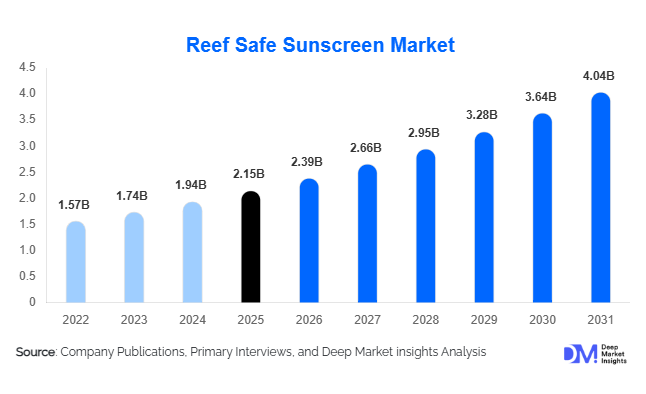
According to Deep Market Insights, the global reef-safe sunscreen market size was valued at USD 2.15 billion in 2025 and is projected to grow from USD 2.39 billion in 2026 to reach USD 4.04 billion by 2031, expanding at a CAGR of 11.1% during the forecast period (2026–2031). The reef safe sunscreen market growth is primarily driven by increasing environmental awareness regarding coral reef preservation, regulatory restrictions on harmful UV-filter ingredients, growing adoption of clean-label personal care products, and rising consumer preference for mineral-based sun protection solutions. The market has evolved from a niche segment within the broader sunscreen industry to a mainstream category as governments, tourism authorities, marine conservation organizations, and consumers increasingly prioritize environmentally responsible skincare products. Improvements in mineral sunscreen formulations, enhanced cosmetic appeal, and growing demand from tourism-intensive coastal destinations continue to strengthen market expansion globally.
Key Market Insights
- Reef-safe formulations are increasingly replacing conventional chemical sunscreens as consumers seek environmentally responsible sun protection products.
- Non-nano zinc oxide remains the dominant active ingredient, accounting for nearly 46% of global reef safe sunscreen demand due to its broad-spectrum protection and coral-friendly profile.
- North America dominates the global market, supported by high consumer awareness, premium skincare spending, and state-level ingredient restrictions.
- Asia-Pacific is the fastest-growing regional market, driven by expanding tourism, growing middle-class incomes, and increasing demand for sustainable beauty products.
- E-commerce has become the leading distribution channel, enabling brands to communicate ingredient transparency and sustainability credentials directly to consumers.
- Technological advancements in mineral formulations, including transparent zinc technologies and lightweight textures, are significantly improving consumer adoption.
Reef Safe Sunscreen Market Trends
Environmental Sustainability Becoming a Core Purchasing Factor
Environmental considerations have become a major driver of sunscreen purchasing decisions. Consumers are increasingly educated about the potential impact of certain chemical UV filters on coral reef ecosystems and marine biodiversity. This has accelerated demand for formulations free from oxybenzone, octinoxate, and other ingredients that face restrictions in several coastal jurisdictions. Sustainability certifications, biodegradable packaging, and cruelty-free manufacturing practices are becoming important brand differentiators. Many sunscreen brands are also investing in marine conservation partnerships and coral restoration initiatives, strengthening consumer trust and brand loyalty. The growing popularity of eco-tourism and sustainable travel is further encouraging travelers to select reef-safe products before visiting marine destinations.
Premium Mineral Sunscreens Gaining Mainstream Acceptance
The reef safe sunscreen market is experiencing a significant shift toward premium mineral-based formulations. Historically, mineral sunscreens faced adoption challenges due to thick textures and visible white residue. However, advancements in formulation technology have improved spreadability, transparency, water resistance, and cosmetic elegance. Consumers are increasingly viewing reef-safe sunscreen as part of a broader skincare regimen rather than a seasonal protection product. Premium formulations now incorporate antioxidants, anti-aging ingredients, moisturizers, and skin-soothing botanicals, allowing brands to command higher price points while improving user experience. This premiumization trend is particularly strong in North America, Europe, Japan, South Korea, and Australia.
Reef Safe Sunscreen Market Drivers
Growing Regulatory Restrictions on Harmful UV Filters
Government regulations banning or restricting ingredients such as oxybenzone and octinoxate are significantly contributing to market expansion. Regions including Hawaii, Palau, the U.S. Virgin Islands, Aruba, and several marine conservation zones have implemented restrictions designed to protect coral reef ecosystems. These regulations are encouraging manufacturers to reformulate product portfolios and invest in reef-safe alternatives. As additional governments evaluate environmental impacts of sunscreen ingredients, regulatory support is expected to remain a key long-term growth driver.
Rising Consumer Demand for Clean Beauty Products
The global clean beauty movement has positively influenced reef safe sunscreen adoption. Consumers increasingly prefer products with transparent ingredient lists, natural formulations, and sustainable sourcing practices. Mineral-based sunscreens align well with these preferences by offering perceived safety benefits for both human health and the environment. Growing awareness regarding skin health, anti-aging protection, and environmentally responsible consumption is encouraging repeat purchases and increasing category penetration across multiple demographic groups.
Reef Safe Sunscreen Market Restraints
Premium Pricing Compared with Conventional Sunscreens
Reef safe sunscreens typically command higher retail prices due to specialized ingredients, certification requirements, sustainable packaging, and advanced formulation technologies. The price premium often ranges between 20% and 40% compared with traditional chemical sunscreen products. This remains a significant barrier in developing markets where affordability remains a key purchasing consideration. Manufacturers must continue improving production efficiency to expand accessibility among price-sensitive consumers.
Lack of Standardized Global Definitions
The absence of universally accepted definitions and certification standards for reef-safe products creates challenges for both manufacturers and consumers. Various brands utilize different criteria when making reef-safe claims, leading to potential consumer confusion. Regulatory inconsistencies across regions further complicate market development. Greater industry standardization and certification frameworks would help improve transparency and strengthen consumer confidence in product claims.
Reef Safe Sunscreen Market Opportunities
Expansion of Eco-Tourism and Sustainable Travel
The rapid growth of eco-tourism presents substantial opportunities for reef safe sunscreen manufacturers. Governments, resorts, cruise operators, marine parks, and conservation organizations are increasingly recommending or mandating environmentally friendly sunscreen use. Tourism destinations that depend heavily on coral reef ecosystems are actively promoting reef-safe products as part of broader sustainability initiatives. Strategic partnerships with hospitality providers and tourism operators offer opportunities for long-term institutional sales and brand visibility.
Integration of Skincare and Sun Protection
Consumer demand for multifunctional beauty products is creating opportunities for reef-safe sunscreen brands to expand into premium skincare segments. Products combining sun protection with hydration, anti-aging benefits, antioxidant protection, and cosmetic enhancement are gaining popularity. This trend enables manufacturers to increase average selling prices while strengthening customer loyalty. Premium reef-safe formulations are increasingly being incorporated into daily skincare routines, supporting year-round demand growth beyond traditional seasonal usage patterns.
Report Scope
| Report Metric | Details |
|---|---|
| Market Size in 2025 | USD 2.15 Billion |
| Market Size in 2026 | USD 2.39 Billion |
| Market Size in 2031 | USD 4.04 Billion |
| CAGR | 11.1% (2026-2031) |
| Base Year for Estimation | 2025 |
| Historical Data | 2022-2024 |
| Forecast Period | 2026-2031 |
| Report Coverage | Revenue Forecast, Competitive Landscape, Supply Chain Disruption, Growth Factors, Environment & Regulatory Landscape and Trends |
| Geographies Covered | North America, Europe, APAC, Middle East and Africa, LATAM |
| Countries Covered | U.S., Canada, U.K., Germany, France, Spain, Italy, Russia, Nordic, Benelux, Rest of Europe, China, Korea, Japan, India, Australia, Singapore, Taiwan, South East Asia, Rest of Asia-Pacific, UAE, Turky, Saudi Arabia, South Africa, Egypt, Nigeria, Rest of MEA, Brazil, Mexico, Argentina, Chile, Colombia, Rest of LATAM |
Explore more data points, trends and opportunities Download Free Sample Report
Product Type Insights
Reef-safe body sunscreen represents the largest product segment, accounting for approximately 41% of global market revenue in 2025. Demand is supported by outdoor recreation, beach tourism, water sports activities, and broad consumer adoption. Reef-safe face sunscreens constitute the second-largest category as consumers increasingly integrate sun protection into daily skincare routines. Premium facial formulations featuring anti-aging benefits, tinted protection, and sensitive-skin compatibility are gaining traction. Lip protection products and multifunctional SPF cosmetics are emerging as high-growth niches, particularly within premium beauty markets where consumers seek comprehensive protection solutions. The growing preference for dermatologist-recommended and sensitive-skin-friendly formulations continues to support category expansion.
Active Ingredient Insights
Non-nano zinc oxide dominates the reef safe sunscreen market, accounting for approximately 46% of global revenue in 2025. Its leadership position is supported by broad-spectrum UV protection, strong environmental compatibility, and favorable consumer perceptions regarding safety. Titanium dioxide-based products maintain significant market presence, particularly in premium skincare formulations where lightweight texture is prioritized. Hybrid mineral formulations combining zinc oxide and titanium dioxide are experiencing increased adoption due to their balanced performance characteristics. Botanical UV-protection ingredients are emerging as complementary additives, enhancing sustainability credentials while supporting product differentiation among premium brands.
Distribution Channel Insights
E-commerce platforms account for approximately 29% of global reef safe sunscreen sales, making online channels the largest distribution segment. Consumers increasingly prefer digital platforms due to greater access to product information, ingredient transparency, customer reviews, and direct brand engagement. Pharmacies and drug stores remain important distribution channels, particularly for dermatologist-recommended and sensitive-skin products. Specialty beauty retailers continue to play a significant role in premium product positioning. Direct-to-consumer sales channels are growing rapidly as brands seek to improve customer retention, increase margins, and communicate sustainability narratives more effectively.
End User Insights
Individual consumers account for approximately 78% of global reef-safe sunscreen demand, reflecting the market's predominantly consumer-driven nature. Personal sun protection remains the primary application, supported by increasing awareness regarding UV exposure and environmental sustainability. Hospitality operators, resorts, cruise companies, and eco-tourism providers represent the fastest-growing institutional customer segment. Many tourism operators now promote reef-safe sunscreen use as part of broader environmental stewardship programs. Government agencies and conservation organizations are also emerging as important buyers through educational initiatives and public awareness campaigns focused on coral reef preservation.
Consumer Group Insights
Adult consumers account for approximately 72% of market demand and represent the largest consumer segment globally. This dominance is driven by higher purchasing power, greater awareness of skincare benefits, and stronger participation in outdoor activities. Women's demand remains particularly strong due to the integration of SPF products within daily skincare routines. Children's reef-safe sunscreen products are experiencing above-average growth as parents increasingly prioritize ingredient safety and environmental responsibility. Infant and baby formulations represent a specialized premium segment, supported by dermatologist recommendations and growing demand for gentle, hypoallergenic sun protection products.
Explore more data points, trends and opportunities Download Free Sample Report
Reef Safe Sunscreen Market Segmentations
By Product Type
- Reef-Safe Face Sunscreen
- Reef-Safe Body Sunscreen
- Reef-Safe Lip Protection
- Reef-Safe SPF Cosmetics
- Reef-Safe After-Sun Care Products
By Active Ingredient Type
- Non-Nano Zinc Oxide
- Titanium Dioxide
- Zinc Oxide + Titanium Dioxide Blends
- Botanical & Plant-Based UV Filters
- Hybrid Mineral Formulations
By Application / End Use
- Individual Consumers
- Hospitality & Resorts
- Eco-Tourism Operators
- Water Sports & Diving Centers
- Government & Conservation Programs
By Distribution Channel
- Online Retail
- Pharmacies & Drug Stores
- Specialty Beauty Stores
- Supermarkets & Hypermarkets
- Brand-Owned Stores
By Consumer Group
- Adults
- Children
- Infants & Babies
- Seniors
- Professional Outdoor Users
Regional Insights
North America
North America accounted for approximately 36% of global reef safe sunscreen market revenue in 2025, making it the largest regional market. The United States alone represents nearly 31% of global demand, supported by high consumer awareness, premium skincare spending, and environmental regulations in coastal regions such as Hawaii. Growing adoption of clean beauty products and increasing participation in outdoor recreational activities continue to strengthen regional demand. Canada also contributes significantly through strong sustainability preferences and growing interest in mineral-based sun protection products.
Europe
Europe accounted for approximately 28% of the global market in 2025. Germany, France, the United Kingdom, Italy, and Spain represent the largest national markets. European consumers demonstrate strong preference for environmentally responsible personal care products, supporting sustained demand for reef-safe formulations. Regulatory emphasis on sustainability and ingredient transparency further contributes to market growth. Premium skincare brands across Europe continue introducing reef-safe product lines to meet evolving consumer expectations.
Asia-Pacific
Asia-Pacific accounted for approximately 24% of global market revenue and is expected to register the fastest growth through 2031, with CAGR exceeding 13%. Australia remains a major market due to high UV exposure levels and strong sunscreen usage culture. China, Japan, South Korea, and India are emerging as key growth engines, driven by expanding middle-class populations, increasing beauty expenditure, and rising awareness regarding environmental sustainability. Growth in beach tourism and outdoor recreation across Southeast Asia further supports regional expansion.
Latin America
Latin America accounted for approximately 7% of global demand in 2025. Brazil and Mexico dominate regional consumption due to extensive coastlines, strong tourism industries, and increasing awareness regarding reef preservation. Growing interest in sustainable tourism and premium personal care products is supporting market development across major urban centers and coastal destinations.
Middle East & Africa
The Middle East & Africa region accounted for approximately 5% of global revenue in 2025. The United Arab Emirates, Saudi Arabia, South Africa, and Egypt are leading markets within the region. Luxury tourism development, increasing skincare awareness, and expanding hospitality sectors are supporting market growth. The UAE is emerging as the fastest-growing market in the region due to rising demand for premium personal care products and strong tourism activity.
Key Players in the Reef Safe Sunscreen Market
- Sun Bum
- Blue Lizard
- Badger Balm
- Thinksport
- Coola
- Raw Elements
- Stream2Sea
- Thrive Natural Care
- All Good
- Babo Botanicals
- ATTITUDE
- Goddess Garden
- Pipette
- Suntegrity
- Waxhead