Ready-To-Eat Meat for Sous Vide Market Size
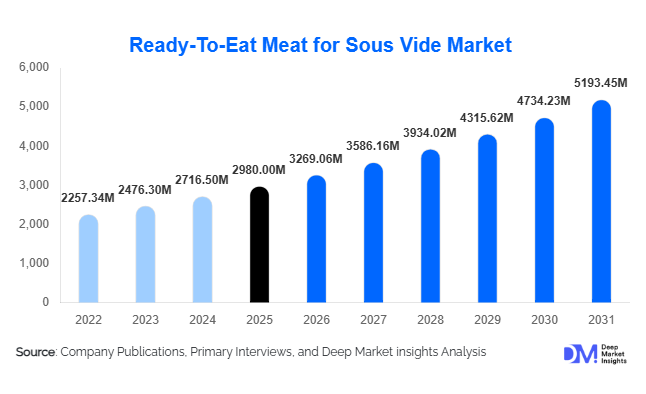
According to Deep Market Insights, the global ready-to-eat meat for sous vide market size was valued at USD 2,980 million in 2025 and is projected to grow from USD 3,269.06 million in 2026 to reach USD 5,193.45 million by 2031, expanding at a CAGR of 9.7% during the forecast period (2026–2031). The ready-to-eat meat for sous vide market growth is primarily driven by increasing consumer demand for premium convenience foods, rapid expansion of organized foodservice and meal delivery industries, and rising adoption of high-protein ready meal solutions across retail and hospitality sectors globally.
Key Market Insights
- Premium convenience food consumption is accelerating globally, driving demand for restaurant-quality ready-to-eat sous vide meat products with minimal preparation requirements.
- Foodservice operators are increasingly adopting sous vide meat products to improve kitchen efficiency, reduce labor dependency, and maintain consistent meal quality across outlets.
- North America dominates the global market, supported by advanced cold-chain infrastructure, strong premium food consumption, and widespread meal-kit adoption.
- Asia-Pacific is the fastest-growing regional market, fueled by urbanization, rising disposable incomes, and rapid growth of online grocery and food delivery platforms.
- Vacuum-sealed flexible pouch packaging remains the leading packaging format, accounting for the majority of global product shipments due to superior shelf-life performance and transportation efficiency.
- Technology integration, including AI-based cooking automation, IoT-enabled cold-chain monitoring, and smart traceability systems, is reshaping production and distribution efficiency across the industry.
Ready-To-Eat Meat for Sous Vide Market Latest Trends
Premium Gourmet Convenience Foods Gaining Strong Consumer Traction
Consumers globally are increasingly seeking premium-quality convenience foods that replicate restaurant-style dining experiences at home. Sous vide ready-to-eat meat products are benefiting from this shift due to their superior tenderness, flavor retention, and precise cooking consistency. Manufacturers are expanding gourmet flavor portfolios with herb-infused marinades, barbecue-inspired variants, Asian fusion flavors, and chef-curated meal solutions to target affluent and experience-driven consumers. Retailers are also dedicating larger refrigerated shelf spaces to premium prepared proteins, especially across North America, Europe, Japan, and South Korea. The growing influence of social media food culture and premium meal aesthetics is further accelerating demand for gourmet sous vide offerings among younger urban consumers.
Smart Packaging and Cold-Chain Digitization Expanding Rapidly
Manufacturers are increasingly investing in advanced packaging and cold-chain technologies to improve product traceability, food safety, and shelf-life performance. Intelligent temperature-monitoring labels, QR-enabled product traceability systems, and IoT-integrated refrigerated logistics are becoming mainstream across premium sous vide product categories. Automation in vacuum sealing, robotic portioning systems, and AI-based cooking controls are also improving production scalability while reducing operational inconsistencies. Sustainable packaging innovations such as recyclable multilayer pouches and biodegradable vacuum films are gaining importance as environmental regulations tighten globally. Companies adopting technologically advanced and sustainability-focused packaging systems are strengthening competitive positioning in both retail and institutional foodservice channels.
Ready-To-Eat Meat for Sous Vide Market Drivers
Growing Demand for High-Quality Convenience Meals
Rapid urbanization, longer working hours, and rising dual-income households are significantly increasing consumer dependence on premium convenience foods. Ready-to-eat sous vide meat products address evolving consumer preferences by delivering restaurant-quality proteins that require minimal preparation time. The growing popularity of home dining, meal kits, and premium reheatable meals has further accelerated market demand. Consumers are increasingly prioritizing convenience without compromising taste, texture, and nutritional value, making sous vide proteins highly attractive across retail channels. This trend is especially prominent among millennials and urban professionals seeking time-efficient premium meal solutions.
Expansion of Global Foodservice and Hospitality Industries
The expansion of restaurants, hotels, cloud kitchens, airline catering operators, and institutional foodservice providers is creating substantial demand for sous vide ready-to-eat meat products. Foodservice operators increasingly utilize sous vide proteins to improve consistency, optimize labor utilization, reduce food wastage, and streamline kitchen operations. Cloud kitchens and delivery-focused restaurants particularly benefit from shortened preparation times and predictable product quality offered by sous vide cooking systems. Large hospitality chains are also integrating sous vide meal components into standardized menu offerings across multiple locations to ensure operational efficiency and culinary consistency.
Ready-To-Eat Meat for Sous Vide Market Restraints
High Production and Cold-Chain Infrastructure Costs
The ready-to-eat meat for sous vide market remains capital intensive due to specialized equipment requirements, including precision cooking systems, industrial vacuum sealers, refrigerated storage infrastructure, and food safety monitoring systems. Maintaining uninterrupted cold-chain logistics significantly increases transportation and distribution costs, particularly in emerging economies with underdeveloped refrigerated infrastructure. Smaller manufacturers often face difficulties scaling production due to high upfront investment requirements, limiting market participation and regional expansion capabilities.
Food Safety and Shelf-Life Management Challenges
Strict food safety regulations governing ready-to-eat meat products remain a major operational challenge for manufacturers. Improper temperature control during transportation or storage can increase contamination risks and negatively impact product quality. Regulatory authorities across North America, Europe, and Asia impose rigorous standards related to pathogen control, shelf-life validation, labeling, and traceability systems. In addition, some health-conscious consumers continue to associate vacuum-sealed processed proteins with heavily processed foods, creating perception-related adoption barriers in certain demographic groups.
Ready-To-Eat Meat for Sous Vide Industry Key Opportunities
Expansion of Online Grocery and Meal Subscription Platforms
The rapid growth of online grocery platforms and direct-to-consumer meal subscription services presents major opportunities for sous vide ready-to-eat meat manufacturers. Digital food retail channels are significantly improving product accessibility among younger urban consumers seeking premium and convenient meal solutions. Meal-kit providers increasingly incorporate sous vide proteins into subscription offerings due to their longer refrigerated shelf life, consistent quality, and portion-control advantages. Companies investing in digital marketing, direct-to-consumer logistics, and personalized meal subscription ecosystems are expected to benefit substantially from evolving consumer purchasing behaviors.
Emerging Demand Across Institutional and Healthcare Foodservice
Healthcare institutions, elderly care facilities, universities, and military foodservice operators are emerging as important end users of sous vide ready-to-eat meat products. These sectors value sous vide proteins for their nutritional consistency, food safety reliability, controlled portion sizing, and operational efficiency. Aging populations in developed economies are also increasing demand for easy-to-consume high-protein meal solutions within healthcare and assisted-living environments. Manufacturers focusing on nutritional optimization, low-sodium formulations, and specialized dietary products are likely to capture substantial growth opportunities within institutional foodservice channels.
Report Scope
| Report Metric | Details |
|---|---|
| Market Size in 2025 | USD 2980.00 Million |
| Market Size in 2026 | USD 3269.06 Million |
| Market Size in 2031 | USD 5193.45 Million |
| CAGR | 9.7% (2026-2031) |
| Base Year for Estimation | 2025 |
| Historical Data | 2022-2024 |
| Forecast Period | 2026-2031 |
| Report Coverage | Revenue Forecast, Competitive Landscape, Supply Chain Disruption, Growth Factors, Environment & Regulatory Landscape and Trends |
| Geographies Covered | North America, Europe, APAC, Middle East and Africa, LATAM |
| Countries Covered | U.S., Canada, U.K., Germany, France, Spain, Italy, Russia, Nordic, Benelux, Rest of Europe, China, Korea, Japan, India, Australia, Singapore, Taiwan, South East Asia, Rest of Asia-Pacific, UAE, Turky, Saudi Arabia, South Africa, Egypt, Nigeria, Rest of MEA, Brazil, Mexico, Argentina, Chile, Colombia, Rest of LATAM |
Explore more data points, trends and opportunities Download Free Sample Report
Meat Type Insights
Beef sous vide ready-to-eat products dominate the global market, accounting for nearly 29% of total market revenue in 2025. Premium steak cuts, brisket, and shredded beef products command strong pricing premiums due to their popularity across restaurants, hotels, and gourmet retail channels. Poultry products, particularly chicken breast and marinated chicken variants, are witnessing rapid growth due to their affordability, lean protein positioning, and broad consumer acceptance. Pork-based sous vide products, including pulled pork and tenderloin solutions, remain popular across North American and European foodservice sectors. Seafood and fish-based sous vide proteins are emerging as high-growth premium segments, particularly in Japan, South Korea, and luxury hospitality applications where demand for precision-cooked seafood continues to expand.
Product Format Insights
Marinated and pre-seasoned sous vide meat products lead the market with approximately 34% share of global demand in 2025. Consumers increasingly prefer ready-flavored meal components that eliminate preparation complexity while delivering restaurant-style taste experiences. Sauce-integrated products and chef-inspired gourmet meal solutions are gaining traction among premium retail consumers. Plain unseasoned protein packs continue to maintain strong demand within foodservice operations where chefs prefer menu customization flexibility. Functional high-protein meal packs targeting fitness-conscious consumers are also expanding rapidly due to growing adoption of ketogenic, paleo, and high-protein dietary lifestyles globally.
Packaging Type Insights
Vacuum-sealed flexible pouches dominate the packaging segment, accounting for approximately 61% of the global market in 2025. These packaging systems provide superior shelf-life extension, lower transportation costs, and excellent compatibility with precision sous vide cooking processes. Manufacturers are increasingly introducing recyclable multilayer pouches and sustainable packaging films to align with evolving environmental regulations and consumer sustainability preferences. Modified atmosphere packaging and thermoformed rigid containers are also gaining traction in premium retail and airline catering applications where enhanced presentation and product protection are critical.
Distribution Channel Insights
Supermarkets and hypermarkets remain the leading distribution channels, representing approximately 38% of global market sales in 2025. Organized retail chains offer extensive refrigerated infrastructure, strong product visibility, and premium shelf placement that support growth in sous vide ready meal categories. Online grocery platforms are emerging as the fastest-growing distribution channel due to rising digital food purchasing behavior and increased adoption of home delivery services. Direct-to-consumer subscription models are also expanding rapidly, particularly in North America and Europe, where premium meal kits and gourmet protein subscriptions are gaining strong consumer traction.
Application Insights
Restaurants and hospitality operators account for nearly 42% of total global demand for ready-to-eat sous vide meat products. Foodservice establishments utilize sous vide proteins to ensure meal consistency, improve kitchen efficiency, reduce preparation times, and lower food wastage. Quick-service restaurants and cloud kitchens are increasingly integrating sous vide proteins into scalable menu solutions to improve operational efficiency. Household consumption is expanding steadily as premium retail products become more accessible through supermarkets and online grocery channels. Airline catering and institutional foodservice applications are also emerging as important growth segments due to increasing demand for standardized premium meal solutions.
Consumer Category Insights
Household consumers represent a significant portion of global market demand due to rising interest in premium convenience meals and gourmet home dining experiences. Fitness-focused consumers are increasingly adopting sous vide ready-to-eat proteins because of their high nutritional retention, controlled portion sizing, and compatibility with protein-rich diets. Premium gourmet consumers continue to drive demand for chef-inspired products featuring premium cuts, specialty marinades, and international flavor profiles. Elderly and convenience-oriented consumers are also emerging as an important demographic due to growing preference for easy-to-prepare high-protein meal solutions requiring minimal cooking effort.
Explore more data points, trends and opportunities Download Free Sample Report
Ready-To-Eat Meat for Sous Vide Market Segmentations
By Meat Type
- Beef Sous Vide Ready-To-Eat Meat
- Poultry Sous Vide Ready-To-Eat Meat
- Pork Sous Vide Ready-To-Eat Meat
- Seafood & Fish Sous Vide Protein
- Lamb & Specialty Meat Products
By Product Format
- Plain Unseasoned Protein Packs
- Marinated & Pre-Seasoned Products
- Sauce-Integrated Ready Meals
- Fully Cooked Meal Components
- High-Protein Functional Meal Packs
By Packaging Type
- Vacuum-Sealed Flexible Pouches
- Modified Atmosphere Packaging (MAP)
- Thermoformed Rigid Containers
- Retort-Compatible Sous Vide Packs
- Sustainable & Recyclable Packaging
By Storage Type
- Refrigerated Sous Vide Products
- Frozen Sous Vide Products
- Ambient Shelf-Stable Products
By Application
- Restaurants & Fine Dining
- Quick-Service Restaurants (QSRs)
- Hotels & Hospitality
- Catering Services
- Meal Kit Companies
- Retail Ready Meals
- Healthcare & Institutional Foodservice
- Household Consumption
Regional Insights
North America
North America remains the largest regional market, accounting for approximately 36% of global market revenue in 2025. The United States dominates regional demand due to advanced refrigerated logistics infrastructure, high premium food consumption, and widespread adoption of meal kits and gourmet convenience foods. Restaurants, hotel chains, and online meal subscription companies continue expanding usage of sous vide proteins across both retail and foodservice applications. Canada is also witnessing robust growth supported by increasing consumer interest in premium prepared meals and protein-focused dietary products.
Europe
Europe represents nearly 29% of the global market, driven by strong culinary traditions and growing demand for premium prepared foods. France, Germany, the United Kingdom, Italy, and Spain remain the largest regional consumers. French and Italian hospitality sectors are major adopters of sous vide proteins due to their emphasis on culinary consistency and gourmet meal preparation. Germany and the United Kingdom are experiencing rapid retail expansion as supermarkets increase refrigerated shelf space dedicated to premium ready meal categories. Sustainability-focused packaging adoption is also particularly strong across European markets.
Asia-Pacific
Asia-Pacific is projected to register the fastest growth globally, with CAGR exceeding 12% through 2031. China leads regional expansion due to rapid urbanization, rising disposable incomes, and strong growth in online grocery and food delivery platforms. Japan and South Korea continue demonstrating high consumer acceptance of premium convenience foods and precision-cooked proteins. India is emerging as a high-potential market driven by expanding organized retail infrastructure, increasing middle-class consumption, and rapid growth in gourmet food delivery services. Australia remains an important regional producer and exporter of premium sous vide meat products.
Latin America
Latin America is gradually expanding as an emerging market led by Brazil, Mexico, and Argentina. Increasing middle-class consumption, growth of organized retail, and strengthening processed meat industries are supporting regional demand. Brazil remains a major production hub due to its strong meat processing capabilities and export-oriented protein industry. Premium convenience foods are gaining popularity among urban consumers across key metropolitan markets in the region.
Middle East & Africa
The Middle East and Africa region is witnessing steady market growth driven by luxury hospitality development, premium airline catering expansion, and rising gourmet food consumption in GCC countries. The UAE and Saudi Arabia are major regional demand centers due to strong tourism growth, high-income consumer bases, and increasing investments in premium hospitality infrastructure. South Africa also represents an important regional market supported by its developed foodservice industry and advanced cold-chain capabilities.
Key Players in the Ready-To-Eat Meat for Sous Vide Market
- Tyson Foods
- JBS S.A.
- Cargill Incorporated
- Hormel Foods
- Maple Leaf Foods
- BRF S.A.
- Smithfield Foods
- OSI Group
- Cuisine Solutions
- Nomad Foods
- Bellisio Foods
- Danish Crown
- NH Foods Ltd.
- Teys Australia
- Premium Brands Holdings