Fresh Fruits Market Size
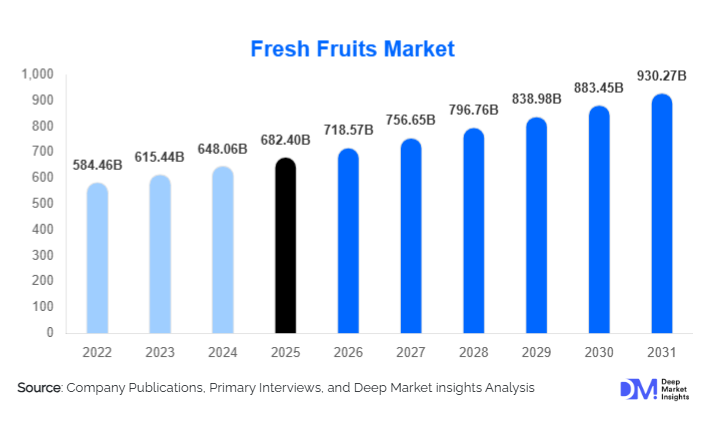
According to Deep Market Insights, the global fresh fruits market size was valued at USD 682.40 billion in 2025 and is projected to grow from USD 718.57 billion in 2026 to reach USD 930.27 billion by 2031, expanding at a CAGR of 5.3% during the forecast period (2026–2031). The fresh fruits market growth is primarily driven by increasing consumer preference for healthy diets, rising consumption of nutrient-rich foods, expanding organized retail networks, improvements in cold-chain logistics, and growing international trade of premium and exotic fruits. Increasing awareness regarding preventive healthcare and functional nutrition continues to strengthen long-term market expansion across developed and emerging economies.
Key Market Insights
- Consumers are increasingly shifting toward fresh, organic, and minimally processed fruits, supported by rising awareness of balanced nutrition, immunity enhancement, and healthy lifestyles.
- Citrus fruits continue to dominate global production and consumption, while berries are emerging as the fastest-growing category due to their high antioxidant content and premium positioning.
- Asia-Pacific dominates the global market owing to large-scale fruit production, expanding domestic consumption, and increasing investments in horticulture infrastructure.
- Africa is projected to witness the fastest growth, supported by expanding commercial farming, export-oriented cultivation, and government investments in modern irrigation systems.
- Digital grocery platforms and organized retail chains are transforming fruit distribution by improving product availability, supply chain transparency, and consumer accessibility.
- Advanced cold-chain infrastructure, precision agriculture, AI-enabled grading systems, and smart packaging technologies are enhancing product quality while reducing post-harvest losses across the global supply chain.
Fresh Fruits Market Latest Trends
Growing Demand for Organic and Premium Fresh Fruits
Consumers worldwide are increasingly purchasing certified organic, residue-free, and premium-quality fresh fruits as awareness regarding food safety and nutritional value continues to rise. Retailers are expanding premium fruit assortments that include imported berries, seedless citrus varieties, avocados, kiwifruit, dragon fruit, and exotic tropical fruits. Organic farming certifications, sustainable cultivation practices, and traceability technologies are becoming major competitive differentiators for producers and exporters. Premium fruit packaging, improved grading systems, and year-round product availability are further strengthening consumer confidence while supporting higher average selling prices across developed and emerging markets.
Digitalization and Cold Chain Modernization Transforming Distribution
The rapid expansion of online grocery platforms and refrigerated logistics networks is significantly improving fresh fruit availability across urban and semi-urban markets. Investments in automated sorting systems, AI-powered demand forecasting, IoT-enabled storage monitoring, and controlled-atmosphere transportation are reducing spoilage while maintaining product freshness throughout the supply chain. Retailers are also utilizing smart packaging, QR-code traceability, and digital inventory management to improve consumer engagement and operational efficiency. These technological advancements continue to improve export competitiveness and strengthen global fruit trade.
Fresh Fruits Market Drivers
Increasing Consumer Preference for Healthy and Nutrient-Rich Diets
Growing awareness regarding preventive healthcare, obesity management, cardiovascular wellness, and immune system support has substantially increased global consumption of fresh fruits. Government nutrition campaigns, school feeding programs, and dietary recommendations encouraging higher fruit intake continue to support market expansion. Rising disposable incomes, urbanization, and changing food consumption patterns have further accelerated demand for fresh fruits through supermarkets, hypermarkets, specialty stores, and online grocery channels. The growing popularity of vegan, vegetarian, and flexitarian lifestyles is also encouraging higher daily fruit consumption worldwide.
Expansion of Organized Retail and Global Fruit Trade
The continuous expansion of organized retail chains and international fruit trade has significantly improved product accessibility across developed and emerging economies. Investments in cold storage facilities, refrigerated transportation, modern packaging technologies, and efficient logistics networks have reduced post-harvest losses while extending product shelf life. Export-oriented cultivation, free trade agreements, and improved phytosanitary compliance are allowing producers to access premium international markets, thereby creating sustained long-term demand across the fresh fruits industry.
Fresh Fruits Market Restraints
High Post-Harvest Losses and Supply Chain Inefficiencies
Fresh fruits remain highly perishable commodities that require efficient harvesting, storage, transportation, and retail handling. Inadequate cold-chain infrastructure in developing economies contributes to significant post-harvest losses, reducing producer profitability and increasing overall supply chain costs. Climatic uncertainty, transportation delays, fluctuating fuel prices, and inconsistent storage conditions continue to impact product quality and market availability. These operational challenges remain major constraints for market participants seeking to improve efficiency and profitability.
Climate Change and Seasonal Production Volatility
Fruit cultivation remains highly dependent on favorable weather conditions, adequate water availability, and stable environmental conditions. Extreme weather events including droughts, floods, frost, and heatwaves continue to disrupt production cycles and reduce crop yields across several major producing countries. Pest infestations and plant diseases are also becoming increasingly frequent due to changing climatic conditions, creating additional production uncertainties and increasing cultivation costs for growers worldwide.
Fresh Fruits Industry Key Opportunities
Expansion of Premium, Organic, and Functional Fruit Categories
Rising consumer willingness to pay premium prices for high-quality, organic, and functional fruits presents substantial growth opportunities for producers and retailers. Products offering enhanced nutritional value, superior taste, convenient packaging, and sustainable cultivation methods are attracting strong consumer demand across both developed and emerging markets. Continuous product innovation, premium branding strategies, and certification programs are expected to support long-term value creation throughout the industry.
Emerging Export Markets and Precision Agriculture
Growing demand for imported fresh fruits across Asia-Pacific, the Middle East, and Eastern Europe is creating significant opportunities for exporting countries. Investments in precision agriculture, smart irrigation systems, drone-based crop monitoring, satellite imaging, and AI-powered farm management solutions are improving productivity while reducing production costs. These technological advancements are expected to enhance export competitiveness and support sustainable industry development over the coming years.
Report Scope
| Report Metric | Details |
|---|---|
| Market Size in 2025 | USD 682.40 Billion |
| Market Size in 2026 | USD 718.57 Billion |
| Market Size in 2031 | USD 930.27 Billion |
| CAGR | 5.3% (2026-2031) |
| Base Year for Estimation | 2025 |
| Historical Data | 2022-2024 |
| Forecast Period | 2026-2031 |
| Report Coverage | Revenue Forecast, Competitive Landscape, Supply Chain Disruption, Growth Factors, Environment & Regulatory Landscape and Trends |
| Geographies Covered | North America, Europe, APAC, Middle East and Africa, LATAM |
| Countries Covered | U.S., Canada, U.K., Germany, France, Spain, Italy, Russia, Nordic, Benelux, Rest of Europe, China, Korea, Japan, India, Australia, Singapore, Taiwan, South East Asia, Rest of Asia-Pacific, UAE, Turky, Saudi Arabia, South Africa, Egypt, Nigeria, Rest of MEA, Brazil, Mexico, Argentina, Chile, Colombia, Rest of LATAM |
Explore more data points, trends and opportunities Download Free Sample Report
Type Insights
Citrus fruits dominate the market owing to their extensive global cultivation, year-round availability, high vitamin C content, and strong consumer demand across both developed and developing countries. Oranges, lemons, mandarins, and grapefruits continue to account for a substantial share of international fruit trade due to their long shelf life and widespread application in fresh consumption and juice production. Tropical fruits including bananas, mangoes, pineapples, papayas, and avocados represent another significant category driven by increasing global consumption and expanding export volumes. Meanwhile, berries are witnessing the fastest expansion as consumers increasingly seek antioxidant-rich fruits with premium nutritional value. Blueberries, strawberries, raspberries, and blackberries are benefiting from growing demand for healthy snacking, functional foods, and premium retail offerings.
Application Insights
Household consumption represents the largest application segment as consumers continue incorporating fresh fruits into daily diets for nutritional benefits, immunity enhancement, and healthy lifestyle management. Increasing urbanization, rising disposable incomes, and expanding supermarket penetration continue supporting residential consumption worldwide. Food processing represents another major application, utilizing fresh fruits for juices, jams, frozen products, canned fruits, concentrates, bakery ingredients, confectionery products, and dairy applications. Foodservice establishments including hotels, restaurants, cafés, catering companies, and beverage chains are also expanding fresh fruit utilization through smoothies, desserts, salads, premium beverages, and healthy menu offerings, supporting sustained market demand.
Distribution Channel Insights
Supermarkets and hypermarkets continue to dominate fresh fruit distribution due to their extensive product assortment, quality assurance, refrigerated storage facilities, and strong purchasing convenience. Traditional wholesale markets remain important, particularly across developing economies where local sourcing and daily procurement continue to drive sales. Online grocery platforms are rapidly expanding their market presence through home delivery services, digital ordering systems, subscription-based fruit boxes, and improved cold-chain logistics. Specialty fruit retailers and direct farm-to-consumer sales are also gaining popularity among consumers seeking premium quality, organic certification, and locally sourced produce.
End User Insights
Individual consumers account for the largest share of fresh fruit demand, supported by increasing awareness regarding healthy eating habits and preventive nutrition. Commercial food manufacturers utilize significant volumes of fresh fruits for processed food production, beverages, dairy products, bakery formulations, confectionery, and frozen foods. Hotels, restaurants, cafés, institutional kitchens, and catering companies continue increasing procurement of premium fresh fruits to satisfy rising consumer preference for nutritious and visually appealing menu offerings. Healthcare institutions and educational organizations are also promoting higher fruit consumption through wellness initiatives and balanced dietary programs.
Explore more data points, trends and opportunities Download Free Sample Report
Fresh Fruits Market Segmentations
By Type
- Citrus Fruits
- Tropical Fruits
- Berries
- Other Fresh Fruits
By Application
- Household Consumption
- Food Processing
- Foodservice
- Institutional Consumption
By Distribution Channel
- Supermarkets & Hypermarkets
- Traditional Grocery Stores
- Online Retail
- Specialty Fruit Stores
- Wholesale Markets
Regional Insights
Asia-Pacific
Asia-Pacific dominates the global fresh fruits market owing to extensive fruit cultivation across China, India, Indonesia, Thailand, Vietnam, and the Philippines. The region benefits from favorable climatic conditions, expanding horticultural production, increasing domestic consumption, supportive government agricultural policies, and growing export activities. Rising disposable incomes, rapid urbanization, expanding organized retail, and improving cold-chain infrastructure continue driving market growth throughout the region. Increasing adoption of precision farming technologies and investments in modern irrigation systems are further strengthening production efficiency and international competitiveness.
North America
North America represents one of the largest consumption markets, supported by high consumer awareness regarding nutrition, premium fruit demand, and advanced retail infrastructure. The United States and Mexico remain key producers and importers with sophisticated cold-chain logistics, efficient transportation systems, and widespread supermarket penetration. Growing demand for organic fruits, functional foods, and convenient online grocery delivery continues supporting steady regional expansion. Technological innovations in storage, packaging, and agricultural automation further enhance supply chain efficiency.
Europe
Europe continues demonstrating stable market growth through increasing consumer preference for organic fruits, sustainable farming practices, and locally sourced produce. Spain, Italy, France, Greece, and Poland remain major fruit-producing countries supplying both domestic and export markets. Strong regulatory standards, environmentally responsible cultivation methods, and advanced logistics infrastructure support consistent product quality throughout the region. Rising imports of tropical and exotic fruits also contribute significantly to regional market expansion.
Latin America
Latin America serves as one of the world's leading fruit-producing and exporting regions, with Brazil, Chile, Peru, Ecuador, and Colombia supplying bananas, grapes, avocados, berries, mangoes, and citrus fruits to international markets. Favorable climatic conditions, expanding commercial farming, increasing export investments, and improving logistics infrastructure continue supporting regional development. Growing adoption of sustainable agricultural practices and export-oriented production further strengthens Latin America's competitive position in the global industry.
Middle East & Africa
The Middle East & Africa region is experiencing rapid market expansion driven by increasing investments in commercial horticulture, greenhouse cultivation, water-efficient irrigation technologies, and food security initiatives. South Africa, Egypt, Morocco, and Kenya remain major fruit exporters, while Gulf countries continue increasing fruit imports to satisfy growing consumer demand. Expanding cold storage infrastructure, government agricultural modernization programs, and rising investments in export-oriented farming are expected to accelerate regional market growth throughout the forecast period.
Key Players in the Fresh Fruits Market
- Dole plc
- Fresh Del Monte Produce Inc.
- Chiquita Brands International
- Total Produce plc
- Fyffes
- Sunkist Growers Inc.
- Zespri International Limited
- Driscoll's Inc.
- The Wonderful Company
- Oppy
- Mission Produce Inc.
- Camposol Holding PLC
- Westfalia Fruit
- Greenyard NV
- Naturipe Farms LLC