Raw Cashew Nuts Market Size
According to Deep Market Insights, the global raw cashew nuts market size was valued at approximately USD 9.12 billion in 2025 and is projected to grow from USD 9.74 billion in 2026 to reach USD 13.53 billion by 2031, expanding at a CAGR of 6.8% during the forecast period (2026–2031). The raw cashew nuts market growth is primarily driven by increasing global consumption of healthy snacks, rising demand for plant-based food ingredients, expansion of the cashew kernel processing industry, and growing utilization of cashew-derived products across food, beverage, nutraceutical, and industrial applications. Strong import demand from processing hubs such as India and Vietnam, coupled with increasing investments in African processing infrastructure, is further supporting market expansion. Additionally, the growing popularity of vegan diets, dairy alternatives, and premium nut-based products is creating sustained demand for raw cashew nuts across developed and emerging economies.
Key Market Insights
- Asia-Pacific dominates the global raw cashew nuts market, accounting for approximately 61% of global demand, led by India and Vietnam.
- Conventional raw cashew nuts remain the largest product category, representing nearly 78% of total market value due to widespread commercial adoption.
- Cashew kernel processing is the leading end-use segment, accounting for approximately 58% of global raw cashew nut consumption.
- West Africa continues to emerge as the world's largest production hub, with Côte d'Ivoire, Ghana, Benin, and Nigeria increasing export volumes.
- Plant-based dairy manufacturers are becoming major consumers of cashew-derived ingredients, driving above-average growth in industrial demand.
- Processing automation and traceability technologies are improving operational efficiency and supply chain transparency across the industry.
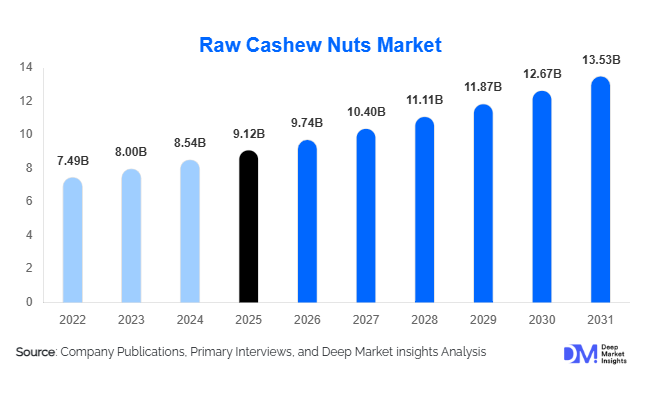
Raw Cashew Nuts Market Latest Trends
Expansion of African Processing Capacity
A major transformation is occurring within the global raw cashew nuts industry as producing nations increasingly invest in domestic processing capabilities. Historically, most raw cashew nuts harvested in Africa were exported to India and Vietnam for processing. However, governments across Côte d'Ivoire, Ghana, Benin, Tanzania, and Nigeria are implementing policies to encourage local value addition through tax incentives, industrial parks, and export support programs. New processing facilities are helping producers capture greater value within domestic economies while reducing reliance on exports of unprocessed nuts. This trend is gradually reshaping global trade flows and creating opportunities for integrated processing operations closer to cultivation regions.
Rising Adoption of Sustainable and Traceable Supply Chains
Global food manufacturers and retailers are increasingly prioritizing sustainability, ethical sourcing, and supply chain transparency. Cashew processors are responding through blockchain-based traceability systems, farm certification programs, digital procurement platforms, and sustainability reporting initiatives. Premium buyers in Europe and North America increasingly require traceable sourcing from farm to final product. Companies capable of demonstrating responsible farming practices, fair labor standards, and environmental stewardship are securing long-term contracts and premium pricing opportunities. Sustainability certifications and carbon footprint reporting are becoming key competitive differentiators across international cashew trade.
Raw Cashew Nuts Market Drivers
Growing Demand for Healthy Snack Products
The increasing global focus on health and wellness continues to boost consumption of nuts as nutritious snack alternatives. Cashews offer protein, healthy fats, minerals, and antioxidants, making them highly attractive to health-conscious consumers. Food manufacturers are introducing flavored cashews, trail mixes, protein snacks, and premium nut products to address growing demand for functional foods. Rising disposable incomes in emerging markets and increasing consumer awareness regarding nutritional benefits are accelerating cashew consumption worldwide.
Expansion of Plant-Based Food and Beverage Industry
The rapid growth of vegan and flexitarian diets is generating substantial demand for cashew-derived ingredients. Cashews are widely used in dairy alternatives including plant-based milk, cheese substitutes, yogurt products, cream alternatives, and desserts. Their favorable texture and fat profile make them one of the most preferred ingredients in premium plant-based formulations. As global plant-based food markets continue expanding, raw cashew procurement requirements are expected to rise significantly.
Advancements in Processing Technologies
Leading processing countries such as Vietnam and India are investing heavily in automated shelling, optical grading, drying systems, and packaging technologies. These innovations improve kernel recovery rates, reduce labor dependency, enhance quality consistency, and increase profitability. Improved processing efficiency enables larger procurement volumes of raw cashew nuts and supports industry scalability.
Raw Cashew Nuts Market Restraints
Volatility in Raw Material Prices
Cashew production remains vulnerable to weather conditions, pest outbreaks, harvest fluctuations, and supply disruptions. Variations in production across major producing countries can significantly impact raw cashew prices. Such volatility affects procurement planning, processor margins, and inventory management strategies, creating challenges for market participants.
Supply Chain and Logistics Constraints
The global cashew industry relies heavily on cross-border trade between producing and processing nations. Shipping disruptions, rising freight costs, port congestion, and geopolitical uncertainties can significantly affect supply chain efficiency. Dependence on international trade routes increases exposure to logistical risks and creates procurement challenges for processors and exporters.
Raw Cashew Nuts Industry Key Opportunities
Growth of Plant-Based Dairy Applications
The plant-based dairy industry represents one of the fastest-growing opportunities for raw cashew nuts. Cashew milk, cream, cheese alternatives, spreads, and frozen desserts continue gaining popularity among consumers seeking dairy-free products. As major food manufacturers expand their vegan product portfolios, procurement demand for cashew kernels and raw nuts is expected to increase substantially. This trend provides significant opportunities for processors, exporters, and producers to establish long-term supply relationships with food manufacturers.
Premium and Certified Cashew Products
Consumer demand for organic, fair-trade, sustainably sourced, and traceable food products continues to grow globally. Premium cashew products command higher margins and stronger customer loyalty. Producers and processors that invest in certifications, sustainability programs, and digital traceability systems are increasingly able to access premium retail channels and secure long-term procurement agreements. The trend is particularly strong across Europe and North America, where retailers increasingly prioritize responsible sourcing standards.
Report Scope
| Report Metric | Details |
|---|---|
| Market Size in 2025 | USD 9.12 Billion |
| Market Size in 2026 | USD 9.74 Billion |
| Market Size in 2031 | USD 13.53 Billion |
| CAGR | 6.8% (2026-2031) |
| Base Year for Estimation | 2025 |
| Historical Data | 2022-2024 |
| Forecast Period | 2026-2031 |
| Report Coverage | Revenue Forecast, Competitive Landscape, Supply Chain Disruption, Growth Factors, Environment & Regulatory Landscape and Trends |
| Geographies Covered | North America, Europe, APAC, Middle East and Africa, LATAM |
| Countries Covered | U.S., Canada, U.K., Germany, France, Spain, Italy, Russia, Nordic, Benelux, Rest of Europe, China, Korea, Japan, India, Australia, Singapore, Taiwan, South East Asia, Rest of Asia-Pacific, UAE, Turky, Saudi Arabia, South Africa, Egypt, Nigeria, Rest of MEA, Brazil, Mexico, Argentina, Chile, Colombia, Rest of LATAM |
Explore more data points, trends and opportunities Download Free Sample Report
Product Type Insights
The conventional raw cashew nuts segment dominates the global raw cashew nuts market, accounting for approximately 78% of total market value in 2025. The segment maintains its leadership position due to extensive cultivation across major producing countries, established supply networks, higher yield consistency, and lower production costs compared to organic alternatives. Conventional cashews remain the preferred choice for large-scale processors and exporters owing to their reliable availability and ability to meet growing industrial demand. Furthermore, expanding consumption of cashew-based snacks, confectionery products, bakery ingredients, and plant-based food formulations continues to strengthen demand for conventionally produced raw cashew nuts. Meanwhile, the organic raw cashew nuts segment is witnessing robust growth, supported by increasing consumer awareness regarding sustainable agriculture, chemical-free food products, and environmental stewardship. Growing demand for organic-certified ingredients from premium food manufacturers, health-focused retailers, and clean-label product developers is creating new growth opportunities, particularly across Europe and North America where organic food consumption continues to expand steadily.
Grade Insights
Standard commercial-grade raw cashew nuts account for nearly 52% of total market demand and remain the leading grade category globally. The dominance of this segment is primarily attributed to its suitability for large-scale kernel extraction and processing operations, where processors prioritize cost efficiency, consistent supply, and operational scalability. Commercial-grade cashews provide an optimal balance between quality and affordability, making them highly suitable for mainstream food manufacturing applications. Premium export-grade cashews command higher market prices due to superior kernel recovery rates, enhanced quality characteristics, and compliance with stringent international quality standards. Demand for premium grades continues to increase as food manufacturers, retailers, and international buyers place greater emphasis on product consistency, traceability, and premium product positioning. Industrial processing grades also maintain significant market importance, particularly in applications involving cashew nut shell liquid (CNSL) extraction, ingredient manufacturing, and industrial processing activities. Rising investments in quality improvement initiatives and post-harvest handling technologies are further supporting demand for higher-grade raw cashew nuts worldwide.
Processing Destination Insights
Raw cashew nuts intended for kernel processing represent the largest processing destination segment, accounting for approximately 74% of global market value. The segment's dominance is driven by the growing global consumption of cashew kernels across multiple food applications, including roasted snacks, confectionery products, bakery ingredients, cereals, energy bars, and plant-based food formulations. Increasing consumer preference for nutritious, protein-rich, and minimally processed foods continues to drive demand for cashew kernels, encouraging processors to expand production capacities. Additionally, the rapid growth of vegan and plant-based food industries has significantly increased the utilization of cashew kernels in dairy alternatives, spreads, sauces, and functional food products. Integrated processing facilities that combine kernel extraction with cashew nut shell liquid recovery are becoming increasingly prevalent as processors seek to improve operational efficiency, diversify revenue streams, and maximize resource utilization. This trend is expected to strengthen further as sustainability and waste reduction become critical priorities across the food processing sector.
End-Use Industry Insights
The cashew kernel processing industry remains the largest end-use segment, accounting for approximately 58% of global raw cashew nut demand. The segment benefits from the widespread use of cashew kernels in retail snacks, foodservice products, bakery applications, confectionery formulations, and ingredient manufacturing. Strong consumer demand for healthy snacking options, coupled with rising disposable incomes and changing dietary preferences, continues to support growth in kernel processing activities worldwide. Snack food manufacturers, bakery producers, and confectionery companies remain important demand generators, while the plant-based food industry is emerging as one of the fastest-growing consumption sectors. The plant-based dairy segment, in particular, is experiencing exceptional growth due to increasing adoption of vegan diets, lactose-free products, and dairy alternatives among health-conscious consumers. Cashews are increasingly utilized in the production of plant-based milk, cheese, yogurt, creams, and spreads due to their favorable texture and nutritional profile. In addition, industrial demand for cashew nut shell liquid continues to expand across coatings, adhesives, friction materials, laminates, paints, and specialty chemical applications, creating additional growth opportunities throughout the value chain.
Procurement Model Insights
Trader and aggregator procurement remains the dominant sourcing model, representing approximately 48% of global market activity. The segment's leadership is largely attributable to the fragmented nature of cashew farming across major producing countries, particularly in Africa and parts of Asia, where smallholder farmers account for the majority of production. Traders and aggregators play a critical role in consolidating supply, facilitating market access, reducing transaction complexities, and ensuring year-round availability for processors and exporters. However, direct farm procurement and contract farming arrangements are gaining increasing traction among large processing companies seeking greater supply security, improved traceability, enhanced quality control, and reduced procurement costs. These sourcing models are becoming particularly important as international buyers place greater emphasis on sustainability, transparency, and responsible sourcing practices. Cooperative procurement systems are also expanding steadily, supported by government initiatives, agricultural development programs, and farmer empowerment schemes aimed at improving market participation, bargaining power, and income generation among cashew producers.
Explore more data points, trends and opportunities Download Free Sample Report
Raw Cashew Nuts Market Segmentations
By Product Type
- Conventional Raw Cashew Nuts
- Organic Raw Cashew Nuts
By Grade
- Premium Export Grade Raw Cashew Nuts
- Standard Commercial Grade Raw Cashew Nuts
- Industrial Processing Grade Raw Cashew Nuts
By Nut Size Classification
- Large Size Raw Cashew Nuts
- Medium Size Raw Cashew Nuts
- Small Size Raw Cashew Nuts
By Processing Destination
- Kernel Processing
- Cashew Nut Shell Liquid (CNSL) Extraction
- Integrated Processing (Kernel + CNSL)
By Procurement Model
- Direct Farm Procurement
- Cooperative Procurement
- Trader/Aggregator Procurement
- Contract Farming Procurement
Regional Insights
Asia-Pacific
Asia-Pacific accounts for approximately 61% of global raw cashew nuts market demand and remains the largest regional market. The region's dominance is supported by its extensive processing infrastructure, strong export capabilities, expanding food manufacturing sector, and growing domestic consumption of cashew-based products. India represents nearly 22% of global market value, driven by its well-established processing industry, large consumer base, and increasing utilization of cashews across snacks, confectionery, and plant-based food applications. Vietnam contributes approximately 18% of global demand and continues to serve as the world's leading cashew processing and export hub, supported by advanced processing technologies and strong international trade networks. China is experiencing robust market growth due to rising health awareness, increasing disposable incomes, rapid urbanization, and growing demand for premium snack products. Additionally, the expansion of organized retail channels, e-commerce platforms, and plant-based food manufacturing is accelerating regional demand. Japan and South Korea remain important import markets, supported by strong consumer preference for premium-quality nuts, functional foods, and health-oriented dietary products.
Europe
Europe accounts for approximately 22% of global market demand and represents one of the most attractive consumption markets for raw cashew nuts and processed cashew products. Demand across the region is primarily driven by growing health-consciousness, increasing adoption of plant-based diets, and strong consumer preference for natural and nutrient-dense food products. The expanding vegan and vegetarian population has significantly increased the use of cashews in dairy alternatives, plant-based cheese products, and nutritional food formulations. Sustainability and ethical sourcing considerations are also playing an increasingly important role in purchasing decisions, encouraging demand for certified and traceable cashew products. Germany remains the largest European importer and consumer, supported by a mature health food sector and strong retail distribution networks. The Netherlands continues to function as a major import, trading, and distribution hub for the European market, facilitating the movement of cashew products throughout the region. Growing investments in clean-label foods, premium snacks, and functional nutrition products are expected to further support market expansion across Europe.
North America
North America represents approximately 11% of global market demand, with the United States accounting for the majority of regional consumption. Market growth is driven by increasing consumer preference for healthy snacking, protein-rich foods, and plant-based nutrition products. The rising popularity of vegan and flexitarian lifestyles has significantly increased demand for cashew-based dairy alternatives, including milk, cheese, yogurt, and cream products. Growing awareness regarding the nutritional benefits of nuts, including healthy fats, protein, vitamins, and minerals, continues to support consumption across multiple demographic groups. Furthermore, the region's highly developed food processing industry is expanding the use of cashew ingredients in energy bars, functional foods, ready-to-eat snacks, and premium food products. Continued innovation in plant-based foods, increasing clean-label product launches, and strong retail penetration are expected to remain key growth drivers throughout the forecast period.
Latin America
Latin America represents an important regional market, with Brazil serving as the dominant producer, processor, and consumer within the region. Market growth is supported by abundant raw material availability, favorable climatic conditions for cultivation, and increasing investments in value-added processing activities. The region is witnessing growing consumer awareness regarding healthy eating habits, leading to higher demand for nutritious snack products and plant-based food ingredients. Rising export opportunities for processed cashew products are encouraging investments in processing infrastructure and quality improvement initiatives. Furthermore, economic development, urbanization, and expanding retail distribution networks are contributing to increased market penetration across several Latin American countries. The growing popularity of natural food products and premium nut-based snacks is expected to create additional opportunities for regional market participants.
Middle East & Africa
The Middle East & Africa region is projected to be the fastest-growing regional market, expanding at an estimated CAGR exceeding 7.5% through 2031. Growth is supported by increasing cashew production, expanding processing investments, and government-led initiatives aimed at strengthening agricultural value chains. Major producing countries including Côte d'Ivoire, Ghana, Benin, Tanzania, and Nigeria continue increasing cultivation acreage and processing capacity to capture greater value from domestic production. Significant investments in local processing facilities are reducing dependence on raw nut exports while enhancing regional competitiveness in international markets. In the Middle East, rising disposable incomes, rapid population growth, expanding tourism activities, and increasing demand for premium food products are supporting higher consumption of cashews and nut-based snacks. Countries such as the UAE and Saudi Arabia are witnessing strong demand growth through modern retail channels, hospitality establishments, and foodservice sectors. Additionally, improving supply chain infrastructure, foreign investment inflows, and government support for agricultural modernization are expected to further accelerate regional market growth during the forecast period.
Key Players in the Raw Cashew Nuts Market
- Olam Food Ingredients (ofi)
- Vietnam Cashew Corporation (VINACAS-affiliated processors)
- Bismi Cashew Company
- Kalbavi Cashews
- Achal Cashew Nuts
- CAMPCO
- Kerala State Cashew Development Corporation
- Cashew Coast
- Intersnack Group
- HLB Specialties
- Shah Nanji Nagsi Exports
- Nutsco
- Miranda Group
- NutriBoost Cashew Industries
- Vietcashew Group