Quail Meat Market Size
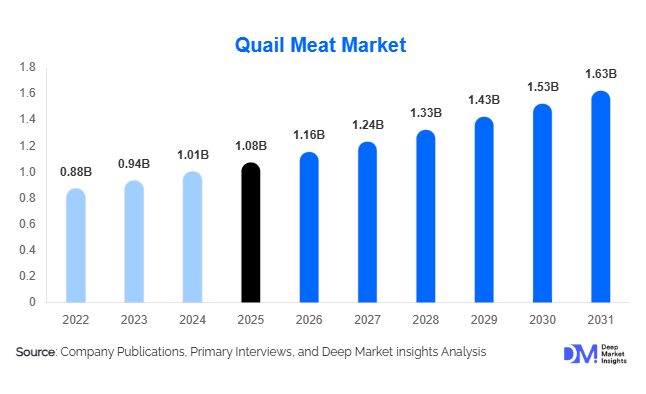
According to Deep Market Insights, the global quail meat market size was valued at USD 1.08 billion in 2025 and is projected to grow from USD 1.16 billion in 2026 to reach USD 1.63 billion by 2031, expanding at a CAGR of 7.1% during the forecast period (2026–2031). The quail meat market growth is primarily driven by rising consumer preference for premium poultry proteins, increasing demand for lean and high-protein meat products, expansion of specialty poultry farming, and growing adoption of quail meat in foodservice and gourmet culinary applications. As consumers increasingly seek healthier alternatives to conventional poultry and red meat, quail meat is gaining traction due to its favorable nutritional profile, lower fat content, and distinctive flavor characteristics. Growing urbanization, rising disposable incomes, and expanding cold-chain infrastructure are further supporting global market growth.
Key Market Insights
- Premium poultry consumption is increasing globally, positioning quail meat as a high-value protein category within specialty meat markets.
- Fresh whole quail remains the dominant product segment, accounting for a significant share of global consumption due to widespread foodservice demand.
- Asia-Pacific dominates global production and consumption, led by China, Japan, South Korea, Thailand, and Vietnam.
- Organic and antibiotic-free quail meat is the fastest-growing farming segment, supported by increasing consumer focus on clean-label and sustainable meat products.
- Foodservice establishments represent the largest end-use sector, particularly premium restaurants, hotels, and catering providers.
- E-commerce and direct-to-consumer meat platforms are expanding rapidly, improving accessibility of specialty poultry products across developed markets.
Quail Meat Market Latest Trends
Growth of Premium and Specialty Protein Consumption
Consumer dietary preferences are increasingly shifting toward premium and differentiated protein sources, creating favorable conditions for quail meat demand. Unlike conventional chicken products, quail meat is often perceived as a gourmet offering and is gaining popularity among health-conscious consumers seeking nutrient-dense proteins. Restaurants and specialty retailers are introducing quail-based dishes to cater to consumers looking for unique culinary experiences. This trend is particularly strong in urban centers across Asia, Europe, and North America, where premium food consumption continues to expand. As disposable incomes rise and consumers become more adventurous in their food choices, demand for specialty poultry products such as quail meat is expected to accelerate further.
Expansion of Organic and Antibiotic-Free Production
Growing concerns regarding food safety, animal welfare, and antibiotic usage in livestock production are encouraging producers to invest in organic and antibiotic-free quail farming systems. Consumers are increasingly willing to pay premium prices for poultry products produced under sustainable and transparent farming practices. Retailers and foodservice operators are responding by expanding offerings of certified organic and free-range quail meat. Producers are also implementing improved traceability systems, animal welfare protocols, and environmentally sustainable production methods to differentiate their products. This trend is creating significant value-added opportunities across both developed and emerging markets.
Quail Meat Market Drivers
Increasing Demand for Lean and High-Protein Meat Products
The growing focus on healthy eating habits is significantly driving demand for quail meat worldwide. Quail meat contains high-quality protein, essential amino acids, vitamins, and minerals while generally offering lower fat content compared to many traditional meat options. Health-conscious consumers are increasingly incorporating specialty poultry into their diets as part of balanced nutrition plans. This trend is particularly evident among urban populations, fitness enthusiasts, and consumers seeking alternative protein sources.
Expansion of Premium Foodservice and Gourmet Dining
The continued growth of premium dining establishments and specialty restaurants is creating substantial demand for quail meat globally. Fine-dining restaurants, luxury hotels, and upscale catering operators increasingly feature quail dishes to differentiate their menus and enhance customer experiences. The unique flavor profile and premium positioning of quail meat make it attractive to chefs seeking innovative culinary offerings. Growing tourism activity and rising expenditure on dining experiences are further contributing to increased consumption through foodservice channels.
Advancements in Commercial Quail Farming
Technological improvements in breeding, feeding, disease management, and production systems are enhancing commercial quail farming efficiency. Modern farming practices are improving feed conversion rates, reducing mortality levels, and increasing production scalability. Investments in automated incubation systems, climate-controlled housing, and genetic improvement programs are enabling producers to meet growing market demand while maintaining product quality standards. These advancements are making commercial quail production increasingly viable and profitable.
Quail Meat Market Restraints
Limited Consumer Awareness in Emerging Markets
Despite its nutritional advantages, quail meat remains relatively unfamiliar to large portions of consumers in several developing regions. Limited product awareness, cultural dietary preferences, and lack of established retail distribution networks can constrain market penetration. Significant marketing and educational efforts are required to increase consumer familiarity and encourage broader adoption of quail meat products.
Higher Production Costs Compared to Conventional Poultry
Quail farming typically involves higher production costs on a per-unit basis than large-scale chicken production. Feed expenses, specialized breeding requirements, and relatively smaller production volumes contribute to elevated costs. These factors often translate into premium retail pricing, limiting mass-market adoption and restricting consumption primarily to higher-income consumer segments and foodservice applications.
Quail Meat Industry Key Opportunities
Expansion into Functional and Health-Focused Food Markets
The growing global market for functional foods presents substantial opportunities for quail meat producers. Consumers increasingly seek protein-rich foods that support active lifestyles, weight management, and overall wellness. Producers can capitalize on this trend through premium branding, nutritional positioning, and value-added product development. Ready-to-cook and portion-controlled quail meat products are expected to attract significant demand among health-conscious consumers and convenience-focused households.
Growth of Export-Oriented Production in Asia
Asia-Pacific countries, particularly China, Thailand, Vietnam, and India, are expanding commercial quail production capacities to serve growing international demand. Improved cold-chain infrastructure, favorable trade agreements, and rising global consumption of specialty poultry products are creating export opportunities for regional producers. Export-oriented production strategies are expected to support market expansion while improving economies of scale for commercial operations.
Development of Processed and Ready-to-Eat Quail Products
The increasing popularity of convenience foods offers significant opportunities for processed quail meat manufacturers. Marinated, smoked, ready-to-cook, and ready-to-eat quail products are attracting consumer interest due to ease of preparation and premium positioning. Food processors investing in innovative product formats and packaging technologies are likely to capture growing demand from modern retail and online distribution channels.
Report Scope
| Report Metric | Details |
|---|---|
| Market Size in 2025 | USD 1.08 Billion |
| Market Size in 2026 | USD 1.16 Billion |
| Market Size in 2031 | USD 1.63 Billion |
| CAGR | 7.1% (2026-2031) |
| Base Year for Estimation | 2025 |
| Historical Data | 2022-2024 |
| Forecast Period | 2026-2031 |
| Report Coverage | Revenue Forecast, Competitive Landscape, Supply Chain Disruption, Growth Factors, Environment & Regulatory Landscape and Trends |
| Geographies Covered | North America, Europe, APAC, Middle East and Africa, LATAM |
| Countries Covered | U.S., Canada, U.K., Germany, France, Spain, Italy, Russia, Nordic, Benelux, Rest of Europe, China, Korea, Japan, India, Australia, Singapore, Taiwan, South East Asia, Rest of Asia-Pacific, UAE, Turky, Saudi Arabia, South Africa, Egypt, Nigeria, Rest of MEA, Brazil, Mexico, Argentina, Chile, Colombia, Rest of LATAM |
Explore more data points, trends and opportunities Download Free Sample Report
Product Form Insights
Fresh quail meat remains the dominant product category, accounting for approximately 44% of the global market in 2025. Its leadership is primarily driven by strong demand from high-end restaurants, hotels, and specialty meat retailers that prioritize superior texture, natural flavor retention, and culinary versatility. The segment benefits from the perception of freshness as a key quality differentiator, particularly in premium dining applications where chefs prefer whole and minimally processed poultry for customized preparations and gourmet presentations. Additionally, the relatively short supply chains in major producing regions help maintain product integrity, further strengthening its position in foodservice-oriented markets.Frozen quail meat represents approximately 29% market share, with growth primarily driven by expanding international trade networks and the increasing need for longer shelf-life products that support cross-border distribution. The segment is also supported by rising demand from import-dependent countries where domestic production is limited but consumption is growing steadily. Improvements in cold-chain logistics and freezing technologies have significantly enhanced product quality retention, making frozen quail a reliable alternative for both retail and institutional buyers seeking year-round availability.Chilled vacuum-packed products are emerging as a premium sub-segment, gaining traction among urban consumers seeking extended freshness without freezing. This format benefits from increasing adoption of advanced vacuum-sealing technologies and heightened consumer awareness around food preservation methods that maintain nutritional value and sensory quality, positioning it as a bridge between fresh and frozen product categories.
Farming Method Insights
Conventional farm-raised quail dominates the market with approximately 71% share of global revenues in 2025. Its leadership is primarily driven by well-established production infrastructure, economies of scale, and lower cost structures that enable consistent supply across both developed and emerging markets. The segment continues to benefit from optimized breeding practices and efficient feed conversion systems, making it the most commercially viable production method for large-scale distribution channels including foodservice and retail.Organic and antibiotic-free quail meat, although accounting for approximately 12% market share, represents the fastest-growing production segment. Growth is strongly driven by rising consumer concerns around food safety, antimicrobial resistance, and environmental sustainability. Increasing willingness among health-conscious consumers to pay premium prices for clean-label protein products is further accelerating adoption. Regulatory support in several developed markets and certification frameworks for organic poultry production are reinforcing trust and expanding market penetration.Free-range production systems are gaining notable traction, particularly in Europe and North America, where consumer preference for ethically raised poultry and animal welfare standards is significantly influencing purchasing decisions. The leading driver for this segment is the premiumization trend in protein consumption, supported by retail branding strategies that emphasize transparency, traceability, and sustainable farming practices. This shift is also being reinforced by hospitality operators seeking differentiated menu positioning through ethically sourced ingredients.
Species Type Insights
Japanese quail (Coturnix japonica) dominates global production and consumption, accounting for approximately 68% of total market value in 2025. Its leadership is primarily driven by its rapid growth cycle, superior feed conversion efficiency, and adaptability to intensive farming systems, which collectively reduce production costs while maximizing output. The species is widely preferred by commercial producers due to its scalability and consistent yield performance, making it the backbone of global quail meat supply chains.Bobwhite quail holds approximately 14% market share, with demand primarily concentrated in North America. The segment is driven by its strong association with niche culinary applications and recreational hunting markets, where it is valued for its distinctive flavor profile and traditional consumption patterns. Limited large-scale farming compared to Japanese quail also contributes to its premium positioning in specialty food segments.Other species, including California and European quail, collectively contribute smaller shares but maintain strong regional relevance. Their demand is driven by localized culinary traditions, specialty farming practices, and niche gourmet markets where biodiversity and regional authenticity are valued attributes. These species also play a role in genetic diversification programs within the broader quail farming industry.
Distribution Channel Insights
Wholesale and direct-to-foodservice channels account for nearly 38% of global sales, with growth primarily driven by sustained demand from restaurants, hotels, and catering businesses. The segment benefits from the central role of institutional buyers in premium poultry consumption, where bulk procurement and consistent supply contracts are essential for menu planning and operational efficiency. Strong relationships between producers and hospitality operators further reinforce this channel’s dominance.Modern retail channels represent approximately 29% market share, supported by expanding supermarket penetration and growing consumer preference for accessible premium protein options. The leading driver in this segment is the increasing urban middle-class population seeking convenient access to high-quality meat products through organized retail formats. Enhanced product visibility and improved cold-chain infrastructure within retail environments are also contributing to steady growth.Online retail is emerging as the fastest-growing distribution channel, driven by rapid digital grocery adoption, improved last-mile logistics, and increasing consumer comfort with direct-to-door meat delivery services. E-commerce platforms are enabling producers to bypass traditional distribution constraints, expand geographic reach, and offer customized product assortments. This shift is particularly pronounced in urban centers where convenience and product variety are key purchasing factors.
End-Use Insights
The foodservice industry represents the largest end-use segment, accounting for approximately 47% of global quail meat demand in 2025. Its dominance is primarily driven by premium restaurants and hotel chains incorporating quail into gourmet menus and fine-dining experiences. The segment benefits from the growing popularity of specialty proteins in culinary innovation, where chefs use quail as a differentiated ingredient to enhance menu exclusivity and customer experience.Household consumption contributes approximately 34% of market revenues, with growth supported by rising health awareness, increasing disposable incomes, and greater availability of quail meat through modern retail and online platforms. The leading driver for this segment is the shift toward protein diversification in home cooking, where consumers seek alternative poultry options perceived as healthier and more nutritious compared to conventional meats.Food processing companies are increasingly incorporating quail meat into value-added product formulations, driven by demand for ready-to-eat and convenience-oriented protein solutions. Institutional buyers, including healthcare facilities, military organizations, and educational programs, maintain stable demand due to structured procurement systems and nutritional planning requirements that prioritize lean protein sources.
Explore more data points, trends and opportunities Download Free Sample Report
Quail Meat Market Segmentations
By Product Form
- Fresh Quail Meat
- Frozen Quail Meat
- Chilled Vacuum-Packed Quail Meat
- Processed Quail Meat
By Farming Method
- Conventional Farm-Raised Quail
- Organic Quail
- Free-Range Quail
- Antibiotic-Free / Hormone-Free Quail
By Species Type
- Japanese Quail
- Bobwhite Quail
- California Quail
- European/Common Quail
- Other Commercial Quail Species
By Distribution Channel
- Modern Retail
- Specialty Meat Stores
- Traditional Wet Markets
- Online Retail / E-Commerce
- Direct-to-Foodservice Supply
- Wholesale Distribution
By End User
- Household Consumers
- Foodservice Industry
- Food Processing Industry
- Institutional Buyers
Regional Insights
Asia-Pacific
Asia-Pacific dominates the global quail meat market with approximately 52% market share in 2025. The region’s leadership is primarily driven by large-scale domestic consumption, deeply rooted culinary traditions, and highly developed commercial production ecosystems. China, accounting for nearly 28% of global demand, benefits from integrated supply chains, strong agricultural infrastructure, and widespread consumer acceptance of quail as a mainstream protein source. Japan and South Korea continue to drive premium demand through high-value culinary applications, while Thailand and Vietnam are emerging as export-oriented production hubs supported by competitive farming costs. India represents one of the fastest-growing markets, with growth driven by rising protein consumption, rapid urbanization, and government initiatives promoting poultry diversification beyond traditional chicken and egg production.
Europe
Europe accounts for approximately 23% of global market revenues, with growth primarily driven by strong culinary heritage, premium food culture, and increasing demand for differentiated poultry products. France leads regional consumption due to its long-standing gastronomic traditions, followed by Spain, Italy, Germany, and the United Kingdom. The key driver of regional growth is the rising consumer preference for organic, free-range, and sustainably produced poultry, supported by stringent food quality regulations and well-established certification systems. Additionally, the premium hospitality sector continues to reinforce demand for high-quality quail meat as part of gourmet and fine-dining offerings.
North America
North America represents approximately 13% of global market value, with the United States contributing nearly 10% of global demand. Growth in this region is primarily driven by increasing consumer interest in specialty and alternative proteins, alongside the expansion of gourmet dining and farm-to-table culinary movements. The rising popularity of artisanal and locally sourced meats is also encouraging small and medium-scale quail farming operations. Canada supports steady growth through premium foodservice demand and increasing awareness of diversified protein consumption patterns among health-conscious consumers.
Latin America
Latin America accounts for approximately 7% of global revenues, with Brazil and Argentina serving as the primary markets. Growth is driven by diversification within established poultry industries, where producers are increasingly expanding into specialty meats to capture higher-value market segments. Rising middle-class incomes, urban dietary shifts, and gradual exposure to premium poultry products are further supporting demand. The region also benefits from improving distribution networks and growing interest from foodservice operators seeking alternative protein options.
Middle East & Africa
The Middle East & Africa region contributes approximately 5% of global market revenues. Growth is primarily driven by expanding hospitality and tourism sectors, particularly in Gulf Cooperation Council countries where luxury dining and international cuisine are key demand drivers. The United Arab Emirates is among the fastest-growing markets, supported by high tourism inflows and premium restaurant expansion. Saudi Arabia, South Africa, and Egypt also contribute significantly, with increasing imports of specialty poultry products to meet rising demand from foodservice operators and affluent consumers seeking diversified protein options.
Key Players in the Quail Meat Market
- Granja Agas
- CIMA Quail Farm
- Caillor SA
- Gures Group
- Lumbini Quails Group
- Higashikawa Quail Farms
- Viet Quail Foods
- Toyohashi Uzura Cooperative
- Murray McMurray Hatchery
- Southwest Gamebirds
- Manchester Farms
- Diamond H Ranch
- Jiangsu Kangde Agriculture
- Shandong Quail Farming Group
- Thai Quail Products Co.