Pillow Market Size
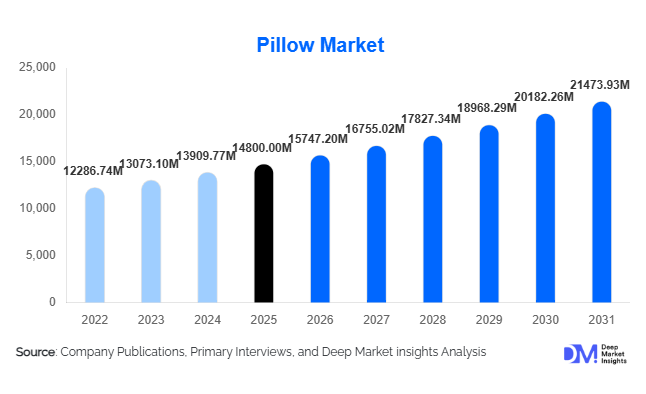
According to Deep Market Insights, the global pillow market size was valued at USD 14,800 million in 2025 and is projected to grow from USD 15,747.20 million in 2026 to reach USD 21,473.93 million by 2031, expanding at a CAGR of 6.4% during the forecast period (2026–2031). The pillow market growth is primarily driven by increasing consumer awareness regarding sleep health, rising demand for ergonomic and premium bedding products, and expansion in hospitality and healthcare infrastructure globally. Technological advancements in materials such as memory foam, cooling gels, and hypoallergenic fibers are further reshaping product innovation and consumer preferences.
Key Market Insights
- Sleep health awareness is driving premiumization, with consumers increasingly opting for orthopedic, memory foam, and cooling pillows.
- Residential demand dominates the market, accounting for nearly 70% of total consumption due to frequent replacement cycles.
- North America leads the global market, supported by high consumer spending and strong adoption of premium bedding products.
- Asia-Pacific is the fastest-growing region, driven by urbanization, rising incomes, and expanding middle-class populations.
- E-commerce is transforming distribution, enabling direct-to-consumer brands to scale rapidly and offer personalized products.
- Sustainability trends are influencing material choices, with increasing adoption of organic cotton, bamboo fibers, and recycled fillings.
What are the latest trends in the pillow market?
Rise of Ergonomic and Health-Focused Pillows
The growing prevalence of sleep disorders, neck pain, and posture-related issues has accelerated demand for ergonomic pillows. Orthopedic and memory foam pillows designed to provide spinal alignment and pressure relief are gaining widespread acceptance. Consumers are increasingly willing to invest in scientifically designed products that enhance sleep quality. This trend is particularly strong in developed markets, where awareness of wellness and preventive healthcare is high. Manufacturers are collaborating with sleep experts and healthcare professionals to develop advanced products, further strengthening the credibility and demand for specialized pillows.
Expansion of Sustainable and Eco-Friendly Materials
Sustainability has become a key focus area in the pillow market, with consumers demanding environmentally responsible products. Manufacturers are increasingly using organic cotton, natural latex, bamboo fibers, and recycled polyester to reduce environmental impact. Certifications related to eco-friendly production and non-toxic materials are influencing purchasing decisions. Brands are also adopting sustainable packaging and transparent sourcing practices to appeal to environmentally conscious consumers. This shift is particularly prominent in Europe and North America, where regulatory frameworks and consumer awareness support sustainable product adoption.
What are the key drivers in the pillow market?
Growing Awareness of Sleep Health
Consumers are increasingly prioritizing sleep quality as a critical component of overall health and well-being. This has led to higher spending on premium bedding products, including pillows designed for comfort and support. The rise of wellness trends, coupled with increasing awareness of sleep disorders, is significantly boosting demand for specialized pillows. Marketing campaigns and educational initiatives by brands are further reinforcing the importance of quality sleep, driving sustained market growth.
Expansion of Hospitality and Healthcare Sectors
The rapid growth of the global hospitality industry is a major driver for the pillow market. Hotels and resorts require high-quality pillows to enhance guest experience, leading to bulk procurement and frequent replacement cycles. Similarly, the healthcare sector is adopting specialized pillows for patient care, including orthopedic and anti-microbial variants. The expansion of hospitals, elderly care facilities, and wellness centers is contributing to steady demand across these segments.
What are the restraints for the global market?
Price Sensitivity in Emerging Markets
Despite growing demand for premium pillows, a significant portion of consumers in developing regions remains highly price-sensitive. This limits the adoption of high-value products and constrains market growth in these regions. Local manufacturers offering low-cost alternatives intensify competition, making it challenging for global brands to penetrate price-sensitive markets.
Raw Material Price Volatility
Fluctuations in the prices of raw materials such as cotton, down feathers, and petrochemical-based synthetic fibers pose a significant challenge for manufacturers. These variations impact production costs and profit margins, forcing companies to frequently adjust pricing strategies. Supply chain disruptions and geopolitical factors further exacerbate this issue.
What are the key opportunities in the pillow market?
Integration of Smart and Cooling Technologies
Technological innovation presents a major opportunity in the pillow market. The integration of cooling gels, temperature-regulating fabrics, and even smart sensors that monitor sleep patterns is gaining traction. These innovations cater to consumers seeking enhanced comfort and personalized sleep solutions. Companies investing in R&D to develop technologically advanced pillows can capture premium market segments and differentiate themselves from competitors.
Expansion in Emerging Economies
Emerging markets such as India, China, and Brazil offer significant growth potential due to rapid urbanization and rising disposable incomes. Increasing awareness of sleep health and the growing availability of branded products are driving demand in these regions. Companies that adopt localized strategies, including affordable product lines and region-specific marketing, can effectively tap into these high-growth markets.
Report Scope
| Report Metric | Details |
|---|---|
| Market Size in 2025 | USD 14800 Million |
| Market Size in 2026 | USD 15747.20 Million |
| Market Size in 2031 | USD 21473.93 Million |
| CAGR | 6.4% (2026-2031) |
| Base Year for Estimation | 2025 |
| Historical Data | 2022-2024 |
| Forecast Period | 2026-2031 |
| Report Coverage | Revenue Forecast, Competitive Landscape, Supply Chain Disruption, Growth Factors, Environment & Regulatory Landscape and Trends |
| Geographies Covered | North America, Europe, APAC, Middle East and Africa, LATAM |
| Countries Covered | U.S., Canada, U.K., Germany, France, Spain, Italy, Russia, Nordic, Benelux, Rest of Europe, China, Korea, Japan, India, Australia, Singapore, Taiwan, South East Asia, Rest of Asia-Pacific, UAE, Turky, Saudi Arabia, South Africa, Egypt, Nigeria, Rest of MEA, Brazil, Mexico, Argentina, Chile, Colombia, Rest of LATAM |
Explore more data points, trends and opportunities Download Free Sample Report
Product Type Insights
Bed pillows continue to dominate the global pillow market, accounting for approximately 52% of the total market share in 2025. This dominance is primarily driven by their universal usage across households, consistent replacement cycles (typically every 18–24 months), and their positioning as an essential bedding product rather than a discretionary purchase. The steady growth of housing units globally, coupled with increasing consumer focus on sleep hygiene, further reinforces demand for bed pillows. Additionally, manufacturers are innovating within this category by offering variants such as cooling, hypoallergenic, and adjustable loft pillows, which sustain consumer interest and repeat purchases.
Specialty pillows, including orthopedic, anti-snore, and cooling gel variants, represent the fastest-growing segment, driven by rising awareness of musculoskeletal health, sleep disorders, and ergonomic support. Increasing incidences of neck pain and poor posture due to sedentary lifestyles and digital device usage are key growth drivers. This segment is also benefiting from higher margins and strong adoption in developed markets. Meanwhile, decorative pillows, although accounting for a smaller share, play a significant role in the home décor industry. Growth in this segment is closely tied to interior design trends, urban home improvement spending, and the rising influence of social media-driven aesthetics, particularly in North America and Europe.
Application Insights
The residential segment leads the pillow market, contributing nearly 70% of total demand. This dominance is driven by large-scale household consumption, increasing disposable incomes, and heightened consumer awareness around comfort and sleep quality. The trend toward premium bedding solutions and frequent product replacement cycles continues to fuel demand in this segment globally. Urbanization and smaller household sizes are also encouraging individualized bedding purchases, further boosting residential consumption.
The hospitality sector is among the fastest-growing application segments, supported by the rapid expansion of global tourism and the proliferation of luxury and boutique hotels. Hotels prioritize high-quality pillows to enhance guest experience, resulting in bulk procurement and frequent replacement cycles. Similarly, the healthcare sector is witnessing steady growth, driven by increasing adoption of orthopedic and anti-microbial pillows in hospitals, rehabilitation centers, and elderly care facilities. The aging global population and rising healthcare expenditure are key drivers for this segment. Emerging applications in transportation, such as airlines, railways, and premium travel services, are also contributing to incremental demand, particularly for compact and ergonomic travel pillows.
Distribution Channel Insights
Offline retail channels dominate the pillow market, accounting for approximately 65% of total sales, particularly in developing regions where consumers prefer physical inspection of products before purchase. Supermarkets, hypermarkets, and specialty bedding stores play a crucial role in product visibility and consumer trust. The presence of in-store promotions, bundled offerings, and immediate product availability continues to sustain offline channel dominance.
However, online channels are rapidly gaining traction and represent the fastest-growing distribution segment. The expansion of e-commerce platforms and direct-to-consumer (DTC) brands has transformed purchasing behavior, particularly in urban and digitally connected populations. Online platforms offer advantages such as competitive pricing, extensive product variety, detailed product descriptions, and customer reviews, which enhance decision-making. Subscription-based models and personalized recommendations are further strengthening online channel growth, making it a key strategic focus for manufacturers.
Material Insights
Synthetic fill materials hold the largest share in the pillow market, accounting for nearly 60% of the market in 2025. Their dominance is attributed to affordability, durability, ease of maintenance, and hypoallergenic properties, making them suitable for mass-market consumption. Polyester fiberfill remains widely used, while memory foam and latex are emerging as premium synthetic options due to their superior support and pressure-relief capabilities.
Memory foam and latex pillows are the fastest-growing sub-segments, driven by increasing demand for ergonomic and health-focused products. These materials are particularly popular in North America and Europe, where consumers prioritize comfort and are willing to pay premium prices. Natural materials such as down, feather, cotton, and wool continue to cater to niche premium segments. Their growth is supported by sustainability trends and consumer preference for organic and eco-friendly products. However, higher costs and maintenance requirements limit their adoption in price-sensitive markets.
Explore more data points, trends and opportunities Download Free Sample Report
Pillow Market Segmentations
By Product Type
- Bed Pillows
- Specialty Pillows
- Decorative Pillows
By Application
- Residential/Household
- Hospitality
- Healthcare
- Commercial
By Distribution Channel
- Online Retail
- Supermarkets & Hypermarkets
- Specialty Bedding Stores
- Department Stores
By Material Type
- Synthetic Fill
- Natural Fill
Regional Insights
North America
North America accounts for approximately 32% of the global pillow market, with the United States representing the largest contributor. The region’s dominance is driven by high consumer awareness of sleep health, strong purchasing power, and widespread adoption of premium and specialty pillows such as memory foam and cooling variants. The presence of leading manufacturers and well-established distribution networks further strengthens market growth. Additionally, the growing trend of wellness-focused lifestyles and increased spending on home comfort products are key drivers. The hospitality industry in the U.S., characterized by a high number of luxury hotels, also contributes significantly to demand through bulk procurement and frequent replacement cycles.
Asia-Pacific
Asia-Pacific holds around 30% of the global market share and is the fastest-growing region, with a CAGR exceeding 7%. China dominates as both a manufacturing hub and exporter, benefiting from cost-efficient production and strong global trade networks. Meanwhile, India is emerging as a high-growth domestic market due to rapid urbanization, rising middle-class incomes, and increasing awareness of branded bedding products. The expansion of e-commerce platforms and the improvement of retail infrastructure are key growth drivers. Additionally, population growth and rising housing construction activities are significantly boosting demand for basic and mid-range pillows across the region.
Europe
Europe represents approximately 25% of the global pillow market, with major demand coming from Germany, the United Kingdom, and France. The region’s growth is driven by strong consumer preference for sustainable and high-quality products, leading to increased adoption of organic and eco-friendly pillows. Stringent regulations related to textile safety and environmental standards are influencing product innovation. Additionally, the aging population in Europe is contributing to higher demand for orthopedic and health-focused pillows. The well-established home décor and furnishing industry further supports market expansion.
Latin America
Latin America is an emerging market, led by Brazil and Mexico, and is witnessing steady growth in pillow demand. Rising disposable incomes, improving living standards, and increasing consumer awareness of sleep health are key drivers in the region. The growing penetration of organized retail and e-commerce platforms is also enhancing product accessibility. Additionally, urbanization and the expansion of the middle class are driving demand for mid-range and premium pillows, particularly in metropolitan areas.
Middle East & Africa
The Middle East & Africa region is experiencing steady growth, supported by the rapid expansion of the hospitality and tourism sectors in countries such as the UAE and Saudi Arabia. Increasing investments in luxury hotels and tourism infrastructure are driving demand for high-quality bedding products, including premium pillows. Additionally, rising disposable incomes and improving retail infrastructure are contributing to increased consumer spending on home furnishing products. In Africa, population growth and urbanization are supporting demand for affordable pillow products, while import-driven supply chains play a crucial role in meeting regional demand.
Key Players in the Pillow Market
- Tempur Sealy International
- Serta Simmons Bedding
- Hollander Sleep Products
- Wendre Group
- MyPillow
- Pacific Coast Feather Company
- American Textile Company
- Carpenter Co.
- John Cotton Group
- Hunan Mendale Hometextile
- Luolai Lifestyle Technology
- Dohia Home Textile
- Romatex
- Latexco
- Sheela Foam