Pecan Nuts Market Size
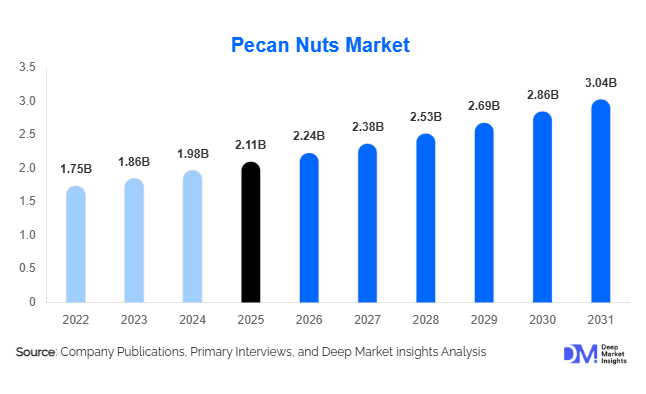
According to Deep Market Insights, the global pecan nuts market size was valued at USD 2.11 billion in 2025 and is projected to grow from USD 2.24 billion in 2026 to reach USD 3.04 billion by 2031, expanding at a CAGR of 6.3% during the forecast period (2026–2031). The pecan nuts market growth is primarily driven by increasing consumer preference for healthy snacking, rising adoption of plant-based nutrition, and growing utilization of pecans across bakery, confectionery, dairy alternatives, and functional food applications. Expanding premium food consumption in Asia-Pacific and rising demand for clean-label ingredients are further accelerating global market expansion.
Key Market Insights
- Healthy snacking trends are significantly boosting pecan consumption, as consumers increasingly seek nutrient-dense foods rich in antioxidants, healthy fats, and fiber.
- Plant-based food manufacturers are rapidly incorporating pecans into dairy alternatives, protein snacks, and vegan product formulations.
- North America dominates the global market, supported by large-scale production, advanced processing infrastructure, and strong export capabilities.
- Asia-Pacific is the fastest-growing regional market, driven by rising disposable income, premium food demand, and westernized dietary habits.
- Organic and sustainably sourced pecans are gaining traction, especially among health-conscious and environmentally aware consumers in Europe and North America.
- Technological advancements in shelling, sorting, and precision farming are improving operational efficiency and product quality across the value chain.
Pecan Nuts Market Latest Trends
Premium and Functional Snacking Driving Market Evolution
The global pecan nuts market is increasingly being shaped by the growing popularity of premium healthy snacks and functional foods. Consumers are shifting away from highly processed snacks toward natural alternatives that offer nutritional benefits alongside convenience. Pecans are gaining strong acceptance due to their high antioxidant levels, heart-health benefits, and compatibility with ketogenic, paleo, and plant-based diets. Manufacturers are introducing flavored, roasted, candied, and protein-enriched pecan snack products to attract younger consumers and health-conscious urban populations. Premium packaging, portion-controlled snack formats, and direct-to-consumer online sales are also strengthening market visibility globally.
Expansion of Plant-Based and Dairy Alternative Applications
Pecan-based dairy alternatives are emerging as one of the most important trends within the industry. Food manufacturers are increasingly launching pecan milk, pecan butter, and pecan-based creamers as consumers seek lactose-free and vegan alternatives. The rise of clean-label and minimally processed ingredient preferences is further encouraging the use of pecans in functional foods, bakery mixes, breakfast cereals, and plant-based desserts. Foodservice operators and café chains are also expanding premium menu offerings featuring pecans in beverages, salads, desserts, and gourmet dishes. This diversification beyond traditional snacking applications is broadening the commercial scope of the pecan nuts market.
Pecan Nuts Market Drivers
Growing Demand for Healthy and Nutrient-Rich Foods
The increasing global focus on health and wellness remains one of the strongest drivers of the pecan nuts market. Consumers are actively seeking foods rich in healthy fats, antioxidants, vitamins, and minerals to support cardiovascular health and overall wellness. Pecans contain monounsaturated fats, magnesium, zinc, and dietary fiber, making them highly attractive among fitness-conscious and aging populations. Rising awareness regarding the benefits of plant-based nutrition and clean eating habits is supporting long-term consumption growth across developed and emerging economies.
Expansion of Bakery and Confectionery Industries
The widespread use of pecans in premium bakery and confectionery products continues to support market growth globally. Pecans are extensively utilized in pies, cookies, cakes, pastries, chocolates, and dessert toppings due to their distinctive texture and flavor profile. Growing demand for artisanal and indulgent bakery products is increasing procurement from industrial food manufacturers. Premium dessert innovation and gourmet product launches across North America, Europe, and Asia-Pacific are further accelerating demand for shelled and processed pecans.
Pecan Nuts Market Restraints
Climate-Sensitive Production and Yield Volatility
The pecan nuts market remains highly vulnerable to climatic fluctuations and alternate-bearing production cycles. Droughts, hurricanes, water shortages, and temperature instability in major producing regions such as the United States and Mexico can significantly affect annual yields and pricing stability. Weather-related disruptions frequently create supply chain uncertainty for processors, exporters, and food manufacturers relying on consistent pecan availability.
High Product Pricing Compared to Alternative Nuts
Pecans are generally priced at a premium compared to almonds, peanuts, and certain other tree nuts due to lower production volumes, labor-intensive shelling operations, and harvest variability. This pricing structure restricts mass-market penetration in price-sensitive developing economies. Transportation costs, export duties, and seasonal inventory fluctuations further contribute to elevated retail pricing, limiting broader affordability.
Pecan Nuts Industry Key Opportunities
Rapid Growth of Plant-Based Food and Beverage Markets
The global shift toward plant-based diets presents significant opportunities for pecan manufacturers and food processors. Pecan milk, pecan butter, vegan desserts, and plant-based protein snacks are gaining popularity among consumers seeking dairy-free and clean-label alternatives. Companies investing in innovative pecan-derived ingredients and functional food formulations are expected to benefit from expanding vegan and flexitarian consumer bases. Increasing demand for premium nut-based beverages in North America, Europe, and Asia-Pacific creates strong long-term growth potential.
Rising Premium and Organic Nut Consumption
Consumer demand for premium, organic, and sustainably sourced food products is opening new opportunities within the pecan nuts market. Organic pecans are gaining traction among health-conscious consumers willing to pay premium prices for chemical-free and traceable products. Export demand from China, Europe, Japan, and the Middle East is increasing steadily due to rising disposable income and luxury gifting culture. Producers focusing on sustainability certifications, organic farming, and transparent sourcing practices are expected to gain strong competitive advantages globally.
Report Scope
| Report Metric | Details |
|---|---|
| Market Size in 2025 | USD 2.11 Billion |
| Market Size in 2026 | USD 2.24 Billion |
| Market Size in 2031 | USD 3.04 Billion |
| CAGR | 6.3% (2026-2031) |
| Base Year for Estimation | 2025 |
| Historical Data | 2022-2024 |
| Forecast Period | 2026-2031 |
| Report Coverage | Revenue Forecast, Competitive Landscape, Supply Chain Disruption, Growth Factors, Environment & Regulatory Landscape and Trends |
| Geographies Covered | North America, Europe, APAC, Middle East and Africa, LATAM |
| Countries Covered | U.S., Canada, U.K., Germany, France, Spain, Italy, Russia, Nordic, Benelux, Rest of Europe, China, Korea, Japan, India, Australia, Singapore, Taiwan, South East Asia, Rest of Asia-Pacific, UAE, Turky, Saudi Arabia, South Africa, Egypt, Nigeria, Rest of MEA, Brazil, Mexico, Argentina, Chile, Colombia, Rest of LATAM |
Explore more data points, trends and opportunities Download Free Sample Report
Product Type Insights
Shelled pecans dominate the global market, accounting for nearly 46% of total market revenue in 2025. Their leadership is driven by convenience, ease of industrial processing, and strong demand from bakery, confectionery, and snack manufacturers. Shelled pecans reduce labor requirements for commercial food processors while improving manufacturing efficiency. In-shell pecans continue to maintain stable demand in retail and export markets, particularly in Asia where consumers associate shell integrity with freshness and premium quality. Processed pecans, including roasted, flavored, and candied variants, are rapidly gaining popularity due to rising healthy snacking trends and premium packaged food consumption. Pecan ingredients such as pecan flour, pecan butter, and pecan oil are also emerging as high-growth categories due to expanding applications in plant-based and functional food industries.
Application Insights
Bakery applications remain the leading segment within the pecan nuts market, contributing approximately 28% of global market revenue in 2025. Pecans are widely used in cookies, pies, cakes, muffins, pastries, and premium baked desserts because of their rich flavor and texture. Confectionery applications are also expanding steadily, particularly in premium chocolates, nut bars, caramel products, and gourmet candies. The snacks segment is experiencing strong growth due to rising consumer preference for protein-rich and nutrient-dense snack alternatives. Functional foods and nutraceutical applications are emerging rapidly as pecans gain recognition for their antioxidant and heart-health benefits. In addition, pecan-based dairy alternatives and breakfast products are becoming increasingly important growth areas within the global market.
Distribution Channel Insights
Business-to-business (B2B) distribution dominates the pecan nuts market, accounting for nearly 61% of global sales in 2025. Food manufacturers, bakery companies, confectionery producers, and foodservice operators procure pecans in large commercial volumes for industrial processing applications. Retail distribution through supermarkets, specialty stores, and online platforms continues to expand steadily as consumer demand for premium packaged nuts increases globally. E-commerce has emerged as a major growth channel, allowing brands to directly target health-conscious consumers through subscription-based snack offerings and premium organic product lines. Specialty gourmet retailers and organic food stores are also strengthening market visibility for premium and sustainably sourced pecan products.
End-Use Industry Insights
The food processing industry remains the largest end-use segment, accounting for approximately 48% of the global pecan nuts market in 2025. Demand is primarily driven by bakery, confectionery, snack manufacturing, breakfast cereals, and frozen dessert applications. Retail household consumption is also growing steadily due to increasing awareness regarding healthy eating habits and at-home snacking trends. The plant-based beverage industry is among the fastest-growing end-use sectors as pecan milk and nut-based dairy alternatives gain wider consumer acceptance. Nutraceutical manufacturers are increasingly incorporating pecans into heart-health supplements and functional nutrition products. Cosmetic and personal care applications involving pecan oil are also expanding gradually within premium skincare formulations.
Explore more data points, trends and opportunities Download Free Sample Report
Pecan Nuts Market Segmentations
By Product Type
- In-shell Pecans
- Shelled Pecans
- Processed Pecans
- Pecan Ingredients
By Nature
- Conventional Pecans
- Organic Pecans
By Form
- Raw/Whole
- Chopped
- Ground
- Powdered
- Liquid Extract/Oil
By Application
- Bakery Products
- Confectionery
- Snacks
- Dairy & Dairy Alternatives
- Cereals & Breakfast Products
- Functional Foods & Nutraceuticals
- Foodservice & Culinary Applications
- Cosmetics & Personal Care
By Distribution Channel
- Business-to-Business (B2B)
- Supermarkets/Hypermarkets
- Convenience Stores
- Specialty Stores
- Online Retail
- Direct-to-Consumer Brands
Regional Insights
North America
North America remains the dominant regional market, accounting for approximately 53% of global market share in 2025. The United States is the world’s leading producer and exporter of pecans due to extensive cultivation across Georgia, Texas, New Mexico, and Arizona. Strong domestic consumption, advanced processing infrastructure, and export-oriented production continue to support regional dominance. Mexico also contributes significantly to global production and benefits from favorable climatic conditions and expanding orchard investments. High demand for healthy snacks and premium bakery products further strengthens market growth across the region.
Europe
Europe represents a major consumption market for premium and organic pecans, accounting for nearly 17% of global market share in 2025. Germany, the United Kingdom, France, Italy, and Spain are leading consumers due to growing demand for clean-label foods, bakery products, and plant-based nutrition. European consumers show strong preference for sustainably sourced and traceable nut products, encouraging imports of certified organic pecans. The expansion of premium confectionery and healthy snacking categories is also contributing to regional demand growth.
Asia-Pacific
Asia-Pacific is the fastest-growing regional market, supported by rising disposable income, westernized eating habits, and increasing premium food consumption. China is one of the largest importers of pecans globally due to strong demand for healthy snacks and gifting products. India is witnessing rising use of pecans in bakery, confectionery, and festive food applications. Japan and South Korea continue to import premium pecans for packaged snacks and processed food industries. Expanding e-commerce penetration and premium retail development are further accelerating regional market growth.
Latin America
Latin America is witnessing gradual market expansion led by Brazil, Argentina, and Chile. Rising urbanization, modernization of retail infrastructure, and increasing consumer awareness regarding healthy eating are supporting demand for imported tree nuts. The region also presents long-term opportunities for domestic cultivation expansion and food processing investments.
Middle East & Africa
The Middle East and Africa region is emerging as an important premium consumption market due to increasing healthy snack imports, luxury hospitality growth, and rising affluent consumer populations. The UAE and Saudi Arabia are key import-driven markets supported by gourmet retail expansion and premium gifting culture. South Africa is also emerging as a regional producer and exporter, benefiting from favorable agricultural conditions and expanding processing investments.
Key Players in the Pecan Nuts Market
- Archer Daniels Midland (ADM)
- John B. Sanfilippo & Son
- Green Valley Pecan Company
- Navarro Pecan Company
- San Saba Pecan
- Carter Pecan
- Hudson Pecan Company
- Durden Pecans
- Whaley Pecan Company
- Lamar Pecan Company
- Oliver Pecan Company
- South Georgia Pecan Company
- Royalty Pecan Farms
- Guidry Pecan Farms
- National Pecan Shellers Association affiliated processors