Organic Hair Care Products Market Size
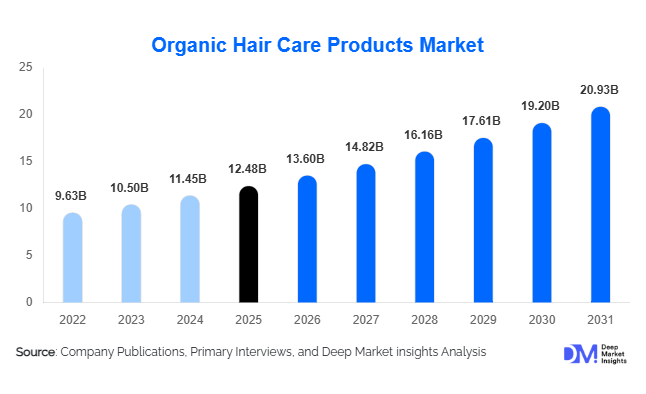
According to Deep Market Insights, the global organic hair care products market size was valued at USD 12.48 billion in 2025 and is projected to grow from USD 13.60 billion in 2026 to reach USD 20.93 billion by 2031, expanding at a CAGR of 9.0% during the forecast period (2026–2031). The organic hair care products market growth is primarily driven by increasing consumer preference for chemical-free personal care solutions, rising awareness regarding scalp and hair health, and the growing adoption of sustainable and ethically sourced beauty products globally.
Key Market Insights
- Consumers are increasingly shifting toward sulfate-free, paraben-free, and plant-based hair care formulations, supporting strong growth in premium organic product categories.
- Online retail and direct-to-consumer channels are rapidly transforming the market, enabling smaller organic brands to compete globally through digital engagement and subscription-based models.
- North America dominates the organic hair care products market, supported by high clean beauty awareness, premium beauty spending, and mature organic retail ecosystems.
- Asia-Pacific remains the fastest-growing region, driven by rising middle-class incomes, herbal beauty traditions, and expanding e-commerce penetration in China and India.
- Ayurvedic and botanical ingredient-based products are witnessing accelerated demand globally, particularly formulations containing aloe vera, argan oil, rosemary oil, neem, coconut oil, and tea tree extracts.
- Technological innovation in biotechnology-based ingredient extraction and personalized hair diagnostics is reshaping product development strategies among leading companies.
Organic Hair Care Products Market Trends
Clean Beauty and Ingredient Transparency Becoming Mainstream
Consumers are increasingly demanding transparency regarding ingredient sourcing, product safety, and manufacturing practices within the beauty and personal care industry. Organic hair care brands are responding by highlighting naturally derived ingredients, cruelty-free certifications, vegan formulations, and sustainable packaging solutions. Sulfate-free shampoos, silicone-free conditioners, and botanical scalp-care products are becoming mainstream across both premium and mass-premium product categories. Consumers are also showing growing interest in formulations containing clinically validated herbal ingredients such as rosemary, tea tree oil, aloe vera, and argan oil due to their perceived therapeutic benefits. Brands that clearly communicate ethical sourcing practices and environmental responsibility are gaining stronger customer loyalty and premium pricing advantages.
Digital Commerce and Personalized Hair Care Solutions Expanding
E-commerce platforms and direct-to-consumer business models are significantly transforming the organic hair care products market. Consumers increasingly rely on online reviews, social media influencers, and digital consultations before purchasing products. Beauty brands are integrating AI-powered scalp diagnostics, customized product recommendations, and subscription-based purchasing models to improve customer retention and personalization. Digital channels are also enabling niche organic brands to expand internationally without extensive retail infrastructure investments. Mobile applications, virtual consultations, and data-driven beauty analytics are helping companies tailor products according to hair texture, scalp sensitivity, climate conditions, and lifestyle preferences, creating a more personalized consumer experience globally.
Organic Hair Care Products Market Drivers
Rising Consumer Awareness Regarding Chemical-Free Beauty Products
The increasing awareness regarding the harmful effects of synthetic chemicals in conventional hair care products is a major growth driver for the organic hair care products market. Consumers are becoming more cautious about ingredients such as sulfates, parabens, silicones, formaldehyde releasers, and artificial fragrances due to concerns associated with scalp irritation, hair damage, and long-term health implications. This shift in consumer behavior is encouraging greater adoption of naturally derived and plant-based formulations. Dermatologists, wellness influencers, and social media platforms are further educating consumers regarding the benefits of organic hair care, accelerating global market penetration.
Growth of Premium Beauty and Wellness Spending
The expansion of premium beauty spending among millennials and Gen Z consumers is contributing significantly to market growth. Organic hair care products are increasingly positioned as wellness-oriented lifestyle products rather than conventional cosmetic solutions. Consumers are willing to pay premium prices for sustainable packaging, vegan certifications, cruelty-free manufacturing, and ethically sourced botanical ingredients. Urbanization, rising disposable incomes, and increasing beauty consciousness across emerging economies are further strengthening demand for premium organic hair care solutions. High-income consumers are also increasingly adopting multi-step hair care routines incorporating organic shampoos, conditioners, scalp treatments, oils, and hair masks.
Organic Hair Care Products Market Restraints
High Product Pricing and Premium Positioning
Organic hair care products generally remain more expensive than conventional hair care products due to higher raw material sourcing costs, certification expenses, sustainable packaging investments, and lower production scale efficiencies. This premium pricing structure limits mass-market adoption in price-sensitive developing economies where affordability remains a critical purchasing factor. Small and emerging brands also face difficulties maintaining competitive pricing while complying with strict organic certification standards and sustainable sourcing requirements.
Regulatory and Certification Complexity
The absence of globally standardized definitions for “organic” and “natural” beauty products creates regulatory challenges for manufacturers operating internationally. Certification standards such as USDA Organic, ECOCERT, COSMOS, and Vegan certifications vary across regions, increasing operational complexity and compliance costs. Regulatory scrutiny regarding greenwashing claims is also intensifying, requiring companies to maintain higher levels of ingredient transparency and supply chain traceability. These factors can slow product launches and increase barriers for smaller market participants.
Organic Hair Care Products Market Opportunities
Expansion of Ayurvedic and Botanical Hair Care Products
The growing global interest in Ayurvedic and herbal wellness solutions presents substantial opportunities for manufacturers specializing in botanical hair care formulations. Consumers across North America and Europe are increasingly adopting products containing ingredients such as neem, bhringraj, hibiscus, amla, rosemary oil, and tea tree extracts due to their perceived scalp and hair health benefits. This trend is creating export-driven opportunities for Asian manufacturers, particularly Indian companies with strong expertise in herbal and Ayurvedic product development. Government support for organic farming and herbal exports is also strengthening international growth potential.
Growth of Sustainable and Eco-Friendly Packaging Solutions
Sustainability-focused packaging innovation represents a major opportunity within the organic hair care products market. Consumers are increasingly prioritizing recyclable, biodegradable, refillable, and plastic-free packaging formats when making purchasing decisions. Companies investing in refill stations, reusable packaging systems, and environmentally friendly material alternatives are expected to strengthen brand differentiation and customer loyalty. Retailers and online marketplaces are also increasingly favoring brands that align with environmental sustainability goals, further accelerating adoption of eco-friendly packaging technologies.
Report Scope
| Report Metric | Details |
|---|---|
| Market Size in 2025 | USD 12.48 Billion |
| Market Size in 2026 | USD 13.60 Billion |
| Market Size in 2031 | USD 20.93 Billion |
| CAGR | 9% (2026-2031) |
| Base Year for Estimation | 2025 |
| Historical Data | 2022-2024 |
| Forecast Period | 2026-2031 |
| Report Coverage | Revenue Forecast, Competitive Landscape, Supply Chain Disruption, Growth Factors, Environment & Regulatory Landscape and Trends |
| Geographies Covered | North America, Europe, APAC, Middle East and Africa, LATAM |
| Countries Covered | U.S., Canada, U.K., Germany, France, Spain, Italy, Russia, Nordic, Benelux, Rest of Europe, China, Korea, Japan, India, Australia, Singapore, Taiwan, South East Asia, Rest of Asia-Pacific, UAE, Turky, Saudi Arabia, South Africa, Egypt, Nigeria, Rest of MEA, Brazil, Mexico, Argentina, Chile, Colombia, Rest of LATAM |
Explore more data points, trends and opportunities Download Free Sample Report
Product Type Insights
Organic shampoos dominate the market due to their high consumption frequency and broad consumer adoption across all demographic groups. Sulfate-free and herbal shampoos account for the largest product category share globally, supported by rising concerns regarding scalp sensitivity and hair damage caused by chemical-based formulations. Organic conditioners are also witnessing strong growth due to increasing adoption of complete hair care routines focused on hydration, repair, and scalp nourishment. Hair oils and serums represent one of the fastest-growing categories, particularly products containing argan oil, coconut oil, castor oil, and Ayurvedic herbal extracts targeting hair growth and anti-hair-fall benefits. Organic hair masks and scalp treatments are increasingly gaining popularity among premium consumers seeking intensive hair repair solutions and salon-grade treatments at home.
Ingredient Type Insights
Plant-based ingredient formulations account for the largest market share globally due to strong consumer preference for naturally sourced and environmentally sustainable ingredients. Aloe vera, rosemary oil, tea tree oil, coconut oil, argan oil, and shea butter remain among the most widely used ingredients across premium organic hair care products. Ayurvedic and herbal ingredient-based formulations are witnessing particularly strong growth in Asia-Pacific and export markets due to increasing consumer interest in traditional wellness solutions. Essential oil-based products are also expanding rapidly, driven by demand for therapeutic scalp-care benefits, stress relief, and aromatherapy integration within beauty routines. Vegan organic formulations are gaining momentum among younger demographics prioritizing cruelty-free and environmentally responsible beauty products.
Distribution Channel Insights
Online retail channels are rapidly becoming the dominant distribution platform within the organic hair care products market. E-commerce marketplaces, brand-owned websites, beauty subscription platforms, and social commerce channels are enabling consumers to access wider product assortments and detailed ingredient information. Influencer-driven marketing and online product reviews are significantly shaping purchasing behavior, particularly among millennials and Gen Z consumers. Specialty beauty retailers and organic product stores continue to play a critical role in premium product positioning and consumer education. Meanwhile, supermarkets, hypermarkets, and pharmacies remain important for mass-market accessibility and expanding product visibility across developing economies.
Consumer Group Insights
Women account for the largest share of the organic hair care products market due to higher spending on scalp treatments, color protection products, conditioners, and hair repair solutions. Premium beauty routines and increasing demand for clean-label personal care products continue supporting strong female consumer adoption globally. Men’s grooming products represent one of the fastest-growing segments, driven by rising awareness regarding scalp care, beard grooming, and hair loss prevention solutions. Children and baby organic hair care products are also expanding steadily due to increasing parental concerns regarding exposure to harsh chemicals in conventional personal care formulations. Unisex product positioning is becoming increasingly popular among minimalist and gender-neutral beauty brands.
Explore more data points, trends and opportunities Download Free Sample Report
Organic Hair Care Products Market Segmentations
By Product Type
- Organic Shampoo
- Organic Conditioner
- Organic Hair Oils & Serums
- Organic Hair Styling Products
- Organic Hair Color Products
- Organic Hair Treatment Products
By Ingredient Type
- Plant-Based Ingredients
- Herbal & Ayurvedic Ingredients
- Essential Oil-Based Formulations
- Fruit Extract-Based Products
- Vegan Organic Hair Care Products
By Distribution Channel
- Online Retail
- Supermarkets & Hypermarkets
- Specialty Beauty Stores
- Pharmacies & Drug Stores
- Salon & Professional Stores
- Brand-Owned Retail Stores
By Consumer Group
- Men
- Women
- Children & Babies
- Unisex Consumers
By End User
- Individual Consumers
- Salons & Spas
- Hotels & Hospitality Industry
- Dermatology Clinics
- Wellness Centers
Regional Insights
North America
North America accounted for approximately 33% of the global organic hair care products market in 2025, making it the leading regional market globally. The United States dominates regional demand due to strong consumer awareness regarding clean beauty, high disposable incomes, and widespread adoption of premium personal care products. Consumers increasingly prioritize sulfate-free, vegan, and cruelty-free hair care products, particularly among millennials and wellness-focused urban populations. Canada also demonstrates strong market growth supported by sustainability-focused consumer behavior and expanding organic retail infrastructure.
Europe
Europe remains one of the most mature organic beauty markets globally, accounting for nearly 29% of total market demand in 2025. Germany, France, the United Kingdom, and Italy are major contributors to regional growth. Strong regulatory standards regarding cosmetic safety and sustainability are supporting demand for certified organic products across the region. European consumers are highly receptive to environmentally sustainable packaging, vegan beauty products, and ethically sourced ingredients. Germany leads regional demand due to strong organic product penetration, while France continues driving innovation within premium botanical beauty formulations.
Asia-Pacific
Asia-Pacific is the fastest-growing regional market and is projected to expand at a CAGR exceeding 11% during the forecast period. China and India represent major growth engines due to rising middle-class incomes, rapid e-commerce expansion, and growing awareness regarding herbal and organic beauty products. India is emerging as a leading exporter of Ayurvedic and botanical hair care products, supported by abundant raw material availability and government-backed herbal wellness initiatives. Japan and South Korea remain important innovation centers for scalp-care and minimalist clean beauty products, while Australia demonstrates strong demand for sustainable premium beauty formulations.
Latin America
Latin America is witnessing increasing adoption of organic hair care products, particularly in Brazil, Mexico, and Argentina. Brazil remains the largest beauty and personal care market within the region, supported by strong consumer focus on hair health and grooming. Consumers are increasingly preferring botanical formulations incorporating native fruit extracts and natural oils. Expanding digital retail penetration and growing awareness regarding clean-label products are supporting regional market expansion.
Middle East & Africa
The Middle East & Africa region is gradually emerging as a promising market for premium organic hair care products. Countries such as the UAE and Saudi Arabia are witnessing rising demand for luxury, halal-certified, and herbal beauty products due to increasing disposable incomes and premium beauty consumption patterns. South Africa remains an important regional growth market supported by expanding urban populations and rising natural beauty awareness. Increasing tourism, luxury hospitality expansion, and wellness-focused retail development are also supporting demand for organic personal care products across the region.
Key Players in the Organic Hair Care Products Market
- L’Oréal Group
- Procter & Gamble
- Unilever
- The Estée Lauder Companies
- Natura & Co
- Aveda Corporation
- John Paul Mitchell Systems
- Kao Corporation
- Shiseido Company
- Henkel AG & Co. KGaA
- Davines Group
- Himalaya Wellness Company
- Giovanni Cosmetics
- Aubrey Organics
- Amway Corporation