Mycelium Leather Market Size
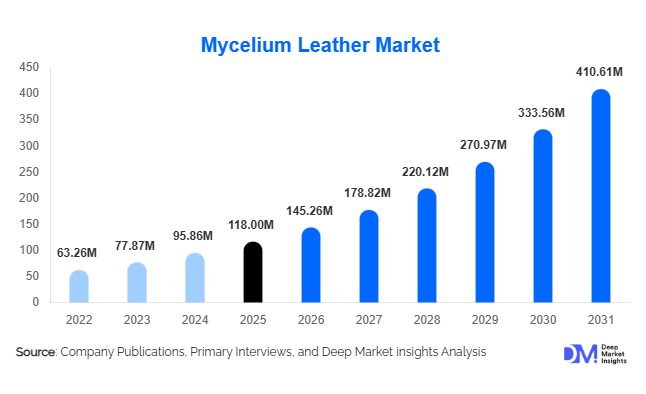
According to Deep Market Insights, the global mycelium leather market size was valued at USD 118 million in 2025 and is projected to grow from USD 145.26 million in 2026 to reach USD 410.61 million by 2031, expanding at a CAGR of 23.1% during the forecast period (2026–2031). The mycelium leather market growth is primarily driven by rising demand for sustainable and animal-free materials, increasing regulatory scrutiny surrounding conventional leather production, and growing adoption of bio-based alternatives by luxury fashion brands, automotive manufacturers, and premium interior design companies. As global brands intensify their ESG commitments and consumers increasingly prioritize environmentally responsible products, mycelium leather is emerging as one of the most promising next-generation biomaterials. Technological advancements in fungal cultivation, biofabrication processes, and material finishing techniques are further accelerating commercialization and improving product performance across diverse end-use applications.
Key Market Insights
- Luxury fashion remains the largest consumer of mycelium leather, accounting for nearly 58% of global demand due to premium pricing power and strong sustainability branding.
- Automotive interior applications are emerging as the fastest-growing segment, supported by increasing adoption of sustainable materials in electric vehicles.
- North America dominates the global market, benefiting from the presence of leading technology developers, venture capital funding, and commercial-scale manufacturing investments.
- Asia-Pacific is the fastest-growing regional market, led by China, Japan, South Korea, and India as sustainable materials gain traction across manufacturing industries.
- Advancements in biomaterial engineering are improving durability, texture, scalability, and commercial viability of mycelium leather products.
- Strategic partnerships between biomaterial producers and luxury brands are accelerating product commercialization and market penetration globally.
Mycelium Leather Market Trends
Luxury Brands Accelerating Adoption of Bio-Based Materials
Luxury fashion houses are increasingly integrating mycelium leather into handbags, footwear, accessories, and apparel collections as part of broader sustainability commitments. Global consumers are demonstrating a growing preference for products that combine premium aesthetics with lower environmental impact, encouraging brands to explore alternatives to conventional animal leather. Mycelium leather offers significant advantages including lower carbon emissions, reduced water consumption, and elimination of animal-derived inputs. Premium brands continue to launch limited-edition products featuring mushroom-derived materials, validating commercial demand and helping establish mycelium leather as a credible luxury material. As production volumes increase and costs gradually decline, adoption is expected to expand beyond limited collections into broader product portfolios.
Industrial Scale-Up and Material Performance Improvements
The industry is transitioning from laboratory-scale innovation toward commercial-scale manufacturing. Producers are investing heavily in automated cultivation systems, engineered fungal strains, advanced finishing technologies, and industrial production facilities to improve consistency and reduce costs. Recent innovations have enhanced tensile strength, abrasion resistance, flexibility, and aesthetic customization, making mycelium leather increasingly suitable for demanding applications such as automotive interiors and furniture upholstery. Continuous investment in R&D and manufacturing infrastructure is expected to improve economies of scale and support wider adoption across multiple industries over the coming decade.
Mycelium Leather Market Drivers
Growing Demand for Sustainable and Vegan Materials
Consumers across global markets are increasingly seeking environmentally responsible alternatives to traditional animal-derived products. The growing popularity of vegan lifestyles, sustainability-focused purchasing decisions, and heightened awareness regarding livestock-related emissions are driving demand for next-generation biomaterials. Mycelium leather provides a renewable, biodegradable, and cruelty-free alternative while maintaining the premium look and feel associated with conventional leather. This trend is particularly pronounced among younger consumer demographics, who prioritize sustainability when making purchasing decisions.
Increasing Regulatory Pressure on Conventional Leather Manufacturing
Governments and regulatory agencies are imposing stricter environmental standards on traditional leather production due to concerns surrounding water usage, chemical-intensive tanning processes, and greenhouse gas emissions. Sustainability reporting requirements and carbon reduction initiatives are encouraging manufacturers to seek lower-impact material alternatives. Mycelium leather aligns well with emerging regulatory frameworks and corporate sustainability targets, positioning it as an attractive solution for brands seeking to reduce environmental footprints.
Mycelium Leather Market Restraints
High Production Costs and Limited Manufacturing Scale
Despite significant technological progress, mycelium leather remains substantially more expensive than conventional leather and synthetic alternatives. Specialized cultivation facilities, controlled growth environments, advanced processing techniques, and relatively limited production volumes contribute to elevated manufacturing costs. These economic challenges restrict adoption primarily to premium and luxury segments, limiting broader market penetration in cost-sensitive applications.
Performance Validation and Durability Concerns
Although material properties have improved significantly, some end users remain cautious regarding long-term durability, wear resistance, and performance consistency. Automotive manufacturers, furniture producers, and industrial users often require extensive testing and validation before integrating new materials into commercial products. Addressing these concerns through continued product development and standardized performance benchmarks remains critical for broader market adoption.
Mycelium Leather Market Opportunities
Expansion into Automotive Interior Applications
The automotive industry represents one of the largest long-term growth opportunities for mycelium leather manufacturers. Electric vehicle producers are increasingly incorporating sustainable materials into interiors to strengthen environmental credentials and meet consumer expectations. Mycelium leather can be utilized in seats, dashboards, steering wheel coverings, door panels, and trim components. As global electric vehicle production continues to expand, demand for sustainable interior materials is expected to increase significantly, creating substantial opportunities for material suppliers.
Government Support for Circular Economy and Bioeconomy Initiatives
Governments across Europe, North America, and Asia are promoting bio-based manufacturing through funding programs, research grants, tax incentives, and sustainability-focused industrial policies. Circular economy initiatives encourage the utilization of agricultural waste streams as feedstock for biomaterial production, improving resource efficiency while supporting environmental objectives. Companies operating within the mycelium leather value chain are increasingly benefiting from favorable regulatory environments and public-sector support programs designed to accelerate the commercialization of sustainable materials.
Report Scope
| Report Metric | Details |
|---|---|
| Market Size in 2025 | USD 118 Million |
| Market Size in 2026 | USD 145.26 Million |
| Market Size in 2031 | USD 410.61 Million |
| CAGR | 23.1% (2026-2031) |
| Base Year for Estimation | 2025 |
| Historical Data | 2022-2024 |
| Forecast Period | 2026-2031 |
| Report Coverage | Revenue Forecast, Competitive Landscape, Supply Chain Disruption, Growth Factors, Environment & Regulatory Landscape and Trends |
| Geographies Covered | North America, Europe, APAC, Middle East and Africa, LATAM |
| Countries Covered | U.S., Canada, U.K., Germany, France, Spain, Italy, Russia, Nordic, Benelux, Rest of Europe, China, Korea, Japan, India, Australia, Singapore, Taiwan, South East Asia, Rest of Asia-Pacific, UAE, Turky, Saudi Arabia, South Africa, Egypt, Nigeria, Rest of MEA, Brazil, Mexico, Argentina, Chile, Colombia, Rest of LATAM |
Explore more data points, trends and opportunities Download Free Sample Report
Product Type Insights
Dyed mycelium leather dominates the global market, accounting for approximately 55% of total revenue in 2025. Luxury brands and premium product manufacturers require consistent color profiles and enhanced visual appeal, making dyed variants the preferred commercial option. Surface-coated mycelium leather is also gaining traction due to improved durability and resistance to environmental exposure. Natural and unstained mycelium leather continues to attract sustainability-focused consumers seeking minimal processing and lower environmental impact. Composite mycelium leather products are emerging as an important innovation category, combining fungal materials with bio-based fibers and polymers to enhance mechanical properties and broaden application potential.
Manufacturing Technology Insights
Sheet-grown mycelium leather represents the leading manufacturing technology, accounting for nearly 62% of global market demand. The format closely resembles conventional leather sheets, allowing manufacturers to integrate the material into existing production processes with minimal modifications. Foam-based and engineered composite production technologies are gaining interest for specialized applications requiring enhanced structural properties and lightweight performance characteristics. Continuous advancements in fungal strain engineering and cultivation techniques are further improving production efficiency and material consistency.
Application Insights
Bags and luggage remain the largest application segment, accounting for approximately 29% of global market revenue in 2025. Luxury handbags, travel accessories, wallets, and small leather goods have served as early commercialization pathways due to their high margins and relatively low material volume requirements. Footwear represents another major application area, with premium brands incorporating mycelium leather into casual, luxury, and athletic footwear collections. Furniture upholstery, automotive interiors, and consumer goods applications are expanding rapidly as material performance improves and production capacity increases.
End-Use Industry Insights
Fashion and luxury goods constitute the largest end-use industry, representing nearly 58% of total market demand. The sector benefits from strong consumer interest in sustainable luxury products and the ability to absorb premium material costs. Automotive applications are expected to register the fastest growth rate through 2031 as electric vehicle manufacturers increasingly adopt sustainable interior materials. Furniture and interior design industries are also emerging as important growth markets, particularly within premium residential, hospitality, and commercial projects emphasizing environmental sustainability and ESG compliance.
Distribution Channel Insights
Direct supply agreements between material producers and brands dominate the market, accounting for approximately 66% of global sales. Luxury brands typically engage directly with mycelium leather manufacturers to ensure product quality, customization, and supply chain transparency. Strategic partnerships and co-development agreements are increasingly common as brands seek exclusive access to innovative materials. Contract manufacturing and specialty material distributors play supporting roles, particularly in regional markets and emerging application segments.
Explore more data points, trends and opportunities Download Free Sample Report
Mycelium Leather Market Segmentations
By Product Type
- Dyed Mycelium Leather
- Natural/Unstained Mycelium Leather
- Surface-Coated Mycelium Leather
- Composite Mycelium Leather
By Manufacturing Technology
- Sheet-Grown Mycelium Leather
- Foam-Based Mycelium Leather
- Fiber-Reinforced Mycelium Leather
- Engineered Mycelium Composite Materials
By Application
- Footwear
- Bags & Luggage
- Apparel
- Accessories
- Furniture Upholstery
- Automotive Interior Components
- Consumer Goods
- Specialty Applications
By End-Use Industry
- Fashion & Luxury Goods
- Automotive
- Furniture & Interior Design
- Consumer Goods
- Hospitality & Commercial Interiors
- Aerospace & Transportation
- Other Industrial Uses
By Distribution Model
- Direct Supply to Brands/OEMs
- Material Platform Partnerships
- Contract Manufacturing
- Specialty Material Distributors
Regional Insights
North America
North America accounted for approximately 38% of global mycelium leather market revenue in 2026, making it the largest regional market. The United States serves as the primary growth engine, supported by the presence of leading biomaterial innovators, extensive venture capital funding, advanced biotechnology infrastructure, and a highly developed ecosystem for sustainable material commercialization. The region is home to several pioneering companies developing next-generation fungal biomaterials, creating a strong innovation pipeline that continues to accelerate product development and market adoption.
The growing commitment of luxury fashion brands, footwear manufacturers, and premium consumer goods companies toward ESG goals and carbon footprint reduction is a major driver of regional demand. Additionally, increasing consumer preference for vegan and cruelty-free products has encouraged brands to incorporate mycelium leather into premium product lines. The automotive sector is emerging as another important demand driver as electric vehicle manufacturers increasingly adopt sustainable interior materials to align with carbon-neutral production targets. Government support for biotechnology innovation, coupled with rising investments in circular economy initiatives and bio-based manufacturing, is expected to strengthen North America's leadership position throughout the forecast period.
Europe
Europe held approximately 34% of the global mycelium leather market in 2026 and remains one of the most influential regions for sustainable material adoption. The region's dominance is primarily supported by stringent environmental regulations, ambitious carbon neutrality targets, and strong consumer demand for ethically sourced products. Europe also serves as the global center for luxury fashion, leather goods, and premium footwear manufacturing, making it a natural market for innovative leather alternatives.
France leads regional demand due to the concentration of luxury fashion houses actively investing in sustainable materials to meet environmental commitments and evolving consumer preferences. Italy remains a major consumer through its globally recognized footwear, handbags, and luxury accessories industries, where premium sustainable materials command significant value. Germany is driving growth through automotive applications as vehicle manufacturers increasingly integrate bio-based materials into premium interiors to meet sustainability targets. Meanwhile, the United Kingdom continues to support market expansion through sustainable fashion innovation, green investment initiatives, and growing consumer awareness regarding environmentally responsible products. The European Green Deal, circular economy policies, and increasing sustainability reporting requirements are expected to further accelerate adoption across multiple industries.
Asia-Pacific
Asia-Pacific is projected to be the fastest-growing regional market, expanding at a CAGR exceeding 26% through 2031. Rapid industrialization, rising environmental awareness, increasing disposable incomes, and growing investments in advanced materials are collectively driving market expansion across the region. As global brands increasingly establish sustainable supply chains in Asia, demand for bio-based alternatives such as mycelium leather is expected to accelerate significantly.
China represents the largest regional market, supported by its expanding sustainable manufacturing ecosystem, growing luxury consumer base, and government initiatives promoting green industrial development. The country's strong position in textiles, footwear, and consumer goods manufacturing provides significant opportunities for large-scale integration of mycelium leather materials. Japan continues to invest heavily in biomaterials research, advanced manufacturing technologies, and premium sustainable products, while South Korea benefits from growing demand within the fashion, cosmetics, and luxury consumer goods sectors. India is emerging as a high-potential growth market due to its extensive textile and apparel manufacturing base, increasing vegan consumer population, and government initiatives supporting sustainable manufacturing. Expanding electric vehicle production throughout the region is also expected to create substantial demand for sustainable interior materials over the coming decade.
Latin America
Latin America accounts for approximately 5% of global mycelium leather demand, with Brazil and Mexico representing the largest regional markets. Although adoption remains at an early stage compared to North America and Europe, increasing awareness of sustainable materials and growing participation in global fashion supply chains are supporting gradual market expansion.
Brazil's strong footwear, apparel, and leather manufacturing industries create favorable conditions for future adoption of bio-based alternatives. As international fashion brands strengthen sustainability requirements throughout their supplier networks, regional manufacturers are increasingly evaluating innovative materials that can improve environmental performance. Mexico is benefiting from its close integration with North American manufacturing supply chains, particularly within footwear, automotive, and consumer goods industries. Additionally, growing investments in sustainable production practices and increasing consumer awareness regarding environmental issues are expected to support long-term market growth throughout the region.
Middle East & Africa
The Middle East & Africa region represents approximately 3% of global market demand but offers considerable long-term growth potential. Demand is primarily concentrated in the Gulf Cooperation Council (GCC) countries, particularly the United Arab Emirates, where luxury retail, premium hospitality developments, and sustainability-focused construction projects are creating opportunities for innovative biomaterials.
The UAE leads regional consumption due to its strong luxury goods market, growing focus on sustainable urban development, and increasing adoption of environmentally responsible materials across hospitality and commercial projects. Saudi Arabia is expected to emerge as a significant growth market as large-scale economic diversification initiatives and sustainability-focused infrastructure investments continue under Vision 2031. In Africa, South Africa represents the most promising market due to its developed fashion industry, growing sustainable design movement, and increasing demand for premium eco-friendly materials. Rising investments in green manufacturing, circular economy initiatives, and sustainable consumer products are expected to support gradual market expansion across the broader region over the forecast period.