Matcha Chocolate Market Size
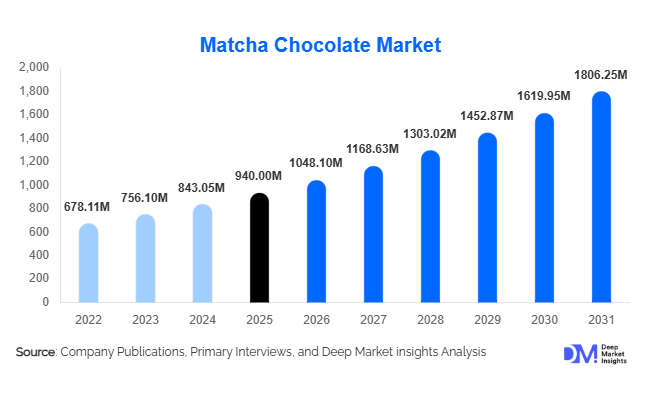
According to Deep Market Insights, the global matcha chocolate market size was valued at USD 940 million in 2025 and is projected to grow from USD 1,048.10 million in 2026 to reach USD 1,806.25 million by 2031, expanding at a CAGR of 11.5% during the forecast period (2026–2031). The matcha chocolate market growth is primarily driven by rising consumer demand for premium confectionery products, increasing awareness of matcha’s antioxidant properties, growing adoption of Japanese-inspired flavors, and the expansion of functional food categories worldwide. Matcha chocolate has emerged as a premium indulgence that combines the sensory appeal of chocolate with the perceived wellness benefits of green tea, attracting health-conscious consumers seeking differentiated snacking experiences.
Key Market Insights
- Premium and functional confectionery products are driving category expansion, with consumers increasingly seeking indulgent products that offer health-oriented positioning.
- Matcha dark chocolate remains the leading product segment, accounting for approximately 34% of global market demand due to strong consumer preference for lower-sugar premium chocolate formats.
- Asia-Pacific dominates the global market, supported by Japan’s leadership in matcha production and strong regional consumption of premium tea-infused confectionery.
- North America represents the fastest-growing regional market, driven by increasing adoption of functional foods, premium snacking, and Japanese culinary influences.
- Online retail and direct-to-consumer channels are rapidly gaining share, allowing brands to educate consumers about matcha sourcing, grades, and wellness benefits.
- Product innovation focused on vegan, organic, and low-sugar formulations is expanding the consumer base beyond traditional premium chocolate buyers.
Matcha Chocolate Market Latest Trends
Premiumization and Functional Indulgence Reshaping Consumer Demand
Consumers are increasingly seeking confectionery products that deliver both indulgence and perceived wellness benefits. Matcha chocolate has positioned itself at the center of this trend by combining premium chocolate with antioxidant-rich matcha green tea. Manufacturers are introducing higher-grade matcha ingredients, single-origin cocoa formulations, organic certifications, and reduced-sugar variants to attract affluent and health-conscious consumers. Premium packaging, luxury gifting formats, and artisanal production methods are becoming important differentiators in developed markets. This trend is particularly evident across North America, Japan, South Korea, Germany, and the United Kingdom, where consumers are willing to pay significant premiums for unique flavor experiences and clean-label ingredients.
Expansion of Plant-Based and Clean-Label Matcha Chocolates
The growing popularity of vegan and plant-based diets is encouraging manufacturers to develop dairy-free matcha chocolate products using oat milk, almond milk, coconut milk, and other plant-derived ingredients. Clean-label trends are also influencing product development, with brands minimizing artificial additives and emphasizing sustainably sourced ingredients. Organic matcha chocolate products are experiencing particularly strong growth within specialty retail channels and premium e-commerce platforms. Consumers increasingly associate matcha with natural wellness, making clean-label positioning a key factor influencing purchase decisions. Companies are also introducing sugar-free and keto-friendly formulations to appeal to consumers seeking healthier alternatives to conventional confectionery.
Matcha Chocolate Market Drivers
Growing Global Consumption of Matcha-Based Products
Matcha consumption has expanded well beyond traditional tea applications and is now widely incorporated into beverages, desserts, bakery products, ice creams, and confectionery. Increased awareness of matcha’s antioxidant content, amino acids, and natural caffeine profile has elevated consumer interest across multiple food categories. As matcha becomes more mainstream in Western markets, demand for innovative products such as matcha chocolate continues to accelerate. The increasing visibility of matcha-based products in cafés, specialty retailers, and social media channels has significantly contributed to category growth.
Rising Demand for Premium Chocolate Products
Premium chocolate continues to outperform mass-market confectionery in value growth across major global markets. Consumers increasingly prioritize quality ingredients, unique flavor profiles, artisanal craftsmanship, and ethical sourcing practices when purchasing chocolate products. Matcha chocolate benefits directly from this premiumization trend by offering a differentiated product that combines exotic flavor characteristics with premium ingredient positioning. The willingness of consumers to pay higher prices for specialty chocolates supports healthy margins and encourages continued investment in product innovation.
Influence of Japanese Food Culture and Social Media
Global interest in Japanese cuisine and food culture has significantly increased over the past decade. Matcha has become one of the most recognizable Japanese ingredients worldwide, supported by strong visibility across social media platforms and foodservice establishments. Influencers, specialty cafés, and premium dessert brands have accelerated consumer awareness of matcha-flavored products. The visual appeal of matcha-based desserts and confectionery products has further strengthened adoption among younger consumers seeking novel and shareable food experiences.
Matcha Chocolate Market Restraints
Volatility in Matcha Raw Material Prices
The supply of premium-quality matcha remains concentrated in Japan, creating vulnerability to agricultural fluctuations, labor shortages, and increasing global demand. Supply constraints have contributed to rising prices for ceremonial-grade and premium culinary-grade matcha, increasing manufacturing costs for chocolate producers. Companies operating in the premium segment must carefully manage sourcing strategies to protect margins while maintaining product quality and authenticity.
Premium Pricing Limits Mainstream Adoption
Matcha chocolate products typically command price premiums ranging from 30% to 100% compared to conventional chocolate products. While affluent consumers readily accept higher pricing, broader adoption remains limited in price-sensitive regions. Expanding beyond niche premium segments will require manufacturers to balance quality, sourcing costs, and affordability while maintaining the distinctive characteristics that differentiate matcha chocolate from traditional confectionery products.
Matcha Chocolate Industry Key Opportunities
Expansion of Functional Confectionery Categories
The global functional food industry presents significant growth opportunities for matcha chocolate manufacturers. Consumers increasingly seek products that deliver nutritional benefits without sacrificing taste or indulgence. Matcha chocolate’s combination of antioxidants, natural caffeine, and premium chocolate ingredients positions it well within this expanding category. Manufacturers can further capitalize on this trend through the addition of complementary ingredients such as probiotics, adaptogens, collagen, and plant proteins. Functional confectionery products are expected to attract both health-conscious consumers and traditional chocolate buyers seeking premium alternatives.
Growth of E-Commerce and Direct-to-Consumer Sales
Digital retail channels provide matcha chocolate brands with opportunities to educate consumers about ingredient sourcing, matcha grades, sustainability practices, and health-related product attributes. Direct-to-consumer platforms support premium pricing strategies while enabling companies to build stronger customer relationships. Subscription models, seasonal product launches, personalized gifting programs, and limited-edition collections are becoming increasingly effective strategies for driving consumer engagement and repeat purchases. The continued expansion of specialty food e-commerce is expected to accelerate market penetration across both developed and emerging economies.
Report Scope
| Report Metric | Details |
|---|---|
| Market Size in 2025 | USD 940.00 Million |
| Market Size in 2026 | USD 1048.10 Million |
| Market Size in 2031 | USD 1806.25 Million |
| CAGR | 11.5% (2026-2031) |
| Base Year for Estimation | 2025 |
| Historical Data | 2022-2024 |
| Forecast Period | 2026-2031 |
| Report Coverage | Revenue Forecast, Competitive Landscape, Supply Chain Disruption, Growth Factors, Environment & Regulatory Landscape and Trends |
| Geographies Covered | North America, Europe, APAC, Middle East and Africa, LATAM |
| Countries Covered | U.S., Canada, U.K., Germany, France, Spain, Italy, Russia, Nordic, Benelux, Rest of Europe, China, Korea, Japan, India, Australia, Singapore, Taiwan, South East Asia, Rest of Asia-Pacific, UAE, Turky, Saudi Arabia, South Africa, Egypt, Nigeria, Rest of MEA, Brazil, Mexico, Argentina, Chile, Colombia, Rest of LATAM |
Explore more data points, trends and opportunities Download Free Sample Report
Matcha Chocolate Market Size
According to Deep Market Insights, the global matcha chocolate market size was valued at USD 940 million in 2025 and is projected to grow from USD 1.02 billion in 2026 to reach USD 1.76 billion by 2031, expanding at a CAGR of 11.5% during the forecast period (2026–2031). The matcha chocolate market growth is primarily driven by rising consumer demand for premium confectionery products, increasing awareness of matcha’s antioxidant properties, growing adoption of Japanese-inspired flavors, and the expansion of functional food categories worldwide. Matcha chocolate has emerged as a premium indulgence that combines the sensory appeal of chocolate with the perceived wellness benefits of green tea, attracting health-conscious consumers seeking differentiated snacking experiences.
Key Market Insights
- Premium and functional confectionery products are driving category expansion, with consumers increasingly seeking indulgent products that offer health-oriented positioning.
- Matcha dark chocolate remains the leading product segment, accounting for approximately 34% of global market demand due to strong consumer preference for lower-sugar premium chocolate formats.
- Asia-Pacific dominates the global market, supported by Japan’s leadership in matcha production and strong regional consumption of premium tea-infused confectionery.
- North America represents the fastest-growing regional market, driven by increasing adoption of functional foods, premium snacking, and Japanese culinary influences.
- Online retail and direct-to-consumer channels are rapidly gaining share, allowing brands to educate consumers about matcha sourcing, grades, and wellness benefits.
- Product innovation focused on vegan, organic, and low-sugar formulations is expanding the consumer base beyond traditional premium chocolate buyers.
Explore more data points, trends and opportunities Download Free Sample Report
Matcha Chocolate Market Segmentations
By Product Type
- Matcha Dark Chocolate
- Matcha Milk Chocolate
- Matcha White Chocolate
- Matcha Ruby Chocolate
- Vegan/Plant-Based Matcha Chocolate
- Sugar-Free & Reduced-Sugar Matcha Chocolate
By Product Format
- Chocolate Bars
- Chocolate Tablets & Squares
- Filled Chocolates/Pralines
- Truffles
- Chocolate Bites & Snacks
- Chocolate-Coated Matcha Products
- Seasonal & Gift Packs
By Matcha Grade
- Ceremonial Grade Matcha Chocolate
- Premium Culinary Grade Matcha Chocolate
- Standard Culinary Grade Matcha Chocolate
By Price Positioning
- Economy
- Mid-Premium
- Premium
- Luxury/Artisanal
By Distribution Channel
- Supermarkets & Hypermarkets
- Convenience Stores
- Specialty Chocolate Stores
- Specialty Tea Stores
- Department Stores
- Duty-Free & Travel Retail
- Online Retail/E-Commerce
- Direct-to-Consumer
Regional Insights
Asia-Pacific
Asia-Pacific accounted for approximately 44% of the global matcha chocolate market in 2025, making it the largest regional market. The region’s dominance is supported by its strong cultural familiarity with matcha, established tea consumption traditions, expanding premium confectionery industry, and growing consumer preference for innovative flavor combinations. Japan remains the leading country due to its position as the global center of matcha production and its long-standing consumer acceptance of matcha-infused confectionery products. China, South Korea, Australia, and Singapore continue to experience robust demand driven by rising disposable incomes, urbanization, premium food consumption, and increasing adoption of Japanese-inspired food products.India is emerging as one of the fastest-growing markets within the region, supported by expanding café culture, increasing exposure to international food trends, premium retail development, and growing middle-class spending. Additional regional growth is being driven by rapid e-commerce expansion, strong gifting traditions, increasing tourism activity, rising demand for functional foods, and growing consumer interest in premium snacks that combine indulgence with wellness-oriented ingredients.
North America
North America represented approximately 27% of global market demand in 2025 and is expected to register the fastest regional growth during the forecast period. The United States accounts for nearly 22% of global demand, supported by strong consumer interest in functional foods, premium snacking, clean-label products, and wellness-focused ingredients. The increasing popularity of matcha across beverages, bakery products, and dietary supplements has also enhanced consumer familiarity with matcha-based confectionery products.Canada continues to experience steady market expansion through specialty food retailers, premium grocery chains, and growing e-commerce penetration. Regional growth is further supported by increasing health awareness, rising demand for premium and artisanal chocolates, growing preference for low-sugar and plant-based confectionery products, and continuous product innovation by premium chocolate manufacturers. The strong influence of social media food trends and consumer willingness to experiment with international flavors continue to accelerate market adoption across the region.
Europe
Europe accounted for approximately 21% of global market revenue in 2025. Germany, the United Kingdom, France, Italy, and the Netherlands represent the largest national markets. The region benefits from a highly developed premium chocolate industry, strong consumer appreciation for artisanal confectionery, and increasing demand for unique flavor experiences that combine indulgence with perceived wellness benefits.Regional growth is being driven by rising demand for organic and clean-label food products, increasing consumer interest in functional ingredients, growing preference for premium gifting products, and expanding availability of matcha-based confectionery across specialty retail channels. Sustainability remains a major purchasing consideration across European markets, with consumers increasingly prioritizing ethically sourced cocoa, organic certifications, environmentally responsible packaging, and transparent supply chains. These trends continue to encourage manufacturers to develop premium and sustainable matcha chocolate offerings tailored to regional preferences.
Latin America
Latin America represented approximately 3% of global demand in 2025. Brazil remains the largest market in the region, supported by growing consumer interest in premium confectionery products, expanding middle-class purchasing power, and increasing exposure to international food trends. Mexico, Argentina, and Chile are also witnessing gradual growth in demand as premium retail infrastructure continues to develop and awareness of matcha-based products increases.Regional market expansion is further supported by urbanization, rising adoption of premium food products among younger consumers, growth in modern retail channels, increasing café culture, and the gradual introduction of specialty confectionery products by international brands. Although market penetration remains relatively low compared to developed regions, growing consumer interest in health-oriented and premium products presents significant long-term growth opportunities.
Middle East & Africa
The Middle East and Africa accounted for approximately 5% of global market demand in 2025. The United Arab Emirates and Saudi Arabia represent the leading markets due to strong luxury gifting cultures, high consumer spending on premium imported confectionery, and increasing demand for premium food experiences. South Africa remains the largest African market, supported by an established premium chocolate industry and growing exposure to international food and beverage trends.Regional growth is being driven by expanding tourism and hospitality sectors, rising disposable incomes among affluent consumer groups, increasing presence of premium retail outlets, and strong demand for luxury gifting products during festive and cultural occasions. The growing influence of international cuisine, expansion of specialty cafés, and increasing consumer willingness to experiment with premium imported confectionery products are expected to further support market development throughout the forecast period.
Key Players in the Matcha Chocolate Market
- Meiji Holdings
- Royce' Chocolate
- Lotte Wellfood
- Lindt & Sprüngli
- Nestlé
- Morozoff
- Mary Chocolate
- Bourbon Corporation
- Glico
- Hotel Chocolat
- Venchi
- Godiva
- Green & Black's
- Compartés
- Matcha Love