Macadamia Nuts Market Size
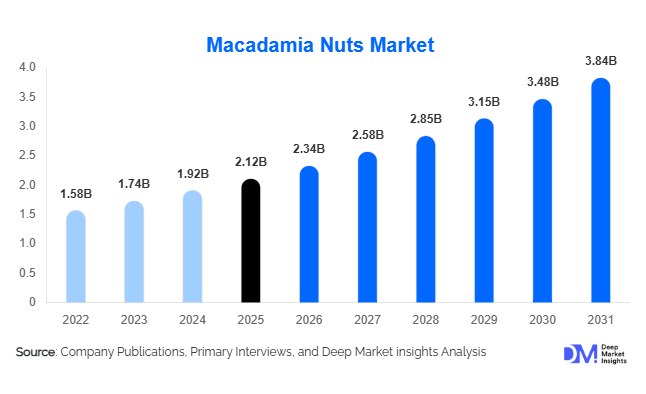
According to Deep Market Insights, the global macadamia nuts market size was valued at USD 2.12 billion in 2025 and is projected to grow from USD 2.34 billion in 2026 to reach USD 3.84 billion by 2031, expanding at a CAGR of 10.4% during the forecast period (2026–2031). The macadamia nuts market growth is primarily driven by rising consumer demand for premium healthy snacks, increasing adoption of plant-based food products, growing utilization of macadamia ingredients in confectionery and bakery applications, and expanding demand for macadamia oil in personal care and cosmetic formulations. The market is also benefiting from increasing cultivation acreage across South Africa, Australia, Kenya, China, and Latin America, which is supporting long-term supply expansion and improving global trade flows.
Key Market Insights
- Macadamia nuts are increasingly positioned as premium functional foods, driven by their high monounsaturated fat content, antioxidant properties, and compatibility with keto, paleo, and plant-based diets.
- Plant-based dairy applications are becoming a major demand driver, with macadamia milk emerging as a premium alternative to almond, oat, and soy-based beverages.
- Asia-Pacific dominates global consumption, supported by strong demand growth in China, Japan, Australia, South Korea, and India.
- India represents one of the fastest-growing consumption markets, driven by rising disposable incomes, urbanization, and increasing awareness of healthy snacking.
- South Africa remains the leading global production hub, accounting for the largest share of global macadamia exports and processing capacity.
- Technological advancements in sorting, shelling, and traceability systems are improving product quality, operational efficiency, and export competitiveness.
Macadamia Nuts Market Latest Trends
Rapid Expansion of Plant-Based Macadamia Beverages
One of the most significant trends shaping the macadamia nuts market is the rapid growth of plant-based dairy alternatives. Macadamia milk is gaining popularity among consumers seeking dairy-free, vegan, lactose-free, and clean-label beverage options. Compared with many competing alternatives, macadamia milk offers a rich texture, creamy mouthfeel, and premium nutritional profile. Major food manufacturers and beverage brands are increasingly introducing macadamia-based beverages, creamers, and yogurt alternatives to capitalize on changing consumer preferences. Growing adoption across North America, Europe, China, and Australia is expected to create sustained demand for food-grade macadamia kernels over the forecast period.
Premiumization of Healthy Snacking
Consumers are increasingly shifting toward premium snacks that combine indulgence with nutritional value. Macadamia nuts occupy a unique position within the global nut industry due to their rich flavor profile, premium pricing, and health benefits. Snack manufacturers are launching roasted, flavored, organic, and functional macadamia products targeted at affluent and health-conscious consumers. Demand for premium nut mixes, gourmet confectionery products, and luxury bakery ingredients continues to strengthen globally. E-commerce channels are also accelerating premium product penetration by allowing manufacturers to directly reach consumers seeking specialty food products and clean-label ingredients.
Macadamia Nuts Market Drivers
Growing Demand for Healthy and Functional Foods
Consumer awareness regarding nutrition and preventive healthcare has increased significantly over the last decade. Macadamia nuts are rich in heart-healthy monounsaturated fats, dietary fiber, antioxidants, and essential micronutrients, making them attractive to health-conscious consumers. Growing adoption of keto, low-carbohydrate, paleo, and Mediterranean dietary patterns has strengthened demand across developed and emerging economies. Food manufacturers are increasingly incorporating macadamias into energy bars, protein snacks, granola products, and functional food formulations to meet evolving consumer preferences.
Expansion of Plant-Based Food and Beverage Industry
The global plant-based food industry continues to expand at a robust pace, creating significant opportunities for macadamia ingredient suppliers. Macadamia milk, nut butter, dairy alternatives, and vegan confectionery applications are witnessing strong growth across retail and foodservice channels. Consumers seeking sustainable and allergen-friendly food alternatives are increasingly selecting macadamia-derived products. Investments by major food companies in plant-based product portfolios are expected to further stimulate demand for macadamia ingredients throughout the forecast period.
Increasing Global Production Capacity
Large-scale investments in orchard development and processing infrastructure are improving supply availability worldwide. South Africa, Australia, Kenya, China, and several Latin American countries are expanding cultivation acreage to meet growing global demand. Improvements in agricultural practices, irrigation systems, and harvesting technologies are enhancing yields and supporting long-term market growth. Expanding processing capacity is also helping producers move further up the value chain through the production of premium kernels, oils, and value-added consumer products.
Macadamia Nuts Market Restraints
High Product Prices Compared to Other Tree Nuts
Macadamia nuts remain among the highest-priced tree nuts globally due to relatively limited production volumes, labor-intensive harvesting processes, and long orchard maturation periods. Premium pricing can limit consumption among price-sensitive consumers and restrict penetration in certain emerging markets. Manufacturers also face challenges in maintaining demand during periods of economic uncertainty when consumers may shift toward lower-cost alternatives such as peanuts, almonds, or cashews.
Climate Variability and Agricultural Risks
The macadamia industry remains highly dependent on favorable climatic conditions. Droughts, excessive rainfall, cyclones, pest infestations, and other weather-related disruptions can significantly affect yields and production quality. Climate change is increasing uncertainty regarding future harvest volumes, creating potential volatility in supply chains and pricing. Producers must continue investing in sustainable farming practices, irrigation infrastructure, and climate-resilient cultivation methods to mitigate these risks.
Macadamia Nuts Industry Key Opportunities
Growth of Cosmetic and Personal Care Applications
Macadamia oil is increasingly used in premium skincare, haircare, anti-aging, and wellness products due to its excellent moisturizing and skin-conditioning properties. The global clean beauty movement is encouraging cosmetic manufacturers to adopt naturally sourced ingredients with strong functional benefits. As demand for sustainable and botanical-based cosmetic formulations grows, macadamia oil suppliers have opportunities to capture higher-margin applications beyond traditional food markets. Premium beauty markets in South Korea, Japan, Europe, and North America present particularly attractive opportunities for industry participants.
Expansion into Emerging Asian Markets
Rapid urbanization, rising disposable incomes, and growing health awareness are creating substantial opportunities across emerging Asian economies. China already represents one of the world's largest import markets for macadamias, while India, Vietnam, Indonesia, and Thailand are witnessing accelerating consumption growth. Premium gifting culture, expanding modern retail infrastructure, and increasing adoption of healthy snacking habits are expected to support long-term demand expansion. New entrants can capitalize on these opportunities through localized product offerings, digital marketing strategies, and strategic distribution partnerships.
Report Scope
| Report Metric | Details |
|---|---|
| Market Size in 2025 | USD 2.12 Billion |
| Market Size in 2026 | USD 2.34 Billion |
| Market Size in 2031 | USD 3.84 Billion |
| CAGR | 10.4% (2026-2031) |
| Base Year for Estimation | 2025 |
| Historical Data | 2022-2024 |
| Forecast Period | 2026-2031 |
| Report Coverage | Revenue Forecast, Competitive Landscape, Supply Chain Disruption, Growth Factors, Environment & Regulatory Landscape and Trends |
| Geographies Covered | North America, Europe, APAC, Middle East and Africa, LATAM |
| Countries Covered | U.S., Canada, U.K., Germany, France, Spain, Italy, Russia, Nordic, Benelux, Rest of Europe, China, Korea, Japan, India, Australia, Singapore, Taiwan, South East Asia, Rest of Asia-Pacific, UAE, Turky, Saudi Arabia, South Africa, Egypt, Nigeria, Rest of MEA, Brazil, Mexico, Argentina, Chile, Colombia, Rest of LATAM |
Explore more data points, trends and opportunities Download Free Sample Report
Product Type Insights
Kernel macadamia nuts dominate the global market with an estimated 68% share of total revenue in 2025, primarily driven by their extensive use across food processing and premium food manufacturing industries. Their versatility, longer shelf stability after processing, and ease of integration into diverse formulations make them the preferred input for confectionery manufacturers, bakery companies, snack producers, and retail brands. A key growth driver for the kernel segment is the rising demand for convenience-oriented, value-added ingredients that reduce processing time while maintaining premium taste and texture profiles. Whole kernels continue to command premium pricing, particularly in luxury gifting, gourmet confectionery, and high-end retail channels where product appearance and authenticity significantly influence purchasing behavior. In-shell macadamias, while comparatively niche, maintain steady demand in select markets where freshness perception, minimal processing, and experiential consumption are valued by consumers. The segment’s expansion is further supported by continuous investments in advanced shelling and processing technologies, which are improving kernel recovery efficiency, reducing waste, and enabling manufacturers to scale value-added production globally.
Nature Insights
Conventional macadamia nuts account for approximately 79% of global market revenue, supported by large-scale agricultural production systems, established supply chains, and comparatively lower cultivation costs. The leading driver for this segment is the ability of conventional farming to meet rising global demand at scale while ensuring consistent quality and stable pricing for industrial buyers. However, the organic segment is gaining strong momentum, supported by increasing consumer awareness of clean-label foods, pesticide-free cultivation practices, and environmentally responsible sourcing. Organic macadamias are witnessing above-average growth rates, particularly in developed markets such as Europe, North America, and Japan, where consumers are willing to pay premium prices for certified sustainable products. Expansion of organic-certified farming acreage, along with strengthening certification frameworks and retailer commitments to sustainable sourcing, is further accelerating adoption across both retail and industrial channels.
Application Insights
Food and beverage applications represent the dominant use case for macadamia nuts, accounting for approximately 84% of global demand in 2025. The leading growth driver within this segment is the increasing consumer shift toward premium snacking, plant-based diets, and functional food products that combine indulgence with nutritional benefits. Macadamias are widely incorporated into bakery products, premium chocolates, confectionery items, snack mixes, breakfast cereals, nut butters, and dairy alternatives due to their rich flavor profile and high healthy fat content. Plant-based beverage applications are emerging as one of the fastest-growing sub-segments, supported by rising demand for vegan, lactose-free, and allergen-friendly alternatives. Cosmetics and personal care applications, though smaller in share, are expanding rapidly as macadamia oil gains popularity for its moisturizing and skin-repair properties in skincare and haircare formulations. Nutraceutical applications are also growing steadily, driven by increasing awareness of heart health, functional nutrition, and preventive healthcare trends among global consumers.
Distribution Channel Insights
Business-to-business channels continue to dominate the macadamia nuts market, accounting for approximately 62% of global revenue, as large-scale procurement by food processors, ingredient manufacturers, cosmetic companies, and nutraceutical firms is primarily conducted through long-term supply agreements. The key growth driver for the B2B segment is the rising demand for consistent, high-quality raw materials that support large-scale production of value-added consumer goods. Within the business-to-consumer segment, supermarkets and hypermarkets remain the leading retail distribution channels due to their wide product assortment and strong consumer accessibility. However, online retail is emerging as the fastest-growing channel, driven by increasing digital adoption, direct-to-consumer brand strategies, and rising consumer preference for premium, health-focused snack products delivered through e-commerce platforms. Subscription-based purchasing models, product traceability features, and educational branding strategies are further enhancing online channel growth and enabling premium differentiation in competitive retail environments.
End-Use Industry Insights
Food manufacturers represent the largest end-use industry segment, accounting for nearly 38% of global demand, with strong utilization across confectionery, bakery, snack foods, and dairy alternative production. The leading driver for this segment is continuous innovation in premium food formulations that emphasize natural ingredients, clean labels, and high nutritional value. Beverage manufacturers are emerging as one of the fastest-growing end-use groups, supported by rising demand for macadamia-based milk and plant-based beverage innovations that cater to vegan and lactose-intolerant consumers. Cosmetic and personal care manufacturers are increasingly incorporating macadamia oil into skincare and haircare products due to its lightweight texture, high absorption rate, and perceived natural benefits, aligning with the broader clean beauty trend. Nutraceutical companies are also expanding their use of macadamia-derived ingredients as consumers increasingly prioritize preventive healthcare, functional foods, and holistic wellness solutions.
Explore more data points, trends and opportunities Download Free Sample Report
Macadamia Nuts Market Segmentations
By Product Type
- In-shell Macadamia Nuts
- Whole Kernel Macadamia Nuts
- Half Kernel Macadamia Nuts
- Macadamia Pieces & Splits
- Macadamia Chips & Granules
By Nature
- Conventional
- Organic
By Processing/Form
- Raw
- Roasted
- Salted
- Flavored/Seasoned
- Chocolate-Coated
- Honey-Coated
- Other Coated Macadamia Products
By Application
- Bakery Products
- Confectionery Products
- Dairy & Dairy Alternatives
- Breakfast Cereals & Granola
- Snack Foods
- Nut Butter & Spreads
- Plant-Based Beverages
- Ice Cream & Frozen Desserts
- Functional Foods
- Personal Care & Cosmetics
- Nutraceuticals & Dietary Supplements
- Foodservice & HoReCa
By Distribution Channel
- Food Ingredient Suppliers
- Food Processors
- Cosmetic Ingredient Suppliers
- Supermarkets & Hypermarkets
- Convenience Stores
- Specialty Stores
- Health Food Stores
- Online Retail
- Direct-to-Consumer Channels
Regional Insights
North America
North America accounted for approximately 28% of global macadamia nuts market revenue in 2025, with the United States serving as the dominant consumer market. The primary growth driver in the region is the strong shift toward healthy snacking, plant-based diets, and premium food experiences supported by rising health consciousness among consumers. Macadamia milk, functional snack bars, and gourmet confectionery products are witnessing particularly strong demand across retail and foodservice channels. Canada is also contributing to regional growth through expanding availability of specialty nut products and increasing consumer preference for natural, nutrient-dense foods. Growth is further supported by innovation in premium packaged foods and expanding distribution through both physical and digital retail platforms.
Europe
Europe represented approximately 23% of global market revenue in 2025, with key consumption markets including Germany, the United Kingdom, France, Italy, and the Netherlands. The leading driver in this region is strong consumer preference for organic, clean-label, and sustainably sourced food products, supported by stringent regulatory standards and high environmental awareness. Demand for premium bakery goods, artisanal confectionery, and plant-based food formulations continues to expand as consumers increasingly prioritize ethical sourcing and product transparency. Growth is further reinforced by rising willingness to pay premium prices for certified organic and fair-trade products, alongside expanding retail offerings in health-focused supermarkets and specialty stores.
Asia-Pacific
Asia-Pacific is the largest regional market, accounting for approximately 34% of global revenue in 2025, with China serving as the leading consumption hub. The key growth driver in this region is rapid urbanization, rising disposable incomes, and increasing adoption of Western-style snacking and premium food consumption patterns. Japan maintains strong demand through high-end confectionery and snack applications, while South Korea continues to expand consumption through health-oriented retail channels and wellness-focused product innovation. India is emerging as one of the fastest-growing markets globally, supported by a growing middle class, increased health awareness, and expanding retail penetration of premium nut-based snacks. Australia plays a dual role as both a major producer and consumer, benefiting from a mature macadamia industry and strong export-oriented supply chains that support global distribution.
Latin America
Latin America accounted for approximately 6% of global market demand in 2025, with Brazil, Guatemala, and Chile playing increasingly important roles in both production and export activities. The primary growth driver in the region is expanding agricultural investment in macadamia cultivation, supported by favorable climatic conditions and increasing integration into global supply chains. While domestic consumption remains relatively modest, rising awareness of nutritional benefits and gradual expansion of premium food segments are supporting steady market growth. Strengthening processing infrastructure and export-oriented farming models are further enhancing the region’s contribution to global supply dynamics.
Middle East & Africa
The Middle East & Africa region accounted for approximately 9% of global macadamia nuts market revenue in 2025. South Africa plays a pivotal role as the world’s largest producer and exporter, supported by well-established orchards, advanced agricultural practices, and strong export infrastructure. The key growth driver in the region is rising global demand for macadamia exports combined with increasing investment in large-scale commercial cultivation. In the Middle East, the UAE and Saudi Arabia are emerging as important premium consumption markets, driven by high-income consumer segments and strong demand for luxury and imported food products. Kenya is rapidly expanding its cultivation base and processing capacity, strengthening its position within the global supply chain and contributing to Africa’s growing importance in macadamia production networks.
Key Players in the Macadamia Nuts Market
- Marquis Macadamias
- Golden Macadamias
- Green Farms Nut Company
- Mauna Loa Macadamia Nut Corp.
- MacFarms
- Ivory Macadamias
- Kenya Nut Company
- Nambucca Macnuts
- Mayo Macs
- Hamakua Macadamia Nut Company
- Eastern Produce
- Buderim Group
- Pacific Gold Macadamias
- Health & Plant Protein Group
- Hawaiian Host Group