Luxury Outdoor Furniture Market Size
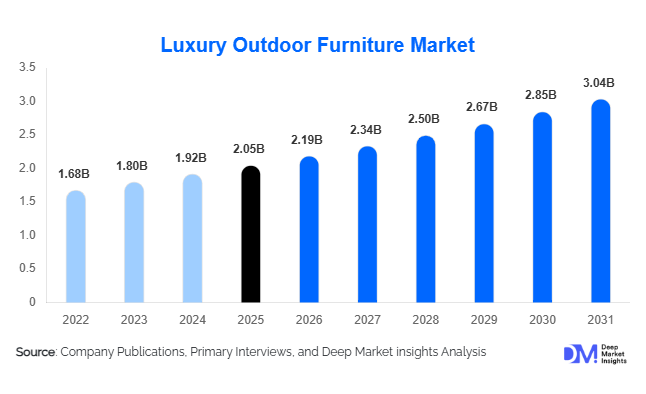
According to Deep Market Insights, the global luxury outdoor furniture market size was valued at USD 2.05 billion in 2025 and is projected to grow from USD 2.19 billion in 2026 to reach USD 3.04 billion by 2031, expanding at a CAGR of 6.8% during the forecast period (2026–2031). The luxury outdoor furniture market growth is being driven by increasing investments in premium residential outdoor living spaces, expansion of luxury hospitality infrastructure, rising demand for high-end weather-resistant furnishings, and growing consumer preference for seamless indoor-outdoor lifestyle experiences. Affluent homeowners, luxury real estate developers, hotels, resorts, golf clubs, and premium dining establishments are increasingly investing in sophisticated outdoor environments that mirror interior luxury standards. Furthermore, technological advancements in materials, modular design concepts, and sustainable manufacturing practices are supporting long-term market expansion across developed and emerging economies.
Key Market Insights
- Luxury outdoor living spaces are becoming an extension of indoor home design, driving demand for premium outdoor sofas, dining sets, lounge furniture, and customized outdoor environments.
- Luxury hospitality developments are accelerating procurement of premium outdoor furnishings, particularly across resorts, branded residences, golf clubs, and beach destinations.
- North America dominates the global market, supported by high disposable incomes, mature outdoor living culture, and extensive luxury residential construction.
- Asia-Pacific is the fastest-growing region, fueled by increasing luxury housing investments, expanding affluent populations, and large-scale hospitality developments.
- Sustainable materials and eco-certified products are becoming key purchasing criteria, especially among premium residential buyers and hospitality operators.
- Smart outdoor furniture solutions, including integrated lighting, wireless charging, modular functionality, and weather monitoring capabilities, are emerging as premium differentiators.
What are the latest trends in the luxury outdoor furniture market?
Indoor-Outdoor Living Integration Reshaping Product Design
One of the most influential trends within the luxury outdoor furniture market is the convergence of indoor and outdoor living spaces. Consumers increasingly view patios, terraces, rooftop lounges, gardens, and poolside areas as functional extensions of their homes. As a result, luxury outdoor furniture manufacturers are introducing collections that replicate interior aesthetics while delivering superior weather resistance and durability. Premium upholstered seating, designer fabrics, modular lounge systems, and coordinated outdoor décor are becoming increasingly popular. Architects and landscape designers are incorporating outdoor living concepts into residential planning stages, further strengthening long-term market demand. The trend is particularly evident across North America, Western Europe, Australia, and affluent urban centers in Asia.
Sustainable Luxury Furniture Gaining Market Acceptance
Sustainability is rapidly becoming a competitive differentiator within the luxury outdoor furniture industry. Consumers increasingly demand responsibly sourced teak, FSC-certified hardwoods, recycled aluminum frames, eco-friendly performance textiles, and low-carbon manufacturing processes. Hospitality operators are also integrating sustainability targets into procurement decisions, encouraging suppliers to improve environmental credentials. Manufacturers are investing in recyclable materials, circular-economy production models, and transparent sourcing programs to strengthen brand positioning. Sustainable luxury furniture commands premium pricing while improving customer loyalty among environmentally conscious buyers, making sustainability one of the most important trends shaping the market through 2031.
What are the key drivers in the luxury outdoor furniture market?
Expansion of Luxury Residential Construction
The continued growth of luxury residential developments is a major driver for the luxury outdoor furniture market. Premium villas, waterfront residences, penthouses, and gated communities increasingly emphasize outdoor lifestyle amenities as a key value proposition. Developers are investing heavily in landscaped gardens, rooftop lounges, outdoor kitchens, and entertainment areas that require premium furniture solutions. Countries such as the United States, UAE, Saudi Arabia, China, Singapore, and India are witnessing substantial luxury housing investments that directly support demand for high-end outdoor furnishings. As affluent consumers continue prioritizing outdoor living experiences, demand for premium furniture is expected to remain robust throughout the forecast period.
Growth of Luxury Hospitality and Tourism Infrastructure
Luxury hotels, resorts, golf clubs, beach clubs, and wellness retreats are significant purchasers of premium outdoor furniture. Hospitality operators continuously upgrade outdoor spaces to improve guest experiences and maintain competitive differentiation. The rapid development of luxury tourism projects across the Middle East, Southeast Asia, the Mediterranean region, and Caribbean destinations is creating substantial procurement opportunities. Premium outdoor furniture serves as a critical component of branding and customer experience strategies, encouraging recurring investments and replacement cycles among commercial buyers.
What are the restraints for the global market?
High Product Acquisition Costs
Luxury outdoor furniture products command substantial price premiums due to premium materials, craftsmanship, customization, and advanced weather-resistant technologies. Complete luxury outdoor furniture sets often require significant capital investment, limiting adoption among middle-income consumers. During periods of economic uncertainty or declining consumer confidence, discretionary spending on premium outdoor furnishings may slow, impacting market growth.
Volatility in Raw Material and Logistics Costs
The market remains exposed to fluctuations in teak, aluminum, stainless steel, synthetic fibers, and premium textile prices. Supply chain disruptions, sustainability regulations, and transportation cost increases can elevate production expenses and compress manufacturer margins. Additionally, procurement of responsibly sourced hardwoods has become increasingly complex due to environmental regulations and certification requirements, presenting operational challenges for manufacturers operating globally.
What are the key opportunities in the luxury outdoor furniture industry?
Smart Outdoor Living Solutions
The growing adoption of connected homes presents a significant opportunity for luxury outdoor furniture manufacturers. Smart furniture equipped with wireless charging systems, integrated lighting, solar-powered functionality, weather-monitoring sensors, and IoT connectivity is gaining popularity among affluent homeowners. As smart-home ecosystems become more widespread, consumers increasingly seek outdoor furniture that complements digital living environments. Manufacturers investing in technology-enabled premium furniture can achieve higher margins while differentiating themselves within a competitive marketplace.
Sustainable Premium Furniture and Hospitality Procurement
Sustainability-focused procurement policies within hospitality, commercial real estate, and luxury residential sectors are creating long-term opportunities for suppliers offering environmentally responsible products. Luxury hotels, resorts, and developers increasingly prioritize furniture manufactured using certified wood, recycled metals, and low-impact materials. Companies capable of demonstrating sustainable sourcing, transparent supply chains, and reduced environmental footprints are expected to capture growing demand while strengthening relationships with institutional buyers and environmentally conscious consumers.
Report Scope
| Report Metric | Details |
|---|---|
| Market Size in 2025 | USD 2.05 Billion |
| Market Size in 2026 | USD 2.19 Billion |
| Market Size in 2031 | USD 3.04 Billion |
| CAGR | 6.8% (2026-2031) |
| Base Year for Estimation | 2025 |
| Historical Data | 2022-2024 |
| Forecast Period | 2026-2031 |
| Report Coverage | Revenue Forecast, Competitive Landscape, Supply Chain Disruption, Growth Factors, Environment & Regulatory Landscape and Trends |
| Geographies Covered | North America, Europe, APAC, Middle East and Africa, LATAM |
| Countries Covered | U.S., Canada, U.K., Germany, France, Spain, Italy, Russia, Nordic, Benelux, Rest of Europe, China, Korea, Japan, India, Australia, Singapore, Taiwan, South East Asia, Rest of Asia-Pacific, UAE, Turky, Saudi Arabia, South Africa, Egypt, Nigeria, Rest of MEA, Brazil, Mexico, Argentina, Chile, Colombia, Rest of LATAM |
Explore more data points, trends and opportunities Download Free Sample Report
Product Type Insights
Seating furniture remains the dominant product category, accounting for approximately 42% of the global luxury outdoor furniture market revenue in 2025. The segment's leadership is primarily driven by the growing transformation of outdoor areas into fully functional living and entertainment spaces. Luxury outdoor sofas, sectional seating systems, lounge chairs, armchairs, and daybeds are increasingly becoming centerpiece investments for affluent homeowners, luxury resorts, rooftop lounges, and hospitality venues. The rising trend of outdoor socialization, staycations, and premium home improvement projects has significantly increased spending on large-format seating solutions that offer indoor-like comfort while maintaining outdoor durability.
Within seating furniture, modular sectional systems are experiencing particularly strong growth due to their flexibility, customization capabilities, and compatibility with contemporary architectural designs. Consumers increasingly prefer adaptable configurations that can accommodate various entertainment and family gathering requirements. Dining furniture remains the second-largest segment, supported by the growing popularity of outdoor kitchens, alfresco dining concepts, and luxury hospitality dining experiences. Relaxation and leisure furniture, including chaise lounges, sun loungers, recliners, and swing chairs, continues to witness robust demand from resorts, beach clubs, wellness retreats, and poolside environments where guest experience enhancement remains a strategic priority. Furthermore, complementary products such as coffee tables, ottomans, side tables, and fire-table furniture are benefiting from the growing trend of complete outdoor lifestyle ecosystems, where consumers seek cohesive furniture collections rather than standalone products.
Material Insights
Premium hardwoods represent the leading material segment, accounting for approximately 31% of global luxury outdoor furniture revenue in 2025. Teak remains the preferred material worldwide due to its exceptional weather resistance, natural oil content, durability, minimal maintenance requirements, and strong luxury appeal. High-end residential buyers and luxury hospitality operators continue to associate teak furniture with premium quality, longevity, and timeless aesthetics, allowing manufacturers to maintain premium pricing structures.
The continued growth of luxury resorts, beachfront developments, and outdoor hospitality projects has strengthened demand for teak-based furniture because of its ability to withstand harsh environmental conditions, including UV exposure, humidity, and saltwater environments. Aluminum has emerged as the fastest-growing material category due to its lightweight properties, corrosion resistance, recyclability, and compatibility with modern minimalist designs. The increasing emphasis on sustainability is also supporting aluminum adoption, particularly among environmentally conscious consumers and commercial buyers.
Meanwhile, synthetic wicker and HDPE-based materials continue gaining market acceptance due to their low maintenance requirements and superior weather performance. Performance textiles and marine-grade fabrics are becoming increasingly important differentiators as consumers demand indoor-level comfort in outdoor environments. Hybrid material combinations integrating wood, metal, stone, and advanced composites are also witnessing growing adoption among luxury buyers seeking unique aesthetics and customized design solutions.
Distribution Channel Insights
Specialty luxury furniture retailers accounted for approximately 38% of global market sales in 2025, making them the leading distribution channel. Their dominance stems from the highly consultative nature of luxury furniture purchasing, where customers frequently seek personalized design guidance, product demonstrations, material selection assistance, and customization options before making substantial investments.
Luxury furniture showrooms provide immersive brand experiences that are difficult to replicate online, particularly for high-value purchases where product quality, comfort, finish, and craftsmanship significantly influence buying decisions. Interior designers, landscape architects, and luxury property consultants frequently collaborate with specialty retailers, further strengthening their market position.
Direct-to-consumer channels are rapidly expanding as manufacturers invest in digital transformation initiatives, virtual showrooms, augmented reality visualization tools, and online customization platforms. The growing adoption of omnichannel retail strategies is enabling brands to engage affluent consumers more effectively while improving margins through direct sales. Additionally, hospitality procurement firms and luxury real estate developers continue to represent important project-based sales channels, particularly for customized large-scale installations involving hotels, resorts, branded residences, and premium commercial developments.
End-Use Insights
The residential segment remains the largest end-use category, accounting for approximately 58% of total market revenue in 2025. The segment's leadership is driven by increasing investments in luxury housing, home renovation projects, outdoor entertainment areas, and premium landscaping developments. Affluent homeowners are increasingly allocating larger portions of renovation budgets toward patios, terraces, rooftop lounges, poolside areas, and outdoor kitchens, creating sustained demand for premium furniture collections.
The growing preference for indoor-outdoor living concepts has fundamentally altered consumer purchasing behavior, with outdoor spaces now viewed as extensions of interior living environments. This trend has increased spending on coordinated outdoor furniture systems featuring premium seating, dining, and relaxation products.
Commercial applications represent the fastest-growing end-use segment and are projected to expand at a CAGR exceeding 7.5% through 2031. Luxury hotels, resorts, restaurants, golf clubs, beach clubs, wellness retreats, and corporate hospitality venues continue investing heavily in premium outdoor environments to enhance customer experiences and strengthen brand differentiation. Emerging concepts such as luxury glamping destinations, wellness-focused resorts, branded residential communities, and mixed-use lifestyle developments are creating additional growth opportunities for premium outdoor furniture suppliers globally.
Design Style Insights
Contemporary design remains the leading style category, accounting for approximately 36% of global market demand in 2025. The segment's dominance reflects broader architectural and interior design trends favoring clean lines, minimalist aesthetics, neutral color palettes, and multifunctional furniture solutions. Contemporary outdoor furniture integrates seamlessly with modern residential and commercial architecture, making it the preferred choice among homeowners, developers, and hospitality operators.
The rising popularity of modular seating systems, minimalist dining collections, and integrated outdoor lifestyle concepts has further strengthened demand for contemporary designs. Scandinavian-inspired styles are also gaining momentum due to their emphasis on simplicity, sustainability, and natural materials. Mediterranean and resort-inspired collections continue to perform strongly within luxury hospitality applications, particularly in coastal tourism destinations where relaxed luxury aesthetics resonate with consumers. Meanwhile, bespoke designer collections remain highly sought after among ultra-high-net-worth individuals seeking exclusivity, personalization, and unique architectural statements.
Explore more data points, trends and opportunities Download Free Sample Report
Luxury Outdoor Furniture Market Segmentations
By Product Type
- Seating Furniture
- Dining Furniture
- Relaxation & Leisure Furniture
- Modular & Multi-Functional Furniture
- Outdoor Accessories & Complementary Furniture
By Material
- Premium Hardwoods
- Metal-Based Furniture
- Synthetic Materials
- Performance Fabrics & Outdoor Textiles
- Hybrid Material Furniture
By Price Range
- Entry Luxury
- Premium Luxury
- Ultra-Luxury
- Bespoke & Designer Luxury
By Distribution Channel
- Brand-Owned Stores
- Luxury Furniture Retailers
- E-Commerce & Direct-to-Consumer
- Interior Designer & Landscape Architect Channels
- Hospitality & Project-Based Procurement
By End User
- Residential
- Luxury Hotels & Resorts
- Restaurants & Beach Clubs
- Golf Clubs & Leisure Facilities
- Corporate & Commercial Outdoor Spaces
Regional Insights
North America
North America accounted for approximately 34% of global luxury outdoor furniture revenue in 2025, making it the largest regional market. The United States alone represented nearly 28% of global demand and continues to serve as the primary growth engine for the industry. Regional growth is supported by high household disposable incomes, a deeply established outdoor living culture, and strong luxury residential construction activity. Homeowners across states such as California, Florida, Texas, Arizona, and coastal regions increasingly invest in outdoor kitchens, poolside entertainment areas, rooftop lounges, and landscaped living spaces that require premium furniture solutions.
The region also benefits from a mature luxury hospitality industry, ongoing home renovation spending, and increasing adoption of smart outdoor living technologies. Canada contributes additional demand through luxury vacation properties, resort developments, and premium urban residential projects. The growing popularity of staycations and home-centric lifestyle investments continues to support long-term market expansion across North America.
Europe
Europe represented approximately 29% of global market revenue in 2025, making it the second-largest regional market. Italy, France, Germany, Spain, and the United Kingdom collectively account for the majority of regional demand. Europe benefits from a strong heritage of premium furniture manufacturing, high consumer appreciation for design and craftsmanship, and widespread adoption of outdoor lifestyle concepts.
One of the primary drivers of regional growth is the thriving tourism and hospitality sector across Mediterranean countries such as Spain, Italy, Greece, Croatia, and Portugal, where luxury hotels, resorts, and beach clubs continuously invest in premium outdoor furnishings. Sustainability regulations and environmentally conscious purchasing behavior are also accelerating demand for FSC-certified wood products, recycled materials, and eco-friendly manufacturing practices. Furthermore, rising renovation activity among affluent European homeowners continues supporting replacement demand for premium outdoor furniture.
Asia-Pacific
Asia-Pacific accounted for approximately 23% of global demand in 2025 and remains the fastest-growing regional market, with projected CAGR exceeding 8.5% through 2031. Rapid urbanization, expanding affluent populations, rising luxury real estate investments, and increasing consumer spending on premium lifestyle products are driving growth across the region.
China remains the largest regional market due to extensive luxury residential development, premium hospitality expansion, and growing demand for outdoor living spaces among high-income consumers. India is emerging as the fastest-growing country globally, supported by rising disposable incomes, luxury villa construction, premium gated communities, and increasing adoption of outdoor entertainment concepts. Australia, Singapore, Japan, and South Korea continue contributing significant demand through luxury residential upgrades and hospitality investments. The rapid expansion of international tourism infrastructure throughout Southeast Asia is creating additional opportunities for premium outdoor furniture suppliers.
Latin America
Latin America represented approximately 6% of global market demand in 2025. Although smaller in size than developed regions, the market presents significant long-term growth potential. Brazil remains the largest regional market, supported by luxury residential construction, premium coastal developments, and growing investments in resort infrastructure. Mexico continues to benefit from expanding tourism projects and luxury hospitality developments across major coastal destinations.
Increasing concentrations of high-net-worth individuals, growing urban affluence, and rising consumer interest in premium outdoor lifestyles are supporting market growth throughout the region. Additionally, luxury real estate developments targeting international buyers are generating new demand for high-end outdoor furnishing solutions.
Middle East & Africa
The Middle East & Africa accounted for approximately 8% of global market revenue in 2025. The region is emerging as one of the most attractive growth markets due to large-scale tourism investments, luxury real estate developments, and government-led economic diversification initiatives. The UAE and Saudi Arabia represent the largest markets, supported by premium residential projects, luxury hospitality developments, and mega-tourism initiatives.
Saudi Vision 2031, the UAE's tourism expansion strategy, and several large-scale hospitality projects are creating substantial procurement opportunities for luxury outdoor furniture manufacturers. Luxury resorts, beachfront developments, branded residences, and entertainment destinations require premium outdoor environments that align with global luxury standards. South Africa continues contributing meaningful demand through luxury hospitality, safari tourism, and premium residential markets. Rising tourism arrivals, growing foreign investment, and increasing luxury construction activity are expected to sustain strong regional growth over the coming years.
Key Players in the Luxury Outdoor Furniture Market
- Brown Jordan
- RH (Restoration Hardware)
- Dedon
- Gloster
- Kettal
- Royal Botania
- Tribù
- Manutti
- B&B Italia
- Roda
- Gandia Blasco Group
- EMU Group
- Paola Lenti
- Lloyd Flanders
- Tuuci