Body Piercing Jewelry Market Size
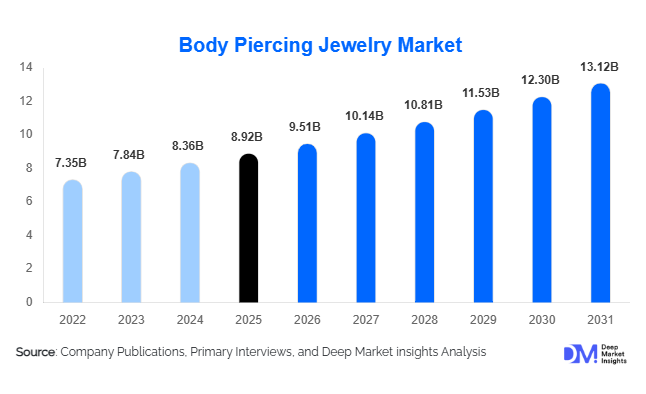
According to Deep Market Insights, the global body piercing jewelry market size was valued at USD 8.92 billion in 2025 and is projected to grow from USD 9.51 billion in 2026 to reach USD 13.12 billion by 2031, expanding at a CAGR of 6.64% during the forecast period (2026–2031). The body piercing jewelry market growth is primarily driven by increasing fashion personalization, rising acceptance of body modifications among younger demographics, growing demand for premium hypoallergenic materials, and rapid expansion of online jewelry retail channels. The market analysis covers key segments, including product types, applications, distribution channels, regional performance, competitive landscape, and emerging industry developments shaping future demand.
Key Market Insights
- North America dominates the global body piercing jewelry market, accounting for approximately 36.4% of revenue share in 2025, supported by strong consumer acceptance, premium jewelry adoption, and established piercing culture.
- Asia-Pacific is the fastest-growing regional market, projected to expand at a CAGR of 7.5% through 2031, driven by rising disposable income, youth fashion trends, and expanding e-commerce penetration.
- Earrings represent the leading product category, holding nearly 46.8% market share due to widespread adoption of ear piercing across age groups and increasing demand for customized designs.
- Personal use remains the largest application segment, contributing approximately 71.2% of global revenue, supported by lifestyle expression, fashion preferences, and social media influence.
- India is emerging as a high-growth market, expected to reach approximately USD 1.36 billion by 2031 at a CAGR of 8.1%, supported by increasing fashion awareness and urban consumer spending.
- Digital transformation is reshaping purchasing behavior, with online channels accounting for nearly 48% of global sales through direct-to-consumer platforms and e-commerce marketplaces.
Body Piercing Jewelry Market Trends
Growing Preference for Premium and Hypoallergenic Materials
The body piercing jewelry industry is experiencing a significant shift toward premium materials such as titanium, surgical stainless steel, recycled gold, and platinum due to rising consumer awareness regarding safety and skin compatibility. Global production exceeded 980 million units in 2025, with premium-grade materials representing more than 62% of total revenue contribution. Titanium-based jewelry adoption has increased by nearly 14% annually as consumers prefer lightweight, corrosion-resistant, and biocompatible products. Manufacturers are also introducing recycled metals and sustainable production methods, with eco-friendly packaging adoption exceeding 34% among leading brands. The increasing preference for durable and safe jewelry solutions continues strengthening the body piercing jewelry market trend.
Digital Customization and Online Retail Expansion
Digital commerce and customization technologies are transforming consumer purchasing patterns in the body piercing jewelry market. Online platforms contribute approximately 48% of global sales, supported by virtual product visualization, personalized recommendations, and influencer-driven marketing. More than 310 million online jewelry transactions were recorded globally in 2025, while AI-powered recommendation tools improved customer engagement rates by nearly 18%. Younger consumers increasingly prefer customized designs, gemstone-based accessories, and limited-edition collections promoted through social media platforms. Fashion collaborations and digital-first brands are launching innovative collections, increasing product discovery and supporting long-term body piercing jewelry market expansion.
Body Piercing Jewelry Market Drivers
Increasing Fashion Personalization and Self-Expression
The growing influence of personal style, fashion experimentation, and social media trends is a major driver of body piercing jewelry demand. More than 54% of Gen Z consumers purchase fashion accessories annually, while body modification acceptance has increased significantly across urban populations. The number of professional piercing studios globally exceeded 125,000 locations, supporting increased consumer accessibility. Customized jewelry, gemstone designs, and premium collections are gaining popularity among consumers seeking unique identity expression. Social media platforms have accelerated trend adoption, with influencer marketing contributing to approximately 22% growth in limited-edition jewelry launches. These factors continue driving body piercing jewelry market growth.
Expansion of E-Commerce and Digital Jewelry Retail
The rapid growth of online shopping platforms is increasing accessibility to body piercing jewelry worldwide. Digital channels now represent nearly 48% of total market revenue, allowing consumers to compare designs, materials, prices, and safety certifications. Mobile commerce adoption has exceeded 68% among younger jewelry buyers, creating strong demand for direct-to-consumer brands. Emerging markets including India, China, and Southeast Asia are witnessing increasing online purchases due to improved digital payment infrastructure and logistics networks. The expansion of personalized shopping experiences and virtual consultations is further accelerating body piercing jewelry market development.
Body Piercing Jewelry Market Restraints
High Cost of Premium Materials
The increasing cost of precious metals and advanced materials remains a significant challenge for market expansion. Gold, platinum, and titanium prices have increased by nearly 9% in recent years, affecting affordability among price-sensitive consumers. Premium jewelry products account for over 44% of market revenue but remain concentrated among high-income customers. Manufacturing expenses associated with precision finishing, sterilization standards, and certification requirements increase production costs by approximately 6–8%. These pricing challenges limit adoption in developing regions and create barriers for new entrants in the body piercing jewelry market.
Counterfeit Products and Quality Concerns
The presence of low-quality and counterfeit jewelry continues restricting market growth. Counterfeit products represent nearly 12% of global sales volume, creating concerns regarding material safety, allergic reactions, and durability. Unregulated manufacturers often use low-grade alloys containing nickel and other harmful materials, affecting consumer confidence. Regulatory requirements across more than 80 international markets increase compliance complexity for manufacturers. Maintaining consistent quality standards across global supply chains remains a key challenge impacting body piercing jewelry market growth.
Body Piercing Jewelry Market Opportunities
Rising Demand for Sustainable Jewelry Products
The increasing focus on sustainability is creating new opportunities for manufacturers offering recycled metals, ethical sourcing, and environmentally responsible production. Sustainable jewelry products currently represent approximately 27% of new product launches, with adoption expected to increase as consumers prioritize environmentally conscious purchases. Brands introducing recycled gold, biodegradable packaging, and transparent sourcing practices are gaining competitive advantages. Growing environmental awareness among younger consumers is expected to create significant opportunities for sustainable body piercing jewelry market development.
Growth Potential in Emerging Economies
Emerging economies present strong growth opportunities due to increasing urbanization, rising disposable incomes, and changing fashion preferences. Countries across Asia-Pacific contribute nearly 58% of global manufacturing output and are experiencing rapid consumer adoption. India, China, and Southeast Asian countries are witnessing increasing demand for affordable premium jewelry products. Expanding retail networks, social commerce platforms, and growing youth populations are expected to support future market penetration. These factors create significant opportunities for body piercing jewelry market expansion across developing regions.
Report Scope
| Report Metric | Details |
|---|---|
| Market Size in 2025 | USD 8.92 Billion |
| Market Size in 2026 | USD 9.51 Billion |
| Market Size in 2031 | USD 13.12 Billion |
| CAGR | 6.64% (2026-2031) |
| Base Year for Estimation | 2025 |
| Historical Data | 2022-2024 |
| Forecast Period | 2026-2031 |
| Report Coverage | Revenue Forecast, Competitive Landscape, Supply Chain Disruption, Growth Factors, Environment & Regulatory Landscape and Trends |
| Geographies Covered | North America, Europe, APAC, Middle East and Africa, LATAM |
| Countries Covered | U.S., Canada, U.K., Germany, France, Spain, Italy, Russia, Nordic, Benelux, Rest of Europe, China, Korea, Japan, India, Australia, Singapore, Taiwan, South East Asia, Rest of Asia-Pacific, UAE, Turky, Saudi Arabia, South Africa, Egypt, Nigeria, Rest of MEA, Brazil, Mexico, Argentina, Chile, Colombia, Rest of LATAM |
Explore more data points, trends and opportunities Download Free Sample Report
Product Type Insights
Earrings dominate the body piercing jewelry market, accounting for approximately 46.8% of global revenue share in 2025, driven by widespread acceptance of ear piercing across different age groups, cultural preferences, and fashion trends. More than 520 million earring units are produced annually, including studs, hoops, barbells, captive bead rings, and gemstone-based designs. Stainless steel and titanium earrings represent nearly 58% of category demand due to their durability, lightweight properties, and hypoallergenic characteristics. Premium gold and platinum earrings continue gaining traction among luxury consumers, while customized and personalized designs are increasing adoption among younger buyers. Rising demand for minimalistic jewelry, interchangeable designs, and online customization options is expected to maintain the dominance of earrings within the body piercing jewelry market.
Nose jewelry represents the second-largest product category, contributing nearly 28.4% of total market revenue. Global production exceeds 260 million units annually, including nose studs, nose hoops, septum rings, and screw-style jewelry. Growing cultural acceptance of nose piercing in Asia-Pacific, increasing fashion experimentation in North America and Europe, and influencer-driven trends are accelerating demand. Titanium and surgical steel products account for more than 64% of nose jewelry sales due to their safety advantages and suitability for long-term wear. Septum rings have recorded strong adoption among younger consumers, with demand increasing by approximately 12% annually. The expansion of affordable premium designs through e-commerce platforms continues supporting growth in the nose jewelry segment.
Navel jewelry accounts for approximately 24.8% market share and represents a rapidly expanding category among fashion-conscious consumers. Production exceeds 200 million units annually, including curved barbells, dangling navel rings, gemstone embellishments, and flexible body jewelry. Demand is particularly strong among consumers aged 18–35 years, who represent nearly 65% of category purchases. Manufacturers are introducing lightweight materials, crystal decorations, and corrosion-resistant coatings to improve comfort and aesthetic appeal. Rising interest in beachwear fashion, festival culture, and body-positive movements is increasing adoption of navel jewelry worldwide, strengthening its contribution to body piercing jewelry market growth.
Application Insights
Personal use represents the largest application segment in the body piercing jewelry market, accounting for nearly 71.2% of global revenue. More than 420 million consumers worldwide purchase body piercing accessories for personal styling, fashion expression, and lifestyle preferences. The segment includes everyday wear jewelry, premium collections, customized designs, and seasonal fashion accessories. Younger demographics, particularly individuals aged 18–35 years, contribute over 62% of personal-use demand, supported by social media trends and increasing acceptance of body modifications. Consumers are increasingly choosing titanium, surgical steel, and gold products due to safety and durability concerns. Online platforms have become a major purchasing channel, contributing nearly 52% of personal-use sales. Growing interest in personalized designs and affordable luxury products continues expanding the personal-use application segment.
Commercial use contributes approximately 17.3% of global market revenue, supported by piercing studios, beauty salons, specialty retailers, and professional jewelry suppliers. More than 125,000 piercing establishments operate globally, creating consistent demand for sterilized, professional-grade jewelry products. Commercial buyers prioritize certified materials, bulk purchasing agreements, and standardized designs suitable for professional applications. Surgical steel and titanium products represent more than 70% of commercial purchases due to their safety standards and compatibility with fresh piercings. Growth in professional piercing services, especially across urban markets, is increasing demand for high-quality body jewelry solutions and supporting body piercing jewelry market expansion.
The fashion industry application segment represents approximately 11.5% of total revenue but is experiencing strong growth due to increasing integration of body jewelry into designer collections, fashion shows, and influencer campaigns. More than 20% annual growth has been observed in limited-edition fashion piercing collections. Luxury fashion brands and independent designers are incorporating body jewelry as statement accessories, increasing visibility among premium consumers. Fashion-focused products often include gemstones, precious metals, artistic designs, and customized pieces targeting high-value customers. The growing relationship between jewelry brands, celebrities, and digital influencers is expected to accelerate fashion industry demand within the body piercing jewelry market.
Distribution Channel Insights
Online distribution channels dominate the body piercing jewelry market, accounting for nearly 48% of global sales revenue. E-commerce platforms, direct-to-consumer websites, and social commerce channels have transformed purchasing behavior by offering wider product selections, competitive pricing, and customization options. More than 310 million online transactions were recorded in 2025, supported by mobile shopping adoption exceeding 68% among younger consumers. Digital platforms enable brands to showcase product details, material certifications, customer reviews, and personalized recommendations. The growth of influencer marketing and online fashion communities is further increasing consumer engagement and strengthening digital distribution within the body piercing jewelry market.
Offline retail channels continue maintaining importance, contributing approximately 52% of global sales through specialty jewelry stores, piercing studios, beauty retailers, and department stores. Physical stores remain preferred for consumers seeking professional guidance, product trials, and piercing services. Premium jewelry purchases are particularly influenced by offline experiences, with luxury retailers accounting for a significant share of high-value transactions. Piercing studios represent an important channel, offering professional recommendations and immediate product availability. The combination of offline expertise and online convenience is creating an integrated retail ecosystem supporting long-term body piercing jewelry market growth.
Material Type Insights
Titanium is becoming one of the fastest-growing material categories in the body piercing jewelry market due to its superior biocompatibility, corrosion resistance, and lightweight characteristics. Titanium products account for approximately 31% of premium jewelry demand, with annual production exceeding 300 million units. Surgical stainless steel remains the largest material category, contributing nearly 38% of total volume due to affordability, durability, and widespread professional use. Gold and platinum jewelry represent around 18% of revenue share, driven by luxury consumers seeking premium and status-oriented accessories. Acrylic, silicone, and other alternative materials contribute approximately 13%, primarily serving fashion-oriented and temporary jewelry applications. Increasing consumer awareness regarding safe materials continues influencing purchasing decisions across the body piercing jewelry market.
Explore more data points, trends and opportunities Download Free Sample Report
Body Piercing Jewelry Market Segmentations
By Product Type
- Earrings
- Nose Jewelry
- Navel Jewelry
- Other Body Piercing Jewelry
By Application
- Personal Use
- Commercial Use
- Fashion Industry
By Material Type
- Surgical Stainless Steel
- Titanium
- Gold & Platinum
- Acrylic & Other Materials
By Distribution Channel
- Online Retail
- Specialty Jewelry Stores
- Piercing Studios
- Beauty & Fashion Retail Stores
Regional Insights
North America
North America remains the largest regional market for body piercing jewelry, accounting for approximately 36.4% of global revenue in 2025. The United States contributes nearly 82% of regional sales, supported by strong consumer acceptance of body modifications, established piercing culture, and high demand for premium jewelry products. Annual regional consumption exceeds 290 million units, with titanium, gold, and surgical steel products dominating demand. Online channels contribute more than 51% of regional purchases, while specialty piercing studios continue driving professional-grade jewelry sales.
The region benefits from increasing adoption among millennials and Gen Z consumers, who prioritize customization, unique designs, and ethical sourcing. Luxury body jewelry brands are expanding through premium retail locations and digital platforms. The growing popularity of personalized jewelry, celebrity-inspired styles, and fashion collaborations continues supporting North America's leadership position in the body piercing jewelry market.
Europe
Europe represents approximately 28.6% of global market revenue, supported by strong fashion influence, premium jewelry demand, and increasing acceptance of body modifications. Germany, the United Kingdom, France, Italy, and Spain collectively contribute more than 74% of regional revenue. Production exceeds 220 million units annually, with sustainable materials representing nearly 32% of new product launches.
European consumers demonstrate strong preference for ethically sourced metals, luxury designs, and customized jewelry. Countries such as Germany and the U.K. have well-established piercing industries, while France and Italy contribute through fashion-oriented collections. Rising demand for recycled metals, environmentally responsible manufacturing, and designer collaborations is expected to strengthen Europe's role in the body piercing jewelry market.
Asia-Pacific
Asia-Pacific accounts for approximately 24.7% of global revenue and represents the fastest-growing regional market with a projected CAGR of 7.5% through 2031. The region contributes nearly 58% of global manufacturing output, with China, India, Japan, South Korea, and Australia representing major markets. Annual production exceeds 560 million units, supported by cost-effective manufacturing capabilities and expanding export networks.
Increasing urbanization, rising disposable income, and growing youth populations are accelerating demand across the region. India is emerging as a high-growth market, projected to reach USD 1.36 billion by 2031. E-commerce expansion, social media influence, and increasing fashion awareness are creating significant opportunities for body piercing jewelry market growth across Asia-Pacific.
Latin America
Latin America represents approximately 6.1% of the global body piercing jewelry market revenue, supported by increasing fashion awareness, urban lifestyle adoption, and growing interest in personal styling accessories. Brazil and Mexico contribute nearly 69% of regional demand, with annual consumption exceeding 65 million units. Earrings and nose jewelry remain the most popular categories, accounting for more than 78% of regional sales volume. The expansion of specialty jewelry stores, beauty salons, and online marketplaces is improving product accessibility across major urban centers.
Younger consumers in countries including Brazil, Argentina, Chile, and Colombia are increasingly adopting body jewelry influenced by international fashion trends and social media platforms. Premium and customized jewelry demand is rising, particularly among urban middle-class consumers seeking affordable luxury products. Digital retail adoption has increased by more than 20% annually, supporting greater availability of titanium, surgical steel, and gemstone-based jewelry. Growing fashion events, influencer marketing, and lifestyle changes are expected to create new opportunities for the body piercing jewelry market across Latin America.
Middle East & Africa
The Middle East & Africa region contributes approximately 4.2% of global body piercing jewelry market revenue, with increasing demand from the UAE, Saudi Arabia, South Africa, and other emerging economies. Regional consumption exceeds 42 million units annually, supported by luxury fashion adoption, expanding retail infrastructure, and rising interest in premium accessories. The UAE represents a key luxury market, contributing nearly 35% of regional premium jewelry demand, while South Africa remains an important market for professional piercing services.
Increasing tourism, international fashion influence, and growing e-commerce penetration are supporting regional expansion. Consumers are showing greater interest in gold, platinum, and customized jewelry designs, particularly in metropolitan areas. Online sales channels have grown by approximately 24% due to improved digital payment systems and logistics networks. The increasing presence of global jewelry brands and professional piercing studios is expected to strengthen the body piercing jewelry market across the Middle East & Africa region.
Key Players in the Body Piercing Jewelry Market
- BVLA
- Anatometal Inc.
- Industrial Strength LLC
- NeoMetal Inc.
- Maria Tash
- Pupil Hall
- Body Vision Los Angeles
- Body Circle Designs
- Invictus Body Jewelry
- LeRoi Inc.
- Junipurr Jewelry
- QualiTi Body Jewellery
- Body Gems
- Tawapa
- Diablo Body Jewelry