Lab Grown Diamond Market Size
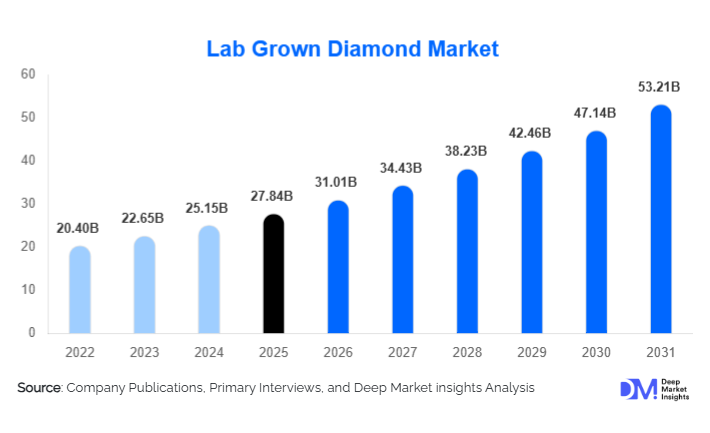
According to Deep Market Insights, the global lab-grown diamond market size was valued at USD 27.84 billion in 2025 and is projected to grow from USD 31.01 billion in 2026 to reach USD 53.21 billion by 2031, expanding at a CAGR of 11.4% during the forecast period (2026–2031). The lab grown diamond market growth is primarily driven by increasing consumer preference for sustainable gemstones, rapid advancements in Chemical Vapor Deposition (CVD) and High Pressure High Temperature (HPHT) technologies, expanding adoption across jewelry and industrial applications, and rising investments in large-scale synthetic diamond manufacturing facilities worldwide.
Key Market Insights
- CVD technology dominates the market, accounting for over 61% of global production due to its ability to manufacture high-purity gem-quality diamonds efficiently.
- Jewelry remains the largest application segment, supported by growing consumer acceptance of sustainable and cost-effective diamond alternatives.
- North America dominates the global market, driven by strong retail demand, technological innovation, and widespread consumer awareness.
- Asia-Pacific is the fastest-growing regional market, led by expanding manufacturing capacity in China and India along with rising domestic jewelry consumption.
- Industrial applications continue to expand, particularly across semiconductor, cutting tool, optical, and thermal management industries.
- Continuous advancements in crystal growth technologies, automation, and AI-enabled production systems are improving manufacturing efficiency and diamond quality.
Lab Grown Diamond Trends
Rapid Expansion of CVD Diamond Manufacturing
Chemical Vapor Deposition technology continues to reshape the industry as manufacturers invest in larger production facilities capable of delivering premium-quality diamonds with improved crystal consistency. Automated plasma control systems, AI-based process monitoring, and enhanced reactor designs have significantly improved production efficiency while reducing manufacturing costs. Continuous improvements in color grading, clarity enhancement, and crystal growth optimization are allowing manufacturers to compete directly with natural diamonds across luxury jewelry applications. Growing investments in renewable-energy-powered manufacturing facilities are also supporting sustainable production practices throughout the value chain.
Growing Consumer Preference for Sustainable Luxury
Consumers are increasingly selecting laboratory-created diamonds due to their environmental advantages, ethical sourcing, and competitive pricing compared to mined diamonds. Millennials and Generation Z buyers are particularly influencing purchasing behavior through sustainability-focused buying decisions. Jewelry retailers are expanding lab grown diamond collections across engagement rings, fashion jewelry, and premium accessories while strengthening online retail platforms. Digital certification, blockchain-enabled traceability, and transparent sourcing information are further enhancing consumer confidence and accelerating adoption across global jewelry markets.
Lab Grown Diamond Drivers
Growing Demand for Sustainable and Affordable Diamonds
Increasing environmental awareness and changing consumer purchasing preferences are significantly driving demand for lab grown diamonds. Compared with natural diamonds, laboratory-grown alternatives offer similar physical, optical, and chemical characteristics while providing lower prices and improved sustainability credentials. Jewelry manufacturers continue expanding their product portfolios to include certified synthetic diamonds, enabling wider accessibility across both premium and mid-range consumer segments. Growing disposable income, rising bridal jewelry demand, and increasing acceptance among younger consumers continue supporting long-term market expansion.
Technological Advancements in Diamond Manufacturing
Continuous innovation in CVD and HPHT manufacturing technologies has improved crystal quality, production scalability, and operational efficiency. Advanced automation, machine learning-based process optimization, and high-precision growth chambers enable manufacturers to produce larger, higher-quality diamonds with greater consistency. These technological improvements are expanding applications beyond jewelry into electronics, optics, semiconductors, aerospace, and quantum computing, creating substantial long-term growth opportunities for manufacturers worldwide.
Lab Grown Diamond Restraints
Strong Consumer Preference for Natural Diamonds
Despite increasing market acceptance, premium natural diamonds continue to maintain significant brand value and emotional appeal among luxury consumers. Traditional perceptions regarding rarity, investment value, and heritage remain important purchasing factors, particularly within high-end jewelry segments. Luxury brands continue emphasizing naturally mined diamonds, creating competitive challenges for laboratory-grown alternatives in premium retail markets.
Pricing Pressure from Expanding Production Capacity
Rapid expansion of global manufacturing capacity has intensified competition among producers, resulting in declining average selling prices for lab grown diamonds. Increasing supply, particularly from Asia-Pacific manufacturers, continues to compress profit margins while forcing companies to invest in product differentiation, certification, branding, and premium-quality production. Maintaining profitability while expanding production remains a significant operational challenge for many manufacturers.
Lab Grown Diamond Opportunities
Growing Applications in Electronics and Semiconductor Industries
Beyond jewelry, lab grown diamonds are increasingly being utilized in advanced electronic applications due to their exceptional thermal conductivity, hardness, and electrical properties. Demand continues to expand across semiconductor heat spreaders, laser optics, high-performance sensors, quantum technologies, and aerospace systems. Continuous innovation within these high-value industrial sectors is expected to create attractive revenue opportunities throughout the forecast period.
Expansion Across Emerging Jewelry Markets
Emerging economies including India, China, Southeast Asia, and the Middle East are witnessing increasing acceptance of lab grown diamond jewelry. Rising disposable income, expanding organized retail networks, digital commerce growth, and greater awareness regarding sustainable luxury products are encouraging broader adoption. International jewelry brands are also increasing investments in localized collections designed specifically for regional consumer preferences.
Report Scope
| Report Metric | Details |
|---|---|
| Market Size in 2025 | USD 27.84 Billion |
| Market Size in 2026 | USD 31.01 Billion |
| Market Size in 2031 | USD 53.21 Billion |
| CAGR | 11.04% (2026-2031) |
| Base Year for Estimation | 2025 |
| Historical Data | 2022-2024 |
| Forecast Period | 2026-2031 |
| Report Coverage | Revenue Forecast, Competitive Landscape, Supply Chain Disruption, Growth Factors, Environment & Regulatory Landscape and Trends |
| Geographies Covered | North America, Europe, APAC, Middle East and Africa, LATAM |
| Countries Covered | U.S., Canada, U.K., Germany, France, Spain, Italy, Russia, Nordic, Benelux, Rest of Europe, China, Korea, Japan, India, Australia, Singapore, Taiwan, South East Asia, Rest of Asia-Pacific, UAE, Turky, Saudi Arabia, South Africa, Egypt, Nigeria, Rest of MEA, Brazil, Mexico, Argentina, Chile, Colombia, Rest of LATAM |
Explore more data points, trends and opportunities Download Free Sample Report
Type Insights
Chemical Vapor Deposition (CVD) diamonds represent the largest product segment in the global lab grown diamond market, primarily due to their superior crystal quality, exceptional scalability, and ability to produce high-purity gemstones suitable for premium jewelry applications. CVD technology enables manufacturers to achieve greater control over crystal growth, resulting in diamonds with improved color, clarity, and consistency while significantly lowering production costs through automated manufacturing processes. Continuous innovations in plasma-assisted deposition systems, AI-enabled process optimization, and large-scale reactor technologies have further enhanced manufacturing efficiency and production capacity. The increasing preference of global jewelry brands for sustainably produced diamonds, coupled with expanding investments in advanced CVD production facilities across China, India, and the United States, continues to strengthen the dominance of this segment.
High Pressure High Temperature (HPHT) diamonds continue to maintain a significant market position owing to their exceptional hardness, durability, and excellent thermal conductivity. HPHT diamonds are extensively utilized across industrial applications including cutting tools, drilling equipment, abrasives, polishing materials, and high-performance machining components where superior mechanical performance is essential. Continuous improvements in crystal synthesis technology have also enabled manufacturers to produce high-quality gem-grade HPHT diamonds, expanding their use within commercial jewelry. Growing investments across automotive, aerospace, electronics, and precision manufacturing industries are expected to sustain demand for HPHT diamonds throughout the forecast period.
Other production technologies, including specialized hybrid manufacturing techniques and customized synthetic diamond processes, primarily serve niche applications within scientific research, optics, quantum technologies, medical devices, and advanced electronics. These specialized diamonds are engineered to meet highly specific optical, electrical, and thermal performance requirements that cannot be achieved through conventional production methods. Increasing research activities in photonics, semiconductor technologies, laser systems, and quantum computing continue to create long-term opportunities for these specialized production technologies.
Application Insights
Jewelry remains the largest application segment of the global lab grown diamond market owing to growing consumer acceptance of sustainable luxury products, competitive pricing compared to mined diamonds, and increasing awareness regarding ethical sourcing practices. Lab grown diamonds are extensively utilized in engagement rings, wedding bands, necklaces, earrings, bracelets, and fashion jewelry while offering identical physical, chemical, and optical characteristics to natural diamonds. The rapid expansion of online jewelry retailers, increasing product availability through branded retail stores, rising millennial and Generation Z purchasing power, and aggressive marketing campaigns promoting sustainability continue to accelerate adoption across global jewelry markets. Furthermore, collaborations between jewelry brands and certified laboratory-grown diamond producers are expanding premium product portfolios and strengthening consumer confidence.
Industrial applications represent the second-largest market segment, supported by the exceptional hardness, wear resistance, and thermal conductivity of synthetic diamonds. These materials are increasingly incorporated into cutting tools, drilling equipment, grinding wheels, machining instruments, mining tools, and advanced manufacturing components where high durability and precision are essential. Rapid industrial automation, increasing investments in precision engineering, and expanding manufacturing activities across automotive, aerospace, defense, and heavy engineering sectors continue to drive industrial demand for laboratory-grown diamonds.
Research and electronics applications are emerging as one of the fastest-growing segments due to increasing utilization of synthetic diamonds in semiconductor manufacturing, quantum computing, optical communication systems, laser technologies, advanced sensors, and thermal management devices. Their outstanding thermal conductivity, electrical insulation properties, optical transparency, and radiation resistance make laboratory-grown diamonds highly suitable for next-generation electronic devices. Growing investments in semiconductor fabrication, artificial intelligence infrastructure, 5G communication technologies, and quantum information science are expected to create substantial opportunities for this segment during the forecast period.
Explore more data points, trends and opportunities Download Free Sample Report
Lab Grown Diamond Market Segmentations
By Type
- Chemical Vapor Deposition (CVD)
- High Pressure High Temperature (HPHT)
- Others
By Application
- Jewelry
- Industrial
- Research & Electronics
Regional Insights
North America
North America remains the largest regional market for lab grown diamonds, driven by strong consumer awareness, advanced retail infrastructure, widespread acceptance of sustainable luxury products, and the presence of established jewelry brands. The United States accounts for the majority of regional revenue owing to high disposable income, rising demand for engagement rings, increasing adoption of ethically sourced diamonds, and continuous expansion of omnichannel jewelry retail networks. Strong investments in advanced CVD manufacturing technologies, robust certification standards, growing e-commerce penetration, and increasing collaboration between retailers and laboratory-grown diamond producers continue to strengthen market leadership. Furthermore, growing environmental consciousness among younger consumers and rising demand for transparent supply chains are accelerating regional market growth.
Europe
Europe continues to demonstrate strong market growth supported by increasing consumer preference for sustainable luxury products, stringent environmental regulations, and growing awareness regarding responsible sourcing practices. Countries including Germany, the United Kingdom, France, Italy, and the Netherlands are witnessing increasing adoption of laboratory-grown diamond jewelry as consumers prioritize ethical purchasing decisions. The region also benefits from well-established luxury jewelry manufacturers that are expanding their portfolios with sustainable diamond collections. Government initiatives promoting responsible manufacturing, increasing ESG commitments by jewelry brands, rising online jewelry sales, and growing demand among younger environmentally conscious consumers continue to drive regional market expansion.
Asia-Pacific
Asia-Pacific is projected to register the fastest growth throughout the forecast period owing to rapidly expanding manufacturing capacity, competitive production costs, abundant skilled labor, and increasing domestic jewelry consumption. China and India have emerged as global manufacturing hubs for CVD and HPHT diamonds due to substantial investments in advanced production technologies and favorable manufacturing ecosystems. Rising disposable income, expanding middle-class populations, increasing bridal jewelry demand, and strong export capabilities continue supporting regional expansion. Additionally, government support for advanced manufacturing, increasing foreign investments, rapid industrialization, and growing adoption of synthetic diamonds across electronics and semiconductor industries further accelerate market growth across Asia-Pacific.
Latin America
Latin America is gradually emerging as a promising market for laboratory-grown diamonds due to rising disposable income, expanding organized jewelry retail, increasing urbanization, and growing consumer awareness regarding sustainable gemstones. Brazil and Mexico remain the leading regional markets supported by rising luxury product consumption, expanding e-commerce platforms, and increasing availability of certified laboratory-grown diamond jewelry through international retailers. The region is also witnessing growing demand from younger consumers seeking affordable alternatives to natural diamonds. Improving retail infrastructure, greater product accessibility, and increasing digital marketing initiatives by jewelry brands are expected to support steady market growth over the coming years.
Middle East & Africa
The Middle East & Africa market continues to expand steadily due to rising luxury jewelry consumption, increasing retail investments, expanding tourism activities, and growing consumer interest in premium yet sustainable gemstones. The United Arab Emirates has established itself as a major international diamond trading and jewelry retail hub, supported by favorable trade policies, world-class retail infrastructure, and a strong luxury consumer base. Saudi Arabia and Qatar are also witnessing increasing demand due to rising disposable income and expanding luxury retail sectors. Meanwhile, South Africa continues to contribute through industrial diamond applications, mining expertise, and advanced engineering industries. Growing investments in organized jewelry retail, international luxury brands, and regional trade exhibitions are expected to further strengthen market growth across the Middle East & Africa.
Company Market Share
Key Players in the Lab Grown Diamond Market
- De Beers Group (Lightbox)
- Diamond Foundry Inc.
- WD Lab Grown Diamonds
- New Diamond Technology
- Swarovski AG
- Pure Grown Diamonds
- Lusix
- Ada Diamonds Inc.
- Henan Huanghe Whirlwind Co., Ltd.
- Zhongnan Diamond Co., Ltd.
- IIa Technologies
- Greenlab Diamonds
- Scio Diamond Technology Corporation
- Applied Diamond Inc.
- Sumitomo Electric Industries Ltd.