Luxury Cosmetics Market Size
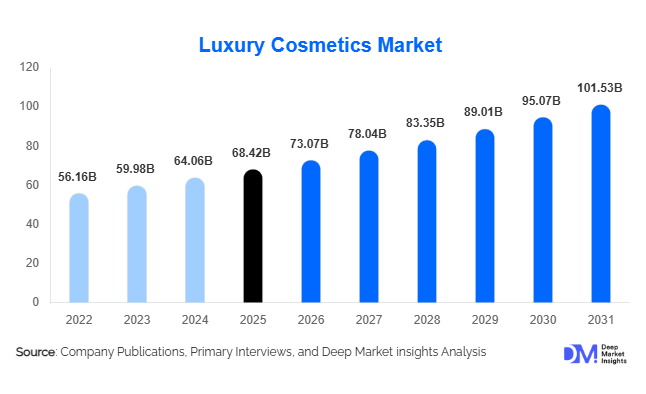
According to Deep Market Insights, the global luxury cosmetics market size was valued at USD 68.42 billion in 2025 and is projected to grow from USD 73.07 billion in 2026 to reach USD 101.53 billion by 2031, expanding at a CAGR of 6.8% during the forecast period (2026–2031). The luxury cosmetics market growth is primarily driven by increasing premium beauty spending, rising disposable income among affluent consumers, growing demand for personalized skincare solutions, and expansion of luxury beauty brands across emerging economies. The market analysis covers detailed segmentation by product type, distribution channel, regional performance, competitive landscape, and evolving consumer preferences shaping the global luxury beauty industry.
Key Market Insights
- Europe dominates the global luxury cosmetics market, accounting for approximately 35.8% market share in 2025, supported by strong luxury brand presence, premium beauty heritage, and established retail infrastructure.
- Asia-Pacific represents the fastest-growing region, projected to expand at a CAGR of 8.3% through 2031, driven by rising middle-class income, digital beauty adoption, and increasing premium product demand in China and India.
- Skincare remains the leading product segment, contributing around 46.2% market share, supported by increasing demand for anti-aging products, premium serums, and advanced dermatological formulations.
- Online retail is the fastest-growing distribution channel, expanding at approximately 9.2% CAGR as luxury beauty brands strengthen direct-to-consumer platforms and digital shopping experiences.
- India is emerging as a high-growth luxury cosmetics market, projected to reach approximately USD 8.9 billion by 2031, growing at a CAGR of 10.4% due to premiumization trends and increasing beauty awareness.
- Technology integration is transforming luxury beauty, with AI-based skin analysis, personalized recommendations, and virtual beauty consultations gaining adoption among digitally connected consumers.
Luxury Cosmetics Market Trends
Premium Personalization and AI-Based Beauty Experiences
The luxury cosmetics industry is increasingly shifting toward personalized beauty solutions powered by artificial intelligence, digital diagnostics, and customized formulations. Luxury brands are integrating AI skin analysis tools, virtual consultations, and data-driven product recommendations to enhance customer engagement. In 2025, more than 620 million premium beauty products incorporated personalized recommendations globally, while AI-based beauty consultation adoption increased by approximately 42%. Consumers are increasingly seeking products designed for specific skin concerns, age groups, and lifestyle requirements, encouraging brands to invest in biotechnology, advanced peptides, and precision skincare technologies. This transformation is strengthening customer loyalty and accelerating premium beauty consumption worldwide, supporting continued expansion of the luxury cosmetics market.
Sustainable Packaging and Clean Luxury Beauty Movement
Sustainability has become a major trend influencing luxury cosmetic product development, with brands focusing on recyclable packaging, refillable containers, and environmentally responsible ingredient sourcing. More than 1.1 billion luxury cosmetic packages incorporated recyclable materials in 2025, while refillable packaging adoption exceeded 37% among premium beauty brands. Clean beauty formulations using botanical extracts, natural actives, and biotechnology-derived ingredients represented over 44% of new luxury product launches. Consumers are increasingly evaluating luxury brands based on ethical sourcing, carbon reduction initiatives, and transparency, creating stronger demand for sustainable premium beauty products and reshaping the future direction of the luxury cosmetics market.
Luxury Cosmetics Market Drivers
Rising Affluent Consumer Base and Premium Beauty Spending
The expansion of affluent consumer groups worldwide is one of the strongest factors driving luxury cosmetics demand. Increasing disposable income, urbanization, and changing beauty standards are encouraging consumers to upgrade from mass-market products to premium alternatives. Global premium beauty spending increased by approximately 8% in 2025, while more than 520 million consumers purchased luxury cosmetic products annually. Premium skincare consumption increased by 11%, whereas luxury fragrance sales expanded by nearly 9%. Emerging wealth centers across Asia-Pacific and the Middle East are creating new demand for premium skincare, makeup, and fragrance products, strengthening long-term luxury cosmetics market growth.
Growing Demand for Sustainable and High-Performance Formulations
Consumers are increasingly prioritizing high-quality formulations that combine luxury positioning with measurable results. Demand for anti-aging solutions, dermatologist-tested products, clean ingredients, and scientifically backed formulations is increasing across global markets. Premium skincare brands are investing heavily in research and development, with advanced ingredients such as peptides, hyaluronic acid, and plant-based compounds becoming major product differentiators. More than 60% of high-income consumers consider ingredient quality a key purchasing factor, while sustainable beauty preferences have increased by over 35% among younger luxury consumers. This shift toward performance-driven and responsible beauty products continues to support expansion of the luxury cosmetics market.
Luxury Cosmetics Market Restraints
High Product Pricing Limiting Mass Adoption
Luxury cosmetics remain highly concentrated among premium-income consumers due to significantly higher pricing compared with mass-market alternatives. Luxury beauty products are often priced between 3 and 8 times higher than conventional cosmetics, limiting accessibility among price-sensitive consumers. Premium import duties exceeding 20% in several emerging markets further increase retail prices. Although demand remains strong among affluent buyers, high product costs restrict broader market penetration, especially in developing regions. These pricing challenges continue to influence consumer purchasing decisions and represent a key limitation for wider luxury cosmetics market expansion.
Counterfeit Products and Brand Protection Challenges
The increasing presence of counterfeit luxury cosmetics affects brand reputation, consumer trust, and revenue generation. Counterfeit products account for nearly 7% of global luxury cosmetic trade, creating challenges related to product authenticity and safety. Luxury brands are investing in blockchain-based authentication, smart packaging, and digital tracking technologies to protect products throughout supply chains. However, increasing online marketplace activity and cross-border sales create additional risks for premium cosmetic companies. Managing authenticity concerns while maintaining global distribution efficiency remains an ongoing challenge for the luxury cosmetics market.
Luxury Cosmetics Market Opportunities
Expansion Across Emerging Beauty Markets
Emerging economies are creating significant opportunities for luxury cosmetics brands due to rising disposable income, increasing urban populations, and growing beauty awareness. Countries including India, China, Brazil, and the UAE are witnessing rapid premium beauty adoption, with luxury cosmetics consumption increasing by more than 10% annually in several markets. Online beauty platforms, influencer marketing, and localized product launches are helping international brands reach new consumer groups. India alone is expected to achieve approximately USD 8.9 billion market value by 2031, highlighting the growing opportunity landscape within the global luxury cosmetics market.
Digital Commerce and Direct-to-Consumer Expansion
The rapid growth of e-commerce is transforming luxury cosmetics distribution by enabling brands to reach consumers directly through personalized digital experiences. Online luxury beauty sales exceeded 420 million orders in 2025, while digital premium beauty penetration surpassed 34% globally. Brands are investing in virtual try-ons, AI recommendations, subscription models, and exclusive online product launches to improve customer engagement. Social commerce and influencer-led campaigns are also influencing purchasing behavior among younger consumers, creating new opportunities for digital expansion within the luxury cosmetics market.
Report Scope
| Report Metric | Details |
|---|---|
| Market Size in 2025 | USD 68.42 Billion |
| Market Size in 2026 | USD 73.07 Billion |
| Market Size in 2031 | USD 101.53 Billion |
| CAGR | 6.8% (2026-2031) |
| Base Year for Estimation | 2025 |
| Historical Data | 2022-2024 |
| Forecast Period | 2026-2031 |
| Report Coverage | Revenue Forecast, Competitive Landscape, Supply Chain Disruption, Growth Factors, Environment & Regulatory Landscape and Trends |
| Geographies Covered | North America, Europe, APAC, Middle East and Africa, LATAM |
| Countries Covered | U.S., Canada, U.K., Germany, France, Spain, Italy, Russia, Nordic, Benelux, Rest of Europe, China, Korea, Japan, India, Australia, Singapore, Taiwan, South East Asia, Rest of Asia-Pacific, UAE, Turky, Saudi Arabia, South Africa, Egypt, Nigeria, Rest of MEA, Brazil, Mexico, Argentina, Chile, Colombia, Rest of LATAM |
Explore more data points, trends and opportunities Download Free Sample Report
Product Type Insights
Skincare dominates the luxury cosmetics market, accounting for approximately 46.2% market share in 2025 due to strong demand for anti-aging creams, premium serums, moisturizers, and advanced facial treatments. Luxury skincare brands are focusing on biotechnology ingredients, peptide-based formulations, and dermatologist-backed solutions to attract high-value consumers. Makeup represents around 29.8% market share, supported by demand for premium foundations, lip products, eye cosmetics, and long-lasting formulations. Luxury makeup products increasingly incorporate skin-friendly ingredients, clean formulations, and innovative packaging designs. Fragrances contribute nearly 24.0% market share and remain a major prestige category due to strong consumer preference for exclusive scents, limited editions, and personalized fragrance experiences. Premium fragrance production exceeded 760 million bottles globally in 2025, supported by increasing demand from Asia-Pacific and Middle Eastern consumers.
Distribution Channel Insights
Offline retail remains the largest distribution channel, contributing approximately 58.4% market share due to the importance of luxury shopping experiences, personalized consultations, and premium brand environments. Department stores, luxury boutiques, and flagship stores continue attracting high-value customers through exclusive launches and personalized services. Online retail is the fastest-growing channel, expanding at a 9.2% CAGR, supported by increasing digital adoption, virtual beauty experiences, and direct-to-consumer platforms. More than 420 million luxury beauty orders were completed online in 2025, reflecting strong consumer acceptance of digital premium shopping. Specialty stores continue supporting brand discovery through expert consultations, curated product collections, and personalized recommendations.
Explore more data points, trends and opportunities Download Free Sample Report
Luxury Cosmetics Market Segmentations
By Product Type
- Skincare
- Makeup
- Fragrances
By Distribution Channel
- Offline Retail
- Online Retail
- Specialty Stores
Regional Insights
North America
North America represents one of the largest luxury cosmetics markets globally, accounting for approximately 29.6% market share in 2025. The region benefits from high disposable income, strong premium beauty awareness, advanced retail infrastructure, and widespread presence of international luxury brands. The United States contributes more than 82% of regional revenue, supported by strong demand for premium skincare, anti-aging solutions, luxury fragrances, and clean beauty products. Regional luxury cosmetics production exceeded 820 million units in 2025, with skincare contributing nearly 45% of total sales, followed by makeup at approximately 32% and fragrances at around 23%. Digital beauty adoption continues accelerating, with online premium cosmetic penetration exceeding 39% among consumers. Increasing preference for personalized skincare, influencer-driven beauty trends, and sustainable luxury products is expected to maintain steady market expansion across North America.
Europe
Europe dominates the global luxury cosmetics market, contributing approximately 35.8% market share in 2025 due to its strong heritage in luxury beauty, established cosmetic manufacturing capabilities, and presence of globally recognized brands. Countries including France, Germany, Italy, and the United Kingdom collectively account for more than 78% of regional luxury cosmetic revenue. European luxury cosmetic production exceeded 1.3 billion units annually, supported by advanced formulation technologies, premium fragrance manufacturing, and strong export capabilities. Skincare represents approximately 44% of regional consumption, while fragrances contribute nearly 31% due to strong demand for exclusive perfumes and niche fragrance collections. Sustainability remains a major factor influencing European consumers, with more than 45% of luxury beauty buyers preferring environmentally responsible brands. Rising demand for clean formulations, refillable packaging, and ethical sourcing continues strengthening Europe’s leadership position in the luxury cosmetics market.
Asia-Pacific
Asia-Pacific is projected to become the fastest-growing luxury cosmetics region, expanding at a CAGR of 8.3% during 2026–2031. The region accounted for approximately 22.4% market share in 2025, driven by increasing disposable income, rapid urbanization, digital commerce growth, and rising interest in premium beauty routines. China, Japan, South Korea, and India collectively contribute more than 74% of regional demand. Luxury cosmetic production exceeded 960 million units in 2025, supported by advanced skincare manufacturing, K-beauty influence, and premium fragrance adoption. China remains the largest contributor due to a growing affluent population and strong e-commerce ecosystem, while India is emerging as a high-growth market with luxury beauty demand expanding at more than 10% annually. Online beauty shopping penetration has exceeded 35% across major Asian markets, creating significant opportunities for global luxury brands. The increasing popularity of personalized skincare, celebrity collaborations, and social commerce is expected to accelerate the luxury cosmetics market growth in Asia-Pacific.
Latin America
Latin America accounted for approximately 6.4% market share of the global luxury cosmetics industry in 2025, supported by rising beauty consciousness, expanding middle-class income, and increasing demand for premium personal care products. Brazil and Mexico represent the largest contributors, generating more than 67% of regional luxury cosmetic revenue. Regional production exceeded 180 million units, with skincare and fragrances representing the strongest categories. Premium fragrance consumption remains particularly strong due to cultural preference for personal grooming and luxury scent products. Online luxury beauty sales increased by approximately 16% annually as consumers increasingly adopt digital purchasing channels. International brands are expanding through partnerships with premium retailers and localized product strategies to capture growing demand among affluent urban consumers. Increasing interest in natural ingredients, sustainable packaging, and premium wellness-oriented beauty products is expected to support future development of the luxury cosmetics market across Latin America.
Middle East & Africa
The Middle East & Africa region contributed approximately 5.8% market share in 2025 and represents a rapidly developing market for premium beauty products. Countries including the UAE, Saudi Arabia, Qatar, and South Africa are driving regional demand through luxury retail expansion, high-income consumer groups, and strong preference for premium fragrances. Regional luxury cosmetics production exceeded 150 million units, with fragrances accounting for nearly 38% of total consumption, followed by skincare and makeup categories. The UAE has become a major luxury beauty hub due to international retail presence, tourism-driven consumption, and premium shopping destinations. Increasing female workforce participation, social media influence, and growing demand for exclusive beauty experiences are supporting market growth. Luxury brands are also expanding through flagship stores, premium malls, and digital commerce platforms, creating additional opportunities for the luxury cosmetics market across the region.
Key Players in the Luxury Cosmetics Market
- L'Oréal Groupe
- Estée Lauder Companies Inc.
- LVMH Moët Hennessy Louis Vuitton
- Chanel Limited
- Shiseido Company, Limited
- Coty Inc.
- Puig S.L.
- Clarins Group
- Sisley Paris
- Amorepacific Corporation
- Hermès International S.A.
- Kao Corporation
- Beiersdorf AG
- Interparfums Inc.
- Oriflame Holding AG