Jewellery Market Size
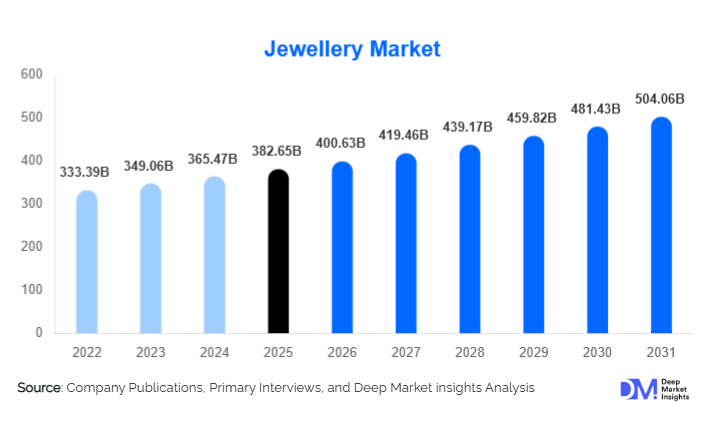
According to Deep Market Insights, the global jewellery market was valued at USD 382.65 billion in 2025 and is projected to grow from USD 400.63 billion in 2026 to reach USD 504.06 billion by 2031, expanding at a CAGR of 4.7% during the forecast period (2026–2031). The jewellery market is experiencing steady expansion due to rising disposable incomes, increasing consumer preference for branded and personalized jewellery, rapid digitalization of retail channels, and growing demand for premium gold, diamond, platinum, and gemstone jewellery across developed and emerging economies. Expanding organized retail networks, increasing online jewellery purchases, and technological advancements in jewellery manufacturing are further strengthening long-term market development.
Key Market Insights
- Gold jewellery continues to dominate global demand, supported by strong cultural significance, investment appeal, and consistent demand across Asia-Pacific and the Middle East.
- Lab-grown diamonds are transforming the premium jewellery segment, offering sustainable and cost-effective alternatives that are attracting younger consumers worldwide.
- Asia-Pacific dominates the global jewellery market, driven by strong consumption in China and India, expanding middle-class populations, and rising bridal jewellery purchases.
- Middle East & Africa is projected to witness the fastest growth, supported by increasing luxury retail investments, tourism, and premium jewellery demand.
- Online jewellery retail is expanding rapidly, driven by virtual try-on technologies, AI-powered product recommendations, and secure digital payment systems.
- Sustainability and ethical sourcing initiatives are becoming major purchasing factors as consumers increasingly prefer responsibly sourced precious metals and diamonds.
Jewellery Market Trends
Growing Adoption of Sustainable and Ethical Jewellery
Consumers are increasingly prioritizing sustainability when purchasing jewellery, encouraging manufacturers to adopt recycled precious metals, responsibly sourced gemstones, and ethically certified diamonds. Major jewellery brands are expanding the use of recycled gold, reducing mining dependency, and improving supply chain transparency through blockchain-based traceability solutions. Ethical sourcing certifications are becoming important purchasing criteria among premium consumers, particularly in Europe and North America. Manufacturers are also investing in carbon-neutral production facilities and environmentally responsible packaging to strengthen brand positioning. As sustainability becomes a competitive differentiator, jewellery companies continue introducing collections manufactured using recycled materials while supporting responsible mining practices and fair-trade sourcing programs.
Digital Transformation Reshaping Jewellery Retail
Digital technologies are significantly changing jewellery purchasing behavior across both luxury and mass-market segments. Artificial intelligence is enabling personalized product recommendations, while augmented reality and virtual try-on applications allow customers to evaluate jewellery remotely before making purchasing decisions. E-commerce platforms continue expanding their premium product portfolios alongside omnichannel retail strategies integrating physical stores with digital experiences. Live-stream shopping, influencer marketing, social commerce, and mobile-first retail platforms are attracting younger consumers who increasingly prefer convenient digital purchasing experiences. Advanced customer analytics and customized product configurators are further improving engagement, allowing retailers to offer personalized jewellery collections based on consumer preferences.
Jewellery Market Drivers
Increasing Disposable Income and Premium Consumer Spending
Growing disposable incomes, urbanization, and expanding middle-class populations continue driving global jewellery purchases. Rising employment levels and increasing purchasing power across emerging economies are encouraging greater spending on gold, diamond, platinum, and gemstone jewellery for weddings, festivals, gifting, and personal fashion. Premiumization trends are encouraging consumers to purchase branded jewellery with certified authenticity, innovative designs, and customized features. Luxury jewellery brands continue expanding internationally through exclusive boutiques and digital platforms, while higher consumer confidence supports demand for investment-grade jewellery products. Growing demand from affluent consumers across Asia-Pacific and the Middle East remains one of the primary factors accelerating long-term market expansion.
Expansion of Organized Retail and E-commerce Platforms
The rapid expansion of organized jewellery retailers and online marketplaces is significantly improving product accessibility across developed and emerging economies. Retail chains continue investing in digital platforms, omnichannel services, flexible financing options, and transparent pricing to attract new customer segments. Online retailers are introducing virtual consultations, AI-powered recommendations, and home delivery services that simplify purchasing decisions. Increased availability of certified jewellery through trusted online platforms has strengthened consumer confidence while enabling manufacturers to expand beyond traditional retail channels. The combination of physical showrooms and digital commerce continues supporting sustained market growth worldwide.
Jewellery Market Restraints
Volatility in Precious Metal and Gemstone Prices
Price fluctuations in gold, silver, platinum, and precious gemstones continue creating uncertainty for jewellery manufacturers, retailers, and consumers. Rising raw material costs directly increase manufacturing expenses and retail pricing, limiting affordability for price-sensitive customers. Frequent fluctuations in international commodity markets also complicate inventory planning and long-term procurement strategies. Manufacturers often experience margin pressure when precious metal prices increase rapidly, while retailers face challenges maintaining competitive pricing without compromising profitability. Such pricing volatility remains one of the major restraints affecting stable market expansion.
Counterfeit Products and Supply Chain Challenges
The presence of counterfeit jewellery and uncertified gemstones continues affecting consumer confidence across several regional markets. Informal retail channels frequently distribute imitation products that negatively impact established brands and reduce overall market transparency. Complex international supply chains also increase compliance costs related to ethical sourcing, certification, and product authentication. Maintaining traceability from mining operations to finished jewellery requires significant investment in digital monitoring systems, regulatory compliance, and supplier verification. These challenges increase operational costs while creating additional barriers for smaller manufacturers entering organized retail markets.
Jewellery Market Opportunities
Expansion of Lab-Grown Diamond Jewellery
Lab-grown diamonds are creating substantial opportunities across premium and mid-priced jewellery categories by offering consumers environmentally responsible alternatives at lower prices than natural diamonds. Increasing consumer acceptance, improvements in production technologies, and growing retailer participation are expanding product availability across global markets. Younger consumers increasingly prioritize sustainability alongside affordability, encouraging manufacturers to diversify their premium product portfolios. Luxury brands are also introducing dedicated lab-grown collections to address evolving customer preferences while maintaining design quality and product certification standards.
Personalized and Customized Jewellery
Consumer demand for personalized jewellery continues increasing as buyers seek unique products reflecting individual preferences and special occasions. Advanced manufacturing technologies such as 3D printing, computer-aided design, and laser engraving enable manufacturers to deliver customized jewellery with shorter production times and improved precision. Personalized engagement rings, engraved necklaces, birthstone collections, and bespoke luxury jewellery are gaining popularity across multiple age groups. Digital customization platforms further simplify product design, enabling customers to participate directly in the creation process while enhancing overall purchasing experiences.
Report Scope
| Report Metric | Details |
|---|---|
| Market Size in 2025 | USD 382.65 Billion |
| Market Size in 2026 | USD 400.63 Billion |
| Market Size in 2031 | USD 504.06 Billion |
| CAGR | 4.7% (2026-2031) |
| Base Year for Estimation | 2025 |
| Historical Data | 2022-2024 |
| Forecast Period | 2026-2031 |
| Report Coverage | Revenue Forecast, Competitive Landscape, Supply Chain Disruption, Growth Factors, Environment & Regulatory Landscape and Trends |
| Geographies Covered | North America, Europe, APAC, Middle East and Africa, LATAM |
| Countries Covered | U.S., Canada, U.K., Germany, France, Spain, Italy, Russia, Nordic, Benelux, Rest of Europe, China, Korea, Japan, India, Australia, Singapore, Taiwan, South East Asia, Rest of Asia-Pacific, UAE, Turky, Saudi Arabia, South Africa, Egypt, Nigeria, Rest of MEA, Brazil, Mexico, Argentina, Chile, Colombia, Rest of LATAM |
Explore more data points, trends and opportunities Download Free Sample Report
Product Type Insights
Gold jewellery continues to represent the largest product category due to its strong investment value, cultural importance, and extensive use during weddings and festivals, particularly across Asia-Pacific and the Middle East. Diamond jewellery maintains significant demand within the premium luxury segment, supported by bridal collections, engagement rings, and high-end fashion accessories. Platinum jewellery continues attracting affluent consumers seeking exclusive premium products with superior durability and elegant aesthetics. Gemstone jewellery is steadily expanding due to increasing consumer preference for colored stones, customized designs, and fashion-oriented collections. Meanwhile, silver jewellery continues gaining popularity among younger consumers because of its affordability, contemporary styling, and increasing online availability.
Distribution Channel Insights
Offline retail continues to dominate the global jewellery market, supported by established jewellery chains, independent retailers, luxury boutiques, and department stores that provide customers with personalized consultations, product authentication, and physical product inspection before purchase. Consumers continue to prefer offline stores for high-value purchases such as bridal jewellery and certified diamonds due to greater confidence in quality and after-sales services. Meanwhile, online retail is emerging as the fastest-growing distribution channel owing to increasing internet penetration, mobile commerce adoption, virtual try-on technologies, AI-powered product recommendations, and secure digital payment systems. Brand-owned e-commerce platforms are also strengthening direct-to-consumer sales through customized collections, exclusive online launches, flexible financing options, and convenient home delivery. Specialty jewellery stores remain an important channel for premium collections, designer jewellery, and customized products that require expert consultation and craftsmanship.
Material Type Insights
Gold continues to account for the largest share of the global jewellery market due to its long-standing cultural significance, investment appeal, and widespread demand during weddings, festivals, and gifting occasions. Diamond jewellery represents the premium luxury segment, driven by engagement rings, bridal collections, and high-income consumers seeking certified products. Platinum jewellery is witnessing steady demand because of its durability, rarity, and growing popularity among younger luxury buyers. Silver jewellery continues expanding among fashion-conscious consumers due to its affordability and versatility for everyday wear. Gemstone jewellery, including sapphire, emerald, ruby, and semi-precious stone collections, is gaining popularity through personalized designs and increasing consumer preference for colorful luxury accessories.
End-user Insights
Women continue to represent the largest consumer segment within the jewellery market owing to consistent demand for bridal, fashion, luxury, and everyday jewellery products. Men's jewellery has emerged as one of the fastest-growing segments, supported by increasing demand for bracelets, chains, rings, cufflinks, and premium accessories among younger consumers. Children's jewellery remains a niche but steadily growing category driven by gifting occasions, cultural ceremonies, and premium family purchases. Additionally, gender-neutral jewellery collections are becoming increasingly popular as manufacturers introduce minimalist and contemporary designs targeting broader consumer demographics across global fashion markets.
Price Range Insights
Premium jewellery accounts for the highest market revenue due to strong consumer demand for certified diamonds, luxury gold jewellery, platinum collections, and designer brands. Mid-range jewellery continues attracting the largest volume of consumers by balancing affordability with quality, particularly in urban markets and organized retail channels. Economy jewellery remains popular among value-conscious consumers seeking fashionable products at competitive prices through both offline and online retail platforms. Personalized premium collections and limited-edition luxury jewellery continue driving higher average selling prices across developed economies.
Explore more data points, trends and opportunities Download Free Sample Report
Jewellery Market Segmentations
By Product Type
- Gold Jewellery
- Diamond Jewellery
- Platinum Jewellery
- Gemstone Jewellery
- Silver Jewellery
By Distribution Channel
- Offline Retail
- Online Retail
- Specialty Stores
By End User
- Women
- Men
- Children
- Gender-neutral Consumers
Regional Insights
Asia-Pacific
Asia-Pacific dominates the global jewellery market, supported by strong consumer demand across China, India, Japan, South Korea, and Southeast Asian countries. India and China together account for the majority of global gold jewellery consumption owing to strong cultural traditions, rising disposable incomes, expanding middle-class populations, and increasing wedding-related purchases. Rapid urbanization, organized retail expansion, and growing online jewellery sales continue strengthening regional demand. Premium diamond jewellery is also witnessing increasing popularity among younger consumers seeking branded luxury products. Government initiatives supporting manufacturing, export activities, and gemstone processing industries further reinforce Asia-Pacific's leadership position in the global jewellery industry.
North America
North America represents one of the largest premium jewellery markets globally, driven primarily by the United States and Canada. Consumers increasingly prefer certified diamonds, customized engagement rings, luxury watches, and premium branded jewellery supported by high disposable income and strong retail infrastructure. E-commerce continues expanding rapidly as digital-native consumers increasingly purchase jewellery through online platforms offering virtual consultations and augmented reality product visualization. Sustainability initiatives, recycled precious metals, and lab-grown diamonds are also gaining widespread acceptance among environmentally conscious buyers across the region.
Europe
Europe remains an important luxury jewellery market led by Italy, France, Germany, Switzerland, and the United Kingdom. The region is recognized globally for premium craftsmanship, heritage luxury brands, and advanced jewellery manufacturing capabilities. Consumers increasingly prioritize ethically sourced diamonds, recycled precious metals, and sustainable production practices. Growing tourism also contributes significantly to luxury jewellery sales, particularly across fashion capitals where international visitors purchase premium designer collections. Innovation in jewellery design and expanding online luxury retail continue supporting steady regional market growth.
Latin America
Latin America is witnessing gradual expansion in jewellery demand, supported by growing urban populations, increasing disposable income, and rising consumer interest in premium accessories. Brazil and Mexico remain the largest regional markets due to expanding organized retail networks and increasing adoption of branded jewellery collections. Gold jewellery continues dominating regional demand, while silver jewellery remains popular because of its affordability and strong domestic production capabilities. International luxury brands are gradually expanding their presence through exclusive boutiques and digital commerce platforms across major metropolitan areas.
Middle East & Africa
The Middle East & Africa is expected to register significant long-term growth driven by luxury spending, tourism expansion, and strong cultural demand for gold jewellery. Countries such as the United Arab Emirates and Saudi Arabia continue serving as major global trading hubs for gold, diamonds, and premium jewellery. Rising high-net-worth populations, increasing investments in luxury retail infrastructure, and growing international tourism continue strengthening regional demand. South Africa also remains an important producer of precious metals and gemstones, supporting regional manufacturing and export activities while reinforcing the market's long-term growth potential.
Key Players in the Jewellery Market
- Compagnie Financière Richemont SA
- LVMH Moët Hennessy Louis Vuitton
- Tiffany & Co.
- Pandora A/S
- Signet Jewelers Ltd.
- Chow Tai Fook Jewellery Group
- Malabar Gold & Diamonds
- Kalyan Jewellers India Ltd.
- Titan Company Ltd.
- Bvlgari S.p.A.
- Harry Winston Inc.
- Swarovski AG
- Graff Diamonds
- Mikimoto Co., Ltd.
- Blue Nile Inc.