Luxury Furniture Market Size
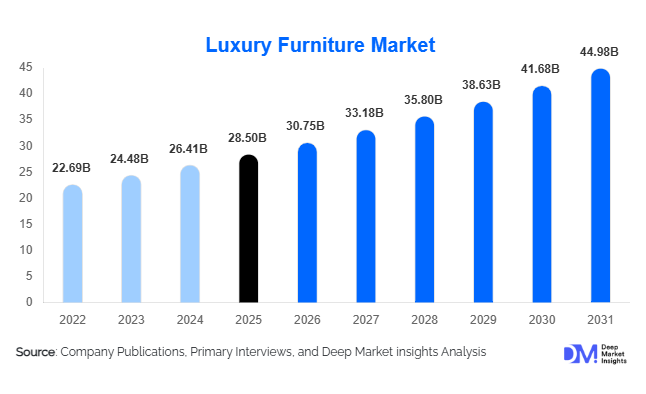
According to Deep Market Insights, the global luxury furniture market size was valued at USD 28.5 billion in 2025 and is projected to grow from USD 30.75 billion in 2026 to reach USD 44.98 billion by 2031, expanding at a CAGR of 7.9% during the forecast period (2026–2031). Market growth is primarily driven by rising disposable incomes among high-net-worth individuals, increasing investments in luxury residential and hospitality projects, growing demand for customized and designer furniture, and the expanding influence of premium interior design trends across both developed and emerging economies. The market is further benefiting from digital transformation, with luxury brands investing in omnichannel retail strategies, virtual showrooms, and personalized customer experiences. Sustainability has also become an important purchasing criterion, encouraging manufacturers to introduce environmentally certified materials, responsibly sourced hardwoods, recycled metals, and low-emission production techniques. Strong demand from luxury hotels, branded residences, premium office spaces, and high-end commercial developments continues to support long-term industry expansion.
Key Market Insights
- Luxury residential furniture continues to account for the largest share of global demand, supported by increasing investments in premium homes, luxury apartments, villas, and branded residential developments.
- Customization and bespoke furniture manufacturing are becoming major competitive differentiators, as affluent consumers increasingly seek exclusive designs, handcrafted finishes, and personalized interior solutions.
- Europe dominates the global luxury furniture market, led by Italy, Germany, and France, owing to their longstanding heritage in premium furniture craftsmanship and designer manufacturing.
- Asia-Pacific is the fastest-growing regional market, driven by expanding high-net-worth populations, rapid urbanization, luxury real estate development, and rising premium lifestyle spending across China, India, Singapore, and Southeast Asia.
- Digital luxury retail is reshaping purchasing behavior, with manufacturers increasingly adopting virtual reality showrooms, AI-powered design consultation, and omnichannel customer engagement platforms.
- Sustainable luxury furniture is emerging as one of the industry's fastest-growing segments, supported by growing consumer awareness regarding responsible sourcing, FSC-certified wood, recycled materials, and environmentally friendly manufacturing processes.
Luxury Furniture Market Trends
Growing Preference for Bespoke and Personalized Luxury Furniture
Luxury furniture manufacturers are increasingly focusing on fully customized products that reflect individual customer preferences rather than standardized collections. High-net-worth consumers are demanding personalized dimensions, premium upholstery, handcrafted finishes, rare wood species, natural stone combinations, and designer collaborations that create unique living environments. Interior designers are playing an increasingly influential role in purchasing decisions, particularly for luxury residences, hospitality projects, and premium commercial developments. Manufacturers are responding by expanding made-to-order production capabilities, shortening customization lead times through digital manufacturing technologies, and offering advanced visualization tools that allow customers to preview finished products before production. Personalized craftsmanship is gradually becoming a defining characteristic of luxury furniture purchasing decisions across both mature and emerging markets.
Sustainability Becoming a Core Luxury Value Proposition
Environmental sustainability is transforming competitive dynamics across the luxury furniture industry. Premium brands are investing in responsibly sourced hardwoods, recycled metals, environmentally certified leather alternatives, water-based coatings, and carbon-neutral manufacturing facilities to meet evolving consumer expectations. Customers increasingly associate sustainability with premium quality rather than compromise, making environmentally responsible production an important component of brand positioning. Circular economy initiatives, furniture refurbishment programs, and product lifecycle transparency are also gaining momentum among leading manufacturers. Several luxury brands are collaborating with certified forestry organizations while incorporating renewable energy into production facilities to reduce carbon emissions throughout the value chain. Sustainable luxury is evolving from a niche offering into a mainstream purchasing criterion, particularly among younger affluent consumers and environmentally conscious commercial buyers.
Luxury Furniture Market Drivers
Expansion of Global Luxury Real Estate and Premium Residential Construction
The rapid development of luxury residential properties worldwide remains one of the strongest growth drivers for the luxury furniture market. Premium apartments, branded residences, luxury villas, waterfront developments, and integrated townships increasingly require high-end interior furnishing packages that complement architectural quality and lifestyle positioning. Developers frequently collaborate with internationally recognized furniture brands to deliver turnkey interior solutions that enhance property values and attract affluent buyers. Rapid urban wealth creation across Asia-Pacific and the Middle East is accelerating investments in luxury residential construction, while mature markets continue to experience steady demand for premium home renovations and interior upgrades. This sustained expansion of luxury housing continues to generate consistent demand for designer furniture across all major product categories.
Rising Population of High-Net-Worth Individuals Worldwide
The increasing number of high-net-worth and ultra-high-net-worth individuals globally continues to strengthen demand for luxury furniture products. Wealth accumulation across North America, Europe, Asia-Pacific, and the Middle East has significantly expanded consumer spending on premium lifestyle products, including bespoke furniture and designer interiors. Affluent consumers increasingly prioritize exclusivity, craftsmanship, heritage brands, and personalized design over price considerations. Luxury furniture purchases are also becoming part of broader lifestyle investments that include premium real estate, luxury hospitality, yachts, and private aviation interiors. Growing intergenerational wealth transfer is expected to further support premium furniture demand among younger affluent consumers seeking contemporary luxury aesthetics and sustainable design solutions.
Digital Transformation Strengthening Customer Engagement
Luxury furniture companies are increasingly adopting advanced digital technologies to improve customer engagement without compromising exclusivity. Virtual reality room visualization, augmented reality product placement, artificial intelligence-powered design consultation, and digital customization platforms allow customers to personalize furniture while maintaining premium purchasing experiences. Omnichannel retail strategies combining flagship showrooms with sophisticated digital platforms are expanding market accessibility while improving customer convenience. These technological advancements are helping manufacturers increase conversion rates, improve customer satisfaction, and reach international buyers more effectively.
Luxury Furniture Market Restraints
High Product Prices and Long Purchase Cycles
Luxury furniture products require significant financial investment due to premium raw materials, handcrafted manufacturing techniques, designer collaborations, and extensive customization. Consequently, purchasing decisions often involve extended evaluation periods and are closely linked to broader economic confidence, luxury housing activity, and wealth creation trends. Economic slowdowns, declining consumer confidence, or weakness in luxury real estate markets can postpone discretionary purchases, affecting short-term revenue growth. Extended production lead times associated with bespoke manufacturing may also discourage customers seeking faster delivery schedules.
Raw Material Price Volatility and Skilled Labor Constraints
The luxury furniture industry relies heavily on premium hardwoods, natural stone, high-quality leather, specialty fabrics, brass, stainless steel, and skilled artisans capable of delivering exceptional craftsmanship. Fluctuations in raw material prices, tightening environmental regulations affecting timber sourcing, and shortages of experienced craftsmen continue to increase manufacturing costs. Rising labor expenses across traditional manufacturing hubs, combined with supply chain disruptions affecting imported premium materials, place additional pressure on production costs and operating margins. Maintaining product quality while controlling costs remains a significant challenge for manufacturers operating within the premium segment.
Luxury Furniture Market Opportunities
Expansion of Luxury Hospitality and Branded Residential Projects
The continuous expansion of luxury hotels, premium resorts, branded residences, serviced apartments, and mixed-use luxury developments presents significant growth opportunities for furniture manufacturers. Hospitality operators increasingly seek customized furniture collections that reinforce brand identity while enhancing guest experiences. Premium developers are partnering directly with luxury furniture brands to furnish model residences, penthouses, and exclusive hospitality suites, creating recurring project-based revenue opportunities. Growing investments in luxury tourism across the Middle East, Southeast Asia, and Europe are expected to further strengthen commercial demand over the forecast period.
Growing Adoption of Smart and Connected Luxury Furniture
Smart home technologies are creating new opportunities for luxury furniture manufacturers to integrate intelligent functionality into premium product offerings. Features including wireless charging, concealed lighting systems, automated reclining mechanisms, climate-controlled bedding, integrated speakers, voice-assisted controls, and IoT connectivity are becoming increasingly attractive to affluent consumers seeking technologically advanced living spaces. Smart luxury furniture combines premium aesthetics with enhanced functionality, enabling manufacturers to differentiate their product portfolios while addressing evolving consumer expectations for connected home environments.
Report Scope
| Report Metric | Details |
|---|---|
| Market Size in 2025 | USD 28.5 Billion |
| Market Size in 2026 | USD 30.75 Billion |
| Market Size in 2031 | USD 44.98 Billion |
| CAGR | 7.9% (2026-2031) |
| Base Year for Estimation | 2025 |
| Historical Data | 2022-2024 |
| Forecast Period | 2026-2031 |
| Report Coverage | Revenue Forecast, Competitive Landscape, Supply Chain Disruption, Growth Factors, Environment & Regulatory Landscape and Trends |
| Geographies Covered | North America, Europe, APAC, Middle East and Africa, LATAM |
| Countries Covered | U.S., Canada, U.K., Germany, France, Spain, Italy, Russia, Nordic, Benelux, Rest of Europe, China, Korea, Japan, India, Australia, Singapore, Taiwan, South East Asia, Rest of Asia-Pacific, UAE, Turky, Saudi Arabia, South Africa, Egypt, Nigeria, Rest of MEA, Brazil, Mexico, Argentina, Chile, Colombia, Rest of LATAM |
Explore more data points, trends and opportunities Download Free Sample Report
Product Type Insights
Seating furniture accounts for the largest share of the global luxury furniture market, representing nearly 34% of total market revenue in 2025. Luxury sofas, sectionals, armchairs, lounge chairs, and recliners remain the centerpiece of premium residential and hospitality interiors, supported by increasing consumer preference for handcrafted upholstery, Italian leather finishes, premium fabrics, and designer collaborations. High-end seating products are increasingly being customized according to room dimensions, material preferences, and lifestyle requirements, making this segment the primary revenue generator for leading manufacturers. Bedroom furniture, including luxury beds, bedside tables, and dressers, represents the second-largest segment, driven by rising investments in premium residential developments and luxury hospitality projects. Dining furniture continues to experience healthy demand as consumers invest in complete luxury dining spaces featuring marble-top dining tables, handcrafted wood finishes, and premium seating collections. Luxury storage furniture, including wardrobes, cabinets, sideboards, and display units, is gaining popularity among consumers seeking both functionality and aesthetic appeal. Outdoor luxury furniture is emerging as one of the fastest-growing categories due to increasing investments in luxury villas, rooftop lounges, premium resorts, and wellness-focused outdoor living spaces. Demand for premium office furniture is also expanding as executive offices, luxury coworking spaces, and corporate headquarters increasingly prioritize sophisticated interior design and employee well-being.
Material Type Insights
Solid wood continues to dominate the luxury furniture market, accounting for approximately 38% of global revenue in 2025. Premium hardwoods such as walnut, oak, mahogany, teak, maple, and rosewood remain highly preferred due to their durability, craftsmanship, timeless aesthetics, and long-term investment value. Consumers increasingly associate natural wood furniture with authenticity, exclusivity, and sustainability, particularly when sourced from certified forests. Upholstered luxury furniture, particularly Italian leather, suede, velvet, linen, and premium woven fabrics, represents another major material segment driven by demand for comfort and personalization. Marble and natural stone furniture has experienced rapid growth as consumers seek statement pieces featuring unique textures and premium finishes. Metal-based luxury furniture, incorporating brass, bronze, stainless steel, and gold-plated accents, is becoming increasingly popular in contemporary interior designs, particularly across luxury hotels and premium commercial spaces. Glass furniture continues to gain acceptance in modern luxury interiors where minimalistic aesthetics and open living concepts are prioritized. Hybrid material combinations integrating wood, marble, metal, leather, and engineered composites are becoming a defining trend, allowing manufacturers to develop distinctive collections that combine functionality, durability, and artistic craftsmanship while appealing to evolving consumer preferences.
Distribution Channel Insights
Luxury furniture showrooms and flagship retail stores continue to dominate global sales, accounting for nearly 41% of market revenue in 2025. Affluent consumers generally prefer physical showrooms where they can experience product quality, evaluate craftsmanship, compare material finishes, and receive personalized consultation from interior design specialists before making high-value purchases. Interior designers and architects also remain important sales channels, particularly for bespoke residential projects, luxury hospitality developments, and premium commercial buildings where customized furniture solutions are required. Direct-to-consumer (D2C) sales are expanding rapidly as leading manufacturers invest in digital platforms that offer virtual room visualization, online customization, and personalized design services while maintaining premium customer experiences. Online luxury furniture platforms are experiencing strong growth, particularly among younger affluent consumers who conduct extensive digital research before visiting physical stores. Contract and project-based sales continue to contribute significantly to industry revenue, supported by large-scale procurement from luxury hotels, resorts, premium office developments, healthcare facilities, private clubs, and high-end residential developers. Omnichannel retail strategies integrating digital engagement with showroom experiences are increasingly becoming the preferred sales model across the luxury furniture industry.
End-Use Insights
Residential applications remain the dominant end-use segment, contributing approximately 52% of the global luxury furniture market in 2025. Increasing construction of luxury homes, branded residences, waterfront villas, premium apartments, and second homes continues to generate consistent demand for customized furniture collections across all product categories. Consumers are increasingly investing in complete interior solutions that combine aesthetics, functionality, and exclusivity, driving higher spending per household. The luxury hospitality sector represents the fastest-growing commercial application, supported by continuous investments in five-star hotels, boutique resorts, serviced apartments, wellness retreats, and premium vacation properties across Asia-Pacific, the Middle East, Europe, and North America. Corporate offices are also becoming an important demand center as multinational companies invest in executive workspaces, boardrooms, reception areas, and collaborative environments that reflect premium corporate branding. Luxury furniture demand within private aviation and yacht interiors continues to expand steadily, driven by rising deliveries of private jets and superyachts requiring highly customized interior furnishings manufactured to strict quality and weight specifications. Emerging applications across luxury healthcare facilities, premium retirement communities, high-end educational institutions, and exclusive members-only clubs are further diversifying revenue opportunities for global luxury furniture manufacturers while reducing dependence on traditional residential demand.
Explore more data points, trends and opportunities Download Free Sample Report
Luxury Furniture Market Segmentations
By Product Type
- Seating Furniture
- Tables
- Beds & Bedroom Furniture
- Storage Furniture
- Outdoor Luxury Furniture
- Luxury Office Furniture
By Material Type
- Solid Wood Furniture
- Leather Upholstered Furniture
- Metal-Based Luxury Furniture
- Marble & Stone Furniture
- Glass Luxury Furniture
- Hybrid & Composite Designer Materials
By Distribution Channel
- Luxury Furniture Showrooms & Flagship Stores
- Interior Designers & Architects
- Direct-to-Consumer (D2C)
- Online Luxury Retail Platforms
- Contract & Project-Based Sales
By End Use
- Residential
- Luxury Hospitality
- Commercial Offices
- Marine & Yacht Interiors
- Private Aviation Interiors
Regional Insights
North America
North America accounted for approximately 27% of the global luxury furniture market in 2025, making it the second-largest regional market. The United States dominates regional demand, supported by a large population of high-net-worth individuals, strong luxury residential construction, and sustained investments in premium home remodeling projects. Cities such as New York, Los Angeles, Miami, Dallas, and San Francisco continue to generate significant demand for bespoke furniture, designer collections, and customized interior solutions. The hospitality sector also contributes substantially through continuous investments in luxury hotels, branded residences, private clubs, and upscale commercial developments. Canada is witnessing steady growth, particularly in Toronto, Vancouver, and Montreal, where luxury condominiums and premium residential communities are supporting demand for imported European furniture brands. Increasing adoption of smart home technologies and premium interior design services further strengthens the regional market, while omnichannel retail strategies continue improving customer accessibility.
Europe
Europe remains the largest regional market, accounting for nearly 38% of global luxury furniture revenue in 2025. Italy continues to lead both manufacturing and consumption, benefiting from centuries-old craftsmanship traditions, internationally recognized designer brands, and a highly developed export industry. Germany remains one of the largest consumers of premium residential and commercial furniture, supported by strong purchasing power and continuous investments in luxury residential developments. France maintains robust demand through luxury apartments, hospitality projects, and high-end retail establishments, while the United Kingdom remains an important market driven by premium residential renovations and luxury commercial interiors. Spain, Switzerland, and the Nordic countries are also experiencing healthy growth as affluent consumers increasingly prioritize sustainable, handcrafted, and customized furniture collections. Europe continues to serve as the global center for luxury furniture innovation, premium craftsmanship, and design excellence, supplying high-value exports across North America, Asia-Pacific, and the Middle East.
Asia-Pacific
Asia-Pacific represents approximately 24% of the global luxury furniture market in 2025 and is projected to register the fastest CAGR of around 9.2% through 2031. China remains the largest regional market due to rapid expansion of luxury residential construction, premium commercial developments, and increasing wealth creation among affluent households. Growing demand for imported European designer furniture and customized interiors continues to drive premium segment growth. India is emerging as one of the fastest-growing national markets, supported by rising disposable incomes, rapid urbanization, expanding luxury housing developments, and increasing demand for premium interior design services across metropolitan cities including Mumbai, Delhi NCR, Bengaluru, Hyderabad, and Pune. Japan maintains stable demand through luxury residential renovations and premium hospitality investments, while South Korea benefits from growing consumer interest in designer interiors and smart luxury living. Singapore, Australia, Thailand, Malaysia, and Indonesia are also experiencing increasing demand due to expanding luxury tourism infrastructure and rising investments in premium residential developments.
Latin America
Latin America accounts for nearly 3% of the global luxury furniture market, with Brazil representing the largest regional market followed by Mexico, Argentina, Chile, and Colombia. Economic growth among affluent consumers, increasing investments in luxury residential properties, and expanding premium hospitality infrastructure are gradually supporting market development. Imported European furniture brands continue to dominate the premium segment, although domestic manufacturers are increasingly introducing designer collections tailored to regional tastes. Luxury condominiums, beachfront villas, boutique hotels, and premium office developments continue to create new opportunities for furniture suppliers across major metropolitan areas. While economic volatility remains a challenge in certain countries, long-term growth prospects remain positive due to expanding upper-income populations and growing appreciation for premium interior design.
Middle East & Africa
The Middle East & Africa region accounts for approximately 8% of the global luxury furniture market in 2025, with the Gulf Cooperation Council (GCC) countries driving the majority of demand. The United Arab Emirates remains the regional leader owing to sustained investments in luxury residential towers, branded residences, premium hospitality projects, and high-end retail developments across Dubai and Abu Dhabi. Saudi Arabia is emerging as one of the fastest-growing markets, supported by Vision 2031 initiatives, mega-city developments, luxury tourism projects, and expanding hospitality infrastructure. Qatar and Kuwait continue to generate healthy demand through premium residential and commercial developments. Within Africa, South Africa represents the largest market, driven by luxury residential construction, hospitality investments, and growing demand for imported designer furniture. Rising investments in luxury tourism, mixed-use developments, and premium commercial real estate across the Middle East are expected to maintain strong regional growth throughout the forecast period.
Key Players in the Luxury Furniture Market
- Roche Bobois
- Poltrona Frau
- B&B Italia
- Minotti
- Poliform
- Cassina
- Vitra
- Baxter
- Fendi Casa
- Armani/Casa
- Kartell
- BoConcept
- RH (Restoration Hardware)
- Bentley Home
- Boca do Lobo