Global Leafy Vegetable Kegs Market Size
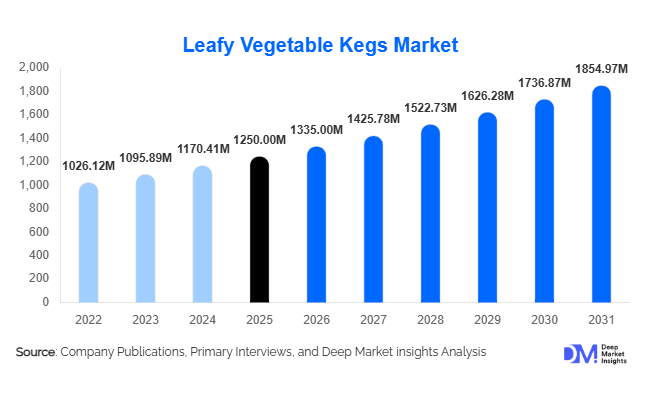
According to Deep Market Insights, the global leafy vegetable kegs market size was valued at USD 1,250 million in 2026 and is projected to grow from USD 1,335.00 million in 2026 to reach USD 1,854.97million by 2031, expanding at a CAGR of 6.8% during the forecast period (2026–2031). The market growth is primarily driven by rising global demand for fresh leafy vegetables, increasing adoption of reusable and sustainable agricultural packaging systems, expansion of cold-chain logistics infrastructure, and growing export-oriented horticulture trade across emerging economies.The Global Leafy Vegetable Kegs Market is transitioning from traditional agricultural crates to standardized, ventilated, and reusable keg systems designed to reduce post-harvest losses and improve supply chain efficiency. Increasing global emphasis on food safety compliance, reduction of plastic waste, and optimization of logistics costs is significantly accelerating adoption. Additionally, technological advancements such as collapsible designs, RFID-enabled tracking, and temperature-controlled smart kegs are further enhancing operational visibility and efficiency across the fresh produce value chain. As global trade in leafy greens expands, especially across Asia-Pacific, Europe, and North America, the demand for durable and export-compliant keg systems is expected to grow steadily over the forecast period.
Key Market Insights
- Reusable HDPE-based kegs dominate adoption, driven by cost efficiency, durability, and recyclability across global supply chains.
- Export-oriented leafy vegetable logistics is the fastest-growing application segment, supported by rising international trade in fresh produce.
- Medium-capacity kegs (15–30 kg) hold the largest share, as they optimize handling efficiency across retail and wholesale distribution systems.
- Direct B2B procurement channels dominate the market, driven by long-term contracts between farmers, exporters, and retail chains.
- Asia-Pacific leads global demand, supported by large-scale agricultural production and export infrastructure in China and India.
- Sustainability and circular economy regulations are reshaping packaging standards, accelerating adoption of reusable and returnable keg systems.
Leafy Vegetable Kegs Market Latest Trends
Sustainable and Circular Packaging Transition
The leafy vegetable kegs market is undergoing a structural transition toward sustainable and circular packaging systems, driven by tightening environmental regulations and increasing corporate sustainability commitments. Governments across major economies are restricting single-use plastics, which is accelerating the adoption of reusable and recyclable alternatives such as HDPE-based kegs and advanced bio-composite materials. These solutions are being designed for extended lifecycle use, improved durability, and compatibility with closed-loop logistics systems. Large-scale retailers, agricultural cooperatives, and export consortia are increasingly implementing returnable pooling models, which not only reduce packaging waste but also optimize long-term operational costs through asset reuse and standardized reverse logistics frameworks.
Smart Logistics and Traceability Integration
Technological advancement is reshaping the competitive landscape of the market, with smart logistics emerging as a key differentiator. The integration of RFID tracking, IoT-enabled sensors, and GPS-based monitoring systems within reusable kegs is enabling real-time visibility across the supply chain. These technologies facilitate precise tracking of temperature, humidity, and transit conditions, significantly reducing spoilage rates and improving product quality retention. The adoption of digitally connected kegs is particularly strong in export-driven supply chains where regulatory compliance, traceability, and food safety certification requirements are stringent. This trend is also enhancing operational efficiency by enabling predictive inventory management and reducing logistical inefficiencies.
Leafy Vegetable Kegs Market Drivers
Rising Global Consumption of Fresh Leafy Vegetables
The increasing global shift toward healthier diets and plant-based nutrition is significantly boosting consumption of leafy vegetables such as spinach, lettuce, kale, and arugula. This structural dietary change is creating sustained demand for efficient packaging solutions that preserve freshness, extend shelf life, and minimize post-harvest losses. The expansion of organized retail formats, including supermarkets and hypermarkets, is further standardizing procurement practices, thereby strengthening demand for uniform, reusable keg systems across both domestic and international supply chains.
Expansion of Cold-Chain Infrastructure
Rapid investments in cold-chain infrastructure, including refrigerated transport, controlled atmosphere storage, and temperature-regulated distribution networks, are playing a critical role in accelerating market growth. Emerging economies across Asia-Pacific and Latin America are witnessing significant infrastructure modernization, enabling long-distance transportation of perishable leafy vegetables with reduced spoilage. This expansion is directly increasing the adoption of ventilated and thermally compatible kegs designed for cold-chain integration, thereby improving overall supply chain efficiency.
Shift Toward Sustainable Agricultural Logistics
Regulatory mandates and sustainability-driven procurement policies are driving a fundamental shift toward reusable agricultural logistics systems. Governments and agribusiness organizations are promoting circular economy frameworks aimed at reducing plastic waste and improving resource efficiency. This has led to widespread adoption of returnable keg systems in large-scale farming, aggregation centers, and export logistics operations. The increasing alignment of packaging strategies with environmental compliance standards is reinforcing long-term market expansion.
Leafy Vegetable Kegs Market Restraints
High Initial Investment Costs
The adoption of advanced reusable and smart keg systems requires significant upfront capital investment, which remains a key barrier for small and medium-scale agricultural producers. Although lifecycle cost efficiencies and long-term savings are evident, limited access to financing in developing regions continues to slow large-scale adoption. This cost sensitivity is particularly pronounced in fragmented agricultural markets where traditional packaging methods remain dominant.
Inefficient Reverse Logistics Systems
The effectiveness of reusable keg systems is highly dependent on the presence of efficient reverse logistics networks. In several developing regions, inadequate infrastructure for collection, cleaning, sanitization, and redistribution of kegs reduces operational efficiency and increases logistical complexity. The absence of standardized return mechanisms limits scalability and discourages widespread adoption among smaller supply chain participants.
Leafy Vegetable Kegs Industry Key Opportunities
Expansion in Export-Oriented Agriculture
The rapid growth of international trade in fresh vegetables from key producing countries such as India, China, Vietnam, and Mexico is creating strong demand for standardized and export-compliant packaging systems. Increasingly stringent global food safety and quality regulations are driving the need for durable, stackable, and ventilated kegs that ensure product integrity during long-haul transportation. This export-driven expansion is expected to remain one of the most influential growth enablers for the market.
Adoption of Smart and IoT-Enabled Kegs
The integration of IoT-enabled tracking and monitoring systems presents a major opportunity for value-added innovation in the market. Smart kegs equipped with sensors for temperature, humidity, and location tracking enable real-time visibility and proactive supply chain management. This capability is particularly valuable for high-value export shipments and premium retail distribution channels, where product quality and traceability are critical competitive factors.
Growth of Organized Retail and HORECA Industry
The expansion of organized retail, hospitality, and food service industries is significantly increasing demand for standardized and hygienic packaging solutions. Supermarkets, hypermarkets, hotels, restaurants, and catering services are prioritizing consistent quality and supply reliability, which is strengthening the adoption of reusable keg systems. This trend is further amplified by urbanization and changing consumer preferences toward fresh and minimally processed food products.
Report Scope
| Report Metric | Details |
|---|---|
| Market Size in 2025 | USD 1250.00 Million |
| Market Size in 2026 | USD 1335.00 Million |
| Market Size in 2031 | USD 1854.97 Million |
| CAGR | 6.8% (2026-2031) |
| Base Year for Estimation | 2025 |
| Historical Data | 2022-2024 |
| Forecast Period | 2026-2031 |
| Report Coverage | Revenue Forecast, Competitive Landscape, Supply Chain Disruption, Growth Factors, Environment & Regulatory Landscape and Trends |
| Geographies Covered | North America, Europe, APAC, Middle East and Africa, LATAM |
| Countries Covered | U.S., Canada, U.K., Germany, France, Spain, Italy, Russia, Nordic, Benelux, Rest of Europe, China, Korea, Japan, India, Australia, Singapore, Taiwan, South East Asia, Rest of Asia-Pacific, UAE, Turky, Saudi Arabia, South Africa, Egypt, Nigeria, Rest of MEA, Brazil, Mexico, Argentina, Chile, Colombia, Rest of LATAM |
Explore more data points, trends and opportunities Download Free Sample Report
Product Type Insights
Within product segmentation, HDPE-based kegs continue to dominate the market due to their high durability, chemical resistance, and recyclability, accounting for approximately 46% share in 2025. The leading driver within this segment is the growing preference for long-life reusable packaging that aligns with circular economy objectives and reduces replacement frequency. Medium-capacity kegs ranging from 15 to 30 kg hold the largest share at around 52%, primarily driven by their operational efficiency in balancing retail-level handling and export logistics requirements. Ventilated standard kegs account for nearly 41% of the market, supported by their cost-effectiveness and ability to maintain airflow, which is critical for preserving freshness. Direct B2B distribution channels dominate with approximately 57% share, driven by long-term procurement contracts between producers, exporters, and large retail buyers, ensuring consistent demand and supply chain stability.
Application Insights
Export-oriented leafy vegetable logistics represents the fastest-growing application segment, accounting for approximately 38% of global demand. The primary growth driver in this segment is the increasing globalization of fresh produce trade, supported by stricter quality compliance standards and rising demand for year-round availability of fresh vegetables in importing countries. Domestic retail supply chains continue to provide a stable demand base, supported by the expansion of organized retail infrastructure and modern distribution networks. The HORECA sector is also witnessing steady growth, driven by rising consumption of fresh produce in commercial food services. Additionally, processed leafy greens such as pre-cut salads and ready-to-eat mixes are emerging as a high-growth niche, requiring highly hygienic and temperature-controlled packaging systems to maintain freshness and safety standards.
Explore more data points, trends and opportunities Download Free Sample Report
Leafy Vegetable Kegs Market Segmentations
By Material Type
- High-Density Polyethylene (HDPE) Kegs
- Polypropylene (PP) Kegs
- Biodegradable & Bio-composite Polymer Kegs
- Stainless Steel Reusable Kegs
By Capacity
- Small Capacity
- Medium Capacity
- Large Capacity
By Functionality
- Standard Ventilated Kegs
- Collapsible Reusable Kegs
- Temperature-Controlled Smart Kegs
- Reinforced Export-Grade Kegs
By Distribution Channel
- Direct B2B
- Agricultural Cooperatives & Wholesale Distributors
- Retail Supply Chain Procurement
- Digital Agri-Logistics Platforms
By Application
- Domestic Fresh Leafy Vegetable Supply
- Export-Oriented Fresh Produce Logistics
- Food Service Industry
- Processed & Fresh-Cut Green Vegetable Industry
Regional Insights
Asia-Pacific
Asia-Pacific leads the global market with approximately 39% share, supported by large-scale agricultural production, expanding export activity, and strong government investments in cold-chain infrastructure. China remains a dominant production hub, while India is emerging as the fastest-growing country in the region. The key growth driver in Asia-Pacific is rapid modernization of agricultural logistics systems combined with increasing participation in global export markets, which is driving strong demand for standardized and reusable keg solutions.
North America
North America accounts for around 27% market share, with the United States being the primary contributor. The region’s growth is driven by highly organized retail supply chains, advanced logistics infrastructure, and strong dependence on imports from Latin America. A key driver in this region is the increasing emphasis on food safety compliance, efficiency in cold-chain logistics, and the adoption of automated and traceable packaging systems that enhance supply chain transparency.
Europe
Europe holds nearly 22% share of the market, supported by stringent environmental regulations and strong institutional adoption of reusable packaging systems. Countries such as Germany, France, Spain, and the Netherlands are leading contributors. The primary growth driver in Europe is regulatory enforcement of circular economy principles, which is compelling stakeholders to transition toward fully reusable, recyclable, and standardized packaging systems across agricultural and retail supply chains.
Latin America
Latin America contributes approximately 8% of global demand, with Brazil and Mexico serving as key export-oriented agricultural economies. The region’s growth is primarily driven by increasing integration into global fresh produce supply chains and rising export volumes of leafy vegetables. Improvements in logistics infrastructure and growing partnerships with North American and European markets are further strengthening demand for durable and export-compliant keg systems.
Middle East & Africa
The Middle East & Africa region is experiencing steady growth driven by high import dependency in Gulf countries and expanding agricultural export capabilities in parts of Africa. A key growth driver is ongoing investment in logistics infrastructure, including cold storage facilities and distribution networks, which is gradually improving supply chain efficiency. Rising food security initiatives and diversification of agricultural output are also contributing to increasing adoption of standardized packaging systems across the region.
Key Players in the Leafy Vegetable Kegs Market
- IFCO Systems
- Brambles (CHEP)
- Tosca Services
- ORBIS Corporation
- Schoeller Allibert
- DS Smith
- Greif Inc.
- Berry Global
- Mauser Packaging Solutions
- Nefab Group
- IPL Plastics
- SSI SCHAEFER
- CABKA Group
- Mondi Group
- PPS Midlands Packaging Systems