Kola Nut Market Size
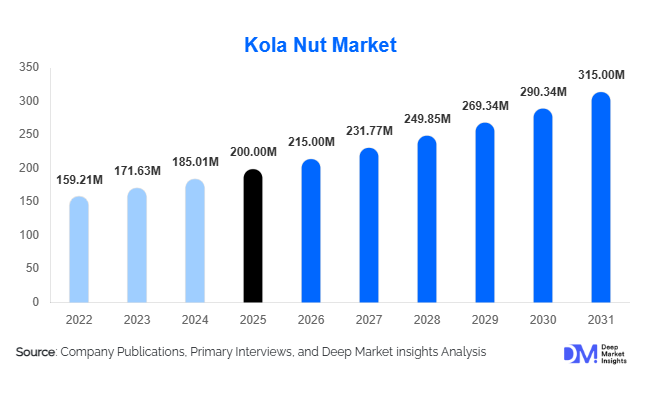
According to Deep Market Insights, the global kola nut market size was valued at USD 200 million in 2025 and is projected to grow from USD 215 million in 2026 to reach USD 315 million by 2031, expanding at a CAGR of 7.8% during the forecast period (2026–2031). The kola nut market growth is primarily driven by rising demand for natural caffeine sources, increasing adoption in functional beverages, and expanding applications in nutraceuticals and pharmaceuticals. The growing preference for plant-based and organic ingredients across global markets is further accelerating demand, while export-oriented trade from West Africa continues to strengthen global supply chains.
Key Market Insights
- Kola nut demand is increasingly driven by natural stimulant applications, particularly in energy drinks and functional beverages.
- Processed kola nut extracts are gaining prominence, enabling standardized usage across pharmaceutical and nutraceutical industries.
- Middle East & Africa dominates production and supply, led by Nigeria, Ghana, and Ivory Coast.
- Asia-Pacific is the fastest-growing consumption region, driven by rising health awareness and expanding beverage markets.
- Organic and sustainably sourced kola nuts are witnessing premium demand, especially in Europe and North America.
- Technological advancements in extraction and processing are improving product quality and expanding industrial applications.
What are the latest trends in the kola nut market?
Rising Popularity of Natural Energy Ingredients
The shift toward natural and plant-based ingredients is significantly influencing the kola nut market. Consumers are increasingly avoiding synthetic caffeine, leading to higher demand for kola nut extracts in energy drinks and dietary supplements. Beverage manufacturers are incorporating kola nut into premium formulations, positioning products as healthier alternatives. This trend is particularly strong among younger consumers and fitness-conscious populations seeking clean-label products. As a result, kola nut is transitioning from a traditional ingredient to a modern functional component in global beverage innovation.
Expansion of Nutraceutical Applications
Kola nut is gaining traction in the nutraceutical sector due to its antioxidant and metabolic properties. Manufacturers are developing capsules, powders, and liquid extracts targeting energy enhancement, digestion, and cognitive support. Increasing consumer awareness of preventive healthcare and herbal remedies is accelerating this trend. Standardization of active compounds and improved extraction technologies are enabling consistent product quality, making kola nut a viable ingredient for large-scale nutraceutical production. This trend is expected to create long-term growth opportunities in both developed and emerging markets.
What are the key drivers in the kola nut market?
Growth of Functional Beverage Industry
The rapid expansion of the global functional beverage market is a key driver for kola nut demand. Energy drinks, herbal teas, and wellness beverages are increasingly incorporating kola nut as a natural caffeine source. The global shift toward healthier beverage options, combined with rising disposable incomes, is supporting this growth. Manufacturers are innovating with new flavors and formulations, further boosting kola nut consumption.
Increasing Adoption in Herbal Medicine
Kola nut has long been used in traditional medicine, and its integration into modern pharmaceutical and herbal formulations is expanding. Its stimulant and digestive properties are driving demand in healthcare applications. Growing consumer preference for natural remedies and increasing investments in herbal medicine research are supporting market growth.
What are the restraints for the global market?
Supply Chain Limitations
Kola nut production is highly concentrated in West Africa, creating supply chain vulnerabilities. Limited scalability, dependence on seasonal harvests, and inadequate infrastructure can lead to supply fluctuations and price volatility. These factors pose challenges for consistent global supply.
Regulatory Barriers in Developed Markets
Strict regulations regarding caffeine content and herbal ingredients in regions such as North America and Europe can limit market expansion. Compliance with quality standards, labeling requirements, and safety regulations increases operational complexity for manufacturers.
What are the key opportunities in the kola nut industry?
Expansion in Export Markets
Export-driven growth presents a major opportunity for kola nut producers. Investments in processing facilities, quality certification, and logistics can help expand market reach in North America, Europe, and Asia-Pacific. Governments supporting agricultural exports can further enhance global trade opportunities.
Integration into Premium and Organic Products
The rising demand for organic and sustainably sourced ingredients offers significant growth potential. Companies focusing on ethical sourcing and traceability can command premium pricing and attract environmentally conscious consumers. This trend is particularly strong in developed markets.
Report Scope
| Report Metric | Details |
|---|---|
| Market Size in 2025 | USD 200 Million |
| Market Size in 2026 | USD 215 Million |
| Market Size in 2031 | USD 315 Million |
| CAGR | 7.8% (2026-2031) |
| Base Year for Estimation | 2025 |
| Historical Data | 2022-2024 |
| Forecast Period | 2026-2031 |
| Report Coverage | Revenue Forecast, Competitive Landscape, Supply Chain Disruption, Growth Factors, Environment & Regulatory Landscape and Trends |
| Geographies Covered | North America, Europe, APAC, Middle East and Africa, LATAM |
| Countries Covered | U.S., Canada, U.K., Germany, France, Spain, Italy, Russia, Nordic, Benelux, Rest of Europe, China, Korea, Japan, India, Australia, Singapore, Taiwan, South East Asia, Rest of Asia-Pacific, UAE, Turky, Saudi Arabia, South Africa, Egypt, Nigeria, Rest of MEA, Brazil, Mexico, Argentina, Chile, Colombia, Rest of LATAM |
Explore more data points, trends and opportunities Download Free Sample Report
Product Type Insights
The product type landscape of the kola nut market reflects a gradual yet significant transformation from traditional consumption formats toward more industrially adaptable and value-added derivatives. Processed kola nuts, particularly in the form of standardized extracts, powders, and concentrates, dominate the market with approximately 42% share of the 2025 market size. This dominance is primarily attributed to their consistent chemical composition, longer shelf life, and ease of incorporation into a wide array of downstream applications, including beverages, pharmaceuticals, nutraceuticals, and dietary supplements. Manufacturers across industries increasingly favor processed kola derivatives because they enable precise dosage control, improved product stability, and scalable production processes, which are essential for large-scale commercialization.In contrast, whole kola nuts continue to maintain cultural and economic significance, particularly in traditional markets across West Africa. They are widely consumed in their raw or minimally processed form for ceremonial, social, and medicinal purposes. However, their global market share is gradually declining as industrial applications favor processed formats that are easier to transport, store, and standardize. Despite this, whole kola nuts still play a crucial role in sustaining local economies and preserving traditional consumption patterns. The coexistence of traditional and modern product forms highlights the dual nature of the kola nut market, where heritage consumption and industrial innovation intersect to shape overall growth dynamics.
Application Insights
The application spectrum of the kola nut market is diverse, with the food and beverages segment leading the market and accounting for nearly 55% of global demand. Kola nuts have historically been a key ingredient in carbonated soft drinks and continue to be widely used in modern formulations of energy drinks, flavored beverages, and traditional food products. The segment’s dominance is largely driven by the increasing global consumption of functional beverages, which are formulated to provide added health benefits such as energy enhancement, cognitive support, and improved metabolism.The leading segment driver for the food and beverages category is the rapid expansion of the functional and energy drink industry, particularly among younger demographics and urban populations. Consumers are increasingly seeking beverages that offer both refreshment and functional benefits, prompting manufacturers to incorporate natural caffeine sources like kola nut. Additionally, the shift toward plant-based and natural ingredients has further amplified demand, as kola nut aligns well with clean-label and organic product positioning.Other niche applications, including cosmetics and personal care products, are also gaining traction. The antioxidant and anti-inflammatory properties of kola nut extracts make them suitable for skincare formulations aimed at combating oxidative stress and promoting skin health. Although currently a smaller segment, the integration of kola nut in cosmetic applications represents a promising avenue for future growth as the demand for natural and botanical ingredients continues to rise.
Distribution Channel Insights
The distribution channel dynamics of the kola nut market are largely shaped by the requirements of industrial buyers and the evolving preferences of end consumers. Direct sales, particularly in the business-to-business (B2B) segment, dominate the market and contribute around 60% of the overall share. This dominance is primarily due to the need for bulk procurement, consistent quality, and reliable supply chains, especially among large-scale manufacturers in the beverage, pharmaceutical, and nutraceutical industries.Indirect distribution channels, including online retail platforms, specialty stores, and health food outlets, are gradually gaining prominence, particularly in developed markets. These channels cater to smaller-scale buyers, individual consumers, and niche markets seeking premium or specialty products. The rise of e-commerce and digital marketplaces has significantly improved accessibility, allowing consumers to purchase kola nut products in various forms, including supplements, powders, and extracts.The growing popularity of online retail is driven by increasing internet penetration, convenience, and the availability of a wide range of products. Additionally, the ability to access detailed product information, customer reviews, and certifications has enhanced consumer confidence in purchasing kola nut products through digital channels. As consumer awareness continues to grow, indirect channels are expected to play an increasingly important role in expanding market reach and diversifying the customer base.
End-Use Industry Insights
The end-use industry landscape of the kola nut market is dominated by the beverage industry, which accounts for over 50% of total demand. This dominance is closely linked to the historical and contemporary use of kola nut as a natural flavoring and stimulant in beverages. The rapid growth of energy drinks, functional beverages, and herbal infusions has further reinforced the importance of this segment, making it a cornerstone of market expansion.The pharmaceutical and nutraceutical industries represent the fastest-growing end-use segments, supported by rising health awareness and the increasing adoption of natural supplements. Kola nut is being incorporated into various formulations aimed at improving cognitive function, enhancing metabolism, and supporting overall well-being. The shift toward preventive healthcare and the growing popularity of herbal remedies are key factors driving demand in these industries.Emerging applications in the cosmetics and personal care industry are also contributing to market growth. The antioxidant properties of kola nut extracts make them suitable for use in anti-aging products, skincare formulations, and hair care solutions. As consumers continue to prioritize natural and sustainable ingredients in personal care products, the demand for kola nut-based formulations is expected to increase, creating new opportunities for market expansion.
Explore more data points, trends and opportunities Download Free Sample Report
Kola Nut Market Segmentations
By Product Type
- Whole Kola Nuts
- Powdered Kola Nut
- Kola Nut Extracts
By Application
- Food & Beverages
- Pharmaceuticals
- Nutraceuticals & Dietary Supplements
- Cosmetics & Personal Care
By Distribution Channel
- Direct Sales
- Supermarkets/Hypermarkets
- Specialty Stores
- Online Retail
Regional Insights
North America
North America accounts for approximately 20% of the global kola nut market, driven by strong demand for functional beverages, dietary supplements, and natural ingredients. The United States leads the region, supported by a well-established nutraceutical industry and high levels of consumer awareness regarding health and wellness. The region’s advanced retail infrastructure and robust distribution networks further facilitate market growth.The key drivers for regional growth in North America include the rising popularity of energy drinks and functional beverages, increasing demand for clean-label and plant-based products, and a growing preference for natural caffeine sources. Additionally, the presence of major beverage manufacturers and continuous product innovation are contributing to market expansion. Regulatory support for natural and herbal ingredients, coupled with increasing investments in research and development, is also enhancing the adoption of kola nut across various applications.
Europe
Europe holds around 18% of the global market share, with countries such as Germany, the United Kingdom, and France serving as key demand centers. The region is characterized by a strong inclination toward organic, sustainable, and ethically sourced products, which aligns well with the natural attributes of kola nut. Stringent regulatory frameworks and quality standards further ensure the safe and effective use of natural ingredients in food, beverages, and pharmaceuticals.The primary drivers of regional growth in Europe include increasing consumer awareness of health and wellness, a strong preference for organic and clean-label products, and supportive regulatory policies promoting the use of natural ingredients. The expanding functional food and beverage sector, along with the growing popularity of herbal supplements, is also contributing to market growth. Additionally, sustainability initiatives and ethical sourcing practices are encouraging the adoption of kola nut products, particularly among environmentally conscious consumers.
Asia-Pacific
Asia-Pacific is the fastest-growing region in the global kola nut market, with a compound annual growth rate exceeding 9%. Countries such as China, India, and Japan are witnessing significant growth due to rising health awareness, rapid urbanization, and expanding middle-class populations. The region’s dynamic beverage industry and increasing demand for functional and herbal products are key factors driving market expansion.The drivers for regional growth in Asia-Pacific include changing consumer lifestyles, increasing disposable incomes, and a growing preference for health-oriented products. The rapid expansion of the food and beverage industry, particularly in emerging economies, is creating substantial demand for natural ingredients like kola nut. Additionally, the integration of traditional herbal medicine with modern healthcare practices is further boosting the adoption of kola nut in pharmaceutical and nutraceutical applications. The rise of e-commerce and improved distribution networks are also enhancing product accessibility across the region.
Latin America
Latin America accounts for approximately 7% of the global kola nut market, with Brazil and Mexico emerging as key contributors. The region is characterized by a growing interest in natural and plant-based ingredients, particularly in the food and beverage sector. Increasing health consciousness and the rising popularity of functional foods are supporting market growth.The key drivers for regional growth in Latin America include the expanding middle-class population, increasing awareness of health and wellness, and the growing demand for natural and organic products. The region’s vibrant food and beverage industry, coupled with the rising adoption of functional ingredients, is creating new opportunities for kola nut applications. Additionally, improving economic conditions and expanding retail infrastructure are facilitating market penetration and growth.
Middle East & Africa
The Middle East & Africa region dominates the global kola nut market with approximately 45% share, led by countries such as Nigeria, Ghana, and Ivory Coast. These countries are among the largest producers and exporters of kola nuts, benefiting from favorable climatic conditions and well-established agricultural practices. Strong domestic consumption and a robust export-oriented supply chain are key factors supporting the region’s dominance.The primary drivers for regional growth in the Middle East & Africa include abundant raw material availability, established production and export networks, and deep-rooted cultural significance of kola nut consumption. Government initiatives aimed at supporting agricultural development and improving export capabilities are further enhancing market growth. Additionally, increasing global demand for natural ingredients is creating new export opportunities for the region. The expansion of processing facilities and value-added production is also contributing to higher revenue generation and strengthening the region’s position in the global market.
Key Players in the Kola Nut Market
- Olam Group
- Archer Daniels Midland Company
- Barry Callebaut AG
- Symrise AG
- Givaudan (Naturex)
- Nexira
- Indigo Herbs Ltd
- Mountain Rose Herbs
- NOW Foods
- Herbal Hills
- Afrigold Kola Nut Company
- Kola Nut International
- Nutra Green Biotechnology
- Herbo Nutra
- Organic Herb Trading