Ice Cream Mooncake Preparations Market Size
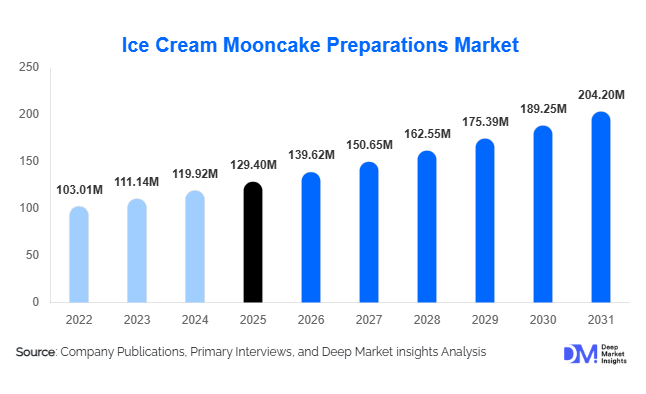
According to Deep Market Insights, the global ice cream mooncake preparations market size was valued at USD 129.4 million in 2025 and is projected to grow from USD 139.62 million in 2026 to reach USD 204.20 million by 2031, expanding at a CAGR of 7.9% during the forecast period (2026–2031). The market growth is primarily driven by the increasing premiumization of festive desserts, rising demand for innovative frozen confectionery products, and expanding corporate gifting expenditure across Asia-Pacific markets. Ice cream mooncakes have evolved from a niche seasonal offering into a premium festive product category, combining traditional mooncake symbolism with modern frozen dessert formulations. Growing consumer preference for luxury gifting, artisanal flavors, and limited-edition festive products continues to support long-term market expansion globally.
Key Market Insights
- Premium gifting remains the largest revenue driver, with multi-pack gift boxes accounting for a substantial share of seasonal sales across China, Hong Kong, Singapore, and Malaysia.
- Traditional Asian flavors continue to dominate product demand, particularly lotus seed, red bean, taro, pandan, and durian-based variants.
- Asia-Pacific dominates the global market, accounting for approximately 72% of total revenue due to strong cultural relevance and mature mooncake consumption patterns.
- Plant-based and low-sugar formulations are emerging rapidly, driven by growing health consciousness and dietary diversification among younger consumers.
- E-commerce channels are transforming seasonal sales, enabling premium brands to expand market reach and improve gifting convenience.
- Advanced cold-chain logistics and freezing technologies are improving product quality, shelf life, and geographic market accessibility.
Ice Cream Mooncake Preparations Market Latest Trends
Premiumization and Luxury Gifting Driving Category Expansion
Premiumization has become the defining trend within the ice cream mooncake preparations market. Consumers increasingly view ice cream mooncakes as luxury festive gifts rather than conventional seasonal desserts. Manufacturers are responding with premium ingredients, handcrafted production techniques, designer packaging, and exclusive flavor collaborations. Luxury gift boxes featuring imported chocolates, premium dairy ingredients, gold embellishments, and limited-edition seasonal themes have become mainstream across major Asian markets. Corporate gifting demand is further supporting this trend, as businesses increasingly seek premium products that enhance brand image and strengthen customer relationships. Premium offerings command significantly higher average selling prices and margins compared to traditional mooncake products, making them a strategic focus area for market participants.
Health-Oriented and Plant-Based Innovation Accelerating Growth
Consumer demand for healthier indulgence is encouraging manufacturers to develop low-sugar, lactose-free, vegan, and functional ice cream mooncake preparations. Oat-based, coconut-based, soy-based, and almond-based formulations are increasingly being introduced to address dietary restrictions and sustainability preferences. Manufacturers are also incorporating natural sweeteners, probiotics, and clean-label ingredients into premium product portfolios. Younger consumers, particularly in urban markets, are demonstrating strong interest in products that balance indulgence with wellness considerations. The trend is expected to broaden category appeal beyond traditional mooncake consumers and create new opportunities for innovation-focused brands.
Ice Cream Mooncake Preparations Market Drivers
Growing Demand for Premium Festive Gifting
Corporate and household gifting continues to represent one of the strongest growth drivers for the ice cream mooncake preparations market. Across China, Hong Kong, Taiwan, Singapore, and Malaysia, premium mooncake gifting remains deeply embedded within Mid-Autumn Festival traditions. Businesses increasingly purchase premium gift sets for employees, customers, distributors, and strategic partners. Ice cream mooncakes provide a differentiated alternative to traditional mooncakes, offering novelty, premium positioning, and strong visual appeal. The ability to command higher prices while delivering enhanced gifting experiences has made premium ice cream mooncakes a preferred choice across both consumer and corporate segments.
Innovation in Flavors and Product Formats
Continuous innovation is expanding the addressable consumer base. Manufacturers are launching flavors such as matcha, yuzu, salted caramel, Belgian chocolate, durian, coffee, and mixed fruit combinations to attract younger consumers seeking unique dessert experiences. Premium fillings, layered textures, and hybrid confectionery concepts are also improving product differentiation. The growing popularity of limited-edition seasonal collections further stimulates consumer engagement and repeat purchases during festive periods.
Expansion of Premium Frozen Dessert Consumption
The broader premium frozen dessert industry continues to experience robust growth globally. Consumers are increasingly willing to pay premium prices for artisanal frozen products that deliver superior quality, unique ingredients, and memorable consumption experiences. Ice cream mooncakes benefit directly from this premium dessert trend while maintaining strong cultural relevance. Rising disposable incomes across Asia-Pacific and growing demand for experiential food products are supporting sustained category growth.
Ice Cream Mooncake Preparations Market Restraints
Cold Chain Infrastructure Requirements
Ice cream mooncake preparations require temperature-controlled manufacturing, transportation, storage, and retail distribution systems. Cold chain dependency significantly increases operating costs compared to traditional mooncake products. Emerging markets with underdeveloped refrigeration infrastructure often face distribution challenges that can limit product availability and increase spoilage risks. Maintaining product quality throughout the supply chain remains a critical operational requirement for market participants.
Seasonal Demand Concentration
Despite ongoing diversification efforts, annual sales remain heavily concentrated around Mid-Autumn Festival celebrations. Manufacturers frequently experience production peaks followed by periods of significantly lower demand. Inventory management, production planning, and resource utilization become more complex under such seasonal conditions. While year-round availability is increasing in select markets, demand concentration continues to present profitability and forecasting challenges.
Ice Cream Mooncake Preparations Market Industry Key Opportunities
Expansion of Plant-Based and Functional Product Lines
The rapid growth of plant-based desserts presents a major opportunity for both established manufacturers and new entrants. Consumers increasingly seek dairy alternatives that align with health, sustainability, and ethical consumption preferences. Oat milk, almond milk, soy milk, and coconut milk-based ice cream mooncakes offer strong growth potential, particularly among younger demographics. Functional ingredients such as probiotics, reduced-calorie sweeteners, and added nutritional benefits further enhance market attractiveness. Manufacturers that successfully combine traditional mooncake flavors with modern health-focused formulations are likely to capture significant market share over the coming years.
International Expansion Through Diaspora and Mainstream Adoption
The globalization of Asian cuisine continues to create attractive growth opportunities. Chinese diaspora communities across North America, Europe, Australia, and the Middle East remain important consumers of mooncake products. At the same time, mainstream consumers are increasingly exploring Asian desserts and premium frozen confectionery. E-commerce platforms, specialty retailers, and international foodservice operators are expanding accessibility to premium ice cream mooncakes. This trend creates opportunities for brands to localize flavors while maintaining cultural authenticity, supporting long-term international market expansion.
Report Scope
| Report Metric | Details |
|---|---|
| Market Size in 2025 | USD 129.40 Million |
| Market Size in 2026 | USD 139.62 Million |
| Market Size in 2031 | USD 204.20 Million |
| CAGR | 7.9% (2026-2031) |
| Base Year for Estimation | 2025 |
| Historical Data | 2022-2024 |
| Forecast Period | 2026-2031 |
| Report Coverage | Revenue Forecast, Competitive Landscape, Supply Chain Disruption, Growth Factors, Environment & Regulatory Landscape and Trends |
| Geographies Covered | North America, Europe, APAC, Middle East and Africa, LATAM |
| Countries Covered | U.S., Canada, U.K., Germany, France, Spain, Italy, Russia, Nordic, Benelux, Rest of Europe, China, Korea, Japan, India, Australia, Singapore, Taiwan, South East Asia, Rest of Asia-Pacific, UAE, Turky, Saudi Arabia, South Africa, Egypt, Nigeria, Rest of MEA, Brazil, Mexico, Argentina, Chile, Colombia, Rest of LATAM |
Explore more data points, trends and opportunities Download Free Sample Report
Product Type Insights
Premium artisan ice cream mooncake preparations hold the leading position in the global market, accounting for approximately 28% of total revenue in 2025. Segment leadership is primarily driven by rising consumer preference for premium gifting products, increasing demand for artisanal food experiences, and strong willingness among affluent consumers to pay premium prices for exclusive seasonal offerings. Manufacturers continue to differentiate products through handcrafted production techniques, limited-edition collections, luxury ingredients, and innovative flavor combinations, reinforcing the segment’s premium positioning. The growing influence of social media and experiential consumption trends has further elevated demand for visually appealing and high-quality artisan mooncake products.Plant-based ice cream mooncake preparations represent the fastest-growing product category during the forecast period. Growth is being supported by increasing adoption of vegan and flexitarian lifestyles, rising prevalence of lactose intolerance across Asian populations, and growing consumer awareness regarding sustainability and animal welfare considerations. Manufacturers are introducing plant-based alternatives utilizing coconut milk, oat milk, almond milk, and soy-based ingredients to expand their consumer base. In addition, low-sugar, high-protein, and functional ice cream mooncake variants are gaining traction as health-conscious consumers seek premium indulgence products that align with evolving wellness preferences without compromising taste and product quality.
Flavor Category Insights
Traditional Asian flavors dominate the flavor category landscape, accounting for an estimated 31% of global market revenue in 2025. The segment's leadership is primarily driven by strong cultural relevance and consumer preference for authentic festival experiences. Popular flavors including lotus seed paste, red bean, taro, pandan, black sesame, yam, and durian continue to resonate strongly across key Asian markets where traditional flavor profiles remain closely associated with Mid-Autumn Festival celebrations. The ability of these flavors to evoke nostalgia and preserve cultural heritage continues to strengthen consumer loyalty and repeat purchases.Matcha and tea-based formulations have witnessed significant growth, particularly among younger consumers who associate these flavors with premium quality, wellness attributes, and contemporary dessert trends. Fruit-based flavors, including mango, lychee, strawberry, passionfruit, and citrus blends, continue to expand market appeal by attracting younger demographics and consumers seeking refreshing alternatives to traditional mooncake offerings.Manufacturers are increasingly leveraging coffee-based variants, fusion flavors, and seasonal limited-edition launches to maintain consumer engagement and stimulate repeat purchases. Continuous flavor innovation remains a critical competitive strategy as brands seek to differentiate product portfolios, capture premium pricing opportunities, and address evolving consumer preferences across both mature and emerging markets.
Distribution Channel Insights
Specialty dessert retailers account for approximately 29% of global sales in 2025, making them the largest distribution channel. Segment dominance is driven by consumers’ preference for premium product selection, enhanced product authenticity, superior freshness assurance, and personalized gifting solutions. Specialty retailers often serve as important brand-building platforms where manufacturers can showcase exclusive seasonal collections, luxury packaging formats, and limited-edition offerings that support premium pricing strategies.Hypermarkets and supermarkets continue to play a critical role in expanding market penetration due to their extensive geographic reach, strong foot traffic, and seasonal promotional capabilities. These channels are particularly important during Mid-Autumn Festival periods when consumers actively seek convenient purchasing options and bundled gifting packages.Ice cream parlors, bakery chains, specialty confectionery stores, and premium food retailers contribute significantly to premium product sales by targeting consumers seeking high-quality dessert experiences. The growing integration of frozen dessert sections within premium retail formats has further enhanced product visibility and accessibility.E-commerce has emerged as one of the fastest-growing distribution channels, accounting for nearly one-fifth of total market revenues. Rapid digitalization, increasing consumer preference for convenience, and expanding online gifting programs are supporting channel expansion. Direct-to-consumer platforms, mobile commerce applications, and online marketplaces have become increasingly important for seasonal promotions, corporate gifting campaigns, and premium product launches. The ability to offer nationwide delivery, customized gift packaging, and personalized purchasing experiences continues to strengthen the role of digital channels within the global market.
End User Insights
Household consumers remain the largest end-user segment, representing approximately 51% of global market demand in 2025. Segment leadership is primarily driven by strong family-oriented consumption patterns during Mid-Autumn Festival celebrations, where mooncakes continue to play a central role in cultural traditions and social gatherings. Rising disposable incomes, increasing premium dessert consumption, and growing interest in innovative festival products continue to support household purchasing activity across major markets.Corporate gifting represents the fastest-growing end-user segment and is expected to witness substantial expansion throughout the forecast period. Growth is being fueled by increasing business expenditure on premium seasonal gifts, rising emphasis on relationship management initiatives, and greater adoption of customized branded gifting solutions. Companies increasingly utilize premium ice cream mooncakes as corporate gifts to strengthen relationships with clients, employees, and business partners.Hospitality establishments, including luxury hotels, premium restaurants, and upscale cafes, are increasingly incorporating branded ice cream mooncake collections into seasonal menus to attract affluent consumers and enhance customer experiences. Foodservice operators are leveraging premium mooncake products to differentiate dessert offerings and capitalize on growing demand for premium festive experiences. Event organizers, cultural institutions, and festival coordinators further contribute to market demand through large-scale seasonal procurement and promotional activities.
Packaging Format Insights
Multi-pack gift boxes dominate the packaging format segment, accounting for approximately 42% of global market revenue in 2025. The segment’s leadership is primarily supported by strong gifting demand from both household and corporate consumers, particularly during major festive seasons. Multi-pack formats offer enhanced presentation value, greater product variety, and improved suitability for family sharing and gift exchanges, making them the preferred packaging option across key markets.Premium presentation packs featuring luxury packaging materials, embossed finishes, collectible designs, and limited-edition themes continue to gain popularity among affluent consumers seeking high-end gifting experiences. Manufacturers increasingly utilize premium packaging as a strategic differentiation tool to strengthen brand perception and justify premium pricing.Family packs remain attractive for household consumption due to their convenience and value proposition, while individual packs continue to support impulse purchases, product trials, and on-the-go consumption occasions. Corporate gifting packs command particularly strong demand due to extensive customization opportunities, premium branding capabilities, and higher perceived value among business purchasers. The growing importance of sustainable packaging materials and environmentally responsible packaging solutions is also influencing product development strategies across the industry.
Explore more data points, trends and opportunities Download Free Sample Report
Ice Cream Mooncake Preparations Market Segmentations
By Product Type
- Traditional Ice Cream Mooncake Preparations
- Gelato-Based Mooncake Preparations
- Frozen Yogurt Mooncake Preparations
- Plant-Based/Vegan Mooncake Preparations
- Low-Sugar/Functional Ice Cream Mooncake Preparations
- Premium Artisan Ice Cream Mooncake Preparations
By Flavor Category
- Chocolate-Based
- Vanilla & Cream-Based
- Fruit-Based
- Matcha & Tea-Based
- Coffee-Based
- Nut-Based
- Traditional Asian Flavor-Based
- Mixed/Seasonal Limited-Edition Flavors
By Ingredient Base
- Dairy-Based Preparations
- Non-Dairy Preparations
By Filling Type
- Lotus Seed Paste
- Red Bean Paste
- Egg Yolk-Based
- Chocolate & Confectionery Fillings
- Fruit Fillings
- Nut & Seed Fillings
- Durian Fillings
- Mixed Premium Fillings
By Packaging Format
- Individual Packs
- Multi-Pack Gift Boxes
- Family Packs
- Corporate Gifting Packs
- Luxury Premium Presentation Packs
Regional Insights
Asia-Pacific
Asia-Pacific dominates the global ice cream mooncake preparations market, accounting for approximately 72% of total market revenue in 2025. The region’s leadership is underpinned by its deeply established mooncake consumption culture, strong seasonal gifting traditions, large consumer base, and growing preference for premium dessert products. China alone contributes nearly 46% of global demand, supported by extensive festival celebrations, rising premiumization trends, increasing consumer spending on luxury food gifts, and continuous product innovation by leading manufacturers.Hong Kong remains a major innovation hub where premium brands frequently introduce new flavors, packaging concepts, and limited-edition collaborations that influence broader regional trends. Singapore and Malaysia continue to exhibit robust demand due to high purchasing power, strong corporate gifting activity, multicultural consumer bases, and mature retail infrastructure. Taiwan maintains stable consumption levels through both household and business gifting channels.Indonesia represents the fastest-growing market within the region, driven by rapid urbanization, expanding middle-class populations, rising disposable incomes, growing penetration of modern retail channels, and increasing adoption of premium frozen dessert products. Additional growth across Asia-Pacific is supported by expanding cold-chain logistics infrastructure, growing e-commerce penetration, increasing tourism activity, and rising consumer willingness to experiment with innovative dessert formats while preserving cultural traditions.
North America
North America accounts for approximately 11% of global market demand. The United States remains the largest regional market due to its sizeable Asian diaspora population, growing multicultural consumer landscape, and increasing mainstream acceptance of Asian-inspired desserts. Demand is further supported by rising interest in premium seasonal gifting products, expanding specialty food retail networks, and the growing influence of international food trends among younger consumers.Canada contributes meaningfully to regional growth through strong demand concentrated in major metropolitan areas with diverse ethnic populations. The region benefits from increasing availability of premium mooncake products through specialty retailers, gourmet food stores, and digital commerce platforms. Growth is also supported by expanding corporate gifting practices, higher consumer spending on premium desserts, and increasing awareness generated through cultural festivals, social media marketing, and foodservice innovation.
Europe
Europe represents approximately 8% of global market revenue, led by the United Kingdom, Germany, France, and the Netherlands. Regional growth is driven by expanding Asian communities, increasing consumer exposure to international cuisines, and rising demand for premium confectionery and dessert products. Consumers are demonstrating greater willingness to explore culturally diverse food experiences, creating favorable conditions for premium mooncake adoption.The continued expansion of specialty Asian retailers, gourmet food chains, and premium e-commerce platforms has significantly improved product accessibility across key European markets. Premiumization trends, increasing disposable incomes among urban consumers, growing demand for artisanal desserts, and broader acceptance of Asian confectionery products continue to support long-term market development. Additionally, tourism flows and cultural exchange activities are contributing to greater awareness and market penetration across the region.
Latin America
Latin America accounts for approximately 5% of global market demand, with Brazil and Mexico serving as the primary consumption markets. Although consumer awareness remains relatively limited compared to mature Asian markets, interest in premium frozen desserts and international food concepts continues to expand steadily. Rising urbanization, increasing middle-class purchasing power, and greater exposure to global culinary trends are creating favorable growth conditions.Market development is further supported by the expansion of premium retail channels, growing social media influence on food purchasing decisions, and increasing participation in international food festivals and cultural events. As awareness improves and distribution networks strengthen, manufacturers are expected to capitalize on opportunities among younger consumers seeking novel dessert experiences and premium seasonal products.
Middle East & Africa
The Middle East & Africa region contributes approximately 4% of global market revenue. The United Arab Emirates leads regional demand due to its affluent consumer base, advanced premium retail infrastructure, large expatriate population, and strong culture of luxury gifting. The country also serves as a major regional hub for premium food imports and innovative dessert concepts.Saudi Arabia is emerging as a promising growth market, supported by rising disposable incomes, increasing premium food consumption, retail modernization initiatives, and growing demand for high-quality seasonal gifting products. Across the Gulf Cooperation Council countries, expanding tourism activity, increasing hospitality investments, and rapid development of luxury retail environments continue to create favorable conditions for market growth.Additional regional growth drivers include expanding cold-chain infrastructure, increasing penetration of international food brands, growing adoption of e-commerce channels, and rising consumer demand for premium experiential food products. As urbanization and premium consumption trends continue to strengthen, the Middle East & Africa region is expected to offer attractive long-term opportunities for market participants.
Key Players in the Ice Cream Mooncake Preparations Market
- Häagen-Dazs
- Maxim's Group
- Ganso Food
- Wing Wah Food
- Guangzhou Restaurant Group
- Shanghai Xinghualou
- Beijing Daoxiangcun
- Huamei Group
- Hong Kong MX
- Jiahua Food
- Three Squirrels
- Bestore (LPPZ)
- Starbucks China Seasonal Desserts
- Nicole Food
- Mr. Durian