Hair Sticks Market Size
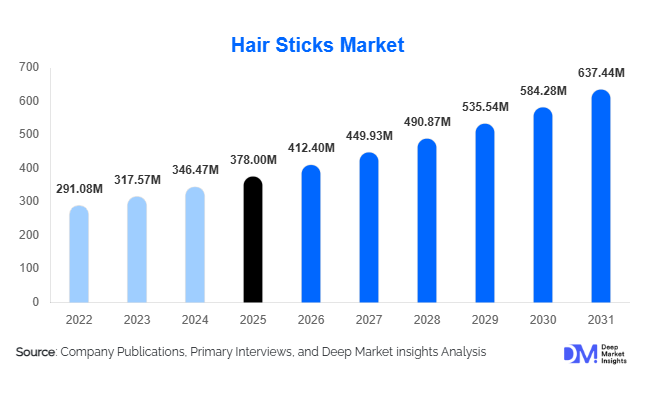
According to Deep Market Insights, the global hair sticks market size was valued at USD 378 million in 2025 and is projected to grow from USD 412.40 million in 2026 to reach USD 637.44 million by 2031, expanding at a CAGR of 9.1% during the forecast period (2026–2031). The market growth is primarily driven by increasing demand for sustainable hair accessories, rising popularity of cultural and minimalist hairstyling trends, and expanding adoption of reusable grooming tools as alternatives to elastic-based hair accessories. Growing influence of Asian fashion aesthetics, coupled with rapid expansion of e-commerce platforms, has transformed hair sticks from traditional accessories into globally recognized fashion and personal grooming products.
Key Market Insights
- Eco-friendly materials such as bamboo and wood are gaining strong traction, driven by sustainability-conscious consumers seeking reusable accessories.
- Online retail dominates global sales, supported by direct-to-consumer brands and artisan marketplaces expanding global accessibility.
- Asia-Pacific leads market demand, benefiting from cultural familiarity and strong manufacturing ecosystems.
- North America represents the fastest-growing region, fueled by minimalist fashion trends and social media-driven hairstyling adoption.
- Premium and handcrafted designs are expanding rapidly, reflecting consumer preference for personalized fashion accessories.
- Influence of Korean, Japanese, and Chinese fashion culture is accelerating global awareness and adoption among younger demographics.
What are the latest trends in the hair sticks market?
Sustainable and Natural Material Adoption
Consumers are increasingly shifting toward eco-conscious grooming products, encouraging manufacturers to adopt biodegradable and sustainably sourced materials such as bamboo, sandalwood, and recycled resin. Hair sticks align well with zero-waste beauty movements because they replace disposable hair ties and plastic accessories. Brands are highlighting ethical sourcing, handcrafted production, and low-carbon manufacturing practices as key differentiators. Certifications related to sustainable forestry and environmentally responsible packaging are also becoming common, helping companies position hair sticks as premium lifestyle accessories rather than traditional fashion items.
Fashion Integration and Cultural Revival
The revival of traditional fashion aesthetics has significantly influenced market growth. Hair sticks, historically rooted in East Asian and indigenous cultures, are being reintroduced through modern fashion collections, cosplay communities, and global entertainment trends. Social media platforms have amplified hairstyling tutorials showcasing bun and twist techniques using hair sticks, encouraging adoption among Gen Z consumers. Designers are integrating decorative hair sticks into runway fashion and bridal styling, expanding their use beyond traditional contexts into everyday fashion statements.
What are the key drivers in the hair sticks market?
Growing Demand for Damage-Free Hair Styling
Hair health awareness is increasing globally, leading consumers to seek alternatives that minimize breakage and scalp tension. Hair sticks provide secure styling without elastic pressure, making them attractive to consumers prioritizing natural haircare practices. Influencer-led education around low-damage hairstyles is accelerating adoption, particularly among consumers with long or thick hair types.
Expansion of Handmade and Artisan Accessory Markets
The rising popularity of handmade goods and independent creators has positively impacted the hair sticks market. Consumers increasingly value craftsmanship, uniqueness, and personalization. Artisan producers are leveraging digital platforms to reach global audiences, enabling small-scale manufacturers to compete with established accessory brands while maintaining premium pricing structures.
What are the restraints for the global market?
Limited Consumer Awareness in Western Markets
Despite growing popularity, hair sticks remain unfamiliar to many consumers outside Asia-Pacific regions. Lack of awareness regarding usage techniques and styling versatility limits mainstream adoption. Educational marketing and tutorial-based promotion remain essential for expanding consumer acceptance.
Fragmented Manufacturing Landscape
The industry consists largely of small-scale producers, resulting in inconsistent quality standards and pricing variability. This fragmentation can create supply challenges for large retailers seeking standardized products, slowing expansion into mass-market distribution channels.
What are the key opportunities in the hair sticks industry?
Direct-to-Consumer and E-commerce Expansion
The lightweight nature of hair sticks makes them ideal for global e-commerce distribution. Brands adopting direct-to-consumer models benefit from higher margins and improved customer engagement through customization options such as engraving, color personalization, and limited-edition releases. Digital marketplaces allow artisan brands to scale internationally without heavy retail investments.
Premiumization and Bridal Styling Applications
Hair sticks are increasingly being incorporated into bridal fashion and occasion styling markets. Decorative designs featuring gemstones, resin art, and metallic finishes are gaining popularity among wedding stylists. This trend enables manufacturers to enter high-margin premium accessory segments while expanding beyond everyday grooming use cases.
Report Scope
| Report Metric | Details |
|---|---|
| Market Size in 2025 | USD 378.00 Million |
| Market Size in 2026 | USD 412.40 Million |
| Market Size in 2031 | USD 637.44 Million |
| CAGR | 9.1% (2026-2031) |
| Base Year for Estimation | 2025 |
| Historical Data | 2022-2024 |
| Forecast Period | 2026-2031 |
| Report Coverage | Revenue Forecast, Competitive Landscape, Supply Chain Disruption, Growth Factors, Environment & Regulatory Landscape and Trends |
| Geographies Covered | North America, Europe, APAC, Middle East and Africa, LATAM |
| Countries Covered | U.S., Canada, U.K., Germany, France, Spain, Italy, Russia, Nordic, Benelux, Rest of Europe, China, Korea, Japan, India, Australia, Singapore, Taiwan, South East Asia, Rest of Asia-Pacific, UAE, Turky, Saudi Arabia, South Africa, Egypt, Nigeria, Rest of MEA, Brazil, Mexico, Argentina, Chile, Colombia, Rest of LATAM |
Explore more data points, trends and opportunities Download Free Sample Report
Material Type Insights
The material composition of hair sticks plays a critical role in determining consumer preference, pricing structure, durability, and overall aesthetic appeal across global markets. Wood-based hair sticks continue to dominate the market, accounting for approximately 34% of global demand. Their leadership is primarily supported by rising consumer inclination toward sustainable fashion accessories, natural textures, and handcrafted product authenticity. Wooden variants are lightweight, comfortable for prolonged wear, and align strongly with eco-conscious purchasing behavior, particularly among environmentally aware consumers seeking biodegradable alternatives to plastic accessories. Additionally, traditional craftsmanship associated with wooden hair sticks enhances their perceived cultural and artisanal value, further strengthening adoption across both premium and everyday styling categories.
Metal hair sticks are experiencing steady growth within premium and fashion-forward segments due to their durability, sleek aesthetics, and compatibility with minimalist styling trends. Materials such as stainless steel, brass, and alloy blends appeal to consumers seeking long-lasting accessories that combine functionality with modern design. The growing influence of contemporary fashion movements emphasizing clean lines and metallic accents continues to support expansion of this segment, particularly in urban and luxury markets.
Resin and acrylic hair sticks are gaining traction among younger consumers driven by experimentation, personalization, and vibrant fashion expression. These materials allow for creative shapes, embedded patterns, and colorful designs, making them highly suitable for trend-based styling and seasonal fashion collections. Their affordability also enables higher purchase frequency, supporting volume sales through online platforms. Meanwhile, eco-natural materials such as bamboo, horn, and other organic composites are witnessing rapid adoption as sustainability regulations, ethical sourcing awareness, and environmentally responsible branding reshape consumer expectations globally. Manufacturers are increasingly investing in responsibly sourced raw materials to strengthen brand positioning and meet evolving environmental standards.
Application Insights
Hair sticks serve a diverse range of functional and decorative purposes, with daily hair styling emerging as the leading application segment, representing nearly 37% of total market demand. The segment’s dominance is primarily driven by increasing consumer preference for quick, damage-free hairstyling solutions that minimize hair breakage compared to elastic-based accessories. Growing awareness of hair health, combined with the popularity of minimalist grooming routines, has encouraged consumers to incorporate hair sticks into everyday styling practices. Their versatility in securing buns, twists, and casual hairstyles further supports consistent usage across different age groups and lifestyles.
Traditional and cultural styling applications continue to represent a substantial share of demand, particularly across Asia-Pacific markets where hair sticks hold historical and ceremonial significance. Cultural celebrations, festivals, and heritage-inspired fashion trends sustain long-term adoption, while modern reinterpretations of traditional accessories are expanding appeal among younger generations globally. Bridal and occasion styling is emerging as one of the fastest-growing applications as decorative hair accessories gain prominence within wedding fashion and formal events. Increasing demand for personalized and ornamental styling elements has encouraged designers to introduce embellished and premium hair stick collections tailored for special occasions.
Performance and costume applications are also expanding steadily, supported by growth in dance, theatre, cosplay, and entertainment industries. Authentic styling requirements within performance arts and character-based fashion communities are driving demand for visually distinctive hair accessories. Social media exposure and fan-driven fashion culture continue to amplify this segment’s growth, transforming hair sticks into both functional tools and expressive fashion statements.
Distribution Channel Insights
Distribution dynamics within the hair sticks market are evolving rapidly as digital commerce reshapes consumer purchasing behavior. Online retail channels account for approximately 46% of global sales, making them the leading distribution segment. This dominance is driven by expanding e-commerce infrastructure, global accessibility to niche fashion brands, and the growth of artisan marketplaces that enable small-scale manufacturers to reach international audiences. Consumers benefit from broader product variety, customization options, and competitive pricing, which collectively strengthen online channel adoption.
Specialty beauty and fashion accessory stores continue to maintain relevance, particularly within premium product categories where tactile evaluation and in-store brand experiences influence purchasing decisions. Urban retail environments and boutique fashion outlets remain important for curated collections and designer collaborations. Meanwhile, salon-based retail is gradually emerging as hairstylists introduce hair sticks as professional styling tools, educating consumers about their functional advantages and styling versatility. Professional endorsement enhances product credibility and encourages repeat purchases.
Social commerce and influencer-driven marketing strategies are increasingly shaping demand patterns, especially among younger consumers. Short-form video platforms, tutorial-based content, and creator-led product recommendations significantly influence discovery and purchase intent. The integration of direct purchasing features within social media platforms further accelerates conversion rates, positioning digital engagement as a critical growth driver across distribution ecosystems.
Consumer Demographics Insights
Consumer demographics significantly influence product design innovation and marketing strategies within the global hair sticks market. Women remain the dominant consumer segment, contributing nearly 72% of total demand due to strong adoption in daily grooming, fashion styling, and occasion-based usage. Increasing participation of women in professional environments and social events has amplified demand for versatile accessories that balance practicality with aesthetic appeal.
Male consumers with long hairstyles are emerging as a niche but rapidly expanding segment, particularly in North America and Europe, where evolving grooming norms and gender-neutral fashion trends encourage broader accessory adoption. This shift is prompting manufacturers to introduce minimalist and unisex designs that appeal to diverse style preferences. Teenagers and young adults represent a highly influential consumer group driving experimentation and trend diffusion through social media platforms. Their preference for customizable, artistic, and affordable accessories supports innovation in materials and designs.Professional performers, stylists, and costume designers form a specialized yet high-value consumer base characterized by frequent purchases and demand for durable, visually distinctive products. Growth in entertainment content creation, live performances, and digital media production continues to reinforce demand within this segment, contributing to premium product sales.
Explore more data points, trends and opportunities Download Free Sample Report
Hair Sticks Market Segmentations
By Material Type
- Wood Hair Sticks
- Metal Hair Sticks
- Plastic & Acrylic Hair Sticks
- Resin & Polymer Hair Sticks
- Eco-Natural Materials
- Glass & Crystal Hair Sticks
By Application
- Daily Hair Styling
- Traditional & Cultural Wear
- Bridal & Occasion Styling
- Performance & Costume Styling
- Fashion Accessory Use
By Distribution Channel
- Online Retail/E-commerce
- Specialty Beauty Stores
- Fashion Accessories Stores
- Department Stores
- Salon & Professional Channels
- Craft & Artisan Markets
Regional Insights
North America
North America accounts for approximately 22% of global market share, led primarily by the United States and supported by Canada’s expanding fashion accessories sector. Regional growth is driven by increasing adoption of sustainable fashion practices, rising awareness of alternative hairstyling solutions that reduce hair damage, and strong penetration of online retail platforms. The popularity of DIY hairstyling tutorials and influencer-led beauty content has significantly accelerated consumer education and product visibility. Additionally, growing demand for gender-neutral fashion accessories and minimalist aesthetics supports product diversification. High disposable income levels and consumer willingness to experiment with niche fashion products further contribute to sustained market expansion across the region.
Europe
Europe holds nearly 19% of the global market share, with strong demand observed in Germany, France, and the United Kingdom. Regional growth is primarily supported by well-established eco-fashion movements and consumer preference for ethically sourced and handcrafted accessories. Increasing regulatory emphasis on sustainable materials and circular economy practices encourages manufacturers to adopt environmentally responsible production methods. Scandinavian countries demonstrate particularly rapid adoption due to minimalist lifestyle trends and strong alignment with natural design aesthetics. Furthermore, growing appreciation for artisanal craftsmanship and locally produced accessories enhances premium product demand across European markets.
Asia-Pacific
Asia-Pacific dominates the global hair sticks market with approximately 46% share, supported by both high consumption and large-scale manufacturing capabilities. China, Japan, South Korea, and India serve as key demand centers due to deep-rooted cultural familiarity with hair stick usage and continued integration into modern fashion trends. Regional growth is driven by expanding middle-class populations, rising disposable income, and increasing influence of K-fashion and J-fashion trends across global markets. Strong domestic production ecosystems enable cost-efficient manufacturing and export competitiveness, reinforcing the region’s leadership position. Additionally, the fusion of traditional styling with contemporary fashion innovation continues to expand consumer adoption across younger demographics.
Latin America
Latin America accounts for roughly 7% of global demand, led by Brazil and Mexico. Market growth in the region is supported by rising disposable income levels, expanding urban populations, and increasing adoption of fashion accessories as lifestyle products. The rapid growth of e-commerce platforms and mobile-based shopping is improving product accessibility, particularly among younger consumers. Cultural emphasis on expressive fashion and vibrant styling trends also supports demand for decorative and colorful hair stick designs. As international brands expand regional distribution networks, product availability and consumer awareness are expected to strengthen further.
Middle East & Africa
The Middle East & Africa region contributes approximately 6% of the global market, with demand concentrated in the UAE, Turkey, and South Africa. Regional growth is driven by expanding premium fashion retail infrastructure, increasing tourism activity, and rising interest in luxury and designer accessories. Consumers in metropolitan areas are increasingly adopting global fashion trends while maintaining cultural styling preferences, creating opportunities for both traditional and modern hair stick designs. Growth in beauty retail chains, shopping malls, and online marketplaces is improving accessibility and product visibility. Additionally, rising youth populations and social media influence are encouraging experimentation with new styling accessories, supporting gradual but steady market expansion.
Key Players in the Hair Sticks Market
- Alexandre de Paris
- France Luxe
- Ficcare Inc.
- Goody Products Inc.
- Scünci International
- L. Erickson USA
- Lady Jayne Ltd.
- Kitsch LLC
- BaByliss Accessories Division
- Camila Paris
- The Hair Edit
- Fromm International
- ALEX Accessories
- Bunheads
- Lilla Rose