Goat Meat Market Size
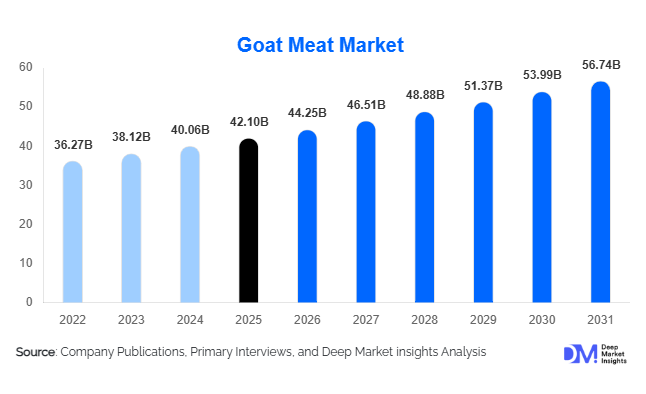
According to Deep Market Insights, the global goat meat market size was valued at USD 42.1 billion in 2025 and is projected to grow from USD 44.25 billion in 2026 to reach USD 56.74 billion by 2031, expanding at a CAGR of 5.1% during the forecast period (2026–2031). The goat meat market growth is primarily driven by rising global protein consumption, increasing demand for lean red meat, expansion of halal food industries, and growing urbanization across developing economies. Goat meat remains a staple source of animal protein in Asia-Pacific, the Middle East, and Africa, while developed regions are witnessing growing adoption through ethnic cuisines, premium retail offerings, and specialty foodservice channels. Improvements in livestock productivity, cold-chain infrastructure, and export-oriented processing facilities are further supporting market expansion globally.
Key Market Insights
- Fresh chilled goat meat remains the dominant product category, accounting for nearly 74% of global market revenue due to strong consumer preference for freshly slaughtered meat across Asia and Africa.
- Asia-Pacific dominates the global goat meat market, contributing approximately 63% of total market value, led by India, China, Pakistan, Bangladesh, and Indonesia.
- Middle East & Africa represents the fastest-growing regional market, supported by increasing imports, population growth, and expansion of the hospitality sector.
- Household consumption remains the largest end-use segment, accounting for nearly 58% of total global demand.
- Halal-certified goat meat is becoming increasingly important, driven by rising demand across Muslim-majority countries and international halal export markets.
- Value-added goat meat products, including ready-to-cook, frozen, marinated, and processed meat offerings, are gaining traction among urban consumers worldwide.
- Technology adoption in livestock management, including genetic breeding programs, disease monitoring, and precision livestock farming, is improving production efficiency and supply chain reliability.
Goat Meat Market Latest Trends
Growth of Premium and Value-Added Goat Meat Products
The goat meat industry is increasingly shifting from traditional carcass-based sales toward premium and value-added offerings. Urban consumers are showing greater preference for portion-controlled cuts, vacuum-packed products, marinated meat, and ready-to-cook formats that offer convenience and consistent quality. Premium cuts such as racks, loins, and boneless leg portions are commanding higher margins, particularly in North America, Europe, Australia, and Gulf Cooperation Council (GCC) countries. Food processors are investing heavily in packaging technologies, shelf-life enhancement solutions, and branding strategies to differentiate products and capture premium pricing opportunities. Organic, antibiotic-free, and pasture-raised goat meat categories are also witnessing rising demand among health-conscious consumers seeking transparency and traceability throughout the supply chain.
Expansion of Halal-Certified International Trade
The global halal food industry continues to create substantial opportunities for goat meat producers and exporters. Countries such as Saudi Arabia, UAE, Qatar, Kuwait, Malaysia, and Indonesia are increasing imports to meet growing domestic demand. Exporters are responding through investments in halal-certified slaughtering facilities, traceability systems, and export-oriented processing plants. International buyers increasingly require compliance with food safety regulations, animal welfare standards, and certification programs, driving modernization throughout the value chain. The expansion of organized retail and foodservice sectors in emerging economies is further supporting demand for standardized halal goat meat products with reliable quality assurance.
Goat Meat Market Drivers
Increasing Demand for Lean and Nutrient-Dense Protein Sources
Consumers worldwide are becoming increasingly conscious of the nutritional profile of their food choices. Goat meat contains lower fat and cholesterol levels compared with many conventional red meats while providing high-quality protein, iron, zinc, potassium, and essential vitamins. Growing awareness of these health benefits is supporting demand among health-conscious consumers, fitness-oriented populations, and individuals seeking healthier alternatives to beef and lamb. The trend is particularly evident in developed markets where specialty meat consumption is expanding through premium retail and foodservice channels.
Rapid Expansion of the Global Halal Food Industry
The halal food sector continues to be one of the most influential drivers of goat meat demand. Goat meat occupies a central position within halal dietary traditions across South Asia, Southeast Asia, the Middle East, and Africa. Population growth in Muslim-majority countries, increasing disposable incomes, and expansion of halal-certified foodservice establishments are creating sustained demand growth. Furthermore, non-Muslim consumers are increasingly recognizing halal-certified products as indicators of quality, hygiene, and traceability, further expanding the potential customer base.
Urbanization and Organized Retail Development
Rapid urbanization across emerging economies is transforming traditional meat purchasing patterns. Supermarkets, hypermarkets, specialty meat stores, and e-commerce platforms are increasingly offering packaged goat meat products. Improvements in refrigerated transportation, cold storage infrastructure, and logistics networks are enabling suppliers to access larger urban consumer bases. Organized retail channels also support higher-value product categories, including branded, frozen, and processed goat meat products, contributing positively to overall market growth.
Goat Meat Market Restraints
Fragmented Production and Supply Chain Structure
A significant proportion of global goat production remains concentrated among smallholder farmers operating under traditional farming systems. Fragmented production structures often result in inconsistent meat quality, variable animal weights, limited traceability, and challenges in disease management. These issues can reduce processing efficiency and complicate efforts to establish standardized export-quality supply chains. In many developing countries, insufficient investment in breeding programs and livestock infrastructure further constrains productivity growth.
Feed Cost Volatility and Climate-Related Risks
Feed expenses represent a substantial share of goat production costs. Fluctuations in feed grain prices, drought conditions, water scarcity, and changing weather patterns can significantly affect producer profitability. Climate-related disruptions across Africa, Asia, and parts of Latin America continue to influence herd productivity, grazing availability, and mortality rates. Disease outbreaks and veterinary challenges further increase operational risks, creating uncertainty for producers and processors throughout the value chain.
Goat Meat Industry Key Opportunities
Export-Oriented Growth Across Middle Eastern Markets
The Middle East remains one of the world's largest net importers of goat meat. Countries including Saudi Arabia, UAE, Qatar, Oman, and Kuwait continue to experience strong demand growth driven by population expansion, tourism development, and hospitality sector investments. Exporters from Australia, India, Ethiopia, Kenya, Sudan, and New Zealand have significant opportunities to expand processing capacity and strengthen export relationships. Increasing emphasis on food security throughout the GCC region is expected to support long-term import demand, creating favorable conditions for producers capable of meeting strict quality and halal certification requirements.
Technology Integration Across Livestock Production Systems
Modern livestock management technologies present substantial opportunities for improving productivity and profitability. Precision feeding systems, genetic improvement programs, digital herd management platforms, and disease monitoring technologies are enabling producers to increase slaughter weights and reduce mortality rates. Governments across Asia and Africa are increasingly supporting livestock modernization initiatives aimed at improving food security and export competitiveness. Technology adoption can significantly enhance supply consistency while reducing operational inefficiencies.
Growth of Organic and Premium Goat Meat Categories
Consumer demand for premium meat products is creating opportunities for organic, pasture-raised, grass-fed, and antibiotic-free goat meat producers. These categories command premium pricing and higher margins compared with conventional offerings. Developed markets such as the United States, Canada, Germany, France, Australia, and the United Kingdom are experiencing increasing demand for ethically sourced and sustainably produced meat products. Producers investing in certification programs, branding strategies, and traceability systems are well positioned to capitalize on this emerging trend.
Report Scope
| Report Metric | Details |
|---|---|
| Market Size in 2025 | USD 42.10 Billion |
| Market Size in 2026 | USD 44.25 Billion |
| Market Size in 2031 | USD 56.74 Billion |
| CAGR | 5.1% (2026-2031) |
| Base Year for Estimation | 2025 |
| Historical Data | 2022-2024 |
| Forecast Period | 2026-2031 |
| Report Coverage | Revenue Forecast, Competitive Landscape, Supply Chain Disruption, Growth Factors, Environment & Regulatory Landscape and Trends |
| Geographies Covered | North America, Europe, APAC, Middle East and Africa, LATAM |
| Countries Covered | U.S., Canada, U.K., Germany, France, Spain, Italy, Russia, Nordic, Benelux, Rest of Europe, China, Korea, Japan, India, Australia, Singapore, Taiwan, South East Asia, Rest of Asia-Pacific, UAE, Turky, Saudi Arabia, South Africa, Egypt, Nigeria, Rest of MEA, Brazil, Mexico, Argentina, Chile, Colombia, Rest of LATAM |
Explore more data points, trends and opportunities Download Free Sample Report
Product Form Insights
The fresh chilled goat meat segment continues to dominate the global goat meat market, accounting for approximately 74% of total revenue in 2025. Its market leadership is primarily attributed to strong consumer preference for freshly slaughtered meat across major consumption markets in Asia-Pacific, the Middle East, and Africa, where traditional purchasing habits and cultural food practices emphasize freshness, taste, and quality. The widespread presence of wet markets, local butcher networks, and direct farm-to-consumer distribution systems further strengthens demand for fresh chilled products. In addition, consumers often perceive fresh goat meat as more nutritious and flavorful compared to frozen alternatives, reinforcing its position as the preferred product form across both urban and rural markets.Processed goat meat products, including sausages, smoked meat, cured products, marinated cuts, ready-to-cook meals, and ready-to-eat offerings, are among the fastest-growing segments within the market. Growth is being driven by increasing urbanization, changing consumer lifestyles, and rising demand for convenience-oriented protein products. Busy working populations, expanding modern retail formats, and the growing popularity of packaged meat products are encouraging manufacturers to diversify their product portfolios with innovative value-added goat meat offerings. Furthermore, the increasing penetration of organized retail chains and e-commerce platforms is improving accessibility to processed goat meat products across developed and emerging economies.Organic and certified goat meat remains a relatively small but rapidly expanding niche segment. Rising consumer awareness regarding food safety, animal welfare, sustainability, and traceability is creating opportunities for premium goat meat products certified under organic, halal, grass-fed, and environmentally sustainable production systems. Affluent consumers in North America, Europe, and parts of Asia-Pacific are increasingly willing to pay premium prices for high-quality meat products that align with health-conscious and ethical consumption preferences, supporting the long-term growth outlook of this segment.
Cut Type Insights
Whole carcass sales account for the largest share of the global goat meat market, representing approximately 42% of total market value. Demand for whole animals remains particularly strong across Asia, the Middle East, and Africa, where traditional culinary practices, religious ceremonies, festive occasions, and institutional procurement activities often require entire carcasses. Wholesale buyers, foodservice operators, and community-based purchasing arrangements also contribute significantly to the continued dominance of this segment. The ability to utilize all portions of the animal while maintaining cost efficiency remains a major factor supporting whole carcass demand.Leg cuts and shoulder cuts collectively represent a substantial portion of global consumption due to their versatility, favorable meat yields, and suitability for a wide range of cooking methods. These cuts are extensively used in both household and commercial food preparation, including roasting, grilling, stewing, and slow-cooking applications. Their affordability relative to premium cuts and broad consumer acceptance continue to drive steady demand across retail and foodservice channels.Premium cuts such as loin, rack, chops, and ribs are gaining increasing market share as consumer spending on specialty meat products rises. Growth within this category is being supported by upscale restaurants, premium butcher shops, gourmet food retailers, and expanding hospitality sectors in developed economies. The increasing popularity of fine dining experiences, culinary innovation, and premium protein consumption is encouraging greater utilization of high-value goat meat cuts across international markets.Offal products, including liver, kidneys, heart, brain, and other organ meats, continue to maintain strong demand in numerous Asian, African, and Middle Eastern countries. These products are valued for their nutritional content, affordability, and cultural significance in traditional cuisines. Growing awareness of nutrient-dense food sources and efforts to maximize carcass utilization are further supporting demand for edible by-products, contributing to overall industry profitability and sustainability.
Distribution Channel Insights
Traditional wet markets remain the leading distribution channel for goat meat globally, accounting for approximately 52% of total market sales. The segment's dominance is driven by strong consumer trust in freshly slaughtered products, the ability to visually inspect meat quality prior to purchase, and deeply rooted purchasing habits across major consuming countries such as India, China, Pakistan, Bangladesh, Indonesia, and Nigeria. The extensive presence of local livestock trading networks and small-scale meat vendors further reinforces the importance of wet markets within the global goat meat supply chain. The primary driver supporting this segment is the continued consumer preference for freshly slaughtered and customized meat products.Butcher shops continue to play a significant role in both developed and emerging markets by offering personalized services, specialized product knowledge, and customized cutting options. Consumers often rely on local butchers for premium-quality products, traditional cuts, and trusted sourcing practices. The segment also benefits from growing demand for specialty meat products and personalized customer experiences.Supermarkets and hypermarkets are steadily expanding their market presence as organized retail infrastructure develops across emerging economies. Improved refrigeration technologies, branded packaging solutions, food safety standards, and enhanced supply chain management systems are enabling large retail chains to capture a greater share of meat sales. Consumers increasingly appreciate the convenience, product consistency, and quality assurance offered by modern retail formats.Online retail and e-commerce platforms represent one of the fastest-growing distribution channels in the goat meat market. Increasing internet penetration, digital payment adoption, and changing shopping behaviors are encouraging consumers to purchase fresh and frozen meat products through online channels. Home delivery services, subscription-based meat offerings, and direct-to-consumer business models are further accelerating growth in this segment, particularly in urban areas where convenience has become a major purchasing consideration.
End-Use Insights
Household consumption remains the largest end-use segment, accounting for approximately 58% of global goat meat demand. Goat meat continues to serve as a staple protein source across many countries in Asia, Africa, and the Middle East, where it forms an integral part of daily diets and cultural food traditions. Strong population growth, increasing disposable incomes, and rising protein consumption levels continue to support household demand. The leading driver for this segment is the widespread cultural acceptance and regular dietary consumption of goat meat across major producing and consuming nations.The foodservice sector, including restaurants, hotels, catering providers, and hospitality establishments, represents the fastest-growing end-use category. Growth is being fueled by expanding tourism activities, increasing urbanization, rising disposable incomes, and growing consumer interest in dining experiences. Restaurants are increasingly incorporating goat meat into traditional, ethnic, fusion, and premium menu offerings to cater to diverse customer preferences. The expansion of the hospitality industry and growing demand for unique culinary experiences are expected to further stimulate consumption through this channel.The meat processing industry is emerging as an increasingly important end-use segment as demand for frozen, packaged, and value-added goat meat products continues to expand. Food manufacturers are investing in product innovation, processing technologies, and packaging solutions to meet evolving consumer preferences for convenience-oriented foods. The growing popularity of ready-to-cook and ready-to-eat products is expected to create additional growth opportunities within this segment.Institutional procurement by military organizations, hospitals, educational institutions, correctional facilities, and government agencies also contributes significantly to market demand. Long-term procurement contracts, nutritional program requirements, and stable purchasing volumes help support overall market stability while creating predictable demand patterns for producers and suppliers.
Explore more data points, trends and opportunities Download Free Sample Report
Goat Meat Market Segmentations
By Product Form
- Fresh Chilled Goat Meat
- Frozen Goat Meat
- Processed Goat Meat
- Organic/Certified Goat Meat
By Cut Type
- Whole Carcass
- Leg Cuts
- Shoulder Cuts
- Loin & Rack Cuts
- Rib Cuts
- Neck & Shank Cuts
- Offal & Organ Meat
By Packaging Type
- Bulk Packaging
- Vacuum Packaging
- Modified Atmosphere Packaging (MAP)
- Skin-Pack Packaging
- Retail Tray Packaging
By Distribution Channel
- Traditional Wet Markets
- Butcher Shops
- Supermarkets & Hypermarkets
- Convenience Stores
- Online Retail & E-Commerce
- Foodservice Wholesale Distribution
By End User
- Household Consumption
- Restaurants
- Hotels & Resorts
- Catering Services
- Quick Service Restaurants (QSRs)
- Meat Processing Industry
- Institutional Buyers
Regional Insights
Asia-Pacific
Asia-Pacific dominates the global goat meat market, accounting for approximately 63% of total market share in 2025. The region benefits from a large livestock population, deeply rooted cultural preferences for goat meat consumption, and the presence of some of the world's largest producing and consuming countries. India remains the largest global producer and consumer, representing nearly 23% of worldwide demand, while China accounts for approximately 18% of the market, supported by rising urbanization and increasing consumption of animal protein. Pakistan, Bangladesh, Indonesia, Malaysia, and several Southeast Asian countries continue to generate substantial demand due to population growth, religious practices, and strong culinary traditions associated with goat meat.Regional growth is being driven by expanding middle-class populations, rising disposable incomes, increasing urbanization, and growing protein consumption across emerging economies. Investments in livestock productivity, veterinary healthcare services, breeding programs, and modern retail infrastructure are improving supply chain efficiency and supporting market expansion. Additionally, the continued importance of goat meat during religious festivals and cultural celebrations remains a key factor sustaining long-term demand throughout the region.
Middle East & Africa
The Middle East & Africa region accounts for approximately 23% of global market value and is projected to register the fastest growth rate through 2031. Goat meat remains a staple component of traditional diets across many countries in the region, supported by strong cultural and religious significance. Saudi Arabia, the United Arab Emirates, Qatar, Kuwait, and Oman rely heavily on imports to meet domestic consumption requirements, while countries such as Ethiopia, Kenya, Sudan, South Africa, and Nigeria serve as major regional producers and exporters.Growth across the region is being driven by rapid population expansion, rising tourism activity, increasing disposable incomes, and growing investments in hospitality and foodservice sectors. The expansion of religious tourism, particularly pilgrimage-related travel, continues to stimulate demand for goat meat in Gulf countries. Furthermore, government initiatives focused on food security, livestock development, and cold-chain infrastructure modernization are strengthening supply chains and supporting sustained market growth throughout the region.
Europe
Europe accounts for approximately 6% of global goat meat demand, with the United Kingdom, France, Germany, Spain, and Italy representing the largest consumption markets. Demand is largely supported by multicultural populations, increasing ethnic food consumption, and growing interest in alternative red meat products. Goat meat is gaining popularity among consumers seeking diverse protein options and healthier dietary choices due to its comparatively lean nutritional profile.Regional growth is being driven by increasing demand for halal-certified products, expanding ethnic communities, rising consumer awareness of sustainable livestock production, and growing preference for premium-quality meat products. The strong presence of specialty retailers, gourmet restaurants, and organic food markets is further contributing to market development. Additionally, increasing demand for traceable, organic, and ethically sourced meat products across Western Europe is creating new opportunities for premium goat meat suppliers.
North America
North America contributes approximately 5% of global market value, led primarily by the United States, followed by Canada. The market remains relatively niche compared to other protein categories but continues to experience steady expansion. Growing multicultural demographics, particularly among Asian, African, Middle Eastern, and Caribbean communities, are supporting increased consumption of goat meat across the region.Key growth drivers include rising awareness of goat meat's nutritional benefits, increasing consumer interest in alternative protein sources, expanding product availability through retail and foodservice channels, and growing demand for ethnic cuisines. The development of specialty meat retailers, ethnic grocery chains, and premium restaurant offerings is improving market accessibility. Furthermore, health-conscious consumers are increasingly recognizing goat meat as a leaner alternative to traditional red meats, contributing to long-term demand growth.
Latin America
Latin America accounts for approximately 3% of global goat meat demand, with Brazil, Argentina, Chile, Peru, and Mexico serving as the primary regional markets. While consumption levels remain lower than those observed in Asia and Africa, the region offers significant long-term growth potential due to improving livestock productivity and increasing diversification of protein consumption patterns.Regional growth is being supported by rising consumer incomes, expanding export opportunities, modernization of meat processing facilities, and investments in animal breeding and livestock management practices. Governments and private sector participants are increasingly focusing on improving production efficiency and enhancing export competitiveness. Growing demand for specialty meat products and increasing participation in international meat trade are expected to further strengthen the region's market position over the forecast period.
Key Players in the Goat Meat Market
- Thomas Foods International
- Fletcher International Exports
- Silver Fern Farms
- Alliance Group
- Australian Lamb Company
- Cedar Meats Australia
- Australian Agricultural Company
- Mountain States Rosen
- Superior Farms
- Samex Australian Meat Company
- AJC International
- JBS S.A.
- Tyson Foods
- Halal Pastures
- Hind Agro Industries