Foot Patches Market Size
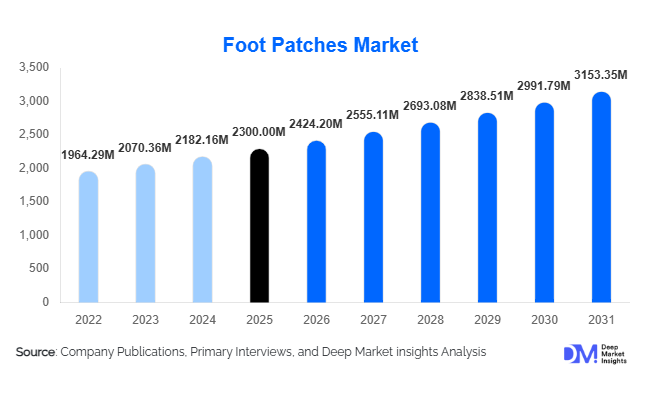
According to Deep Market Insights, the global foot patches market size was valued at USD 2,300 million in 2025 and is projected to grow from USD 2,424.20 million in 2026 to reach USD 3,153.35 million by 2031, expanding at a CAGR of 5.4% during the forecast period (2026–2031). The foot patches market growth is primarily driven by rising consumer interest in natural wellness products, increasing adoption of preventive healthcare routines, and expanding availability of herbal detox products through e-commerce platforms.
Foot patches are adhesive wellness products applied to the soles of the feet overnight and are commonly marketed for detoxification, improved circulation, relaxation, and sleep support. These patches typically contain ingredients such as bamboo vinegar, herbal extracts, tourmaline, essential oils, and activated charcoal. Although clinical evidence supporting detoxification claims remains debated, strong consumer perception of health benefits and increasing awareness of alternative therapies continue to support market demand.
Key Market Insights
- Herbal foot patches dominate the market, accounting for nearly half of total revenue due to strong consumer preference for plant-based wellness products.
- E-commerce channels lead global sales, driven by direct-to-consumer wellness brands and the expansion of online marketplaces.
- Asia-Pacific is the largest regional market, supported by strong cultural acceptance of herbal and traditional medicine.
- North America remains a major consumption hub, with the U.S. accounting for the largest share of demand outside Asia.
- Mid-range pricing products account for the largest share, balancing affordability with perceived health benefits.
- Commercial wellness centers and spas are emerging as a growing distribution channel, integrating detox patches into therapy and relaxation programs.
What are the latest trends in the foot patches market?
Growing Demand for Herbal and Clean-Label Wellness Products
Consumers worldwide are increasingly seeking natural and plant-based alternatives to conventional health products. This trend has significantly boosted demand for herbal detox foot patches formulated with ingredients such as bamboo vinegar, ginger, lavender, and green tea extracts. Clean-label products that emphasize organic ingredients, biodegradable materials, and sustainable sourcing are gaining traction. Manufacturers are responding by developing eco-friendly patches with bamboo fibers and plant-based adhesives, catering to environmentally conscious consumers.
Expansion of Direct-to-Consumer and Digital Wellness Brands
Digital marketing and e-commerce platforms have transformed the distribution landscape for foot patches. Many wellness brands now sell products directly through their websites and online marketplaces, allowing them to reach global consumers without relying heavily on traditional retail channels. Influencer marketing, wellness blogs, and social media platforms play a crucial role in promoting detox patch benefits and encouraging consumer trials. Subscription-based sales models and bundled wellness kits are also becoming popular strategies to increase repeat purchases and customer retention.
What are the key drivers in the foot patches market?
Rising Focus on Preventive Healthcare
Preventive healthcare has become a major global trend as consumers prioritize maintaining overall health and well-being. Products that support relaxation, detoxification, and improved circulation are increasingly incorporated into daily self-care routines. Foot patches are positioned as convenient wellness products that can be easily used at home, making them appealing to consumers seeking non-invasive health solutions.
Increasing Popularity of Alternative and Traditional Medicine
Traditional Asian medicine practices, including reflexology and herbal therapies, have influenced the global adoption of foot patches. Countries such as China, Japan, and South Korea have long histories of herbal remedies and holistic therapies, which have shaped consumer acceptance of detox patches. As global awareness of traditional medicine increases, demand for such products continues to grow in Western markets as well.
What are the restraints for the global market?
Limited Scientific Evidence Supporting Detox Claims
One of the major restraints for the foot patches market is the limited clinical validation supporting detoxification claims. Regulatory authorities in some regions have questioned the effectiveness of detox patches, which may affect consumer trust and restrict marketing claims. Companies must carefully position these products as wellness or relaxation solutions rather than medical treatments.
High Market Fragmentation and Price Competition
The market contains numerous small manufacturers and private-label brands offering similar products. This has led to intense price competition, particularly on e-commerce platforms where low-cost products are widely available. Price pressure can reduce profit margins for premium brands and create challenges in maintaining product differentiation.
What are the key opportunities in the foot patches industry?
Integration with Wellness Tourism and Spa Treatments
The rapid expansion of the global wellness tourism industry presents new opportunities for foot patch manufacturers. Spas, massage clinics, and wellness resorts are increasingly incorporating detox and relaxation products into their treatment offerings. Foot patches can be marketed as complementary products for reflexology sessions, detox programs, and sleep therapy treatments, creating additional revenue streams for manufacturers.
Product Innovation and Multi-Functional Wellness Patches
Innovation in product formulations presents a major growth opportunity. Companies are developing multi-functional patches that combine detoxification benefits with aromatherapy, pain relief, or sleep enhancement features. Integration of essential oils, advanced adhesives, and improved absorption materials can help differentiate products and attract new consumer segments seeking comprehensive wellness solutions.
Report Scope
| Report Metric | Details |
|---|---|
| Market Size in 2025 | USD 2300 Million |
| Market Size in 2026 | USD 2424.20 Million |
| Market Size in 2031 | USD 3153.35 Million |
| CAGR | 5.4% (2026-2031) |
| Base Year for Estimation | 2025 |
| Historical Data | 2022-2024 |
| Forecast Period | 2026-2031 |
| Report Coverage | Revenue Forecast, Competitive Landscape, Supply Chain Disruption, Growth Factors, Environment & Regulatory Landscape and Trends |
| Geographies Covered | North America, Europe, APAC, Middle East and Africa, LATAM |
| Countries Covered | U.S., Canada, U.K., Germany, France, Spain, Italy, Russia, Nordic, Benelux, Rest of Europe, China, Korea, Japan, India, Australia, Singapore, Taiwan, South East Asia, Rest of Asia-Pacific, UAE, Turky, Saudi Arabia, South Africa, Egypt, Nigeria, Rest of MEA, Brazil, Mexico, Argentina, Chile, Colombia, Rest of LATAM |
Explore more data points, trends and opportunities Download Free Sample Report
Product Type Insights
Herbal foot patches represent the largest product category, accounting for approximately 48% of the global market. These patches typically contain plant-based ingredients such as bamboo vinegar, herbal extracts, and essential oils that are believed to support detoxification and relaxation. Ionic and magnetic foot patches represent smaller segments but are marketed for their potential benefits in improving circulation and relieving muscle fatigue. Aromatherapy foot patches are gaining popularity among consumers seeking relaxation and improved sleep quality, particularly in premium wellness product categories.
Application Insights
Detoxification remains the primary application for foot patches, representing the largest share of consumer demand. Many consumers use detox patches as part of wellness routines aimed at improving overall health and energy levels. Pain relief and anti-inflammatory applications represent another growing segment, particularly among older consumers and individuals with physically demanding lifestyles. Stress relief and sleep enhancement applications are also gaining traction as consumers seek natural alternatives to sleep aids and relaxation therapies.
Distribution Channel Insights
Online retail channels dominate the global foot patches market, accounting for more than half of total sales. E-commerce platforms provide consumers with easy access to a wide range of brands, competitive pricing, and product reviews that influence purchasing decisions. Offline distribution channels, including pharmacies, supermarkets, and specialty wellness stores, remain important for brand visibility and consumer trust. Spa centers and wellness clinics are also emerging as niche distribution channels for premium detox patch products.
End-User Insights
Individual consumers represent the largest end-user segment in the foot patches market, accounting for more than two-thirds of total demand. These products are primarily used as part of personal wellness routines aimed at relaxation and detoxification. Commercial users such as spas, massage clinics, and wellness centers represent a smaller but rapidly growing segment. These establishments often incorporate foot patches into therapy sessions or sell them as complementary retail products to customers seeking holistic health treatments.
Explore more data points, trends and opportunities Download Free Sample Report
Foot Patches Market Segmentations
By Product Type
- Herbal Foot Patches
- Ionic Foot Patches
- Magnetic Foot Patches
- Aromatherapy Foot Patches
- Reflexology Foot Patches
By Application
- Detoxification & Toxin Removal
- Pain Relief & Anti-Inflammatory Relief
- Stress Relief & Sleep Enhancement
- Moisturizing & Skin Care
- Circulation Improvement
- Multi-Functional Wellness Patches
By Distribution Channel
- Online Retail
- Pharmacies & Drug Stores
- Supermarkets & Hypermarkets
- Specialty Wellness Stores
- Spa & Salon Retail
By End User
- Individual Consumers
- Wellness Centers
- Spa & Massage Clinics
- Alternative Medicine Clinics
- Fitness & Recovery Centers
Regional Insights
Asia-Pacific
Asia-Pacific holds the largest share of the global foot patches market, accounting for approximately 35% of total revenue. Countries such as China, Japan, and South Korea are major producers and consumers of detox patches due to strong cultural acceptance of herbal remedies and traditional medicine practices. China, in particular, is emerging as both a major manufacturing hub and a rapidly growing consumer market. Increasing disposable incomes and expanding e-commerce penetration are further supporting regional market growth.
North America
North America represents the second-largest market, with the United States accounting for the majority of regional demand. Growing interest in natural wellness products, combined with the popularity of alternative health therapies, is driving market expansion in the region. Consumers in the United States and Canada are increasingly purchasing detox patches through online wellness platforms and specialty health stores.
Europe
Europe accounts for a significant share of the global market, with strong demand from countries such as Germany, the United Kingdom, France, and Italy. European consumers show a strong preference for organic and clean-label wellness products, which has encouraged manufacturers to introduce herbal and eco-friendly foot patch formulations.
Latin America
The foot patches market in Latin America is gradually expanding, particularly in Brazil and Mexico. Rising consumer awareness regarding alternative health products and increasing penetration of online retail platforms are supporting market growth across the region.
Middle East & Africa
The Middle East and Africa represent emerging markets for foot patches. Demand is primarily driven by wellness tourism, expanding spa industries, and increasing consumer interest in holistic health treatments. Countries such as the United Arab Emirates and South Africa are witnessing the gradual adoption of herbal wellness products.
Key Players in the Foot Patches Market
- Nuubu
- Avazo Healthcare
- BodyPure
- Detox Foot Pads
- Doctor Organic
- Global Healing
- Groots
- Herb-Science
- Kiyome Kinoki
- Medi-7
- Patch-It
- SMYLLS
- Takara
- Verseo
- EcoNugenics