Fat Bikes Market Size
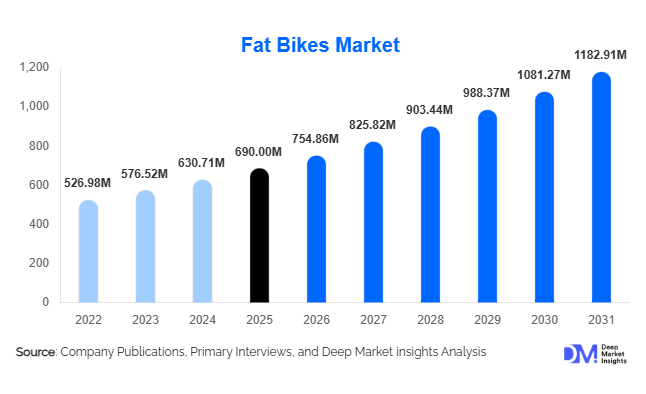
According to Deep Market Insights, the global fat bikes market size was valued at USD 690 million in 2025 and is projected to grow from USD 754.86 million in 2026 to reach USD 1,182.91 million by 2031, expanding at a CAGR of 9.4% during the forecast period (2026–2031). The fat bikes market growth is primarily driven by increasing participation in outdoor adventure activities, rising adoption of electric fat bikes, growing interest in all-terrain cycling, and expanding investments in sustainable recreational mobility. Originally developed for snow and sand riding, fat bikes have evolved into versatile bicycles used across mountain trails, beaches, deserts, and urban recreational environments. Technological advancements in lightweight frame materials, lithium-ion battery systems, hydraulic braking technologies, and integrated smart cycling features are further enhancing consumer adoption globally.
Key Market Insights
- Electric fat bikes are becoming the fastest-growing category, driven by improved battery performance, extended riding range, and increasing demand from recreational and adventure cyclists.
- Adventure tourism and outdoor recreation activities continue to expand globally, creating strong demand for commercial fat bike fleets and rental operators.
- North America dominates the global fat bikes market, accounting for approximately 41% of total market revenue in 2025 due to strong cycling culture and winter sports participation.
- Asia-Pacific is the fastest-growing regional market, supported by rising disposable incomes, cycling infrastructure investments, and growing outdoor recreation participation.
- Direct-to-consumer and e-commerce sales channels are transforming the industry, enabling manufacturers to improve margins and expand global reach.
- Carbon fiber frames, connected cycling technologies, and advanced electric drivetrains are reshaping product innovation across premium market segments.
What are the latest trends in the fat bikes market?
Rapid Expansion of Electric Fat Bikes
The strongest trend influencing the fat bikes market is the rapid adoption of electric fat bikes (e-fat bikes). Consumers increasingly seek bicycles capable of traversing challenging terrain while minimizing rider fatigue. Modern e-fat bikes offer ranges exceeding 80–120 kilometers per charge and integrate advanced mid-drive motors, regenerative braking systems, and smart display technologies. Manufacturers are launching premium models equipped with app connectivity, GPS tracking, ride analytics, and battery optimization software. Electric variants are increasingly attracting older consumers, recreational riders, and tourism operators seeking accessible all-terrain mobility solutions. This trend is expected to contribute more than half of incremental market growth during the forecast period.
Growing Popularity of Adventure and Experiential Cycling
Fat bikes are increasingly being integrated into adventure tourism and experiential travel offerings worldwide. Operators across Canada, Scandinavia, Iceland, New Zealand, the United States, and alpine European destinations are offering guided fat bike expeditions across snow-covered trails, beaches, deserts, and mountain landscapes. Travelers increasingly seek immersive outdoor experiences that combine physical activity, exploration, and sustainability. As governments continue investing in recreational infrastructure and eco-tourism projects, fat bikes are becoming a preferred transportation mode for outdoor adventures. The trend is also supported by social media influence, with adventure cycling content generating significant consumer interest among younger demographics.
What are the key drivers in the fat bikes market?
Rising Outdoor Recreation Participation
Outdoor recreation has become a major lifestyle trend across developed and emerging economies. Consumers are increasingly prioritizing health, wellness, and experiential activities over traditional leisure spending. Fat bikes provide a unique value proposition by enabling year-round cycling across terrain unsuitable for conventional bicycles. National parks, mountain trails, coastal routes, and snow-covered landscapes are driving demand among recreational users. Growing participation in cycling events, endurance sports, and adventure tourism continues to expand the addressable customer base for fat bike manufacturers worldwide.
Growing Demand for Sustainable Mobility Solutions
Governments and consumers are increasingly supporting environmentally friendly transportation alternatives. Fat bikes, particularly electric variants, align with sustainability goals by offering zero-emission mobility for recreational and commuting applications. Numerous municipalities are investing in cycling infrastructure, dedicated bike lanes, and outdoor recreational networks that indirectly support fat bike adoption. The growing emphasis on reducing carbon footprints and promoting active transportation is expected to remain a key growth catalyst over the next decade.
Technological Advancements in Bicycle Design
Innovation in bicycle engineering has significantly enhanced fat bike performance. Manufacturers are increasingly utilizing lightweight aluminum alloys, carbon fiber composites, high-capacity lithium-ion batteries, hydraulic braking systems, and integrated digital technologies. These innovations improve ride quality, reduce maintenance requirements, and enhance overall consumer value. Product differentiation through technology is also enabling premium pricing strategies and supporting margin expansion for leading manufacturers.
What are the restraints for the global market?
High Acquisition Costs
Fat bikes remain relatively expensive compared to conventional bicycles, particularly within premium and electric categories. High-quality electric fat bikes often retail above USD 3,000, while premium carbon-fiber models can exceed USD 6,000. This limits accessibility among price-sensitive consumers and constrains adoption in developing economies. Rising battery costs and advanced component requirements further contribute to elevated retail prices.
Seasonal Demand Concentration
Demand for fat bikes remains highly seasonal across many regions. Snow-based riding applications generate significant sales during winter months, while tourism-driven demand often peaks during specific travel seasons. Such seasonality creates inventory management challenges for manufacturers, distributors, and retailers. Companies must increasingly diversify application areas to reduce dependency on seasonal revenue fluctuations.
What are the key opportunities in the fat bikes industry?
Expansion of Adventure Tourism Infrastructure
The rapid growth of global adventure tourism presents substantial opportunities for fat bike manufacturers and rental operators. Governments and tourism boards are investing in recreational trails, eco-tourism destinations, and outdoor adventure facilities that support cycling-based activities. Commercial fleet purchases by tourism operators create recurring demand for bicycles, maintenance services, accessories, and replacement parts. Countries with strong outdoor tourism ecosystems are expected to emerge as high-growth markets for fat bike deployment.
Emerging Market Penetration Across Asia-Pacific
Asia-Pacific offers significant long-term growth potential due to increasing disposable income levels, expanding middle-class populations, and rising interest in outdoor recreation. China, India, South Korea, Japan, and Australia are witnessing increased cycling participation and infrastructure development. Manufacturers that establish local assembly operations, distribution networks, and regional marketing strategies are expected to benefit from accelerating demand and lower production costs.
Report Scope
| Report Metric | Details |
|---|---|
| Market Size in 2025 | USD 690 Million |
| Market Size in 2026 | USD 754.86 Million |
| Market Size in 2031 | USD 1182.91 Million |
| CAGR | 9.4% (2026-2031) |
| Base Year for Estimation | 2025 |
| Historical Data | 2022-2024 |
| Forecast Period | 2026-2031 |
| Report Coverage | Revenue Forecast, Competitive Landscape, Supply Chain Disruption, Growth Factors, Environment & Regulatory Landscape and Trends |
| Geographies Covered | North America, Europe, APAC, Middle East and Africa, LATAM |
| Countries Covered | U.S., Canada, U.K., Germany, France, Spain, Italy, Russia, Nordic, Benelux, Rest of Europe, China, Korea, Japan, India, Australia, Singapore, Taiwan, South East Asia, Rest of Asia-Pacific, UAE, Turky, Saudi Arabia, South Africa, Egypt, Nigeria, Rest of MEA, Brazil, Mexico, Argentina, Chile, Colombia, Rest of LATAM |
Explore more data points, trends and opportunities Download Free Sample Report
Product Type Insights
Electric fat bikes represent the leading product category, accounting for approximately 46% of total global market revenue in 2025. The segment's leadership is primarily driven by the growing convergence of outdoor recreation and electric mobility trends. Electric fat bikes combine pedal-assist technology with superior all-terrain capabilities, enabling riders to navigate snow, sand, mud, gravel, and mountain trails with significantly less physical effort. This has expanded the addressable consumer base beyond traditional cycling enthusiasts to include older riders, fitness-conscious consumers, tourists, and urban commuters. The increasing affordability of lithium-ion batteries, improvements in motor efficiency, and longer riding ranges are accelerating adoption globally. Additionally, government support for low-emission transportation and expanding cycling infrastructure in North America, Europe, and Asia-Pacific are creating favorable conditions for electric fat bike sales. The segment also benefits from premium pricing, resulting in a disproportionately higher revenue contribution compared to unit sales.
Meanwhile, conventional fat bikes continue to maintain a strong market presence among adventure cyclists, mountain biking enthusiasts, and consumers seeking lower ownership costs. Their simpler mechanical design, reduced maintenance requirements, and lighter overall weight make them particularly attractive for extreme sports applications and remote off-road expeditions. However, increasing electrification across the broader bicycle industry is expected to strengthen the competitive position of e-fat bikes throughout the forecast period.
Frame Material Insights
Aluminum frame fat bikes dominate the global market with approximately 52% revenue share, making aluminum the preferred material across both recreational and performance-oriented segments. The segment's leadership is driven by aluminum's optimal balance of lightweight construction, structural strength, corrosion resistance, and cost-effectiveness. Manufacturers increasingly favor aluminum because it enables mass-market production while delivering the durability required for harsh riding environments such as snow-covered trails, rocky terrain, beaches, and mountain routes. Aluminum frames also support the growing electric fat bike segment, as their strength-to-weight ratio allows manufacturers to accommodate batteries and motors without significantly compromising handling performance. Furthermore, advances in hydroforming and welding technologies have improved frame design flexibility while reducing manufacturing costs.
Carbon fiber fat bikes are experiencing the fastest growth among frame materials, supported by increasing demand from performance-focused cyclists and premium recreational users. Carbon fiber offers exceptional weight reduction, vibration damping, and ride responsiveness, making it particularly attractive for competitive and long-distance riders. Meanwhile, steel frame fat bikes remain popular among expedition riders due to their durability and ease of repair in remote locations, while titanium frames occupy a niche ultra-premium segment catering to enthusiasts seeking superior strength-to-weight characteristics and long-term durability.
Application Insights
Recreational riding remains the largest application segment, accounting for approximately 34% of global market demand in 2025. The segment's dominance is driven by growing consumer interest in outdoor fitness, wellness activities, and experiential recreation. Fat bikes provide riders with year-round usability across diverse terrains, making them particularly attractive for leisure cycling, family activities, and outdoor exploration. The segment has benefited significantly from post-pandemic lifestyle shifts that emphasize outdoor activities, personal fitness, and nature-based recreation. Recreational riders increasingly view fat bikes as versatile equipment capable of supporting both exercise and adventure-oriented experiences. Their ability to perform effectively in varying weather conditions further enhances consumer appeal.
Trail and mountain riding represent another major application segment, supported by the growing popularity of off-road cycling and adventure sports. Snow riding remains a core demand driver in North America and Nordic Europe, where winter cycling infrastructure continues to expand. Additionally, beach and desert riding applications are gaining traction in tourism-focused destinations across the Middle East, Australia, and coastal regions. Utility and commuting applications are also emerging as electric fat bikes gain acceptance among consumers seeking versatile transportation alternatives capable of handling diverse urban and suburban terrain conditions.
Distribution Channel Insights
Specialty bicycle retailers account for approximately 44% of global market revenue, making them the dominant distribution channel within the fat bikes industry. Their leadership is largely driven by the technical complexity and premium nature of fat bike purchases. Consumers often require expert guidance regarding frame materials, tire specifications, battery performance, suspension systems, and intended riding applications before making purchasing decisions. Specialty retailers offer professional consultations, product customization, fitting services, maintenance support, and test rides, all of which significantly influence purchasing behavior. The channel is particularly important for electric fat bikes, where technical support and after-sales service remain critical decision factors.
However, direct-to-consumer (DTC) and online sales channels are experiencing rapid growth. Manufacturers are increasingly leveraging e-commerce platforms to improve profit margins, expand geographic reach, and engage directly with consumers. Improvements in logistics, virtual product demonstrations, online financing options, and digital customer support are accelerating channel adoption. Additionally, rental operators are becoming an increasingly important sales channel due to growing adventure tourism activities, destination cycling programs, and outdoor recreation services.
End User Insights
Individual consumers represent the largest end-user segment, accounting for approximately 68% of total global market demand. The segment's dominance is supported by growing participation in outdoor recreation, increasing health and wellness awareness, and rising consumer spending on premium sporting equipment. Recreational riders, cycling enthusiasts, fitness-focused consumers, and adventure seekers collectively contribute to strong retail demand worldwide. The increasing popularity of electric fat bikes has further broadened the consumer base by attracting older riders and individuals seeking enhanced accessibility across challenging terrain. Growing social media exposure and participation in cycling communities are also encouraging consumer adoption.
Adventure tourism operators represent the fastest-growing end-user category. Demand from this segment is being fueled by rising investment in guided cycling tours, eco-tourism experiences, snow biking excursions, and destination-based outdoor recreation programs. Bicycle rental companies are similarly expanding procurement volumes as they seek to support growing tourism traffic. In addition, government agencies, recreational organizations, and public park authorities are gradually incorporating fat bikes into outdoor activity programs, creating new institutional demand streams.
Explore more data points, trends and opportunities Download Free Sample Report
Fat Bikes Market Segmentations
By Product Type
- Electric Fat Bikes
- Conventional (Non-Electric) Fat Bikes
By Frame Material
- Aluminum Frame Fat Bikes
- Carbon Fiber Frame Fat Bikes
- Steel Frame Fat Bikes
- Titanium Frame Fat Bikes
By Application
- Recreational Riding
- Trail & Mountain Riding
- Snow Riding
- Sand & Beach Riding
- Adventure Tourism
- Fitness & Wellness Cycling
- Utility & Commuting
By Distribution Channel
- Specialty Bicycle Retailers
- Multi-Sport Retail Chains
- Direct-to-Consumer (D2C)
- E-Commerce Platforms
- Rental & Fleet Operators
By End User
- Individual Consumers
- Adventure Tourism Operators
- Bicycle Rental Companies
- Sports Clubs & Training Centers
- Government & Public Recreation Agencies
Regional Insights
North America
North America remains the largest regional market, accounting for approximately 41% of global revenue in 2025. The United States alone contributes nearly 33% of worldwide demand, while Canada represents one of the most established fat bike markets globally. Regional leadership is driven by a strong outdoor recreation culture, extensive trail networks, widespread participation in winter sports, and high consumer spending on premium sporting equipment.
Several structural factors continue to support market growth, including increasing adoption of electric bicycles, substantial investments in cycling infrastructure, expanding adventure tourism activities, and growing consumer interest in year-round outdoor recreation. Canada benefits particularly from favorable snow-riding conditions, while northern U.S. states continue to invest in winter cycling trails and fat bike-specific recreational facilities. Strong brand presence, technological innovation, and mature retail distribution networks further reinforce North America's leadership position.
Europe
Europe accounts for approximately 29% of global market demand, making it the second-largest regional market. Germany, France, the United Kingdom, Norway, Sweden, Finland, and the Netherlands are among the most important demand centers. The region's growth is supported by extensive cycling infrastructure, strong environmental awareness, favorable government policies promoting active mobility, and increasing consumer interest in sustainable transportation.
One of the primary growth drivers is the rapid adoption of electric bicycles across Western Europe. Consumers increasingly view e-fat bikes as environmentally friendly alternatives for both recreation and mobility. Nordic countries continue to demonstrate particularly strong demand due to favorable winter riding conditions and established outdoor sports cultures. Additionally, growing investments in cycling tourism, eco-tourism initiatives, and recreational trail development are supporting long-term market expansion throughout the region.
Asia-Pacific
Asia-Pacific accounts for approximately 18% of global revenue and represents the fastest-growing regional market. China remains the dominant manufacturing hub while also emerging as a significant consumer market. Japan, Australia, South Korea, and India are rapidly increasing their contributions to regional demand.
The region's growth is being driven by rising disposable incomes, expanding middle-class populations, urbanization, and increasing participation in fitness and outdoor recreational activities. Government investments in cycling infrastructure and sustainable transportation initiatives are encouraging bicycle adoption across major metropolitan areas. Furthermore, growing adventure tourism sectors in Australia, New Zealand, China, and India are creating new demand for premium recreational bicycles. The increasing popularity of electric mobility solutions and outdoor lifestyle trends is expected to make Asia-Pacific the highest-growth market throughout the forecast period.
Latin America
Latin America contributes approximately 7% of global market revenue, with Brazil, Mexico, Argentina, and Chile serving as the primary demand centers. While market penetration remains lower than in North America and Europe, the region presents significant long-term growth opportunities.
Regional demand is being driven by expanding mountain biking communities, increasing participation in outdoor adventure sports, and rising investments in tourism infrastructure. Countries such as Chile and Argentina are witnessing growing popularity of cycling-based adventure tourism, while Brazil continues to experience increased consumer spending on recreational sporting equipment. Improvements in cycling infrastructure and greater awareness of health and wellness activities are expected to support future market growth across the region.
Middle East & Africa
The Middle East & Africa region accounts for approximately 5% of global market demand, with the United Arab Emirates, Saudi Arabia, South Africa, and Morocco representing key markets. Although the region remains relatively small, it is increasingly attracting attention due to its growing tourism and outdoor recreation sectors.
Market growth is primarily supported by expanding desert tourism activities, government-led tourism diversification programs, and rising investment in recreational infrastructure. Countries such as the UAE and Saudi Arabia are actively promoting adventure tourism under broader economic diversification strategies, creating opportunities for fat bike rentals and guided desert cycling experiences. South Africa continues to benefit from a well-established cycling culture and growing participation in outdoor sports. Rising disposable incomes, luxury tourism growth, and increasing awareness of fitness activities are expected to further strengthen regional demand over the coming years.
Key Players in the Fat Bikes Market
- Trek Bicycle Corporation
- Giant Manufacturing Co. Ltd.
- Specialized Bicycle Components
- Cannondale
- Salsa Cycles
- Rocky Mountain Bicycles
- Borealis Bikes
- Mongoose
- Felt Bicycles
- Fuji Bikes
- Norco Bicycles
- Pivot Cycles
- Cube Bikes
- Rad Power Bikes
- Aventon