Bicycle Market Size
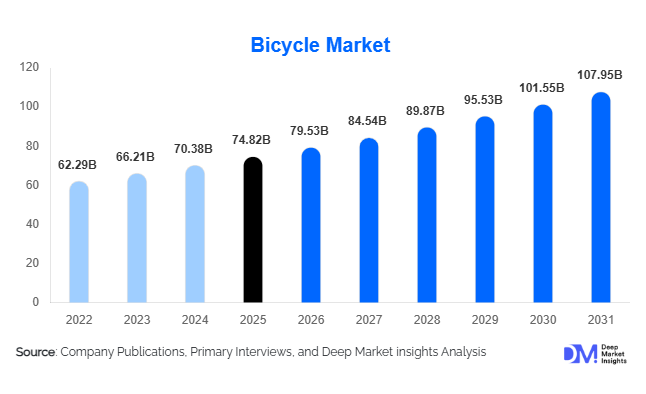
According to Deep Market Insights, the global bicycle market size was valued at USD 74.82 billion in 2025 and is projected to grow from USD 79.53 billion in 2026 to reach USD 107.95 billion by 2031, expanding at a CAGR of 6.3% during the forecast period (2026–2031). The market is driven by rising urbanization, increasing adoption of sustainable transportation, growing popularity of cycling for fitness and recreation, and expanding government investments in cycling infrastructure. The rapid adoption of electric bicycles, technological advancements in lightweight frame materials, and favorable environmental policies continue to accelerate global industry expansion.
Key Market Insights
- Electric bicycles represent the fastest-growing product category, supported by increasing urban commuting and government incentives for sustainable mobility.
- Transportation remains the largest application segment, accounting for nearly half of global demand due to rising fuel costs and urban congestion.
- Asia-Pacific dominates the global market, led by China, India, Taiwan, and Japan owing to strong manufacturing capabilities and high domestic consumption.
- Europe is projected to witness the fastest growth, driven by cycling-friendly infrastructure, environmental regulations, and increasing electric bicycle adoption.
- Emerging economies, such as India and those in Southeast Asia, are becoming major growth centers due to expanding urban populations and rising disposable incomes.
- Smart technologies, connected bicycles, GPS tracking, IoT integration, and advanced lithium-ion battery systems are transforming product innovation across premium bicycle categories.
Bicycle Market Trends
Rapid Expansion of Electric Bicycle Adoption
Electric bicycles continue to reshape the global industry as consumers increasingly prefer sustainable and cost-effective mobility solutions. Manufacturers are investing heavily in lightweight battery systems, high-efficiency motors, and longer-range electric drivetrains to improve riding performance. Governments across Europe and Asia are offering subsidies and tax incentives that encourage electric bicycle purchases, while urban infrastructure projects continue expanding dedicated cycling lanes. Fleet operators, delivery companies, and bike-sharing providers are also accelerating electric bicycle deployment, creating significant opportunities across commercial and consumer segments.
Integration of Smart Cycling Technologies
Digital innovation is becoming a defining trend throughout the industry. Premium bicycles now feature GPS navigation, Bluetooth connectivity, anti-theft tracking, mobile applications, predictive maintenance systems, and AI-powered ride analytics. Manufacturers are incorporating lightweight carbon fiber frames, hydraulic braking systems, and smart safety features to improve rider experience. These technological advancements are attracting younger consumers, fitness enthusiasts, and daily commuters while supporting premium product sales worldwide.
Bicycle Market Drivers
Growing Preference for Sustainable Urban Transportation
Governments worldwide are promoting cycling as an environmentally friendly transportation alternative through investments in bicycle lanes, parking infrastructure, and public bike-sharing programs. Rising fuel prices, traffic congestion, and carbon emission reduction targets are encouraging consumers to replace short-distance vehicle trips with bicycles. Increasing awareness regarding personal health and active lifestyles is further strengthening long-term demand across both developed and emerging economies.
Increasing Health and Fitness Awareness
The growing popularity of cycling as a recreational and fitness activity continues to support market expansion. Consumers are increasingly participating in cycling events, endurance races, mountain biking, and outdoor recreational activities. Fitness-conscious individuals prefer bicycles as a low-impact exercise option that improves cardiovascular health while reducing environmental impact. Rising disposable incomes and growing participation in outdoor sports continue driving premium bicycle purchases globally.
Bicycle Market Restraints
Volatility in Raw Material and Manufacturing Costs
Fluctuating prices of aluminum, steel, carbon fiber, lithium-ion battery materials, and electronic components continue affecting production costs across the bicycle industry. Supply chain disruptions, transportation expenses, and semiconductor shortages have also increased manufacturing complexity for premium and electric bicycles. These cost pressures often result in higher retail prices, limiting affordability for price-sensitive consumers in developing markets.
Limited Cycling Infrastructure in Developing Economies
Despite growing consumer interest, inadequate cycling infrastructure remains a significant barrier to wider adoption in several emerging countries. Limited availability of dedicated bicycle lanes, parking facilities, road safety measures, and supportive urban planning reduces commuter confidence. Safety concerns, inconsistent regulations, and increasing vehicle traffic continue restricting bicycle usage across several metropolitan regions.
Bicycle Market Opportunities
Expansion of Electric Mobility Ecosystems
Rapid electrification of urban transportation presents significant opportunities for bicycle manufacturers. Continued improvements in battery efficiency, charging infrastructure, connected mobility platforms, and government incentive programs are expanding electric bicycle adoption. Fleet operators, logistics companies, tourism providers, and shared mobility platforms are increasingly integrating electric bicycles into their operations, creating new revenue opportunities throughout the value chain.
Growth of Smart Urban Mobility Solutions
Smart cities are increasingly incorporating cycling into integrated transportation systems through intelligent traffic management, digital bike-sharing platforms, IoT-enabled parking systems, and multimodal mobility networks. Manufacturers developing connected bicycles with predictive maintenance, remote diagnostics, and smartphone integration are well positioned to benefit from evolving urban mobility trends.
Report Scope
| Report Metric | Details |
|---|---|
| Market Size in 2025 | USD 74.82 Billion |
| Market Size in 2026 | USD 79.53 Billion |
| Market Size in 2031 | USD 107.95 Billion |
| CAGR | 6.3% (2026-2031) |
| Base Year for Estimation | 2025 |
| Historical Data | 2022-2024 |
| Forecast Period | 2026-2031 |
| Report Coverage | Revenue Forecast, Competitive Landscape, Supply Chain Disruption, Growth Factors, Environment & Regulatory Landscape and Trends |
| Geographies Covered | North America, Europe, APAC, Middle East and Africa, LATAM |
| Countries Covered | U.S., Canada, U.K., Germany, France, Spain, Italy, Russia, Nordic, Benelux, Rest of Europe, China, Korea, Japan, India, Australia, Singapore, Taiwan, South East Asia, Rest of Asia-Pacific, UAE, Turky, Saudi Arabia, South Africa, Egypt, Nigeria, Rest of MEA, Brazil, Mexico, Argentina, Chile, Colombia, Rest of LATAM |
Explore more data points, trends and opportunities Download Free Sample Report
Type Insights
Electric bicycles dominate the global bicycle market, accounting for the largest revenue share due to increasing demand for sustainable, cost-efficient, and technologically advanced transportation solutions. Growing concerns regarding carbon emissions, rising fuel prices, and supportive government incentives for electric mobility have significantly accelerated electric bicycle adoption across both developed and emerging economies. Modern electric bicycles incorporate advanced lithium-ion battery systems, pedal-assist technology, regenerative braking, GPS tracking, IoT connectivity, smartphone integration, and intelligent ride management systems, making them highly attractive for urban commuters, delivery fleets, and shared mobility operators. Continuous improvements in battery range, charging efficiency, and lightweight frame materials are further strengthening demand across residential and commercial users.
Mountain bicycles continue to represent a significant product category owing to the increasing popularity of outdoor adventure tourism, mountain biking competitions, and recreational cycling activities. Consumers prefer mountain bicycles because of their durable aluminum or carbon fiber frames, advanced suspension systems, hydraulic disc brakes, and superior off-road capabilities that enable safe riding across rough terrains. The expansion of cycling parks, adventure tourism destinations, and international sporting events continues to support demand for high-performance mountain bicycles worldwide.
Road bicycles maintain steady market demand among professional cyclists, endurance athletes, and fitness-conscious consumers seeking lightweight, aerodynamic, and high-speed transportation solutions. Their efficient frame geometry, lightweight construction, multiple gear configurations, and enhanced riding efficiency make them suitable for competitive racing, long-distance touring, and urban commuting. Growing participation in cycling events, triathlons, and fitness programs continues to support sales of premium road bicycles across Europe, North America, and Asia-Pacific.
Application Insights
Transportation represents the leading application segment of the global bicycle market as consumers increasingly adopt bicycles for daily commuting to reduce transportation expenses, traffic congestion, and greenhouse gas emissions. Rapid urbanization, government investments in dedicated cycling infrastructure, expanding bicycle-sharing programs, and rising environmental awareness continue driving adoption across metropolitan areas. The increasing popularity of electric bicycles for short-distance commuting further strengthens the transportation segment, while employers and municipalities continue promoting cycling as a sustainable mobility solution through incentive programs and workplace infrastructure.
Sports and recreation remain a major application segment driven by increasing participation in cycling competitions, fitness activities, endurance sports, recreational riding, and adventure tourism. Rising consumer awareness regarding physical fitness, cardiovascular health, and outdoor wellness activities has significantly expanded recreational bicycle ownership across all age groups. Professional cycling tournaments, community cycling events, and growing investments in cycling trails and recreational parks continue supporting long-term segment growth.
Commercial applications are witnessing rapid expansion with the increasing adoption of bicycles by last-mile delivery providers, courier companies, food delivery platforms, tourism operators, bicycle rental services, and urban logistics companies. Electric cargo bicycles are becoming an efficient alternative for urban freight transportation because they reduce operating costs, improve delivery efficiency, and help organizations achieve sustainability goals. Growing investments in smart city projects and environmentally friendly logistics networks are expected to further accelerate commercial bicycle adoption during the forecast period.
Explore more data points, trends and opportunities Download Free Sample Report
Bicycle Market Segmentations
By Type
- Road Bicycles
- Mountain Bicycles
- Electric Bicycles
By Application
- Transportation
- Sports & Recreation
- Commercial Use
Regional Insights
North America
North America maintains a strong position in the global bicycle market owing to increasing recreational cycling participation, expanding electric bicycle adoption, and continuous investments in cycling infrastructure. The United States dominates regional demand due to high consumer purchasing power, widespread participation in outdoor fitness activities, and increasing demand for premium bicycles. Canada also contributes significantly through expanding cycling networks and supportive environmental policies promoting sustainable transportation.
The primary drivers supporting regional growth include growing investments in protected bicycle lanes, increasing government initiatives encouraging carbon emission reduction, expanding bicycle-sharing programs, rising consumer preference for healthy lifestyles, and the rapid adoption of electric bicycles for urban commuting. Continuous product innovation by leading manufacturers and growing participation in cycling competitions further strengthen market expansion throughout North America.
Europe
Europe represents the fastest-growing regional market, supported by well-established cycling infrastructure, favorable environmental regulations, and widespread government incentives promoting sustainable transportation. Germany, the Netherlands, France, Italy, and Denmark remain key contributors due to high bicycle ownership rates and mature cycling cultures. Electric bicycles have become increasingly popular among commuters seeking efficient, environmentally friendly mobility alternatives.
Regional growth is primarily driven by ambitious carbon neutrality targets, significant investments in cycling highways and urban mobility infrastructure, generous subsidies for electric bicycle purchases, increasing fuel prices, and strong consumer preference for eco-friendly transportation. Growing awareness regarding public health, active lifestyles, and low-emission mobility solutions continues to create favorable long-term growth opportunities across the European bicycle market.
Asia-Pacific
Asia-Pacific dominates the global bicycle market due to its extensive manufacturing ecosystem, large consumer base, competitive production costs, and expanding domestic demand. China remains the world's largest producer and exporter of bicycles, while India, Taiwan, and Japan continue strengthening manufacturing capabilities through technological innovation and production efficiency. Rising disposable incomes and increasing urban populations are also supporting higher bicycle ownership throughout the region.
The region's growth is driven by rapid urbanization, strong government support for electric mobility, expanding cycling infrastructure, rising environmental awareness, increasing fuel prices, and continuous investments in local manufacturing facilities. Growing demand for affordable transportation, expanding e-commerce delivery services, and rising adoption of electric bicycles among commuters continue reinforcing Asia-Pacific's leadership in the global market.
Latin America
Latin America is experiencing steady market expansion as governments increasingly promote sustainable urban transportation while consumers embrace cycling for commuting, recreation, and fitness. Brazil and Mexico account for the largest regional demand owing to their expanding urban populations, improving economic conditions, and increasing investments in bicycle infrastructure. Electric bicycles are gradually gaining acceptance across major metropolitan cities as charging infrastructure continues to improve.
Key growth drivers include increasing traffic congestion, rising fuel costs, expanding government investments in dedicated cycling lanes, improving awareness regarding healthy lifestyles, and growing popularity of bicycle-sharing programs. The expansion of tourism activities and outdoor recreational cycling is also creating additional opportunities for bicycle manufacturers across the region.
Middle East & Africa
The Middle East & Africa bicycle market is gradually expanding due to increasing investments in smart city projects, recreational infrastructure, tourism development, and public health initiatives. Countries including the UAE, Saudi Arabia, and South Africa are investing in cycling tracks, sports facilities, and international cycling events to encourage active lifestyles and diversify tourism offerings. Growing consumer interest in premium bicycles and electric mobility solutions is further supporting regional demand.
Regional growth is primarily driven by government initiatives promoting healthy living, increasing investments in sustainable transportation infrastructure, expanding tourism and recreational activities, rising environmental awareness, and ongoing smart city developments. Growing participation in cycling events, improved urban planning, and increasing adoption of electric bicycles are expected to support long-term market expansion across the Middle East & Africa.
Key Players in the Bicycle Market
- Giant Manufacturing Co. Ltd.
- Trek Bicycle Corporation
- Merida Industry Co., Ltd.
- Specialized Bicycle Components, Inc.
- Accell Group N.V.
- Pon.Bike
- Scott Sports SA
- Cannondale Bicycle Corporation
- Hero Cycles Ltd.
- Atlas Cycles Ltd.
- Fuji Bikes
- Santa Cruz Bicycles
- BMC Switzerland AG
- Cervélo Cycles
- Brompton Bicycle Ltd.