Golf Ball Market Size
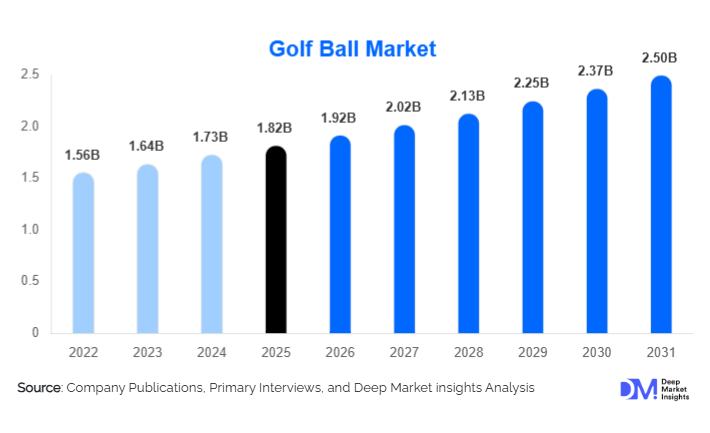
According to Deep Market Insights, the global golf ball market size was valued at USD 1.82 billion in 2025 and is projected to grow from USD 1.92 billion in 2026 to reach USD 2.91 billion by 2031, expanding at a CAGR of 5.4% during the forecast period (2026–2031). The golf ball market growth is driven by rising participation in recreational and professional golf, continuous advancements in golf ball construction technologies, increasing investment in golf infrastructure, and growing consumer preference for premium multi-layer golf balls that offer superior distance, spin control, and durability.
Key Market Insights
- Multi-layer golf balls are witnessing rapid adoption, supported by improved aerodynamics, enhanced spin control, and premium performance characteristics.
- Recreational golf remains the largest application segment, fueled by increasing participation among beginners, corporate players, and amateur golfers worldwide.
- North America dominates the global market, led by high golf participation rates, established golf infrastructure, and strong replacement demand.
- Asia-Pacific is the fastest-growing regional market, driven by expanding golf tourism, rising disposable incomes, and increasing golf course development.
- Manufacturers are investing in advanced core materials and aerodynamic dimple designs to improve distance, consistency, and ball durability.
- Digital fitting technologies and customized golf equipment are enhancing purchasing decisions and supporting premium product demand.
Golf Ball Trends
Advanced Multi-Layer Ball Technologies Driving Performance
Manufacturers are increasingly focusing on multi-layer golf ball designs incorporating advanced rubber cores, urethane covers, and optimized mantle constructions to improve launch angle, spin rate, and energy transfer. Modern golf balls feature sophisticated dimple patterns that reduce aerodynamic drag while enhancing flight stability. Premium products are increasingly being adopted by both professional and experienced amateur golfers seeking improved greenside control and longer driving distances. Continuous investments in research and development are enabling brands to introduce innovative compression technologies that deliver greater consistency across varying swing speeds.
Growing Adoption of Personalized Golf Equipment
Golf equipment manufacturers are expanding customized fitting programs that recommend golf balls based on swing characteristics, playing style, and performance objectives. Artificial intelligence-powered fitting systems, launch monitors, and digital analytics are improving product selection for consumers while strengthening brand loyalty. In addition, direct-to-consumer online channels are making premium golf balls more accessible through subscription models, personalized packaging, and digital product recommendations, contributing to sustained market expansion.
Golf Ball Drivers
Increasing Global Participation in Golf
The growing popularity of golf among younger consumers, women, and recreational players continues to drive demand for golf balls across developed and emerging economies. Government investments in sports infrastructure, increasing golf tourism, and expanding corporate golf events have significantly increased participation levels. The expansion of golf academies, driving ranges, and championship courses is further supporting equipment sales, while major international tournaments continue encouraging new consumers to adopt the sport.
Continuous Innovation in Golf Ball Manufacturing
Manufacturers are introducing advanced materials, improved dimple configurations, and high-performance core technologies that enhance ball speed, control, and durability. The development of low-compression balls for slower swing speeds and premium urethane-covered balls for professional performance is expanding product portfolios across multiple consumer segments. Continuous innovation enables manufacturers to differentiate premium offerings while maintaining strong replacement demand.
Golf Ball Restraints
High Cost of Premium Golf Balls
Premium multi-layer golf balls remain significantly more expensive than conventional two-piece products, limiting adoption among casual golfers and beginners. Higher production costs associated with advanced materials and precision manufacturing contribute to elevated retail prices. Price-sensitive consumers often choose entry-level alternatives, particularly in developing economies where golf participation is still emerging.
Environmental Concerns Related to Golf Ball Waste
Millions of golf balls are lost annually in lakes, forests, and rough terrain, raising concerns regarding long-term environmental impact. Conventional synthetic materials require extended degradation periods, encouraging manufacturers to explore recyclable and bio-based alternatives. Sustainability regulations and increasing consumer awareness are placing additional pressure on manufacturers to develop environmentally responsible product solutions.
Golf Ball Opportunities
Expansion of Golf Tourism
Rapid development of golf resorts, destination courses, and international golf tournaments is creating significant opportunities for equipment manufacturers. Countries across Asia-Pacific and the Middle East are investing in premium golf facilities to attract international visitors, increasing demand for high-quality golf balls through retail stores, golf clubs, and professional tournaments.
Growth of Direct-to-Consumer Sales Channels
E-commerce platforms and manufacturer-owned digital stores are enabling brands to strengthen customer relationships through customized products, subscription services, and personalized marketing. Digital retail channels also allow manufacturers to introduce exclusive product launches, promotional campaigns, and performance-based recommendations, supporting long-term market expansion.
Report Scope
| Report Metric | Details |
|---|---|
| Market Size in 2025 | USD 1.82 Billion |
| Market Size in 2026 | USD 1.92 Billion |
| Market Size in 2031 | USD 2.50 Billion |
| CAGR | 5.4% (2026-2031) |
| Base Year for Estimation | 2025 |
| Historical Data | 2022-2024 |
| Forecast Period | 2026-2031 |
| Report Coverage | Revenue Forecast, Competitive Landscape, Supply Chain Disruption, Growth Factors, Environment & Regulatory Landscape and Trends |
| Geographies Covered | North America, Europe, APAC, Middle East and Africa, LATAM |
| Countries Covered | U.S., Canada, U.K., Germany, France, Spain, Italy, Russia, Nordic, Benelux, Rest of Europe, China, Korea, Japan, India, Australia, Singapore, Taiwan, South East Asia, Rest of Asia-Pacific, UAE, Turky, Saudi Arabia, South Africa, Egypt, Nigeria, Rest of MEA, Brazil, Mexico, Argentina, Chile, Colombia, Rest of LATAM |
Explore more data points, trends and opportunities Download Free Sample Report
Type Insights
Two-piece golf balls account for the largest share of the global market due to their affordability, exceptional durability, and superior distance performance, making them the preferred choice among recreational golfers, beginners, and high-volume users. Their solid-core construction and ionomer cover provide excellent resistance to wear while maintaining consistent ball flight, making them ideal for golf courses, driving ranges, and training academies. The continued expansion of amateur golf participation, rising enrollment in golf coaching programs, and increasing demand for value-oriented sporting equipment are the primary factors driving the dominance of the two-piece segment. Manufacturers are also introducing improved low-compression cores and enhanced dimple designs to maximize distance without significantly increasing production costs.
Three-piece golf balls continue to witness healthy demand among intermediate and skilled golfers seeking a balance between distance, control, and feel. These balls incorporate an additional mantle layer that improves energy transfer while generating higher spin around the greens compared to two-piece alternatives. Increasing participation in club-level competitions, rising consumer awareness regarding performance-specific golf equipment, and the growing popularity of custom golf ball fitting services are supporting segment growth. Manufacturers are further enhancing product performance through advanced mantle materials and optimized compression technologies that deliver improved shot consistency across varying swing speeds.
Multi-layer golf balls represent the premium segment of the market, offering superior spin control, enhanced ball speed, optimized launch conditions, and exceptional greenside performance for professional golfers and low-handicap players. These products feature multiple performance layers engineered to maximize energy transfer while maintaining precise shot control under tournament conditions. Rising participation in professional competitions, increasing demand for premium sporting goods, technological advancements in urethane cover materials, and continuous investments in research and development are driving strong demand for multi-layer golf balls. The growing influence of professional golf tournaments and endorsement by leading athletes is further accelerating adoption within the premium segment.
Application Insights
Recreational golf represents the dominant application segment owing to the steady increase in leisure golf participation, corporate golf events, golf tourism, and beginner training programs across developed and emerging economies. Rising disposable incomes, growing awareness of golf as a lifestyle sport, and continuous expansion of public golf courses are encouraging greater equipment purchases among casual players. Recreational golfers also exhibit frequent replacement cycles due to ball loss during play, creating sustained demand for affordable two-piece golf balls. The increasing popularity of family-oriented golf activities and youth development initiatives continues to strengthen long-term growth within this segment.
Professional tournaments account for a significant premium application segment, generating robust demand for high-performance golf balls that deliver superior distance, spin consistency, flight stability, and shot accuracy. Professional golfers increasingly rely on advanced multi-layer constructions with urethane covers to optimize performance under varying course conditions. The expansion of international golf championships, sponsorship investments by leading manufacturers, and rising participation in amateur professional circuits continue driving premium product sales. Product innovation remains highly concentrated within this segment, with manufacturers introducing advanced aerodynamic technologies and optimized compression ratings to meet evolving player requirements.
Driving ranges continue to represent an important application area as golf participation expands globally and demand for structured player development increases. Commercial driving ranges, golf academies, entertainment-based golf venues, and indoor golf simulator facilities require highly durable practice balls capable of withstanding repeated high-impact usage while maintaining consistent flight characteristics. The rapid expansion of indoor golf entertainment centers, increasing adoption of launch-monitor technologies, and rising investments in golf coaching infrastructure are creating new growth opportunities for this segment. The integration of technology-enabled practice facilities is further supporting demand for specialized driving range golf balls.
Explore more data points, trends and opportunities Download Free Sample Report
Golf Ball Market Segmentations
By Type
- Two-piece Golf Balls
- Three-piece Golf Balls
- Multi-layer Golf Balls
By Application
- Recreational Golf
- Professional Tournaments
- Driving Ranges
By Distribution Channel
- Online Retail
- Sporting Goods Stores
- Golf Pro Shops
- Department Stores
- Direct-to-Consumer (Brand Stores)
Regional Insights
North America
North America holds the largest share of the global golf ball market owing to its well-established golf ecosystem, high participation rates, extensive golf course infrastructure, and strong presence of leading golf equipment manufacturers. The United States accounts for the majority of regional demand, supported by thousands of public and private golf courses, professional tournaments, and a large population of recreational golfers. Rising consumer spending on premium sporting equipment, increasing golf tourism, and continuous product innovation by major manufacturers continue to strengthen regional market leadership. Furthermore, advanced retail distribution networks, growing adoption of custom club and ball fitting services, and widespread availability of indoor golf simulator facilities are supporting consistent replacement demand across all consumer segments.
Europe
Europe represents a mature and steadily expanding market driven by strong golf participation across the United Kingdom, Germany, France, Spain, Ireland, and the Nordic countries. The region benefits from a well-developed golf club network, increasing golf tourism, and rising consumer preference for premium sporting equipment. Government investments in sports infrastructure, growing popularity of golf among younger demographics, and increasing international golf events are supporting market expansion. In addition, sustainability initiatives encouraging environmentally responsible golf course management, combined with technological advancements in golf equipment and the expansion of specialist sporting goods retailers, continue to stimulate demand throughout the region.
Asia-Pacific
Asia-Pacific is projected to register the fastest market growth during the forecast period, supported by rapidly expanding golf tourism, rising disposable incomes, growing middle-class populations, and increasing investments in sports infrastructure. Japan and South Korea remain technologically advanced golf equipment markets, while China and India are witnessing substantial growth in golf participation through new golf academies, training facilities, and premium residential golf communities. Australia continues to contribute significantly due to its established golf culture and extensive course network. The increasing popularity of indoor golf simulators, favorable government initiatives promoting sports participation, and rising international tourism are further accelerating regional demand for premium and recreational golf balls.
Latin America
Latin America is witnessing gradual market expansion led by Brazil, Mexico, Argentina, and Chile as golf gains popularity among both recreational and corporate participants. Rising investments in tourism infrastructure, increasing development of golf resorts, and the growing presence of international golf tournaments are creating favorable market conditions. Expanding middle-class incomes, increasing availability of golf training facilities, and greater participation by younger consumers are supporting equipment sales across the region. Additionally, improved distribution channels through online sporting goods retailers and specialty golf stores are enhancing product accessibility and supporting long-term market growth.
Middle East & Africa
The Middle East & Africa market is expanding steadily with increasing investments in luxury golf resorts, championship golf courses, sports tourism, and international sporting events. The United Arab Emirates, Saudi Arabia, Qatar, and South Africa continue to drive regional demand through significant investments in premium hospitality developments and world-class golf infrastructure. Government initiatives aimed at diversifying tourism, rising hosting of international golf championships, and growing participation among affluent consumers are strengthening market expansion. In addition, the development of integrated golf communities, increasing expatriate populations, favorable climatic conditions for year-round golf activities, and expanding luxury tourism continue to create attractive growth opportunities for golf ball manufacturers across the region.
Key Players in the Golf Ball Market
- Titleist (Acushnet Holdings Corp.)
- Bridgestone Golf
- Callaway Golf Company
- TaylorMade Golf Company
- Srixon Sports Co., Ltd.
- Mizuno Corporation
- Vice Golf
- Volvik Inc.
- Wilson Sporting Goods
- PXG