Performance Apparel Market Size
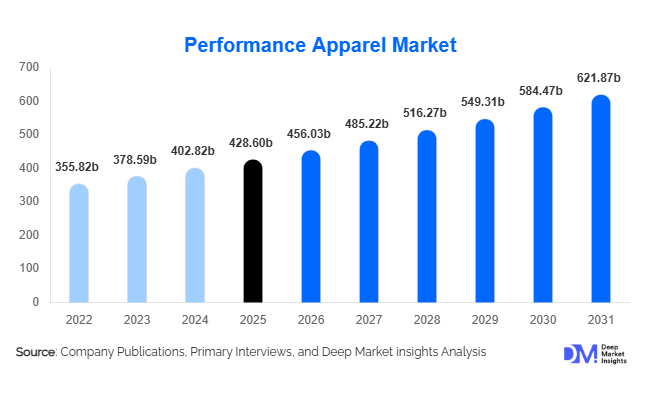
According to Deep Market Insights, the global performance apparel market size was valued at USD 428.6 billion in 2025 and is projected to grow from USD 456.03 billion in 2026 to reach USD 621.87 billion by 2031, expanding at a CAGR of 6.4% during the forecast period (2026–2031). The performance apparel market growth is primarily driven by increasing participation in fitness and sports activities, rising consumer preference for athleisure clothing, growing adoption of sustainable performance fabrics, and continuous advancements in moisture-wicking, compression, and temperature-regulating textile technologies.
Key Market Insights
- Performance apparel is increasingly evolving toward sustainable and smart textile solutions, with manufacturers investing in recycled fibers, antimicrobial fabrics, and wearable-compatible clothing.
- Top wear remains the leading product category, supported by growing demand for training, running, yoga, and outdoor sports apparel across global markets.
- North America dominates the global market, driven by high sports participation, premium brand presence, and strong consumer spending on fitness apparel.
- Asia-Pacific is the fastest-growing regional market, supported by expanding middle-class income, rising health awareness, and growing sports infrastructure in China and India.
- Women's performance apparel is witnessing the fastest expansion, fueled by increasing female participation in fitness, wellness, and professional sports activities.
- Digital retail and direct-to-consumer platforms continue reshaping purchasing behavior through personalized shopping experiences, AI-based recommendations, and omnichannel strategies.
Performance Apparel Market Trends
Growing Adoption of Sustainable Performance Textiles
Leading apparel manufacturers are increasingly incorporating recycled polyester, bio-based fibers, organic cotton, and low-impact manufacturing processes into their product portfolios. Sustainability initiatives have become a key competitive differentiator as consumers prioritize environmentally responsible apparel without compromising comfort or durability. Brands are also introducing circular economy programs, garment recycling initiatives, and carbon-neutral production facilities to strengthen sustainability commitments. The integration of eco-friendly dyes, water-saving technologies, and recyclable packaging continues to transform product development while supporting long-term industry expansion.
Smart and Technology-Integrated Apparel Becoming Mainstream
Performance apparel manufacturers are integrating advanced textile technologies including temperature regulation, compression engineering, antimicrobial coatings, UV protection, and sensor-enabled fabrics. AI-powered product customization, seamless knitting technologies, and digital body scanning are improving garment fit and consumer experience. Wearable-compatible clothing designed for athletes and fitness enthusiasts is gaining popularity, while connected apparel capable of monitoring physical activity and biometric performance is expected to create new opportunities for premium sportswear brands throughout the forecast period.
Performance Apparel Market Drivers
Growing Global Participation in Sports and Fitness Activities
Increasing awareness regarding healthy lifestyles and preventive healthcare has significantly increased participation in gym memberships, running events, yoga, outdoor recreation, and organized sports worldwide. Rising disposable income, expanding fitness club networks, and government initiatives promoting sports participation continue to drive demand for high-performance athletic clothing. Additionally, the growing popularity of athleisure has blurred the boundaries between sportswear and casual fashion, further accelerating market expansion across all consumer demographics.
Rapid Expansion of Athleisure Fashion
Athleisure has become one of the fastest-growing apparel categories as consumers increasingly seek clothing that combines athletic functionality with everyday comfort and style. The trend is supported by hybrid work environments, changing fashion preferences, celebrity endorsements, and social media influence. Premium sportswear manufacturers continue introducing versatile collections suitable for workouts, travel, office wear, and leisure activities, significantly expanding the addressable consumer base.
Performance Apparel Market Restraints
Volatility in Raw Material Prices
Fluctuating prices of polyester, nylon, elastane, cotton, and specialty fibers continue to affect manufacturing costs and profit margins across the performance apparel industry. Supply chain disruptions, rising transportation expenses, and geopolitical uncertainties further increase production costs. These pricing fluctuations often result in higher retail prices, limiting affordability in price-sensitive markets and creating challenges for manufacturers operating in highly competitive segments.
Counterfeit Products and Intense Market Competition
The widespread availability of counterfeit sportswear and imitation branded products continues to impact premium manufacturers worldwide. Counterfeit products reduce brand value, affect customer trust, and create pricing pressure for established companies. Additionally, increasing competition from regional brands, private labels, and digital-first apparel companies is intensifying market rivalry and requiring continuous investment in innovation, branding, and product differentiation.
Performance Apparel Market Opportunities
Expansion of Sustainable Apparel Collections
Consumer demand for environmentally responsible clothing continues to create significant opportunities for manufacturers investing in recycled fabrics, biodegradable materials, and circular production models. Growing regulatory support for sustainable manufacturing and increasing corporate ESG commitments are encouraging brands to develop eco-friendly product lines that appeal to environmentally conscious consumers while strengthening long-term competitiveness.
Growth of Digital Commerce and Direct-to-Consumer Sales
E-commerce platforms and direct-to-consumer business models are transforming the performance apparel industry by providing personalized shopping experiences, virtual fitting technologies, AI-driven recommendations, and subscription-based purchasing models. Brands are increasingly investing in omnichannel retail strategies, mobile commerce, and digital marketing campaigns to improve customer engagement and strengthen long-term revenue growth.
Report Scope
| Report Metric | Details |
|---|---|
| Market Size in 2025 | USD 428.6 billion |
| Market Size in 2026 | USD 456.03 billion |
| Market Size in 2031 | USD 621.87 billion |
| CAGR | 6.4% (2026-2031) |
| Base Year for Estimation | 2025 |
| Historical Data | 2022-2024 |
| Forecast Period | 2026-2031 |
| Report Coverage | Revenue Forecast, Competitive Landscape, Supply Chain Disruption, Growth Factors, Environment & Regulatory Landscape and Trends |
| Geographies Covered | North America, Europe, APAC, Middle East and Africa, LATAM |
| Countries Covered | U.S., Canada, U.K., Germany, France, Spain, Italy, Russia, Nordic, Benelux, Rest of Europe, China, Korea, Japan, India, Australia, Singapore, Taiwan, South East Asia, Rest of Asia-Pacific, UAE, Turky, Saudi Arabia, South Africa, Egypt, Nigeria, Rest of MEA, Brazil, Mexico, Argentina, Chile, Colombia, Rest of LATAM |
Explore more data points, trends and opportunities Download Free Sample Report
Product Type Insights
Top wear dominates the performance apparel market owing to widespread demand for T-shirts, jackets, hoodies, jerseys, and compression tops used across fitness training, running, cycling, and outdoor sports. Bottom wear, including leggings, shorts, joggers, and training pants, represents the second-largest product category as consumers increasingly prioritize flexibility, durability, and moisture management. Innerwear continues gaining popularity through seamless construction, compression technology, breathable fabrics, and antimicrobial materials that improve comfort during athletic activities. Continuous innovation in lightweight textiles, stretchable materials, and sustainable fabric technologies is supporting product development across all categories.
End User Insights
Men account for the largest share of the performance apparel market due to strong participation in organized sports, gym memberships, outdoor recreation, and professional athletics. Women's performance apparel represents the fastest-growing segment, supported by increasing female participation in fitness programs, yoga, running, cycling, and wellness activities. Children's performance apparel is also experiencing steady growth owing to rising participation in school sports, recreational activities, and youth athletic programs. Manufacturers continue expanding product portfolios specifically designed to address the performance requirements of each consumer segment.
Explore more data points, trends and opportunities Download Free Sample Report
Performance Apparel Market Segmentations
By Product Type
- Top Wear
- Bottom Wear
- Innerwear
By End User
- Men
- Women
- Children
Regional Insights
North America
North America remains the largest regional market for performance apparel, supported by strong consumer spending, widespread participation in fitness activities, advanced retail infrastructure, and the presence of major global sportswear manufacturers. The United States represents the dominant contributor owing to high adoption of premium athletic apparel, expanding athleisure trends, and continuous product innovation. Canada also contributes significantly through increasing outdoor sports participation and growing demand for sustainable apparel.
Europe
Europe continues to represent a significant market driven by strong consumer awareness regarding health, fitness, and sustainability. Germany, the United Kingdom, France, Italy, and Spain remain major contributors due to increasing participation in cycling, football, running, skiing, and outdoor recreation. The region also benefits from strong demand for eco-friendly performance apparel and government initiatives promoting sustainable textile manufacturing.
Asia-Pacific
Asia-Pacific is expected to witness the fastest growth throughout the forecast period due to rapid urbanization, expanding disposable income, increasing sports participation, and growing popularity of fitness lifestyles. China dominates regional manufacturing and consumption, while India continues experiencing robust demand driven by expanding middle-class consumers, growing e-commerce penetration, and increasing government investment in sports infrastructure. Japan, South Korea, and Australia also contribute substantially through premium sportswear consumption and technological innovation.
Latin America
Latin America continues to experience steady market expansion, primarily supported by Brazil, Mexico, and Argentina. Rising participation in football, running, fitness training, and outdoor recreational activities is driving demand for performance apparel. Increasing digital retail penetration and improving economic conditions are expected to support long-term market development across the region.
Middle East & Africa
The Middle East & Africa market is gradually expanding due to increasing health awareness, rising disposable income, and government investments in sports and wellness initiatives. Countries including the United Arab Emirates, Saudi Arabia, and South Africa continue witnessing growing demand for premium sportswear, while expanding retail infrastructure and international brand presence are supporting future market growth.
Key Players in the Performance Apparel Market
- Nike, Inc.
- Adidas AG
- PUMA SE
- Under Armour, Inc.
- Lululemon Athletica Inc.
- ASICS Corporation
- New Balance Athletics, Inc.
- Columbia Sportswear Company
- Skechers USA, Inc.
- VF Corporation
- Fila Holdings Corp.
- Anta Sports Products Limited
- Li Ning Company Limited
- Mizuno Corporation
- Decathlon S.A.