Recreational Boating Market Size
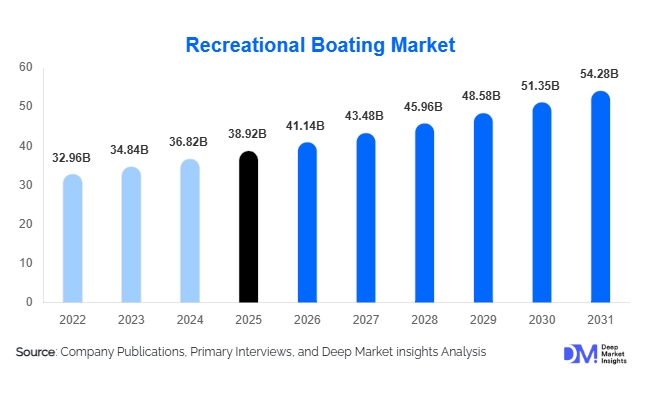
According to Deep Market Insights, the global recreational boating market size was valued at USD 38.92 billion in 2025 and is projected to grow from USD 41.14 billion in 2026 to reach USD 54.28 billion by 2031, expanding at a CAGR of 5.7% during the forecast period (2026–2031). The recreational boating market growth is primarily driven by rising participation in marine leisure activities, increasing disposable incomes, expanding coastal tourism, and growing investments in marina infrastructure worldwide. Technological advancements in boat manufacturing, including lightweight composite materials, connected navigation systems, and electric propulsion technologies, are further supporting market expansion. Increasing demand for premium boating experiences, rental platforms, and sustainable recreational vessels is also strengthening long-term industry growth across developed and emerging economies.
Key Market Insights
- Motorboats remain the largest product category, accounting for more than 52% of global recreational boat sales owing to their versatility across leisure cruising, tourism, and watersports.
- North America dominates the global recreational boating market, supported by extensive marina infrastructure, high boat ownership rates, and strong consumer spending on outdoor recreation.
- Asia-Pacific is the fastest-growing regional market, driven by increasing marine tourism investments, expanding middle-class income, and growing participation in water-based recreational activities.
- Electric and hybrid recreational boats are witnessing rapid adoption, supported by environmental regulations, battery technology improvements, and consumer demand for low-emission marine transportation.
- Digital technologies including AI-assisted navigation, IoT connectivity, and smart onboard monitoring systems are improving vessel safety, operational efficiency, and customer experience.
- Boat-sharing platforms and rental-based recreational boating services are expanding market accessibility by reducing ownership costs and attracting younger consumers.
Recreational Boating Market Trends
Growing Adoption of Electric and Sustainable Recreational Boats
The recreational boating industry is witnessing an accelerating transition toward electric and hybrid propulsion systems as manufacturers focus on reducing emissions and improving operational efficiency. Advancements in lithium-ion battery technologies, lightweight hull materials, and high-efficiency electric motors are enabling longer cruising ranges while lowering maintenance costs. Governments across Europe and North America are introducing stricter marine emission standards, encouraging manufacturers to develop environmentally sustainable recreational boats. Boat builders are also integrating recyclable composite materials and solar-assisted charging systems into premium recreational vessels. These innovations are particularly attractive to environmentally conscious consumers seeking quieter, cleaner, and more sustainable boating experiences. As battery performance continues improving and charging infrastructure expands across marinas, electric recreational boats are expected to capture an increasing share of new vessel registrations over the coming decade.
Digitalization and Smart Marine Technologies Transforming User Experience
Smart technologies are becoming an essential component of modern recreational boats. Manufacturers are increasingly integrating AI-powered navigation assistance, GPS-based route optimization, remote diagnostics, predictive maintenance software, and IoT-enabled onboard monitoring systems to improve operational safety and convenience. Mobile applications now allow owners to remotely monitor battery status, fuel consumption, security systems, and engine diagnostics in real time. Premium recreational boats are also incorporating automated docking systems, digital helm controls, touchscreen navigation displays, and cloud-connected maintenance scheduling. These technological improvements enhance customer satisfaction while reducing operating costs and improving overall boating safety. The growing demand for connected recreational vessels is encouraging continuous investments in marine electronics and intelligent navigation solutions throughout the recreational boating industry.
Recreational Boating Market Drivers
Expansion of Marine Tourism and Outdoor Recreational Activities
Growing consumer preference for outdoor leisure experiences continues to accelerate demand for recreational boating worldwide. Increasing participation in coastal tourism, island vacations, fishing activities, watersports, and luxury cruising has significantly expanded boat ownership and rental services. Governments across numerous coastal economies are investing heavily in marina construction, waterfront redevelopment, tourism infrastructure, and recreational waterfront facilities to attract domestic and international tourists. The expansion of charter services, yacht clubs, and boat-sharing platforms is making recreational boating accessible to a broader consumer base beyond traditional boat owners. Rising disposable incomes, flexible financing options, and increasing interest in experiential travel are expected to remain major long-term growth drivers for the recreational boating market.
Continuous Innovation in Boat Manufacturing Technologies
Manufacturers are investing significantly in advanced boat construction technologies to improve vessel durability, efficiency, and overall customer experience. Composite fiberglass structures, aluminum alloys, carbon-fiber materials, fuel-efficient engines, digital steering systems, and advanced marine electronics are improving vessel performance while reducing maintenance requirements. Automation technologies, including joystick controls, autonomous docking systems, and integrated navigation platforms, are simplifying boat operation for first-time users. Continuous innovation in safety equipment, fuel efficiency, onboard connectivity, and electric propulsion technologies is expanding recreational boating adoption among younger consumers while supporting premium product differentiation across global markets.
Recreational Boating Market Restraints
High Purchase, Maintenance, and Marina Ownership Costs
The high total cost of recreational boat ownership continues to limit market penetration among middle-income consumers. In addition to significant upfront purchase prices, owners must incur recurring expenses related to insurance, fuel, maintenance, docking fees, winter storage, repairs, registration, and safety compliance. Marina availability remains limited in several developing regions, resulting in higher berthing costs and longer waiting periods for boat owners. Economic uncertainty, fluctuating fuel prices, and rising interest rates also influence discretionary consumer spending on premium leisure products. These financial barriers continue to restrict widespread adoption despite increasing interest in marine recreational activities.
Environmental Regulations and Seasonal Demand Variability
Environmental regulations governing marine emissions, wastewater discharge, noise pollution, and coastal ecosystem protection are becoming increasingly stringent across numerous countries. Manufacturers must invest heavily in cleaner propulsion systems, sustainable manufacturing processes, and regulatory compliance, increasing production costs. Additionally, recreational boating demand remains highly seasonal in many regions due to weather conditions, limiting vessel utilization during colder months. Climate change, severe storms, fluctuating water levels, and changing weather patterns can also negatively affect boating activities and tourism revenues, creating additional operational challenges for manufacturers and service providers.
Recreational Boating Market Opportunities
Expansion of Boat Rental and Shared Ownership Platforms
Digital boat rental marketplaces and shared ownership models are creating significant opportunities for recreational boating service providers. Consumers increasingly prefer flexible boating experiences without assuming full ownership costs, driving demand for subscription-based boating memberships, peer-to-peer rentals, and charter services. Mobile booking applications, digital payment systems, and online reservation platforms have simplified customer access while increasing fleet utilization rates. This evolving business model enables operators to serve younger demographics, tourists, and occasional users while improving overall market accessibility. Continued expansion of digital boating platforms is expected to support long-term industry growth across both developed and emerging markets.
Luxury Marine Tourism and Premium Boating Experiences
Growing demand for premium leisure experiences is creating attractive opportunities within luxury recreational boating. High-net-worth individuals increasingly seek customized yacht charters, luxury cruising, waterfront wellness experiences, sport fishing excursions, and exclusive marine tourism packages. Boat manufacturers are responding by introducing larger luxury vessels equipped with smart automation, advanced entertainment systems, eco-friendly propulsion technologies, and personalized interior designs. Luxury marinas, waterfront resorts, and integrated marine tourism developments are also expanding globally, creating additional demand for premium recreational boats and supporting sustained growth across the high-end boating segment.
Report Scope
| Report Metric | Details |
|---|---|
| Market Size in 2025 | USD 38.92 Billion |
| Market Size in 2026 | USD 41.14 Billion |
| Market Size in 2031 | USD 54.28 Billion |
| CAGR | 5.7% (2026-2031) |
| Base Year for Estimation | 2025 |
| Historical Data | 2022-2024 |
| Forecast Period | 2026-2031 |
| Report Coverage | Revenue Forecast, Competitive Landscape, Supply Chain Disruption, Growth Factors, Environment & Regulatory Landscape and Trends |
| Geographies Covered | North America, Europe, APAC, Middle East and Africa, LATAM |
| Countries Covered | U.S., Canada, U.K., Germany, France, Spain, Italy, Russia, Nordic, Benelux, Rest of Europe, China, Korea, Japan, India, Australia, Singapore, Taiwan, South East Asia, Rest of Asia-Pacific, UAE, Turky, Saudi Arabia, South Africa, Egypt, Nigeria, Rest of MEA, Brazil, Mexico, Argentina, Chile, Colombia, Rest of LATAM |
Explore more data points, trends and opportunities Download Free Sample Report
Boat Type Insights
Motorboats dominate the recreational boating market, accounting for the largest share of global revenue owing to their versatility, performance, and suitability across leisure cruising, watersports, fishing, and coastal tourism. Their widespread adoption is supported by continuous advancements in fuel-efficient outboard engines, lightweight composite hulls, digital helm controls, and integrated navigation technologies. Manufacturers are increasingly introducing electric and hybrid motorboats to comply with evolving environmental regulations while meeting consumer demand for sustainable marine transportation. Sailboats continue to maintain steady demand among recreational sailors seeking environmentally friendly and long-distance cruising experiences. Improvements in hull aerodynamics, carbon-fiber masts, and automated sail management systems are enhancing sailing efficiency and ease of operation. Personal watercraft (PWC) represent the fastest-growing product segment, driven by rising participation in adventure sports, water-based tourism, and recreational rentals. Compact design, high maneuverability, and relatively lower ownership costs continue to attract younger consumers and first-time buyers. Pontoon boats and deck boats are also experiencing growing demand for family-oriented leisure activities due to their spacious layouts, comfort features, and multi-purpose recreational capabilities.
Application Insights
Recreational tourism represents the largest application segment within the recreational boating market, supported by increasing coastal travel, island tourism, luxury yacht charters, and expanding waterfront hospitality infrastructure. Growing consumer preference for experiential vacations and marine leisure activities continues to stimulate demand for recreational boats across both developed and emerging tourism destinations. Fishing and watersports constitute another major application area, benefiting from increasing participation in recreational fishing, wakeboarding, water skiing, scuba diving, and sport boating activities. Governments and tourism authorities are actively investing in marinas, waterfront development projects, and boating infrastructure to support this expanding recreational ecosystem. Personal leisure boating also continues to witness steady growth as consumers increasingly view boating as a lifestyle activity associated with wellness, family recreation, and outdoor entertainment. The expansion of boat rental services, subscription-based boating memberships, and peer-to-peer sharing platforms is further broadening customer accessibility while supporting higher vessel utilization rates throughout the recreational boating industry.
Explore more data points, trends and opportunities Download Free Sample Report
Recreational Boating Market Segmentations
By Boat Type
- Motorboats
- Sailboats
- Personal Watercraft
- Pontoon Boats
By Application
- Recreational Tourism
- Fishing & Watersports
- Personal Leisure Use
- Boat Rental & Charter Services
By Propulsion Type
- Internal Combustion Engine Boats
- Electric Boats
- Hybrid Boats
Regional Insights
North America
North America remains the largest regional market for recreational boating, driven by high boat ownership rates, well-established marina infrastructure, favorable financing options, and strong consumer spending on outdoor recreation. The United States accounts for the overwhelming majority of regional demand, supported by an extensive network of inland lakes, coastal waterways, and recreational boating destinations. Canada also contributes significantly through its large freshwater resources and increasing participation in recreational fishing and marine tourism. The region benefits from continuous product innovation, widespread adoption of advanced marine electronics, and a mature dealer network that supports both new boat sales and aftermarket services. Growing demand for electric recreational boats, luxury yachts, and digitally connected vessels continues to reinforce North America's leadership position in the global recreational boating market.
Europe
Europe represents the second-largest recreational boating market, supported by strong marine tourism activity, established yacht manufacturing capabilities, and increasing environmental awareness among consumers. Countries including Italy, France, Germany, Spain, the United Kingdom, and the Netherlands serve as major production and consumption centers for recreational boats. The region is witnessing growing investment in electric propulsion systems, hybrid vessels, and sustainable marina infrastructure as governments strengthen marine emission regulations. Mediterranean tourism, luxury yacht charters, and coastal leisure activities continue to generate robust demand for premium recreational boats. European manufacturers are also leading innovation in lightweight composite materials, digital navigation systems, and environmentally sustainable vessel construction, strengthening the region's competitive position within the global recreational boating industry.
Asia-Pacific
Asia-Pacific is projected to register the fastest growth throughout the forecast period, supported by rising disposable incomes, expanding middle-class populations, increasing marine tourism investments, and improving coastal infrastructure. China, Australia, Japan, South Korea, and Southeast Asian countries are witnessing rapid expansion of recreational boating activities as governments promote waterfront tourism and private marine recreation. Growing popularity of luxury travel, island tourism, recreational fishing, and water sports is creating significant opportunities for boat manufacturers and rental service providers. Marina development projects, improved coastal connectivity, and increasing adoption of digital booking platforms are making recreational boating more accessible across the region. Rising demand for premium yachts, compact leisure boats, and electric recreational vessels is expected to further accelerate regional market growth over the coming decade.
Latin America
Latin America is gradually emerging as an attractive market for recreational boating, primarily supported by expanding coastal tourism, rising disposable incomes, and growing investments in marine leisure infrastructure. Brazil remains the largest regional market due to its extensive coastline, established boating culture, and increasing demand for sport fishing and leisure cruising. Mexico is also witnessing increasing recreational boat demand driven by coastal tourism, luxury resort development, and expanding marina facilities. International tourism, charter operations, and water-based recreational activities continue to stimulate vessel sales across several Caribbean and South American destinations. As governments continue investing in tourism development and waterfront infrastructure, recreational boating adoption is expected to increase steadily across the region.
Middle East & Africa
The Middle East & Africa region continues to experience steady growth in recreational boating, supported by luxury marine tourism, expanding waterfront developments, and increasing investments in premium marina infrastructure. The United Arab Emirates leads regional demand through its well-developed yacht marinas, luxury tourism sector, and high-income consumer base. Saudi Arabia is also investing significantly in coastal tourism projects under long-term economic diversification initiatives, creating new opportunities for recreational boating manufacturers and service providers. South Africa remains an important boating destination due to its extensive coastline, sport fishing industry, and marine recreational activities. Increasing demand for yacht charters, leisure cruising, diving excursions, and luxury waterfront experiences is expected to support sustained market expansion across the Middle East and Africa during the forecast period.
Key Players in the Recreational Boating Market Brunswick Corporation Yamaha Motor Co., Ltd. Beneteau Group Malibu Boats, Inc. MasterCraft Boat Holdings, Inc. Marine Products Corporation Polaris Inc. Correct Craft Princess Yachts Sunseeker International Azimut Benetti Group Ferretti Group Bavaria Yachts White River Marine Group Chaparral Boats, Inc.