Athletic Footwear Market Size
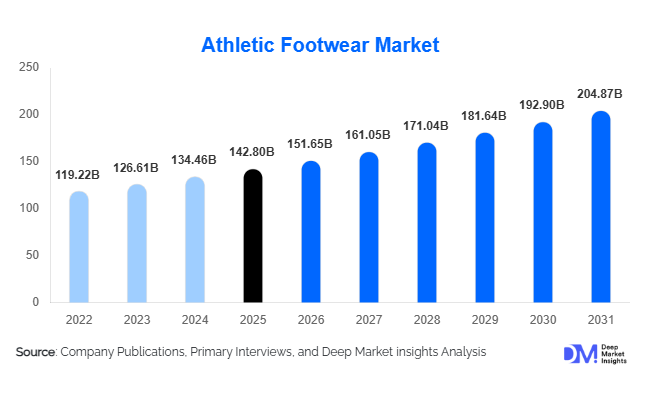
According to Deep Market Insights, the global athletic footwear market was valued at USD 142.8 billion in 2025 and is projected to grow from USD 151.65 billion in 2026 to reach USD 204.87 billion by 2031, expanding at a CAGR of 6.2% during the forecast period (2026–2031). The athletic footwear market growth is primarily driven by increasing sports participation, rising health and fitness awareness, rapid innovation in lightweight cushioning technologies, and expanding online retail channels. Growing demand for premium performance footwear, sustainability-focused product development, and continuous investments by leading brands are further supporting long-term market expansion across developed and emerging economies.
Key Market Insights
- Running shoes remain the largest product category, accounting for nearly 44.8% of global revenue due to increasing recreational and professional running activities.
- North America dominates the global market, holding approximately 35.6% market share, supported by high consumer spending and strong brand penetration.
- Asia-Pacific is the fastest-growing regional market, driven by expanding middle-class populations, rising disposable incomes, and increasing sports participation.
- Digital commerce continues transforming footwear sales, with online channels contributing nearly 38% of total global revenue.
- Sustainable footwear manufacturing is accelerating, with growing adoption of recycled materials, bio-based foams, and environmentally responsible production technologies.
- Smart footwear technologies, including AI-enabled gait analysis, connected fitness tracking, and customized fit solutions, are gaining commercial adoption worldwide.
Athletic Footwear Market Trends
Performance Technology Continues to Transform Product Innovation
Manufacturers are increasingly investing in advanced cushioning systems, carbon-fiber plates, nitrogen-infused midsoles, breathable engineered mesh, and AI-assisted footwear design. Premium athletic footwear is becoming lighter, more responsive, and more durable while enhancing energy return and injury prevention. More than 72% of newly launched premium footwear models incorporate advanced performance technologies, enabling brands to target professional athletes as well as recreational fitness enthusiasts. Increasing consumer demand for high-performance products continues to strengthen innovation across running, training, and multi-sport footwear categories.
Sustainability and Digital Customization Gain Momentum
Environmental sustainability has become a major focus across the athletic footwear industry. Leading manufacturers are expanding the use of recycled polyester, plant-based foams, circular manufacturing processes, and low-carbon production facilities. Consumers increasingly prefer footwear manufactured using sustainable materials while expecting personalized designs through digital customization platforms. AI-powered sizing, virtual fitting technologies, and direct-to-consumer customization are improving customer experience while supporting higher premium product sales across global markets.
Athletic Footwear Market Drivers
Growing Participation in Sports and Fitness Activities
Rising participation in organized sports, recreational running, gym memberships, and outdoor fitness activities continues to drive global demand for athletic footwear. Increasing government investments in sports infrastructure, expanding youth participation programs, and growing awareness regarding healthy lifestyles are encouraging footwear replacement cycles. Premium sports footwear has become an essential component of both athletic performance and casual lifestyle fashion, supporting consistent long-term industry expansion across multiple consumer segments.
Rapid Product Innovation and Premiumization
Continuous technological innovation has significantly improved footwear comfort, durability, and athletic performance. Manufacturers are introducing lightweight foams, carbon-plate running shoes, advanced stability systems, and customized cushioning technologies that appeal to professional athletes and everyday consumers alike. Premium footwear categories continue gaining popularity due to increasing consumer willingness to invest in high-performance products offering superior comfort, energy return, and durability.
Athletic Footwear Market Restraints
Volatility in Raw Material Prices
Fluctuating prices of synthetic rubber, EVA foam, TPU compounds, textiles, and petroleum-based materials continue impacting manufacturing costs across the athletic footwear industry. Rising labor expenses, freight costs, and supply chain disruptions further pressure manufacturer profit margins. Price-sensitive consumers in developing markets often delay replacement purchases, limiting premium footwear adoption across several regions.
Counterfeit Products and Intense Market Competition
The widespread availability of counterfeit athletic footwear remains a significant challenge for established brands. Unauthorized manufacturers replicate premium products at considerably lower prices, reducing brand revenues and affecting consumer confidence. Additionally, intense competition among international and regional manufacturers has increased promotional spending and pricing pressure across multiple product categories.
Athletic Footwear Market Opportunities
Expansion of Smart Footwear Technologies
Smart athletic footwear equipped with embedded sensors, activity tracking capabilities, pressure monitoring, AI-powered gait analysis, and mobile connectivity presents significant future growth opportunities. Increasing integration between footwear and digital fitness ecosystems enables personalized training experiences while strengthening customer engagement and premium product positioning.
Growth Across Emerging Economies
Rapid urbanization, rising disposable income, expanding middle-class populations, and increasing health awareness across countries such as India, China, Indonesia, Vietnam, and Brazil continue creating substantial growth opportunities. International brands are expanding manufacturing capacity, retail networks, and digital commerce operations across these markets to capture growing consumer demand for branded athletic footwear.
Report Scope
| Report Metric | Details |
|---|---|
| Market Size in 2025 | USD 142.8 Billion |
| Market Size in 2026 | USD 151.65 Billion |
| Market Size in 2031 | USD 204.87 Billion |
| CAGR | 6.2% (2026-2031) |
| Base Year for Estimation | 2025 |
| Historical Data | 2022-2024 |
| Forecast Period | 2026-2031 |
| Report Coverage | Revenue Forecast, Competitive Landscape, Supply Chain Disruption, Growth Factors, Environment & Regulatory Landscape and Trends |
| Geographies Covered | North America, Europe, APAC, Middle East and Africa, LATAM |
| Countries Covered | U.S., Canada, U.K., Germany, France, Spain, Italy, Russia, Nordic, Benelux, Rest of Europe, China, Korea, Japan, India, Australia, Singapore, Taiwan, South East Asia, Rest of Asia-Pacific, UAE, Turky, Saudi Arabia, South Africa, Egypt, Nigeria, Rest of MEA, Brazil, Mexico, Argentina, Chile, Colombia, Rest of LATAM |
Explore more data points, trends and opportunities Download Free Sample Report
Product Type Insights
Running shoes represent the largest product segment in the athletic footwear market, supported by the growing popularity of recreational running, marathon participation, trail running, and fitness-focused lifestyles. Rising awareness of cardiovascular health, increasing enrollment in running clubs, and the expansion of organized sporting events continue to strengthen demand for high-performance running footwear. Manufacturers are introducing advanced technologies such as carbon-fiber plates, nitrogen-infused midsoles, energy-return cushioning, breathable engineered mesh uppers, and AI-assisted biomechanical designs to improve comfort, speed, and injury prevention. The premium running footwear category is also benefiting from increasing consumer willingness to invest in technologically advanced products that enhance athletic performance. Growing adoption of smart running shoes integrated with fitness tracking capabilities and sustainable materials further reinforces the leadership of this segment across both developed and emerging markets.
Sports shoes continue to account for a significant share of global demand owing to increasing participation in football, basketball, tennis, volleyball, badminton, cricket, and other organized sports. Continuous investments in professional sports leagues, school athletics, collegiate competitions, and government-backed sports development programs are expanding the consumer base worldwide. Manufacturers continue enhancing product durability, grip performance, multidirectional traction, shock absorption, and lateral stability to meet sport-specific performance requirements. Additionally, the growing popularity of athleisure has significantly expanded the use of sports shoes beyond athletic activities into everyday casual wear, creating sustained demand among fashion-conscious consumers.
Training shoes are witnessing steady growth due to the rapid expansion of gym memberships, functional fitness programs, CrossFit training, home workouts, and strength-conditioning activities. Consumers increasingly seek versatile footwear capable of supporting multiple workout routines while providing flexibility, cushioning, stability, and durability. Product innovations including lightweight foam midsoles, reinforced heel support, responsive cushioning systems, and improved flexibility continue attracting fitness enthusiasts. The increasing adoption of personalized fitness programs and wearable fitness technologies further supports long-term demand for multi-purpose training footwear globally.
Application Insights
Men account for the largest application segment, driven by higher participation in organized sports, professional athletics, running competitions, outdoor recreational activities, and fitness training. Growing interest in endurance sports, gym workouts, football, basketball, and trail running continues to generate strong replacement demand for performance footwear. Premium product launches endorsed by professional athletes, combined with increasing investments in sports infrastructure and sporting events, continue strengthening the men's segment. Manufacturers are also introducing sport-specific technologies that improve stability, comfort, and durability, further supporting market leadership.
Women represent the fastest-growing application segment as female participation in sports, fitness programs, marathons, yoga, and outdoor recreational activities continues to increase worldwide. Growing health awareness, rising disposable income, expanding women's professional sports leagues, and the popularity of athleisure fashion are encouraging higher athletic footwear adoption. Manufacturers are increasingly developing women-specific footwear with improved anatomical fit, lightweight construction, enhanced cushioning, and fashionable designs that combine athletic performance with everyday lifestyle appeal, significantly expanding market opportunities.
Kids' athletic footwear continues to experience stable growth due to increasing participation in school sports, youth athletic academies, recreational activities, and outdoor play. Rising parental awareness regarding children's physical development, sports safety, and foot health is encouraging purchases of high-quality performance footwear. Manufacturers are introducing lightweight, durable, and ergonomically designed products that provide improved flexibility, cushioning, and support while accommodating rapid foot growth. Growing investments in youth sports development programs and physical education initiatives further support long-term demand across this segment.
Distribution Channel Insights
Online retail platforms have emerged as the fastest-growing distribution channel, supported by increasing internet penetration, smartphone adoption, and the growing preference for convenient digital shopping experiences. Consumers benefit from extensive product selections, transparent pricing, AI-powered size recommendations, customer reviews, virtual try-on technologies, and personalized product suggestions. Brand-owned e-commerce platforms continue strengthening direct-to-consumer strategies by offering exclusive product launches, customization options, loyalty programs, and faster delivery services. The integration of social commerce, influencer marketing, and digital payment solutions is further accelerating online athletic footwear sales globally.
Specialty sporting goods retailers continue playing a critical role by offering professional product consultation, gait analysis, personalized fitting services, and access to premium performance footwear. These retailers remain the preferred purchasing destination for serious athletes and fitness enthusiasts seeking technical product guidance. Demonstration zones, in-store customization services, and expert staff continue enhancing the overall consumer purchasing experience while supporting premium product sales.
Department stores, supermarkets, and multi-brand retail outlets remain important distribution channels, particularly for value-conscious consumers seeking affordable footwear options across multiple brands. Meanwhile, omnichannel retail strategies that seamlessly integrate physical stores with digital platforms continue improving customer engagement through services such as click-and-collect, real-time inventory visibility, personalized promotions, and flexible return policies, strengthening overall market accessibility.
Explore more data points, trends and opportunities Download Free Sample Report
Athletic Footwear Market Segmentations
By Product Type
- Running Shoes
- Sports Shoes
- Training Shoes
By Application
- Men
- Women
- Kids
By Distribution Channel
- Online Retail
- Brand-Owned Stores
- Specialty Sporting Goods Stores
- Department Stores & Supermarkets
- Multi-Brand Retail Stores
Regional Insights
North America
North America remains the largest regional market for athletic footwear due to its deeply established sports culture, high disposable income, strong consumer preference for premium footwear, and widespread fitness participation. The United States accounts for the majority of regional demand, supported by extensive participation in basketball, running, football, baseball, tennis, and gym-based fitness activities. The region benefits from strong brand loyalty, rapid adoption of innovative footwear technologies, and well-developed retail and e-commerce infrastructure.
Regional growth is primarily driven by increasing participation in recreational running, expanding health and wellness awareness, rising demand for premium performance footwear, strong endorsement by professional athletes and sports leagues, and continuous product innovation by leading global manufacturers. Growing popularity of athleisure fashion, digital commerce expansion, and increasing investments in wearable fitness technologies continue supporting long-term market growth across North America.
Europe
Europe represents one of the world's most mature athletic footwear markets, supported by strong sports participation, increasing fitness awareness, and high consumer demand for premium and sustainable footwear products. Germany, the United Kingdom, France, Italy, and Spain remain the largest regional markets due to their well-established sporting culture, organized athletic events, and extensive retail networks. Consumers increasingly prefer environmentally responsible footwear manufactured using recycled materials and low-carbon production processes.
The region's growth is driven by rising participation in recreational sports, increasing marathon and cycling events, strong government initiatives promoting active lifestyles, growing adoption of sustainable footwear, and continuous innovation by European sportswear manufacturers. The expanding popularity of athleisure fashion and increasing consumer willingness to purchase premium performance products further strengthen long-term regional demand.
Asia-Pacific
Asia-Pacific is projected to register the fastest growth throughout the forecast period, driven by rapid urbanization, expanding middle-class populations, rising disposable incomes, and increasing health awareness. China, India, Japan, South Korea, and Australia continue leading regional consumption while also serving as major manufacturing hubs for global athletic footwear production. Strong manufacturing capabilities, extensive supplier networks, and cost-efficient production continue strengthening the region's competitive position.
Regional growth is supported by increasing participation in sports and fitness activities, rapid expansion of organized retail and e-commerce platforms, government investments in sports infrastructure, growing youth populations, and rising consumer preference for branded athletic footwear. The expanding popularity of marathons, gym memberships, and athleisure fashion, coupled with increasing international brand investments across emerging Asian economies, continues accelerating market expansion.
Latin America
Brazil, Mexico, and Argentina continue leading athletic footwear demand across Latin America due to strong sporting traditions, particularly football, running, volleyball, and outdoor recreational activities. Rising urbanization, expanding retail infrastructure, and improving consumer purchasing power continue supporting regional market development. International manufacturers are strengthening local distribution networks while introducing competitively priced product portfolios tailored to regional preferences.
The market is primarily driven by increasing participation in organized sports, growing health and fitness awareness, expanding middle-income populations, rising penetration of online retail platforms, and increasing investments in domestic sports events. The growing popularity of athleisure footwear among younger consumers and improving access to branded products are expected to further support long-term regional growth.
Middle East & Africa
The Middle East & Africa athletic footwear market continues expanding due to increasing investments in sports infrastructure, government-led fitness initiatives, and rising participation in recreational and professional sports. Countries including the UAE, Saudi Arabia, South Africa, Egypt, and Qatar are witnessing growing consumer demand for premium athletic footwear supported by expanding retail networks, international sporting events, and increasing awareness of healthy lifestyles.
Regional growth is driven by government programs promoting physical fitness, rising disposable incomes, rapid urbanization, expanding youth demographics, and increasing investments in international sporting tournaments and sports tourism. The growing presence of global sportswear brands, rapid expansion of shopping malls and e-commerce platforms, together with the increasing popularity of running events, football leagues, and gym memberships, continues creating favorable opportunities for sustained market expansion across the region.