Facial Steamers Market Size
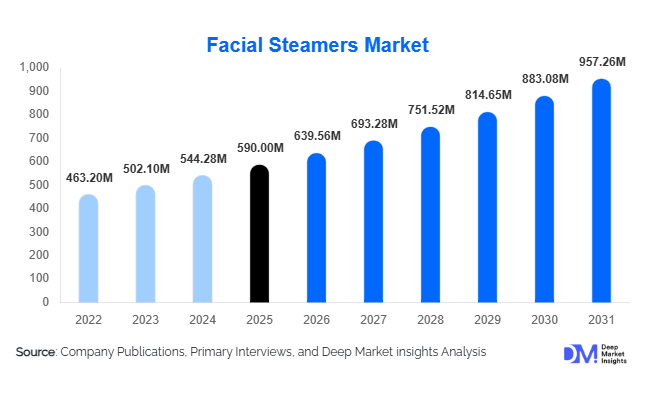
According to Deep Market Insights,the global facial steamers market size was valued at USD 590 million in 2025 and is projected to grow from USD 639.56 million in 2026 to reach USD 957.26 million by 2031, expanding at a CAGR of 8.4% during the forecast period (2026–2031). The facial steamers market growth is driven by increasing consumer awareness of skincare routines, rising adoption of at-home beauty devices, and expanding professional skincare services offered by salons, spas, and dermatology clinics. Facial steamers are widely used to cleanse pores, improve skin hydration, and enhance the absorption of skincare products, making them an essential component of modern skincare treatments.
Growing demand for non-invasive beauty treatments and affordable personal skincare technologies has significantly boosted the popularity of facial steamers globally. The expansion of the beauty and personal care industry, valued at hundreds of billions of dollars worldwide, has also contributed to rising demand for skincare devices that complement cosmetic products. Technological advancements such as nano-ionic steam technology and multifunction facial treatment machines are improving product performance and consumer experience.
In addition, the rise of e-commerce platforms and social media-driven beauty trends has made facial steamers widely accessible to consumers worldwide. Influencer-led skincare routines and online beauty tutorials have further increased product visibility and consumer adoption. As personal grooming, wellness, and preventive skincare continue to gain importance globally, the facial steamers market is expected to experience steady growth during the forecast period.
Key Market Insights
- Personal facial steamers dominate global demand, accounting for more than half of market sales due to rising adoption of home skincare routines.
- Nano-ionic steam technology is rapidly gaining traction, offering deeper skin penetration and improved hydration compared to traditional steam systems.
- Asia-Pacific leads global production and consumption, supported by strong electronics manufacturing ecosystems and growing beauty-conscious populations.
- E-commerce channels dominate distribution, with online retail accounting for the majority of consumer purchases globally.
- The professional spa and salon industry continues to expand, driving demand for high-capacity facial steaming equipment.
- Multifunction beauty devices are emerging as a key innovation trend, combining steaming with ozone therapy, magnification lamps, and skin treatment technologies.
What are the latest trends in the facial steamers market?
Rise of At-Home Beauty Technology
One of the most prominent trends shaping the facial steamers market is the increasing adoption of at-home beauty devices. Consumers are increasingly looking for convenient alternatives to expensive salon treatments, which has boosted demand for personal facial steamers designed for home use. Compact designs, user-friendly controls, and affordable price points have made these devices accessible to a broad consumer base. Beauty influencers and dermatologists frequently recommend facial steaming as part of skincare routines for deep cleansing and improved skin hydration. This growing awareness has accelerated consumer purchases, particularly among younger demographics who prefer do-it-yourself skincare solutions.
Manufacturers are responding to this demand by developing portable devices with adjustable steam settings, rapid heating technology, and compatibility with aromatherapy oils. These innovations enhance user convenience and expand the use of facial steamers beyond simple skincare treatments. As consumers increasingly invest in personal wellness and beauty technologies, the adoption of home facial steamers is expected to remain a major market trend.
Technological Advancements in Skincare Devices
Technological innovation is significantly transforming the facial steamers market. Advanced technologies such as nano-ionic steam generation and ozone-infused steaming systems are improving the effectiveness of facial steaming treatments. Nano-ionic technology produces extremely fine steam particles that penetrate deeper into the skin, enhancing hydration and improving the absorption of skincare products. This technology is particularly popular in premium consumer devices and professional salon equipment.
Another important technological development is the integration of facial steamers into multifunction skincare machines. These devices combine steaming with features such as magnifying lamps, vacuum extraction tools, and LED therapy systems. Professional beauty clinics and dermatology centers increasingly adopt such equipment to provide comprehensive facial treatments. As beauty technology continues to evolve, innovation will play a key role in differentiating facial steamer products in a competitive marketplace.
What are the key drivers in the facial steamers market?
Growing Consumer Awareness of Skincare
The increasing global focus on skincare and personal grooming is one of the primary drivers of the facial steamers market. Consumers are becoming more aware of the importance of maintaining healthy skin and adopting regular skincare routines. Facial steaming is widely recognized as a simple yet effective method to cleanse pores, remove impurities, and prepare the skin for further treatments such as exfoliation or moisturizing. As skincare awareness spreads through social media, dermatology education, and beauty marketing campaigns, facial steamers are gaining popularity among consumers worldwide.
Expansion of the Global Spa and Wellness Industry
The global spa and wellness industry continues to expand rapidly, creating significant demand for professional facial treatment equipment. Facial steaming is a fundamental step in many professional skincare procedures performed in beauty salons, spas, and dermatology clinics. These establishments use high-capacity facial steamers to prepare the skin for extractions, chemical treatments, and therapeutic facials. As the number of spa and aesthetic clinics increases globally, particularly in urban centers, the demand for professional facial steaming devices continues to grow.
What are the restraints for the global market?
Availability of Alternative Skincare Devices
The growing popularity of alternative beauty technologies represents a key restraint for the facial steamers market. Consumers have access to a wide range of skincare devices including LED masks, ultrasonic skin scrubbers, microdermabrasion tools, and facial cleansing brushes. These devices offer similar skincare benefits and may compete directly with facial steamers for consumer spending. As a result, manufacturers must differentiate their products through advanced features and improved performance to remain competitive.
Safety Concerns and Improper Usage
Facial steamers operate by generating heated steam, which may pose safety risks if used incorrectly. Improper usage can potentially lead to skin irritation, burns, or excessive dryness. Some consumers may hesitate to adopt facial steaming devices due to these concerns. To address this challenge, manufacturers are increasingly incorporating safety features such as automatic shut-off systems, temperature control mechanisms, and user guidance to ensure safe operation.
What are the key opportunities in the facial steamers industry?
Integration with Smart Beauty Technology
The integration of facial steamers with smart beauty technologies presents significant growth opportunities for manufacturers. The broader beauty device industry is witnessing the emergence of connected skincare devices capable of providing personalized treatment recommendations. Facial steamers equipped with sensors, mobile application connectivity, and customizable steam intensity settings can enhance user experience and attract technology-oriented consumers. This innovation trend is particularly relevant in developed markets where consumers increasingly seek technologically advanced beauty solutions.
Expansion of Professional Skincare Clinics
The rapid expansion of dermatology clinics, cosmetic treatment centers, and aesthetic medical facilities worldwide represents another major opportunity for the facial steamers market. Professional skincare providers require advanced equipment to deliver high-quality treatments to clients. Multifunction facial steaming devices integrated with ozone therapy, magnification lamps, and other skincare technologies are becoming increasingly popular in professional settings. As demand for non-invasive cosmetic treatments continues to rise, this segment offers strong long-term growth potential for facial steamer manufacturers.
Report Scope
| Report Metric | Details |
|---|---|
| Market Size in 2025 | USD 590.00 Million |
| Market Size in 2026 | USD 639.56 Million |
| Market Size in 2031 | USD 957.26 Million |
| CAGR | 8.4% (2026-2031) |
| Base Year for Estimation | 2025 |
| Historical Data | 2022-2024 |
| Forecast Period | 2026-2031 |
| Report Coverage | Revenue Forecast, Competitive Landscape, Supply Chain Disruption, Growth Factors, Environment & Regulatory Landscape and Trends |
| Geographies Covered | North America, Europe, APAC, Middle East and Africa, LATAM |
| Countries Covered | U.S., Canada, U.K., Germany, France, Spain, Italy, Russia, Nordic, Benelux, Rest of Europe, China, Korea, Japan, India, Australia, Singapore, Taiwan, South East Asia, Rest of Asia-Pacific, UAE, Turky, Saudi Arabia, South Africa, Egypt, Nigeria, Rest of MEA, Brazil, Mexico, Argentina, Chile, Colombia, Rest of LATAM |
Explore more data points, trends and opportunities Download Free Sample Report
Product Type Insights
Personal facial steamers represent the leading product category in the global facial steamers market, accounting for approximately 62% of total demand. The strong dominance of this segment is primarily driven by the rapid growth of at-home skincare routines and the increasing consumer preference for convenient beauty devices that deliver professional-like results in a domestic setting. Consumers are increasingly incorporating facial steaming into their regular skincare regimens as it helps open pores, improve hydration, and enhance the effectiveness of cleansing and skincare products. The affordability and accessibility of personal facial steamers have significantly contributed to their widespread adoption among a broad consumer base.
The rising influence of social media beauty trends, skincare influencers, and online beauty tutorials has further accelerated the demand for personal facial steaming devices. Consumers are increasingly seeking compact, portable, and easy-to-use devices that can be conveniently integrated into daily self-care routines. Manufacturers have responded to this demand by introducing lightweight countertop and handheld models with features such as adjustable steam settings, automatic shutoff, and ergonomic designs. In addition, the growing popularity of e-commerce platforms has made these devices widely available at competitive prices, enabling consumers to easily compare products and select models that fit their preferences and budgets.
Professional facial steamers represent a smaller but strategically important segment of the market. These devices are widely used in beauty salons, spas, dermatology clinics, and cosmetic treatment centers where facial steaming is an essential step in many professional skincare treatments. Professional-grade steamers typically offer advanced functionalities such as ozone steam technology, adjustable mechanical arms, magnifying lamps, and higher steam output capacity to support intensive treatments. The growth of the global beauty services industry, particularly the expansion of salon and spa chains, continues to drive demand for professional facial steaming equipment. As consumers increasingly seek specialized skincare treatments from trained professionals, salons and clinics are investing in technologically advanced facial steamers to enhance treatment effectiveness and customer satisfaction.
Technology Insights
Nano-ionic steam technology currently leads the facial steamers market, accounting for nearly 48% of global demand. The growth of this segment is largely driven by the superior performance characteristics offered by nano-ionic steaming systems compared to conventional thermal steamers. Nano-ionic technology generates ultra-fine steam particles that penetrate deeper into the skin, helping to improve hydration, remove impurities, and promote better absorption of skincare products. These benefits have made nano-ionic steamers highly attractive for both personal and professional skincare applications, contributing significantly to their leading market position.Another key driver supporting the adoption of nano-ionic steamers is the increasing consumer demand for advanced skincare technologies that provide visible and long-lasting results. Many modern facial steamers now incorporate nano-ionic technology combined with features such as temperature regulation, adjustable steam intensity, and aromatherapy compatibility. These enhancements improve the overall user experience while ensuring safer and more effective skincare treatments. As consumers become more aware of the benefits of deep skin hydration and pore cleansing, the demand for nano-ionic facial steamers continues to rise across both developed and emerging markets.
Ozone steam technology also represents a significant portion of the market, particularly in professional skincare equipment used in salons and dermatology clinics. Ozone steamers are designed to deliver antibacterial and purifying benefits by producing ozone-enriched steam that helps eliminate bacteria on the skin surface. This technology is widely used in treatments targeting acne, oily skin conditions, and deep cleansing facial procedures. Beauty professionals frequently incorporate ozone steaming as part of advanced skincare protocols to improve treatment outcomes and maintain hygiene standards in professional settings.Traditional thermal steamers continue to maintain a presence in the market due to their simplicity and affordability. These devices rely on basic heating elements to generate steam and are commonly found in entry-level consumer products. While they do not offer the same level of performance as nano-ionic systems, their lower price points make them accessible to price-sensitive consumers and first-time buyers. As a result, traditional steamers continue to contribute to overall market demand, particularly in developing markets where affordability remains a key purchasing factor.
Distribution Channel Insights
Online retail platforms represent the leading distribution channel in the facial steamers market, accounting for approximately 55% of total global revenue. The growth of this segment is primarily driven by the rapid expansion of e-commerce platforms and the increasing consumer preference for convenient digital shopping experiences. Online marketplaces allow consumers to easily explore a wide range of facial steamer models, compare product specifications, read customer reviews, and access competitive pricing from multiple brands. This level of transparency and accessibility has significantly influenced purchasing decisions and contributed to the strong growth of online sales.The influence of digital marketing and social media platforms has also played a major role in driving online facial steamer sales. Beauty influencers, skincare professionals, and online content creators frequently recommend facial steaming devices as part of skincare routines, increasing consumer awareness and product visibility. Promotional campaigns, discounts, and bundled offers available through e-commerce channels further encourage consumers to purchase beauty devices online. As a result, online retail continues to expand rapidly as a preferred purchasing channel for personal facial steamers.
Offline retail channels remain an important component of the distribution landscape, particularly for professional equipment sales and consumers who prefer in-store purchasing experiences. Specialty beauty stores, electronics retailers, pharmacy chains, and professional beauty equipment suppliers continue to serve a diverse range of customers across global markets. Offline channels offer consumers the opportunity to physically examine products, receive demonstrations, and consult with sales representatives before making purchasing decisions.Professional beauty equipment distributors play a particularly critical role in supplying salons, spas, and dermatology clinics with advanced facial steaming systems. These distributors provide specialized equipment designed for high-frequency usage and professional-grade performance. In addition, they often offer technical support, installation services, and equipment training for salon professionals. As the global beauty services industry continues to expand, offline distribution networks remain essential for supporting the professional segment of the facial steamers market.
End-User Insights
Household consumers constitute the largest end-user segment in the facial steamers market, accounting for approximately 58% of global demand. The dominance of this segment is primarily driven by the growing consumer interest in self-care, personal grooming, and home-based beauty treatments. As consumers increasingly seek affordable alternatives to professional skincare services, facial steamers have become a popular addition to at-home skincare routines. These devices are widely used to cleanse pores, improve skin hydration, and prepare the skin for the application of serums, masks, and moisturizers.The rising popularity of do-it-yourself beauty treatments and wellness practices has further strengthened demand among household users. Consumers are increasingly investing in compact beauty devices that allow them to replicate spa-like skincare experiences at home. Technological advancements in facial steaming devices, combined with attractive product designs and user-friendly features, have further encouraged consumer adoption across a wide demographic range. As awareness of skincare health continues to grow globally, the household segment is expected to remain the primary driver of market demand.
Beauty salons and spas represent another major end-user segment in the facial steamers market. Facial steaming is a fundamental step in many professional skincare treatments, including deep cleansing facials, extractions, exfoliation therapies, and hydration treatments. Professional steamers help soften the skin and open pores, allowing skincare professionals to perform treatments more effectively. As the global beauty services industry expands and consumers increasingly seek specialized skincare services, salons and spas continue to invest in advanced facial steaming equipment to enhance treatment quality and customer satisfaction.Dermatology clinics and cosmetic treatment centers are also increasingly adopting professional facial steamers as part of medical facial procedures and dermatological treatments. These facilities use advanced steaming devices to prepare the skin prior to procedures such as chemical peels, microdermabrasion, and acne treatments. The growing demand for medically supervised skincare procedures and aesthetic treatments is contributing to steady growth in the professional end-user segment.
Explore more data points, trends and opportunities Download Free Sample Report
Facial Steamers Market Segmentations
By Product Type
- Personal / Home Facial Steamers
- Professional Salon Facial Steamers
- Handheld Portable Facial Steamers
- Multifunction Facial Steamer Systems
By Technology
- Nano-Ionic Steam Technology
- Ozone Steam Technology
- Thermal / Conventional Steam Technology
- Hybrid Steam Technology
By End User
- Household Consumers
- Beauty Salons and Spas
- Dermatology Clinics and Aesthetic Centers
- Cosmetology Training Institutes
By Distribution Channel
- Online Retail / E-commerce Platforms
- Specialty Beauty and Cosmetic Stores
- Electronics and Appliance Retailers
- Professional Beauty Equipment Distributors
Regional Insights
North America
North America accounts for approximately 29% of global facial steamer demand, with the United States representing the largest national market in the region. The strong growth of the facial steamers market in North America is primarily supported by high consumer spending on personal care and beauty products. Consumers across the region demonstrate strong awareness of skincare routines and are increasingly adopting advanced beauty devices to improve their skincare results.
The widespread adoption of digital commerce platforms has significantly increased the accessibility of facial steaming devices across the region. Online beauty retailers, e-commerce marketplaces, and direct-to-consumer brand websites provide consumers with easy access to a wide variety of facial steamer models. In addition, the strong influence of beauty influencers, dermatologists, and skincare professionals on social media platforms has further contributed to consumer interest in facial steaming devices. The presence of well-established beauty technology brands and a large network of professional salons and spas also continues to support market growth in North America.
Europe
Europe represents approximately 24% of global demand for facial steamers and remains a key market for skincare devices due to its well-established beauty and personal care industry. Countries such as Germany, the United Kingdom, France, and Italy play a significant role in driving regional demand. Consumers in these markets show strong interest in premium skincare devices and wellness-focused beauty treatments, which has supported the adoption of advanced facial steaming technologies.
The strong presence of professional beauty salons, wellness spas, and dermatology clinics across Europe further contributes to steady demand for professional facial steamers. European consumers also place high importance on skincare health, anti-aging treatments, and dermatologically tested beauty solutions. Additionally, the region’s focus on personal wellness, spa culture, and beauty innovation continues to encourage the use of facial steaming devices in both home and professional environments.
Asia-Pacific
Asia-Pacific holds the largest share of the global facial steamers market at approximately 34%, driven by strong consumer demand for skincare products and beauty technology across major regional markets. China, Japan, South Korea, and India represent the key contributors to regional growth. The region benefits from a large consumer population, rapidly expanding middle-class income levels, and strong cultural emphasis on skincare and personal grooming.
China leads both the manufacturing and consumption of facial steaming devices due to its robust electronics production ecosystem and rapidly expanding beauty consumer base. Many global and regional beauty device manufacturers operate production facilities in China, enabling cost-efficient manufacturing and large-scale distribution. Meanwhile, South Korea and Japan are internationally recognized leaders in skincare innovation and beauty technology, which has accelerated the adoption of advanced beauty devices including nano-ionic facial steamers.
India is emerging as one of the fastest-growing markets in the region due to rising disposable incomes, growing urbanization, and increasing awareness of skincare products and personal grooming practices. The rapid growth of e-commerce platforms in the region has further expanded access to facial steaming devices, allowing consumers in both metropolitan and smaller cities to purchase beauty devices easily. As skincare awareness continues to increase across Asia-Pacific, the region is expected to remain the largest and fastest-growing market for facial steamers.
Latin America
Latin America is experiencing steady growth in facial steamer adoption, led primarily by Brazil and Mexico. Brazil has one of the largest beauty and cosmetics markets in the world, and the country’s strong beauty culture significantly contributes to demand for skincare devices. Consumers in Brazil frequently invest in beauty treatments and personal care products, creating a favorable environment for the adoption of facial steaming devices.
The growing expansion of e-commerce platforms across Latin America has also improved product availability and accessibility. Online marketplaces enable consumers to access international brands and compare product offerings more easily. Additionally, the increasing popularity of home-based beauty treatments and personal wellness routines is encouraging more consumers in the region to adopt facial steaming devices as part of their skincare routines.
Middle East & Africa
The Middle East and Africa represent a smaller but steadily expanding market for facial steamers. Countries such as the United Arab Emirates and Saudi Arabia are witnessing rapid growth in the beauty and wellness sector, supported by increasing consumer spending on personal grooming and cosmetic treatments. The expansion of luxury spas, beauty salons, and dermatology clinics across major urban centers has contributed to growing demand for professional facial steaming equipment.
In addition, the rising popularity of premium skincare services and aesthetic treatments in the Middle East is encouraging beauty service providers to invest in advanced skincare equipment. Consumers in the region are increasingly seeking high-quality beauty experiences and technologically advanced skincare treatments, which supports the adoption of professional facial steamers. As the regional beauty industry continues to expand and wellness tourism grows, the demand for facial steaming devices is expected to gradually increase across the Middle East and Africa.
Key Players in the Facial Steamers Market
- Panasonic Corporation
- Conair LLC
- Kingdom Beauty Equipment Co., Ltd.
- LCL Beauty
- NanoSteamer (Pure Daily Care)
- Revlon Inc.
- Dr. Dennis Gross Skincare
- Beurer GmbH
- EZBASICS
- Amconsure
- Lonove
- SkinAct
- Vanity Planet
- Ya-Man Ltd.
- Okachi Gliya