Egg White Cubes Market Size
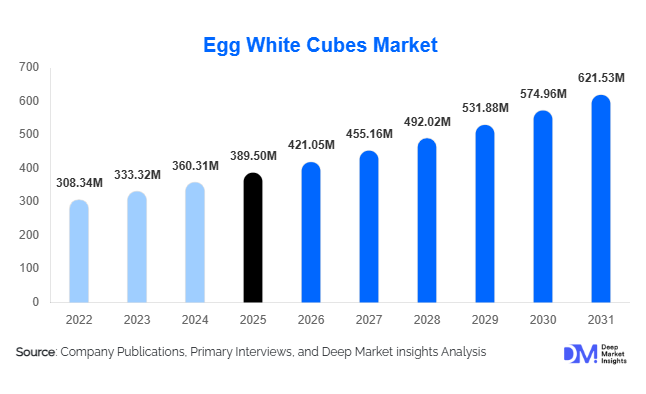
According to Deep Market Insights, the global egg white cubes market size was valued at USD 389.5 million in 2025 and is projected to grow from USD 421.05 million in 2026 to reach USD 621.53 million by 2031, expanding at a CAGR of 8.1% during the forecast period (2026–2031). The egg white cubes market growth is primarily driven by the increasing demand for high-protein ingredients, expanding consumption of functional and convenience foods, and rising utilization of standardized egg ingredients in bakery, nutraceutical, and foodservice applications. Manufacturers are increasingly adopting frozen and pasteurized egg white cube formats due to their superior shelf life, ease of handling, food safety advantages, and ability to deliver consistent functionality in industrial food production.
Key Market Insights
- High-protein and functional food products are becoming the primary demand drivers, increasing the incorporation of egg white cubes in sports nutrition, meal replacements, and protein-enriched foods.
- Frozen egg white cubes dominate the market, accounting for more than half of global revenues owing to longer shelf life and superior processing convenience.
- North America remains the largest market, supported by mature food processing industries and high per capita protein consumption.
- Asia-Pacific is the fastest-growing region, driven by rapid urbanization, increasing disposable incomes, and expanding processed food manufacturing capacities.
- Bakery and confectionery applications account for the largest share of demand, benefiting from the exceptional foaming and binding properties of egg white ingredients.
- Technological innovations in pasteurization and IQF processing are improving product quality, extending shelf life, and enabling premium product development.
Egg White Cubes Market Latest Trends
Growing Adoption of Clean-Label and Functional Protein Ingredients
The global food industry is witnessing a substantial shift toward clean-label and minimally processed ingredients, positioning egg white cubes as an attractive protein solution for manufacturers. Consumers increasingly prefer foods containing recognizable ingredients with natural nutritional benefits. Egg white cubes provide high-quality complete protein while remaining free from artificial additives and preservatives. Food manufacturers are incorporating egg white cubes into ready meals, protein snacks, bakery products, and nutritional beverages to satisfy growing demand for functional ingredients. Furthermore, the rising popularity of ketogenic and high-protein diets is supporting increased demand from health-conscious consumers and sports enthusiasts.
Expansion of Premium and Specialty Egg Products
Demand for organic, cage-free, and free-range egg products is creating opportunities for premium egg white cube offerings. Consumers are increasingly willing to pay premium prices for ethically sourced and sustainable food ingredients. Manufacturers are responding by introducing certified organic and specialty egg white cubes targeted at premium food processors and nutraceutical companies. In addition, technological advancements in freezing and packaging solutions are enabling longer shelf life and improved product stability, making specialty egg white cubes more commercially viable across international markets.
Egg White Cubes Market Drivers
Rising Demand for Protein-Enriched Foods
Protein has become one of the most sought-after nutritional ingredients globally. Consumers increasingly associate high-protein diets with weight management, muscle health, and overall wellness. Egg white cubes contain high biological value protein and are increasingly utilized in sports nutrition products, clinical nutrition formulations, and fortified foods. The rapid growth of protein-focused food categories is significantly contributing to market expansion.
Expansion of Processed and Convenience Foods
The processed food industry continues to expand globally, particularly in emerging economies where urbanization and changing lifestyles are driving demand for convenience products. Egg white cubes offer food manufacturers superior functionality, consistency, and ease of use compared with shell eggs. Their application in bakery products, sauces, dressings, and ready-to-eat meals continues to increase, supporting long-term market growth.
Increasing Focus on Food Safety and Standardization
Commercial food manufacturers increasingly prefer pasteurized and standardized egg ingredients to minimize microbial risks and improve production efficiency. Egg white cubes provide superior food safety characteristics and reduce labor costs associated with shell egg handling. The implementation of stringent food safety regulations globally is further accelerating the transition toward processed egg ingredients.
Egg White Cubes Market Restraints
Volatility in Raw Material Prices
Egg white cube manufacturers remain highly exposed to fluctuations in shell egg prices, which are influenced by feed costs, disease outbreaks, and supply-demand imbalances. Sudden increases in egg prices can compress margins and create pricing uncertainties for downstream food manufacturers.
Increasing Competition from Plant-Based Proteins
The growing popularity of plant-based protein alternatives, including pea protein and soy protein, presents competitive challenges for egg-derived ingredients. Vegan and flexitarian consumer trends are encouraging food manufacturers to diversify their protein portfolios, potentially limiting demand growth in certain applications.
Egg White Cubes Industry Key Opportunities
Growth in Sports Nutrition and Functional Foods
The global sports nutrition market continues to experience double-digit growth, creating significant opportunities for egg white cube manufacturers. Protein bars, meal replacement products, and nutritional beverages increasingly require high-quality proteins that provide superior amino acid profiles and functionality. Egg white cubes offer manufacturers a clean-label protein solution with excellent digestibility and minimal fat content, making them highly suitable for premium formulations.
Emerging Market Expansion
Rapid urbanization and rising disposable incomes across Asia-Pacific, Latin America, and the Middle East are supporting increased consumption of processed and protein-rich foods. Countries including China, India, Indonesia, Brazil, and Saudi Arabia are expected to generate substantial demand over the next decade. Investments in food processing infrastructure and cold-chain logistics further strengthen growth prospects in these markets.
Technology-Driven Product Innovation
Advancements in individually quick frozen (IQF) technology, high-pressure processing, and sustainable packaging are enabling manufacturers to introduce differentiated products with enhanced quality and longer shelf life. The development of fortified egg white cubes with added vitamins, minerals, and functional ingredients presents an additional avenue for premium market expansion.
Report Scope
| Report Metric | Details |
|---|---|
| Market Size in 2025 | USD 389.50 Million |
| Market Size in 2026 | USD 421.05 Million |
| Market Size in 2031 | USD 621.53 Million |
| CAGR | 8.1% (2026-2031) |
| Base Year for Estimation | 2025 |
| Historical Data | 2022-2024 |
| Forecast Period | 2026-2031 |
| Report Coverage | Revenue Forecast, Competitive Landscape, Supply Chain Disruption, Growth Factors, Environment & Regulatory Landscape and Trends |
| Geographies Covered | North America, Europe, APAC, Middle East and Africa, LATAM |
| Countries Covered | U.S., Canada, U.K., Germany, France, Spain, Italy, Russia, Nordic, Benelux, Rest of Europe, China, Korea, Japan, India, Australia, Singapore, Taiwan, South East Asia, Rest of Asia-Pacific, UAE, Turky, Saudi Arabia, South Africa, Egypt, Nigeria, Rest of MEA, Brazil, Mexico, Argentina, Chile, Colombia, Rest of LATAM |
Explore more data points, trends and opportunities Download Free Sample Report
Product Type Insights
The frozen egg white cubes segment dominated the global market and accounted for approximately 58% of total revenues in 2025. The segment's leadership is primarily attributed to the increasing demand for extended shelf-life protein ingredients, superior storage stability, and greater operational efficiency in large-scale food manufacturing. Frozen formats enable manufacturers to minimize product wastage, optimize inventory management, and ensure consistent product quality across industrial applications. The growing adoption of convenience-oriented ingredients by bakery manufacturers, ready-meal producers, and foodservice operators continues to strengthen demand for frozen egg white cubes globally.Refrigerated and ready-to-use egg white cubes are witnessing steady growth due to increasing utilization among foodservice establishments, commercial kitchens, and institutional catering operators seeking labor-saving and portion-controlled ingredients. The ability to reduce preparation time and eliminate shell waste makes refrigerated products increasingly attractive for restaurants and bakery chains. Meanwhile, freeze-dried and fortified egg white cubes represent relatively smaller but rapidly expanding product categories, particularly in sports nutrition, premium health foods, and functional food formulations where enhanced nutritional profiles, portability, and prolonged shelf stability are key purchasing considerations. The rising consumer preference for high-protein diets and functional ingredients is expected to accelerate demand for value-added and fortified product variants over the forecast period.
Processing Technology Insights
Pasteurized egg white cubes accounted for nearly 46% of the global market in 2025, making them the leading processing technology segment. The segment's dominance is largely driven by increasingly stringent food safety regulations, rising concerns regarding foodborne illnesses, and growing compliance requirements among food manufacturers and institutional buyers. Pasteurization provides enhanced microbiological safety while preserving the functional characteristics of egg proteins, making these products highly suitable for bakery, confectionery, and nutritional applications. The expanding use of processed egg ingredients in industrial food production continues to reinforce the demand for pasteurized products worldwide.Individually Quick Frozen (IQF) technology is emerging as one of the fastest-growing processing methods due to its ability to preserve texture, functionality, and nutritional properties while extending shelf life. Food manufacturers increasingly prefer IQF products because they provide greater flexibility in portion control and improve production efficiency. Ultra-pasteurized products are also gaining significant traction, particularly in export-oriented markets where extended distribution timelines and long-distance transportation require enhanced microbiological stability and reduced cold-chain risks. Continuous technological advancements in egg processing and packaging are expected to further improve product quality and expand the commercial viability of advanced processing technologies.
Application Insights
Bakery and confectionery applications represented the largest application segment, accounting for approximately 34% of global market revenues in 2025. The segment's leadership is primarily driven by the indispensable functional properties of egg whites, including superior foaming, emulsification, aeration, and binding capabilities that are critical in the production of cakes, pastries, meringues, macarons, confectionery fillings, and other baked goods. Rising global consumption of premium bakery products, increasing demand for convenience foods, and the rapid expansion of artisanal and industrial baking industries continue to support strong demand for egg white cubes in this segment.Sports nutrition and dietary supplements constitute the fastest-growing application area, supported by increasing consumer focus on fitness, muscle recovery, and protein-enriched diets. Egg white proteins are increasingly incorporated into protein powders, ready-to-drink beverages, meal replacement products, and functional nutrition formulations due to their high biological value and complete amino acid profile. Clinical nutrition, ready-to-eat foods, and functional dairy alternatives are also emerging as important application segments as manufacturers seek high-quality, easily digestible protein ingredients to address evolving consumer preferences for healthier and nutritionally enhanced food products.
Distribution Channel Insights
Direct business-to-business (B2B) sales dominate the global market and account for nearly 60% of total revenues. The leadership of this channel is primarily driven by the ingredient-centric nature of the industry, where large food manufacturers and industrial processors prefer long-term procurement agreements to ensure consistent quality, reliable supply, and price stability. Strategic partnerships between egg processors and food manufacturers have become increasingly important as companies seek secure sourcing arrangements and integrated supply chain management solutions.Food ingredient distributors continue to play a crucial role in expanding regional market penetration, particularly in emerging economies where fragmented customer bases and developing supply chains create opportunities for specialized distribution networks. Online channels are gradually gaining prominence for retail-oriented and specialty nutritional products, supported by the growth of e-commerce and direct-to-consumer sales models. Institutional and wholesale distribution channels are also witnessing increasing demand from bakery chains, hotels, restaurants, and catering operators seeking standardized, convenient, and protein-rich ingredients for large-scale food preparation.
End-Use Industry Insights
The food processing industry remains the largest end-use segment and contributes approximately 50% of global demand. The segment's dominance is primarily driven by the increasing production of processed foods, bakery products, convenience meals, confectionery items, and protein-enriched food formulations. The growing consumer preference for convenient and ready-to-eat food products, coupled with rising investments in food manufacturing capacity worldwide, continues to generate substantial demand for processed egg ingredients, including egg white cubes.The nutraceutical industry represents one of the fastest-growing end-use sectors, supported by increasing consumer awareness regarding preventive healthcare, active lifestyles, and protein supplementation. Egg white cubes are increasingly utilized in dietary supplements and functional nutrition products owing to their superior amino acid composition and high digestibility. Clinical nutrition and specialized medical food applications are also emerging as significant growth areas, driven by increasing demand for high-quality protein ingredients in elderly nutrition, patient recovery diets, and therapeutic nutrition products.
Explore more data points, trends and opportunities Download Free Sample Report
Egg White Cubes Market Segmentations
By Product Form
- Frozen Egg White Cubes
- Freeze-Dried Egg White Cubes
- Refrigerated Ready-to-Use Egg White Cubes
- Fortified/Functional Egg White Cubes
By Processing Technology
- Pasteurized Egg White Cubes
- Ultra-Pasteurized Egg White Cubes
- Individually Quick Frozen (IQF) Egg White Cubes
- Spray-Dried and Reconstituted Egg White Cubes
By Nature
- Conventional
- Organic
- Cage-Free Certified
- Free-Range Certified
By Application
- Bakery and Confectionery
- Ready-to-Eat Foods
- Sports Nutrition and Dietary Supplements
- Meat Processing and Binders
- Sauces, Dressings and Emulsified Products
- Dairy Alternatives and Functional Foods
- Clinical Nutrition
- Pet Food and Animal Nutrition
- Foodservice and HoReCa Applications
By End Use Industry
- Food Processing Industry
- Nutraceutical Industry
- Foodservice Industry
- Retail Consumer Market
- Pharmaceutical and Clinical Nutrition Industry
- Pet Food Industry
Regional Insights
North America
North America accounted for approximately 32% of the global egg white cubes market in 2025, making it the largest regional market. The United States represents the dominant contributor due to its highly developed food processing industry, robust sports nutrition sector, and increasing consumption of protein-rich foods. Canada continues to exhibit steady growth, supported by expanding bakery and convenience food industries, while Mexico is benefiting from increasing industrial food production and rising demand for processed ingredients.Regional growth is being driven by strong consumer preference for high-protein diets, increasing adoption of functional foods and nutritional supplements, and the widespread presence of large-scale food manufacturing companies. The rapid expansion of ready-to-eat meal production, growing demand for clean-label and low-fat protein ingredients, and rising investments in food processing automation are further accelerating market development. Additionally, the well-established cold-chain infrastructure and advanced distribution networks across North America continue to support the efficient commercialization of frozen and refrigerated egg products.
Europe
Europe held approximately 28% of global revenues in 2025. Germany, the United Kingdom, France, Italy, and the Netherlands remain major demand centers due to their advanced food processing sectors and stringent food safety regulations. Consumer preference for clean-label, natural, and cage-free products is encouraging manufacturers to develop premium egg white cube offerings. The region also serves as a major exporter of processed egg ingredients to Asia and the Middle East.The regional market is being supported by increasing demand for sustainable and ethically sourced food ingredients, rising consumption of premium bakery and confectionery products, and the growing popularity of high-protein functional foods. Stringent quality standards and traceability requirements continue to encourage the adoption of processed egg ingredients with superior safety and consistency. Furthermore, the expansion of sports nutrition markets and increasing innovation in specialty protein formulations are creating additional growth opportunities across the European market.
Asia-Pacific
Asia-Pacific is the fastest-growing regional market and is projected to register a CAGR exceeding 10.2% during the forecast period. China remains the largest market in the region owing to its substantial food manufacturing industry and increasing consumption of convenience foods. India is expected to record the highest growth rate due to rising disposable incomes, growing health awareness, and the expansion of organized food processing industries. Japan and South Korea continue to exhibit strong demand for premium and functional protein ingredients.The region's exceptional growth is being driven by rapid urbanization, changing dietary habits, rising middle-class incomes, and increasing consumer awareness regarding protein-rich nutrition. The expansion of modern retail channels, growing investments in food processing infrastructure, and rising demand for ready-to-eat and packaged foods are significantly increasing the utilization of processed egg ingredients. Additionally, the rapid growth of fitness culture and sports nutrition industries across major Asian economies is creating substantial opportunities for egg white cube manufacturers.
Latin America
Brazil and Argentina lead regional demand due to their large poultry industries and increasing processed food exports. Rising urbanization and improving retail infrastructure are contributing to growing adoption of processed egg ingredients. Demand for premium protein products is gradually increasing among middle-income consumers throughout the region.Regional growth is further supported by expanding food processing capacities, increasing investments in export-oriented food manufacturing, and rising consumption of convenience foods among urban populations. The development of modern cold-chain logistics and increasing penetration of organized retail channels are improving product accessibility and supporting the commercialization of frozen egg products. Growing health awareness and increasing demand for affordable protein sources are also contributing to long-term market expansion across Latin America.
Middle East & Africa
The Middle East and Africa region is witnessing steady growth driven by increasing investments in food processing and hospitality industries. Saudi Arabia and the UAE represent major import markets for processed egg ingredients due to limited domestic production capabilities and growing demand from bakery and foodservice sectors. South Africa remains the largest market in Sub-Saharan Africa and continues to experience rising consumption of convenience foods and nutritional products.The market is benefiting from rapid urbanization, increasing tourism activity, and the expansion of modern foodservice establishments and bakery chains throughout the region. Rising investments in food security initiatives, growing dependence on imported processed food ingredients, and increasing demand for high-quality protein products are further supporting market growth. Additionally, changing consumer lifestyles, increasing disposable incomes in Gulf countries, and the gradual modernization of retail and cold-storage infrastructure are expected to create favorable conditions for sustained demand growth in the coming years.
Key Players in the Egg White Cubes Market
- Kewpie Corporation
- Eurovo Group
- Ovostar Union
- Rose Acre Farms
- Rembrandt Foods
- Interovo Egg Group
- Sanovo Technology Group
- IGRECA
- Pulviver
- Bouwhuis Enthoven
- Dalian Hanovo Foods
- Wulro BV
- Egg Solutions
- Farm Pride Foods
- Lodewijckx Group