Silver Tourism Market Size
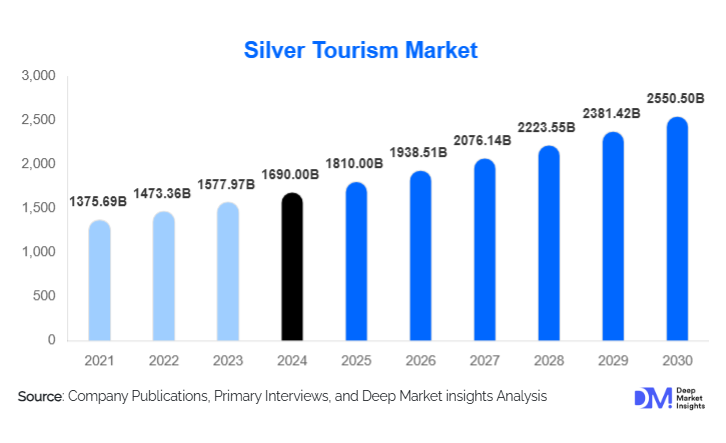
According to Deep Market Insights, the global silver tourism market was valued at USD 1,690.0 billion in 2025 and is projected to grow from USD 1,810.0 billion in 2026 to reach USD 2,550.5 billion by 2031, expanding at a CAGR of 7.1% during the forecast period (2026–2031). The silver tourism market growth is primarily driven by the rising global senior population, increasing disposable income among older adults, and growing demand for healthcare-integrated, leisure, and cultural travel experiences tailored to senior travelers.
Key Market Insights
- Health and wellness tourism is becoming a major focus, with seniors increasingly seeking medical, rehabilitation, and preventive care travel combined with leisure experiences.
- Leisure and long-stay tourism dominate the market, driven by extended trips, cruises, and senior-friendly resorts offering comfort, accessibility, and personalized services.
- North America leads global demand, with the U.S. and Canada contributing a major share of high-spending senior travelers.
- Asia-Pacific is the fastest-growing region, led by Japan, China, and Australia, where the aging population and rising middle-class wealth are boosting demand for premium and mid-range senior tourism.
- Europe maintains a strong market share, driven by Germany, France, and the U.K., with seniors favoring cultural, heritage, and wellness experiences.
- Technological integration, including AI-assisted itineraries, telemedicine services, and smart mobility solutions, is enhancing convenience and safety for senior travelers.
Silver Tourism Market Trends
Healthcare-Integrated Travel Experiences
Senior travelers increasingly prefer destinations offering seamless access to healthcare and wellness services. Packages integrating medical check-ups, rehabilitation, and spa services alongside leisure activities are becoming standard offerings. Destinations providing age-friendly infrastructure, geriatric healthcare support, and emergency response systems are attracting premium travelers. These services not only enhance traveler confidence but also increase length of stay and per-trip spending, boosting overall market revenue.
Technology-Enhanced Senior Travel
Emerging technologies are revolutionizing senior tourism. AI-assisted itineraries, teleconsultation services, wearable health monitoring, and emergency alert systems ensure safety and convenience. Mobile apps and online platforms provide real-time assistance, accessible booking interfaces, and personalized recommendations, appealing to both independent and care-supported seniors. Cruise operators and hotels are increasingly deploying smart accessibility features, enhancing both mobility and comfort, while digital platforms allow easy comparison of senior-friendly travel packages.
Silver Tourism Market Drivers
Growing Senior Population
The global demographic shift, with rising life expectancy and an increasing number of individuals aged 60+, is the strongest driver of silver tourism growth. Seniors are healthier, more active, and willing to travel, creating a sustainable demand base. The aging population directly correlates with higher participation in both domestic and international tourism, particularly for long-stay and wellness-focused trips.
Higher Disposable Income and Financial Security
Many seniors in developed markets have accumulated substantial savings, pension income, and property wealth. This financial security enables discretionary spending on premium travel experiences, extended vacations, and wellness-integrated tours. Seniors are willing to pay for comfort, healthcare access, and convenience, fueling revenue growth for hospitality, cruise, and wellness operators.
Advancements in Healthcare and Accessibility
Improved medical technologies, mobility aids, and age-friendly infrastructure have reduced barriers for senior travelers. Accessible hotels, medical support on cruises, and senior-friendly transport solutions are enabling higher participation in both domestic and international trips. These advancements are particularly impactful in regions like North America, Europe, and the Asia-Pacific.
Silver Tourism Market Restraints
Health Risks and Insurance Costs
Seniors face higher medical risks while traveling, leading to elevated travel insurance premiums and potential hesitancy for long-haul trips. Limited or costly insurance coverage can restrict travel options, particularly for international journeys, creating a growth barrier for the market.
Inconsistent Accessibility Standards
While some destinations have senior-friendly infrastructure, others lack adequate accessibility, trained staff, and emergency services. Such inconsistencies affect traveler confidence and limit expansion opportunities, especially in emerging tourism regions where infrastructure development is still underway.
Silver Tourism Market Opportunities
Wellness and Medical Tourism Integration
Combining wellness, rehabilitation, and preventive healthcare with leisure travel presents a significant growth opportunity. Resorts, cruises, and senior-focused destinations that provide integrated health services alongside recreational activities can capture high-value travelers, increasing both average trip spend and duration.
Technology-Driven Personalization
Digital solutions tailored for seniors, including AI itineraries, health monitoring wearables, and simplified booking platforms, provide differentiation in a competitive market. Travel operators that integrate these technologies can attract care-supported and long-haul travelers seeking safety, convenience, and personalized experiences.
Emerging Regional Demand
Asia-Pacific, the Middle East, and Eastern Europe are witnessing strong growth due to rising senior populations, increasing wealth, and supportive government policies. Countries offering cost-effective healthcare, age-friendly infrastructure, and cultural experiences are attracting long-stay retirees and seasonal migrants, creating multi-billion-dollar opportunities for operators and local tourism stakeholders.
Report Scope
| Report Metric | Details |
|---|---|
| Market Size in 2025 | USD 1690 Billion |
| Market Size in 2026 | USD 1810 Billion |
| Market Size in 2031 | USD 2550.5 Billion |
| CAGR | 7.1% (2026-2031) |
| Base Year for Estimation | 2025 |
| Historical Data | 2022-2024 |
| Forecast Period | 2026-2031 |
| Report Coverage | Revenue Forecast, Competitive Landscape, Supply Chain Disruption, Growth Factors, Environment & Regulatory Landscape and Trends |
| Geographies Covered | North America, Europe, APAC, Middle East and Africa, LATAM |
| Countries Covered | U.S., Canada, U.K., Germany, France, Spain, Italy, Russia, Nordic, Benelux, Rest of Europe, China, Korea, Japan, India, Australia, Singapore, Taiwan, South East Asia, Rest of Asia-Pacific, UAE, Turky, Saudi Arabia, South Africa, Egypt, Nigeria, Rest of MEA, Brazil, Mexico, Argentina, Chile, Colombia, Rest of LATAM |
Explore more data points, trends and opportunities Download Free Sample Report
Product Type Insights
Leisure & relaxation travel dominates, particularly cruises and senior-friendly resorts, capturing nearly 38% of the market. Health and wellness tourism is rapidly growing, driven by preventive care, rehabilitation, and medical tourism packages. Cultural and heritage travel appeals to seniors seeking experiential trips, while visiting friends and relatives (VFR) and educational travel represent niche but high-value segments. Premium offerings targeting affluent seniors are expanding, with luxury resorts, cruises, and wellness retreats commanding higher revenues per trip.
Application Insights
Hospitality remains the largest application, encompassing hotels, resorts, and cruise services. Healthcare and wellness applications, including medical tourism and rehabilitation, are the fastest-growing segments, expanding at approximately 10% CAGR. Transportation, particularly senior-friendly airlines and cruise operators, benefits from longer stays and higher per-capita spending. Emerging applications include retirement migration programs, seasonal living, and lifelong learning tours, bridging travel with healthcare, education, and community engagement.
Distribution Channel Insights
Online travel agencies (OTAs) and direct booking platforms dominate bookings, enabling seniors to access curated packages, read reviews, and compare pricing. Specialist senior-focused travel agencies thrive in providing tailored services for premium segments. Increasingly, operators are integrating subscription-based and membership models, offering repeat travelers exclusive seasonal packages and loyalty programs. Digital marketing, social media engagement, and AI recommendation engines are shaping consumer preferences, particularly for tech-savvy seniors.
Traveler Type Insights
Fully independent seniors represent the largest traveler type, accounting for 52% of the market. Care-supported travelers, while fewer, contribute significantly to revenue due to premium pricing. Domestic travel dominates volume at 46%, with long-haul international travel growing fastest, particularly in wellness and medical tourism. Group travel, couples, and family segments each display distinct patterns, with organized packages appealing to cost-conscious seniors, and luxury packages targeting affluent travelers.
Age Group Insights
Seniors aged 60–75 are the primary market drivers, combining health, mobility, and disposable income. Travelers above 75 represent a niche segment, increasingly targeted through care-supported, wellness-focused, and slower-paced itineraries. Younger seniors (60–65) are more active, preferring longer trips and experiential tourism, while older seniors seek safety, healthcare access, and convenience.
Explore more data points, trends and opportunities Download Free Sample Report
Silver Tourism Market Segmentations
By Travel Motivation
- Leisure & Relaxation Tourism
- Health, Wellness & Medical Tourism
- Cultural & Heritage Tourism
- Visiting Friends & Relatives (VFR)
- Educational & Experiential Tourism
By Health & Mobility Profile
- Fully Independent Seniors
- Assisted-Mobility Seniors
- Care-Supported Travelers
By Travel Type
- Domestic Silver Tourism
- Short-Haul International Tourism
- Long-Haul International Tourism
By Accommodation Type
- Senior-Friendly Hotels & Resorts
- Cruise-Based Accommodation
- Medical & Wellness Resorts
- Long-Stay Rentals & Retirement Resorts
By Spending Category
- Budget Silver Travelers
- Mid-Range Silver Travelers
- Premium & Luxury Silver Travelers
Regional Insights
North America
North America dominates silver tourism, with the U.S. and Canada contributing a combined 32% of global market share. High disposable income, strong healthcare systems, and extensive cruise and resort infrastructure drive demand. Seniors prefer premium packages, wellness retreats, and long-stay domestic trips, with outbound international travel also increasing for cultural and heritage experiences.
Europe
Europe accounts for 28% of the market, led by Germany, France, the U.K., Italy, and Spain. Seniors favor cultural, wellness, and heritage tourism, with sustainability and experiential travel gaining importance. Germany represents the largest share within Europe, driven by a high senior population and strong travel spending. Younger European seniors contribute to mid-range and eco-focused travel trends.
Asia-Pacific
Asia-Pacific is the fastest-growing region, driven by Japan, China, Australia, and South Korea. Rising senior populations, increasing disposable income, and expanding awareness of wellness and leisure travel are key growth drivers. Japan leads in domestic silver tourism, while China is rapidly adopting mid-range and premium wellness-focused packages. Enhanced air connectivity and government tourism incentives further accelerate growth.
Latin America
Latin America accounts for 7% of the market, with Brazil, Mexico, and Argentina leading outbound travel to international wellness and cultural destinations. Affluent seniors are increasingly opting for long-haul trips, while domestic senior tourism infrastructure is still developing.
Middle East & Africa
Africa remains the primary destination for wellness and leisure tourism, with South Africa, Kenya, and Botswana leading in resort and cruise offerings. The Middle East, particularly the UAE and Saudi Arabia, is emerging as a key source market, supported by high-income seniors seeking international wellness and leisure experiences.
Leading Players in the Silver Tourism Industry
- Carnival Corporation
- Royal Caribbean Group
- TUI Group
- Marriott International
- Hilton Worldwide
- Accor
- Viking Cruises
- Princess Cruises
- MSC Cruises
- Club Med
- Banyan Tree Holdings
- InterContinental Hotels Group
- Genting Group
- Four Seasons Hotels & Resorts
- Minor International