Duck Egg Market Size
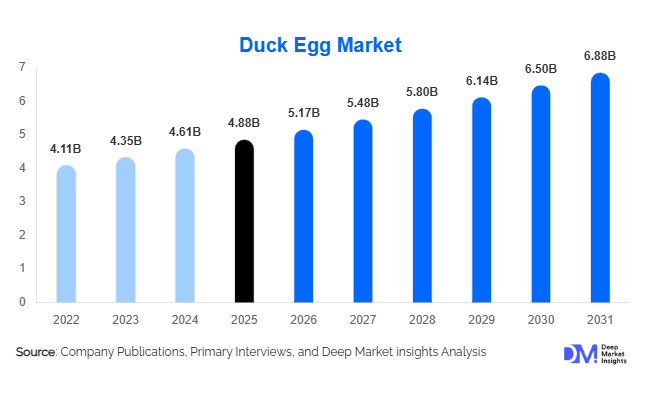
According to Deep Market Insights, the global duck egg market size was valued at USD 4.88 billion in 2025 and is projected to grow from USD 5.17 billion in 2026 to reach USD 6.88 billion by 2031, expanding at a CAGR of 5.9% during the forecast period (2026–2031). The duck egg market growth is primarily driven by increasing global demand for nutrient-rich protein sources, rising consumption of traditional Asian egg products, expanding food processing applications, and growing consumer interest in premium and specialty poultry products. The market is witnessing gradual diversification beyond household consumption, with food manufacturers, bakeries, and functional food producers increasingly incorporating duck eggs into value-added products. Improvements in commercial duck farming practices, cold-chain infrastructure, and international trade networks are further supporting market expansion across both developed and emerging economies.
Key Market Insights
- Asia-Pacific dominates the global duck egg market, accounting for more than 70% of global consumption and production, led by China, Vietnam, Indonesia, and Thailand.
- Processed duck egg products are witnessing strong growth, particularly liquid eggs, egg powders, and salted egg ingredients used in food manufacturing.
- Food processing applications are emerging as the fastest-growing end-use segment, supported by increasing use in bakery, confectionery, and ready-to-eat food production.
- Organic and free-range duck eggs are gaining popularity, particularly in North America, Europe, Japan, and South Korea, where consumers are willing to pay premium prices.
- Export-oriented demand is increasing, driven by growing international consumption of preserved duck eggs, salted eggs, and ethnic food products.
- Technology adoption in duck farming, including automated feeding systems, disease monitoring solutions, and precision livestock management, is improving productivity and profitability.
Duck Egg Market Latest Trends
Premium and Specialty Duck Egg Products Gaining Market Acceptance
Consumer demand for premium food products is driving significant growth in specialty duck egg categories. Organic, cage-free, free-range, and pasture-raised duck eggs are increasingly available across retail channels, particularly in developed markets. Consumers perceive duck eggs as a healthier and more nutritious alternative to conventional chicken eggs due to their higher protein content, richer flavor profile, and elevated levels of vitamins and minerals. Retailers are expanding shelf space for specialty eggs, while producers are investing in certification programs and traceability systems to capture premium pricing opportunities. This trend is particularly pronounced among health-conscious consumers and gourmet food enthusiasts seeking differentiated poultry products.
Expansion of Processed Duck Egg Ingredients
The food processing industry is increasingly utilizing duck egg ingredients due to their superior emulsification, foaming, and baking properties. Duck egg powders, liquid eggs, yolk concentrates, and preserved egg products are finding broader applications across bakery, confectionery, sauces, snacks, and ready-to-eat meals. Salted duck egg flavoring has emerged as a major food trend in Asia-Pacific and is gradually expanding into global snack categories. Food manufacturers are leveraging duck egg ingredients to create premium products with improved texture, flavor, and nutritional value. As industrial demand continues to rise, investments in egg processing facilities and value-added product development are expected to accelerate.
Duck Egg Market Drivers
Growing Consumer Preference for Nutrient-Rich Protein Sources
Rising awareness regarding nutrition and dietary health is significantly boosting demand for duck eggs globally. Compared with conventional chicken eggs, duck eggs contain higher concentrations of protein, omega fatty acids, vitamin B12, selenium, and iron. Consumers increasingly seeking functional foods and high-protein diets are contributing to greater market penetration across both developed and emerging economies. Fitness-conscious consumers, athletes, and individuals following specialized nutrition plans are increasingly incorporating duck eggs into their diets, creating new demand channels beyond traditional consumption patterns.
Rapid Expansion of the Global Bakery and Food Processing Industries
The bakery and food manufacturing sectors represent a major demand driver for duck eggs. Commercial bakeries value duck eggs for their enhanced baking performance, improved emulsification capabilities, and ability to produce richer textures in cakes, pastries, and confectionery products. The continued expansion of global bakery markets, premium dessert segments, and processed food manufacturing is generating consistent demand for duck egg ingredients. Industrial processors are also increasingly adopting duck egg powders and liquid eggs to improve production efficiency while maintaining product quality.
Rising Popularity of Asian Cuisine Worldwide
The globalization of Asian cuisine has significantly expanded international demand for duck egg products. Traditional products such as salted eggs, preserved eggs, mooncakes, noodle dishes, and specialty sauces are gaining popularity among consumers outside Asia. Growth in Asian diaspora populations across North America, Europe, and the Middle East has further strengthened demand. Foodservice operators and specialty food retailers are increasingly incorporating duck egg-based offerings into their product portfolios, creating sustained growth opportunities for producers and exporters.
Duck Egg Market Restraints
Higher Production Costs Compared to Chicken Eggs
Duck egg production generally involves higher feed consumption, longer growth cycles, and increased production costs compared to conventional chicken egg farming. As a result, duck eggs often command significantly higher retail prices, limiting their adoption among price-sensitive consumers. The premium pricing structure can restrict mass-market penetration, particularly in developing regions where affordability remains a critical purchasing factor.
Disease Outbreaks and Biosecurity Risks
Avian influenza and other poultry diseases continue to pose significant challenges to the duck egg industry. Disease outbreaks can disrupt supply chains, reduce flock populations, increase operating expenses, and impact international trade. Producers must invest heavily in biosecurity measures, veterinary monitoring, and disease prevention programs to maintain stable production levels. Regulatory restrictions imposed during outbreaks can further affect market growth and export opportunities.
Duck Egg Industry Key Opportunities
Functional Food and Nutraceutical Applications
The growing global functional food market presents substantial opportunities for duck egg producers. Due to their high protein content and superior nutritional profile, duck eggs are increasingly being explored for use in sports nutrition, meal replacement products, protein supplements, and fortified food formulations. Manufacturers investing in processed duck egg ingredients and value-added nutritional products are positioned to benefit from expanding consumer demand for health-focused foods. The trend toward clean-label protein sources further strengthens the market potential for duck egg-derived ingredients.
Premium Organic and Export-Oriented Production
Organic and free-range duck egg production remains relatively underdeveloped compared with chicken eggs, creating significant opportunities for market participants. Consumers in Europe, North America, Japan, and South Korea increasingly prioritize sustainability, animal welfare, and traceability when purchasing food products. Export markets are also expanding for specialty products such as salted duck eggs, preserved eggs, and processed egg ingredients. Investments in certification programs, cold-chain logistics, and export-oriented processing facilities can enable producers to access premium international markets while improving profit margins.
Report Scope
| Report Metric | Details |
|---|---|
| Market Size in 2025 | USD 4.88 Billion |
| Market Size in 2026 | USD 5.17 Billion |
| Market Size in 2031 | USD 6.88 Billion |
| CAGR | 5.9% (2026-2031) |
| Base Year for Estimation | 2025 |
| Historical Data | 2022-2024 |
| Forecast Period | 2026-2031 |
| Report Coverage | Revenue Forecast, Competitive Landscape, Supply Chain Disruption, Growth Factors, Environment & Regulatory Landscape and Trends |
| Geographies Covered | North America, Europe, APAC, Middle East and Africa, LATAM |
| Countries Covered | U.S., Canada, U.K., Germany, France, Spain, Italy, Russia, Nordic, Benelux, Rest of Europe, China, Korea, Japan, India, Australia, Singapore, Taiwan, South East Asia, Rest of Asia-Pacific, UAE, Turky, Saudi Arabia, South Africa, Egypt, Nigeria, Rest of MEA, Brazil, Mexico, Argentina, Chile, Colombia, Rest of LATAM |
Explore more data points, trends and opportunities Download Free Sample Report
Product Form Insights
Shell duck eggs continue to represent the dominant product form in the global market, accounting for approximately 72% of total market value in 2025. Their leadership is primarily driven by deeply embedded household consumption patterns across Asia-Pacific, where duck eggs are a dietary staple, as well as their expanding penetration into premium retail formats in international markets. The strong consumer preference for fresh shell eggs is reinforced by perceptions of naturalness, nutritional richness, and versatility in home cooking, which collectively sustain steady volume demand across both urban and rural populations. At the same time, increasing urbanization and rising disposable incomes in emerging economies are strengthening demand for packaged and branded shell eggs, further consolidating their market leadership.Preserved and salted duck eggs form a highly culturally significant specialty segment, with particularly strong demand concentrations in China, Vietnam, Thailand, and the Philippines. Growth in this category is primarily driven by culinary tradition, seasonal consumption patterns, and increasing commercialization of traditional food products through modern retail channels. Meanwhile, processed duck egg products are emerging as the fastest-growing product form, supported by accelerating demand from food manufacturers seeking consistent, scalable, and functional ingredients. Liquid egg formulations, frozen egg products, powders, and yolk concentrates are increasingly preferred due to their extended shelf life, ease of storage, and operational efficiency in industrial food production. The key growth driver for processed eggs is their superior functional performance, particularly emulsification and binding capabilities, which make them highly valuable in bakery, confectionery, sauces, and ready-to-eat food applications.
Production System Insights
Conventional duck egg production continues to dominate the global market, accounting for nearly 68% of total output, primarily driven by well-established farming systems, cost efficiency, and high scalability in major producing regions. The dominance of this system is strongly supported by entrenched supply chains, availability of traditional farming expertise, and lower capital requirements, making it the preferred model for large-scale commercial production, especially in Asia-Pacific. This production system remains the backbone of global supply due to its ability to meet high-volume demand at competitive pricing.However, organic and free-range production systems are expanding at a significantly faster pace, supported by shifting consumer preferences toward sustainability, animal welfare, and food safety transparency. The leading growth driver for these systems is the rising willingness of consumers, particularly in developed markets, to pay premium prices for ethically sourced and environmentally responsible products. Cage-free and pasture-raised duck eggs are increasingly positioned as premium offerings in specialty retail and gourmet food segments, where differentiation and brand value are critical. This transition is further supported by regulatory encouragement in certain markets and increasing adoption by producers seeking higher-margin product positioning in competitive retail environments.
Distribution Channel Insights
Modern retail channels, including supermarkets and hypermarkets, remain the leading distribution channel, accounting for approximately 38% of global duck egg sales. Their dominance is driven by strong product visibility, organized cold-chain infrastructure, and the ability to offer a wide assortment of both conventional and premium egg products under one roof. Retail chains are increasingly expanding their specialty egg sections to cater to rising demand for organic, free-range, and value-added duck egg products, thereby reinforcing their central role in global distribution networks.Traditional grocery stores continue to play a crucial role, particularly in Asia-Pacific markets, where duck eggs are deeply integrated into daily dietary habits and local food systems. The fastest-growing distribution channel is online retail, supported by rapid e-commerce penetration, digital grocery adoption, and improvements in cold-chain logistics that enable safe transportation of perishable goods. The key driver for online channel growth is the increasing consumer preference for convenience, home delivery, and direct access to niche and premium producers. Specialty food stores are also gaining traction, driven by rising demand for artisanal, organic, and premium-positioned duck egg products among health-conscious and urban consumers seeking differentiated food experiences.
End-Use Insights
Household consumption remains the largest end-use segment, accounting for approximately 52% of global demand. This leadership is primarily driven by the entrenched role of duck eggs in traditional diets across Asia-Pacific, where they are widely consumed as table eggs and incorporated into a broad range of regional dishes. The affordability, nutritional density, and cultural familiarity of duck eggs continue to support strong household penetration, particularly in emerging economies with large population bases and growing food consumption.The food processing industry represents the fastest-growing end-use segment, driven by increasing demand from bakery, confectionery, snack, and ready-to-eat food manufacturers. The primary growth driver in this segment is the functional superiority of duck eggs in industrial applications, particularly their emulsification strength, richer yolk composition, and enhanced flavor profile, which improve product texture and quality. Foodservice applications, including hotels, restaurants, and catering services, are also expanding steadily, supported by the growing trend of menu premiumization and culinary innovation. Additionally, emerging applications in functional foods and nutraceuticals are gaining attention as manufacturers explore high-protein, nutrient-dense ingredients for health-oriented product development.
Explore more data points, trends and opportunities Download Free Sample Report
Duck Egg Market Segmentations
By Product Form
- Fresh Shell Duck Eggs
- Preserved & Salted Duck Eggs
- Fertilized Duck Eggs (Balut)
- Liquid Duck Eggs
- Frozen Duck Eggs
- Duck Egg Powder
- Duck Egg Yolk Products
- Duck Egg White Products
By Production System
- Conventional Duck Eggs
- Free-Range Duck Eggs
- Organic Duck Eggs
- Cage-Free/Pasture-Raised Duck Eggs
By Application
- Table Egg Consumption
- Bakery Applications
- Confectionery Applications
- Traditional Ethnic Foods
- Functional Foods
- Protein Ingredients
By End Use
- Household Consumption
- Restaurants
- Hotels
- Catering Services
- Food Processing Industry
- Nutraceutical & Functional Food Industry
By Distribution Channel
- Supermarkets & Hypermarkets
- Traditional Grocery Stores
- Specialty Food Stores
- Online Retail
- Direct Farm Sales
- Wholesale Distribution
Regional Insights
Asia-Pacific
Asia-Pacific remains the dominant regional market, accounting for approximately 72% of global duck egg consumption and production. The region’s leadership is driven by deeply rooted culinary traditions, large-scale commercial duck farming infrastructure, and strong domestic demand across both urban and rural populations. China alone contributes nearly 55% of global demand, supported by extensive production ecosystems and integrated supply chains that ensure consistent availability and affordability. Additional growth drivers include rapid urbanization, rising disposable incomes, and increasing consumption of processed and packaged food products, which are expanding the use of duck eggs beyond traditional households into industrial food manufacturing and modern retail formats.
North America
North America accounts for approximately 8% of the global market and is characterized by a steadily expanding niche demand for premium and specialty egg products. The primary growth driver in the region is increasing consumer awareness of the nutritional benefits of duck eggs, combined with rising interest in gourmet cooking and ethnic cuisines, particularly Asian-inspired dishes. The United States leads regional demand, supported by the growth of artisanal bakeries, specialty restaurants, and health-conscious consumers seeking alternative protein sources. Expansion of organic and free-range product offerings, along with improved availability through specialty retail and e-commerce platforms, is further strengthening market growth.
Europe
Europe contributes roughly 10% of global demand and is strongly oriented toward premiumization, sustainability, and regulatory compliance. The key driver of regional growth is the increasing consumer preference for organic, traceable, and animal welfare-certified food products. Major markets including the United Kingdom, Germany, France, the Netherlands, and Spain are witnessing rising adoption of duck eggs in both retail and foodservice sectors. European bakeries and confectionery manufacturers are increasingly incorporating duck eggs to enhance product richness and quality, particularly in premium baked goods. Strict regulatory frameworks around animal welfare and food traceability are also accelerating the shift toward higher-value production systems.
Latin America
Latin America represents approximately 5% of global demand, with Brazil and Mexico emerging as the key markets. Growth in the region is primarily driven by rising protein consumption, expanding urban populations, and increasing exposure to international culinary trends. The foodservice sector is playing a particularly important role in introducing duck eggs into mainstream consumption through restaurants and hospitality channels. Although domestic production remains relatively limited, increasing investment in poultry diversification and specialty agriculture is supporting gradual market expansion and reducing dependence on imports over time.
Middle East & Africa
The Middle East & Africa region accounts for approximately 5% of global market value and is projected to record the fastest growth during the forecast period. The primary growth drivers include rising disposable incomes, rapid expansion of the hospitality and tourism sectors, and increasing demand for imported premium food products. Countries such as the UAE, Saudi Arabia, South Africa, and Egypt are witnessing growing consumption of specialty eggs as dietary diversification increases. Improvements in cold-chain logistics, import infrastructure, and international trade connectivity are further enhancing product availability and supporting sustained market penetration across both retail and foodservice channels.
Key Players in the Duck Egg Market
- Gaoyou Hongtaiyang Food
- Guiliu Group
- Ningbo Aoji Agricultural Technology
- Shen Dan Group
- Guangxi Guiliu Food Group
- Jiangsu Lihua Animal Husbandry
- Charoen Pokphand Foods
- Japfa Ltd.
- New Hope Group
- Wen's Food Group
- Emivest Feedmill Vietnam
- QL Foods
- Betagro Group
- PT Charoen Pokphand Indonesia
- Dezhou Shengda Food