Cosmetic Products Market Size
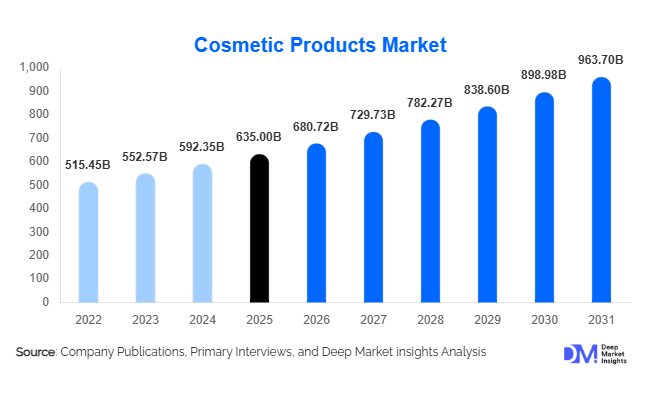
According to Deep Market Insights, the global cosmetic products market size was valued at USD 635.0 billion in 2025 and is projected to grow from USD 680.4 billion in 2026 to reach USD 965.2 billion by 2031, expanding at a CAGR of 7.2% during the forecast period (2026–2031). The cosmetic products market growth is primarily driven by increasing consumer focus on personal grooming, rising adoption of premium skincare and wellness-oriented beauty products, rapid e-commerce penetration, and growing demand for clean-label and sustainable cosmetic formulations across developed and emerging economies.
Key Market Insights
- Skin care products continue to dominate the cosmetic products market, supported by rising anti-aging demand, sun protection awareness, and preventive skincare adoption among younger consumers.
- Clean beauty and sustainable cosmetics are reshaping industry innovation, with growing consumer preference for vegan, cruelty-free, sulfate-free, and eco-friendly cosmetic formulations.
- Asia-Pacific dominates the global cosmetic products market, driven by strong demand from China, Japan, South Korea, and India, alongside expanding middle-class spending on beauty products.
- E-commerce and direct-to-consumer platforms are accelerating cosmetic sales globally, enabling personalized recommendations, influencer-led marketing, and improved access to premium products.
- Men’s grooming and gender-neutral beauty categories are witnessing rapid expansion, supported by changing consumer attitudes and rising awareness regarding skincare and wellness.
- Technological integration, including AI-based skin diagnostics, virtual makeup try-on tools, and biotechnology-driven formulations, is transforming customer engagement and product innovation.
Cosmetic Products Market Trends
Clean Beauty and Sustainable Cosmetics Gaining Momentum
The cosmetic products industry is witnessing a strong transition toward clean beauty, sustainable packaging, and ingredient transparency. Consumers are increasingly demanding cosmetic products that are free from harmful chemicals such as parabens, sulfates, phthalates, and synthetic fragrances. This trend is driving cosmetic manufacturers to invest heavily in plant-based formulations, vegan products, cruelty-free testing methods, and refillable packaging systems. Premium brands are increasingly promoting carbon-neutral manufacturing operations and biodegradable packaging to align with evolving environmental expectations. Governments across Europe and North America are also strengthening regulatory frameworks surrounding ingredient disclosure and sustainability standards, further accelerating the shift toward eco-conscious beauty products. In addition, consumers are increasingly favoring multifunctional products combining skincare, wellness, and cosmetic benefits into a single formulation, creating opportunities for innovative hybrid beauty products.
Technology-Driven Personalization Reshaping Consumer Engagement
Artificial intelligence, augmented reality, and biotechnology are increasingly transforming the global cosmetic products market. AI-powered skin analysis tools, virtual makeup try-on applications, and personalized beauty recommendations are enabling companies to improve customer engagement and purchasing accuracy. Consumers increasingly expect customized skincare and haircare solutions tailored to individual skin conditions, climate, age, and lifestyle preferences. Cosmetic companies are integrating machine learning algorithms with consumer data to create hyper-personalized product experiences and subscription-based beauty models. Biotechnology-based ingredients, including peptides, probiotics, microbiome skincare compounds, and lab-developed actives, are further strengthening product efficacy and premiumization trends. Social commerce and influencer-driven digital marketing are also significantly reshaping product discovery, particularly among Gen Z and Millennial consumers globally.
Cosmetic Products Market Drivers
Growing Consumer Focus on Personal Grooming and Wellness
Rising beauty consciousness and growing consumer focus on self-care and personal wellness continue to drive strong demand across the cosmetic products industry. Cosmetic products are increasingly integrated into everyday lifestyle routines rather than being considered occasional discretionary purchases. Younger consumers, particularly Millennials and Gen Z, are highly influenced by digital beauty trends, skincare education content, and social media-driven product awareness. Consumers are increasingly investing in anti-aging products, hydration solutions, scalp-health products, and wellness-oriented cosmetics that combine therapeutic and aesthetic benefits. Male grooming adoption has also expanded significantly, contributing to broader market growth across skincare, beard care, and premium grooming categories.
Rapid Expansion of Digital Commerce and Omnichannel Retailing
E-commerce expansion has fundamentally transformed cosmetic product accessibility and consumer purchasing behavior worldwide. Online platforms allow consumers to compare products, evaluate reviews, access influencer recommendations, and purchase premium cosmetics from global brands. Direct-to-consumer business models are enabling cosmetic companies to improve customer retention, collect first-party consumer data, and accelerate product innovation cycles. Social commerce, live-stream shopping, and influencer marketing have become critical growth drivers, especially across China, South Korea, Southeast Asia, and North America. Subscription-based beauty services and AI-powered product recommendations are further supporting online cosmetic sales growth and strengthening brand engagement.
Cosmetic Products Market Restraints
Stringent Regulatory and Compliance Requirements
The cosmetic products market faces increasing regulatory complexity regarding ingredient safety, labeling standards, environmental compliance, and product claims. Different countries maintain varying regulations concerning preservatives, allergens, animal testing restrictions, and sustainability standards, creating operational challenges for multinational cosmetic manufacturers. Regulatory non-compliance can lead to product recalls, financial penalties, reputational risks, and delayed product launches. The European Union’s strict cosmetic safety framework continues to influence global formulation standards, increasing compliance costs for manufacturers.
Raw Material Price Volatility and Supply Chain Challenges
Fluctuations in raw material prices, particularly for essential oils, natural extracts, specialty chemicals, and sustainable packaging materials, remain major challenges for cosmetic manufacturers. Climate-related agricultural disruptions, geopolitical instability, transportation cost increases, and inflationary pressures have significantly impacted procurement costs. Sustainable packaging solutions and premium organic ingredients often involve higher production expenses, compressing operating margins for manufacturers competing in price-sensitive markets. Supply chain disruptions also continue to affect manufacturing lead times and inventory management strategies globally.
Cosmetic Products Market Opportunities
Growth of Biotechnology-Based and Personalized Cosmetics
The increasing integration of biotechnology and AI-based personalization presents major growth opportunities within the cosmetic products market. Consumers increasingly demand products tailored to their skin biology, age profile, and environmental exposure. Biotechnology-based cosmetic formulations utilizing peptides, probiotics, stem-cell extracts, and microbiome-friendly ingredients are gaining strong traction in premium skincare categories. AI-powered diagnostics and subscription-based beauty solutions allow companies to strengthen customer engagement while improving product efficacy and retention rates. Cosmetic manufacturers investing in data-driven personalization and clinically validated formulations are expected to gain significant competitive advantages over the forecast period.
Expansion Across Emerging Markets
Emerging economies across Asia-Pacific, Latin America, the Middle East, and Africa present significant untapped growth potential for cosmetic product manufacturers. Rising urbanization, increasing disposable income, expanding female workforce participation, and growing social media influence are accelerating beauty product consumption in countries such as India, Indonesia, Vietnam, Brazil, Saudi Arabia, and the UAE. Herbal cosmetics, halal-certified beauty products, Ayurvedic skincare, and affordable premium products are witnessing particularly strong demand growth across these markets. Governments are also supporting domestic cosmetic manufacturing through industrial development policies and export-oriented initiatives, creating favorable conditions for regional production expansion.
Report Scope
| Report Metric | Details |
|---|---|
| Market Size in 2025 | USD 635 Billion |
| Market Size in 2026 | USD 680.72 Billion |
| Market Size in 2031 | USD 963.70 Billion |
| CAGR | 7.2% (2026-2031) |
| Base Year for Estimation | 2025 |
| Historical Data | 2022-2024 |
| Forecast Period | 2026-2031 |
| Report Coverage | Revenue Forecast, Competitive Landscape, Supply Chain Disruption, Growth Factors, Environment & Regulatory Landscape and Trends |
| Geographies Covered | North America, Europe, APAC, Middle East and Africa, LATAM |
| Countries Covered | U.S., Canada, U.K., Germany, France, Spain, Italy, Russia, Nordic, Benelux, Rest of Europe, China, Korea, Japan, India, Australia, Singapore, Taiwan, South East Asia, Rest of Asia-Pacific, UAE, Turky, Saudi Arabia, South Africa, Egypt, Nigeria, Rest of MEA, Brazil, Mexico, Argentina, Chile, Colombia, Rest of LATAM |
Explore more data points, trends and opportunities Download Free Sample Report
Product Type Insights
Skin care products dominate the cosmetic products market, accounting for the largest share of global revenue due to rising consumer focus on anti-aging, hydration, sun protection, and preventive skincare solutions. Facial creams, serums, cleansers, and dermatologist-recommended products continue to experience strong demand growth globally. Hair care products remain another major category, supported by increasing demand for scalp-health treatments, anti-hair fall products, and premium hair repair formulations. Color cosmetics continue to benefit from social media influence, beauty tutorials, and premium makeup trends, while fragrances and perfumes maintain strong demand in luxury beauty segments. Men’s grooming and multifunctional cosmetic products combining skincare and wellness benefits are also gaining increasing market traction worldwide.
Ingredient Type Insights
Conventional synthetic cosmetics continue to hold a substantial market share due to affordability and large-scale production capabilities. However, natural, organic, vegan, and cruelty-free cosmetics are rapidly gaining market momentum as consumers increasingly prioritize ingredient transparency and sustainability. Herbal and Ayurvedic cosmetic products are experiencing especially strong growth across India and Southeast Asia, supported by consumer preference for plant-based wellness solutions. Biotechnology-derived ingredients, including peptides, probiotics, and microbiome skincare compounds, are emerging as premium innovation segments with strong growth potential. Cosmetic companies are increasingly investing in clinically validated active ingredients and sustainable sourcing practices to strengthen product differentiation.
Distribution Channel Insights
E-commerce platforms and direct-to-consumer channels are among the fastest-growing distribution segments within the cosmetic products market. Online retail platforms provide consumers with convenient product access, personalized recommendations, influencer reviews, and dynamic pricing benefits. Social commerce, live-stream beauty shopping, and subscription-based beauty models are accelerating digital cosmetic sales, particularly in Asia-Pacific and North America. Specialty beauty stores continue to maintain strong market relevance for premium cosmetics due to personalized consultations and experiential retail environments. Pharmacies and dermatology-linked retail channels are also witnessing increased demand for therapeutic skincare and dermocosmetic products.
Consumer Group Insights
Women remain the largest consumer segment in the cosmetic products market, contributing the majority of global demand across skincare, haircare, makeup, and fragrance categories. However, men’s grooming products are among the fastest-growing segments globally, driven by rising awareness regarding skincare, beard care, and wellness-focused grooming routines. Gender-neutral beauty products are also gaining popularity, particularly among younger consumers seeking inclusive branding and multifunctional cosmetic solutions. Senior consumers represent another growing demographic, especially for anti-aging skincare and wellness-oriented cosmetic formulations designed to address mature skin concerns.
Price Range Insights
Mid-premium cosmetic products account for the largest market share globally, balancing affordability with premium product quality and advanced formulations. Consumers increasingly prefer products offering clinical efficacy, dermatologist recommendations, and high-performance ingredients without the extreme pricing associated with ultra-luxury beauty brands. Premium luxury cosmetics continue to maintain strong growth among affluent consumers seeking exclusivity, advanced formulations, and personalized beauty experiences. Economy cosmetic products remain important in emerging markets where affordability and accessibility continue to drive mass-market demand.
Explore more data points, trends and opportunities Download Free Sample Report
Cosmetic Products Market Segmentations
By Product Type
- Skin Care Products
- Hair Care Products
- Color Cosmetics / Makeup
- Fragrances & Perfumes
- Personal Care Cosmetics
By Ingredient Type
- Conventional / Synthetic Cosmetics
- Natural Cosmetics
- Organic Cosmetics
- Vegan & Cruelty-Free Cosmetics
- Biotechnology-Based Cosmetic Formulations
- Herbal & Ayurvedic Cosmetics
By Distribution Channel
- Supermarkets & Hypermarkets
- Specialty Beauty Stores
- Pharmacies & Drug Stores
- Department Stores
- E-commerce Platforms
- Direct-to-Consumer (D2C) Channels
- Salon & Professional Channels
- Convenience Stores
By Price Range
- Economy / Mass Market
- Mid-Premium
- Premium Luxury Cosmetics
- Prestige / Ultra-Luxury Cosmetics
By End Use
- Household / Retail Consumers
- Beauty Salons & Spas
- Dermatology Clinics & Aesthetic Centers
- Hospitality Industry
- Entertainment & Fashion Industry
- Professional Makeup Industry
Regional Insights
North America
North America represents one of the largest cosmetic products markets globally, supported primarily by strong consumer demand from the United States. Premium skincare, anti-aging products, clean beauty formulations, and personalized cosmetics continue to drive market growth across the region. The U.S. remains a global innovation hub for beauty technology, influencer-driven marketing, and direct-to-consumer cosmetic brands. Canada is also witnessing growing demand for sustainable and dermatologist-tested beauty products, while Mexico continues to expand as both a manufacturing and consumption market for affordable premium cosmetics.
Europe
Europe remains a major center for luxury cosmetics, fragrances, and sustainable beauty innovation. France continues to dominate premium beauty and fragrance exports due to the strong global presence of luxury cosmetic brands. Germany and the United Kingdom are experiencing increasing demand for organic cosmetics, vegan beauty products, and clinically validated skincare solutions. European consumers place strong emphasis on sustainability, ingredient transparency, and environmental compliance, encouraging manufacturers to prioritize eco-friendly formulations and recyclable packaging. Italy and Spain also maintain strong market positions through fashion-linked beauty brands and premium fragrance production.
Asia-Pacific
Asia-Pacific dominates the global cosmetic products market and remains the fastest-growing region globally. China represents the largest regional market due to rising middle-class spending, strong e-commerce penetration, and increasing premium skincare demand. South Korea continues to shape global beauty trends through K-beauty innovations, advanced skincare technologies, and strong product exports. Japan maintains strong demand for technologically advanced anti-aging products and luxury skincare solutions. India is emerging as one of the fastest-growing cosmetic markets globally, supported by urbanization, increasing disposable income, and rising popularity of herbal and Ayurvedic beauty products. Southeast Asia is also witnessing strong growth due to expanding internet penetration and increasing beauty awareness among younger consumers.
Latin America
Latin America continues to experience steady cosmetic market expansion, particularly in Brazil, Mexico, Argentina, and Chile. Brazil remains the region’s largest cosmetic products market due to strong consumer engagement with beauty products, especially haircare and fragrances. Increasing urbanization, growing middle-class populations, and expanding digital retail infrastructure are supporting cosmetic demand across the region. Premium beauty products and sustainable cosmetic formulations are gradually gaining popularity among affluent urban consumers in major Latin American cities.
Middle East & Africa
The Middle East and Africa region is witnessing growing demand for premium fragrances, halal-certified beauty products, and luxury skincare solutions. The UAE and Saudi Arabia represent major premium cosmetic consumption hubs due to high disposable income levels and expanding luxury retail infrastructure. South Africa remains one of the largest cosmetic markets in Africa, supported by urbanization and increasing beauty product adoption among younger consumers. Rising tourism activity, luxury retail expansion, and increasing social media influence are further strengthening regional cosmetic product demand.
Key Players in the Cosmetic Products Market
- L’Oréal S.A.
- The Estée Lauder Companies Inc.
- Procter & Gamble
- Unilever
- Shiseido Company Limited
- Coty Inc.
- Beiersdorf AG
- Kao Corporation
- Johnson & Johnson
- Amorepacific Corporation
- Natura & Co.
- Revlon Inc.
- Chanel Beauty
- Oriflame Holding AG
- Avon Products Inc.