Cosmetic Oil Market Size
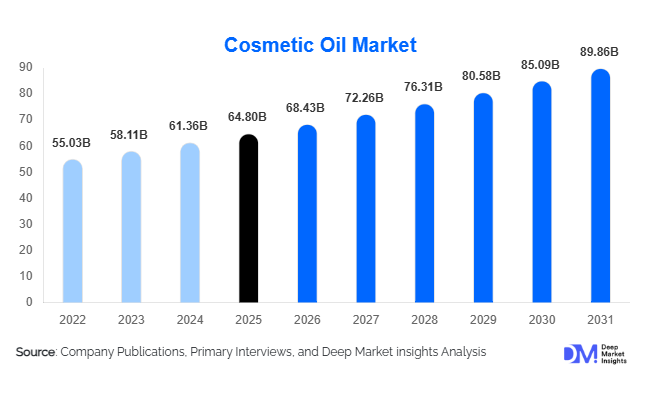
According to Deep Market Insights, the global cosmetic oil market size was valued at USD 64.8 billion in 2025 and is projected to grow from USD 68.43 billion in 2026 to reach USD 89.7 billion by 2031, expanding at a CAGR of 5.6% during the forecast period (2026–2031). Market growth is being driven by increasing consumer preference for natural and plant-based beauty products, rising demand for multifunctional skincare and haircare formulations, and growing adoption of premium cosmetic oils across both developed and emerging economies. Cosmetic oils have become essential ingredients in modern beauty formulations due to their moisturizing, anti-aging, antioxidant, and skin barrier repair properties. The shift toward clean-label cosmetics, sustainable sourcing practices, and organic certifications is further accelerating market expansion. In addition, the rapid growth of e-commerce beauty channels, social media-driven beauty trends, and rising spending on personal care products are creating favorable conditions for cosmetic oil manufacturers globally.
Key Market Insights
- Natural and botanical cosmetic oils are increasingly replacing synthetic ingredients as consumers prioritize clean-label and sustainable beauty products.
- Hair care applications account for the largest revenue share, supported by growing demand for scalp treatments, hair repair solutions, and nourishing oil formulations.
- Asia-Pacific dominates the global cosmetic oil market, accounting for approximately 34% of global demand in 2025.
- Middle East & Africa is the fastest-growing regional market, supported by rising premium beauty consumption and increasing disposable incomes.
- E-commerce has become one of the fastest-growing distribution channels, enabling direct-to-consumer expansion and broader access to niche beauty brands.
- Advanced extraction technologies, including cold-press and supercritical CO₂ processing, are improving oil purity, efficacy, and premium positioning.
Cosmetic Oil Market Trends
Clean Beauty and Organic Ingredient Adoption Accelerating
One of the most significant trends shaping the cosmetic oil market is the growing consumer preference for clean beauty products formulated with naturally derived ingredients. Consumers are increasingly scrutinizing ingredient labels and seeking products free from parabens, sulfates, silicones, and synthetic fragrances. This shift has elevated demand for oils such as argan, jojoba, rosehip, marula, and coconut oil, which are perceived as safer and more environmentally responsible alternatives. Manufacturers are responding by investing in certified organic ingredients, transparent sourcing practices, and sustainable supply chains. The growing influence of beauty influencers, dermatologists, and wellness-focused consumer communities continues to reinforce the popularity of botanical oils across premium and mass-market beauty categories.
Multifunctional Cosmetic Oils Becoming Mainstream
Consumers increasingly prefer beauty products that provide multiple benefits within a single formulation. Cosmetic oils are being incorporated into hybrid products that combine moisturization, anti-aging benefits, skin repair, antioxidant protection, and cosmetic enhancement. Facial oils, overnight treatment oils, hair serums, cleansing oils, and lip oils are gaining popularity due to their versatility. Product innovation is increasingly focused on customized blends targeting specific skin conditions such as acne, pigmentation, sensitivity, and barrier repair. This multifunctionality is helping cosmetic oils expand beyond traditional applications and penetrate broader personal care categories.
Cosmetic Oil Market Drivers
Growing Demand for Natural and Sustainable Beauty Products
The global beauty industry is undergoing a major transition toward naturally derived ingredients. Consumers increasingly associate plant-based oils with safety, efficacy, and sustainability, leading to stronger adoption across skincare, haircare, and wellness products. Botanical oils offer moisturizing, antioxidant, anti-inflammatory, and restorative properties that align with modern consumer preferences. The growing popularity of clean beauty movements, ingredient transparency initiatives, and eco-conscious consumption continues to strengthen demand for cosmetic oils globally.
Expansion of Premium Skincare and Haircare Segments
Premium beauty products continue to outperform many traditional personal care categories. Cosmetic oils are increasingly incorporated into luxury skincare formulations, anti-aging serums, scalp treatments, and hair repair products. Consumers are willing to pay premium prices for clinically validated, naturally sourced oils that deliver visible results. The expansion of prestige beauty brands and rising disposable incomes in Asia-Pacific, the Middle East, and Latin America are creating additional growth opportunities for cosmetic oil manufacturers.
Cosmetic Oil Market Restraints
Volatility in Raw Material Supply and Pricing
Many cosmetic oils are derived from agricultural crops that are highly sensitive to weather conditions, climate variability, and geopolitical disruptions. Supply fluctuations affecting argan oil, rosehip oil, jojoba oil, and specialty botanical oils can significantly impact production costs and profit margins. Rising transportation costs and sustainability compliance requirements further contribute to pricing uncertainty across global supply chains.
Regulatory Complexity Across International Markets
The cosmetic oil industry operates under diverse regulatory frameworks governing ingredient safety, labeling requirements, organic certifications, and product claims. Compliance with regulations across Europe, North America, Asia-Pacific, and emerging markets can increase development costs and extend product launch timelines. Smaller manufacturers often face challenges in meeting multiple certification standards while maintaining competitive pricing.
Cosmetic Oil Market Opportunities
Expansion of Certified Organic and Sustainable Cosmetic Oils
The rapid growth of organic beauty products presents substantial opportunities for both existing manufacturers and new market entrants. Consumers are increasingly seeking certified organic ingredients supported by recognized standards such as ECOCERT, COSMOS, and USDA Organic. Organic cosmetic oils often command premium pricing while enhancing brand credibility. Manufacturers investing in traceable sourcing, sustainable agriculture partnerships, and environmental certifications are expected to gain competitive advantages as consumer demand for ethical beauty products continues to increase.
Premium Botanical Oil Innovation
High-value specialty oils such as marula, baobab, tamanu, and prickly pear seed oil represent attractive growth opportunities. These oils offer unique functional benefits, including anti-aging properties, skin regeneration, hydration, and protection against environmental stressors. As consumers increasingly seek targeted beauty solutions, brands that introduce clinically validated specialty oil formulations are expected to capture higher-margin market segments. Biotechnology-assisted extraction and ingredient enhancement technologies may further accelerate innovation in premium cosmetic oil categories.
Report Scope
| Report Metric | Details |
|---|---|
| Market Size in 2025 | USD 64.8 Billion |
| Market Size in 2026 | USD 68.43 Billion |
| Market Size in 2031 | USD 89.86 Billion |
| CAGR | 5.6% (2026-2031) |
| Base Year for Estimation | 2025 |
| Historical Data | 2022-2024 |
| Forecast Period | 2026-2031 |
| Report Coverage | Revenue Forecast, Competitive Landscape, Supply Chain Disruption, Growth Factors, Environment & Regulatory Landscape and Trends |
| Geographies Covered | North America, Europe, APAC, Middle East and Africa, LATAM |
| Countries Covered | U.S., Canada, U.K., Germany, France, Spain, Italy, Russia, Nordic, Benelux, Rest of Europe, China, Korea, Japan, India, Australia, Singapore, Taiwan, South East Asia, Rest of Asia-Pacific, UAE, Turky, Saudi Arabia, South Africa, Egypt, Nigeria, Rest of MEA, Brazil, Mexico, Argentina, Chile, Colombia, Rest of LATAM |
Explore more data points, trends and opportunities Download Free Sample Report
Product Type Insights
Essential oils represent the largest product segment in the global cosmetic oil market, accounting for approximately 26% of total market revenue in 2025. The segment's leadership is primarily driven by the growing consumer preference for multifunctional natural ingredients that deliver skincare, haircare, aromatherapy, and wellness benefits through a single formulation. Essential oils such as lavender, tea tree, peppermint, eucalyptus, sandalwood, and rosemary continue to witness strong adoption due to their anti-inflammatory, antimicrobial, antioxidant, and therapeutic properties. The increasing integration of essential oils into clean-label beauty products, organic cosmetics, and wellness-focused personal care formulations has further strengthened segment growth. In addition, rising consumer awareness regarding synthetic chemical alternatives has encouraged manufacturers to expand essential oil-based product portfolios across premium and mass-market categories.
Carrier oils, including coconut, argan, almond, avocado, and jojoba oils, continue to generate substantial demand due to their moisturizing, nourishing, and restorative characteristics. These oils are increasingly incorporated into hair serums, facial oils, body oils, and anti-aging formulations. Meanwhile, specialty botanical oils such as marula, rosehip, tamanu, baobab, and prickly pear oils are among the fastest-growing product categories, supported by premium skincare trends, dermatologist-backed formulations, and growing consumer willingness to pay for targeted beauty solutions. The rising popularity of ingredient transparency and functional skincare is expected to further support demand for high-performance botanical oils throughout the forecast period.
Application Insights
Hair care remains the dominant application segment, accounting for approximately 34% of global cosmetic oil demand in 2025. The segment continues to benefit from deeply rooted hair oiling traditions across Asia-Pacific, increasing consumer awareness regarding scalp health, and growing concerns surrounding hair fall, damage repair, and hydration. Consumers are increasingly adopting natural oil-based treatments as alternatives to chemically intensive products, particularly in emerging markets where botanical ingredients maintain strong cultural acceptance. The expansion of premium hair oils, scalp treatment serums, anti-frizz solutions, and hair growth formulations is further strengthening segment leadership.
Skin care represents the second-largest application category and continues to witness strong growth driven by rising adoption of facial oils, cleansing oils, anti-aging serums, overnight treatments, and intensive moisturization products. Consumers increasingly favor oil-based skincare formulations due to their ability to provide deep nourishment while supporting skin barrier repair. Lip care applications are also emerging rapidly, supported by growing popularity of premium lip oils, tinted oil treatments, and multifunctional beauty products. Additionally, cosmetic oils are increasingly incorporated into hybrid beauty products, fragrances, makeup formulations, wellness-oriented cosmetics, and dermatological skincare solutions that combine aesthetic and therapeutic benefits. Growing consumer preference for personalized beauty regimens is expected to further expand application diversity across the market.
Distribution Channel Insights
Specialty beauty stores remain the largest distribution channel, accounting for approximately 28% of global market revenue. The segment maintains its leadership position due to consumers' preference for personalized product recommendations, product demonstrations, expert consultations, and access to premium beauty brands. These retail environments provide consumers with opportunities to evaluate product quality, ingredient composition, and efficacy before purchase, particularly within premium skincare and cosmetic oil categories. Strong brand partnerships and exclusive product launches further reinforce the importance of specialty retail channels.
E-commerce is the fastest-growing distribution channel as digital beauty platforms continue to transform purchasing behavior globally. Growth is being supported by rising smartphone penetration, expanding social commerce ecosystems, influencer-driven marketing campaigns, and direct-to-consumer business models. Online channels enable consumers to access a broader range of global brands, compare product reviews, and purchase niche formulations unavailable through traditional retail networks. Pharmacies, hypermarkets, professional salons, and direct-selling channels continue to play important roles in market expansion, particularly in emerging economies. Subscription beauty services, AI-powered skincare recommendation platforms, and personalized beauty marketplaces are also emerging as significant customer acquisition channels, contributing to the digital transformation of the cosmetic oil industry.
End User Insights
Individual consumers account for approximately 74% of global cosmetic oil consumption, making them the largest end-user segment. Segment dominance is driven by rising consumer focus on self-care, wellness-oriented lifestyles, skincare personalization, and preventive beauty routines. Consumers are increasingly incorporating cosmetic oils into daily beauty regimens for hydration, anti-aging benefits, scalp care, and therapeutic wellness applications. Growing awareness regarding natural and organic personal care products continues to support sustained demand across both developed and emerging markets.
Professional beauty salons and spas represent a significant commercial end-user category, particularly within premium treatment and luxury wellness segments. Cosmetic product manufacturers also constitute a major demand source as botanical oils become increasingly integrated into skincare, haircare, cosmetics, and personal wellness formulations. Furthermore, contract manufacturing organizations are expanding production capabilities to support growing demand from independent beauty brands, private-label manufacturers, and emerging direct-to-consumer companies. The increasing diversification of beauty product portfolios is expected to further strengthen commercial demand for cosmetic oils throughout the forecast period.
Explore more data points, trends and opportunities Download Free Sample Report
Cosmetic Oil Market Segmentations
By Product Type
- Essential Oils
- Carrier Oils
- Botanical & Specialty Oils
- Mineral Oils
- Synthetic Cosmetic Oils
By Application
- Hair Care
- Skin Care
- Lip Care
- Color Cosmetics
- Fragrances & Personal Care
By Distribution Channel
- Specialty Beauty Stores
- E-Commerce
- Pharmacies & Drug Stores
- Hypermarkets & Supermarkets
- Professional Salons & Spas
- Direct Selling Channels
By End User
- Individual Consumers
- Beauty Salons & Spas
- Cosmetic Manufacturers
- Contract Manufacturing Organizations
Regional Insights
Asia-Pacific
Asia-Pacific dominates the global cosmetic oil market, accounting for approximately 34% of total revenue in 2025. The region's leadership is driven by its large consumer base, deep-rooted beauty traditions, expanding middle-class population, and strong preference for natural personal care ingredients. China remains the largest market within the region, supported by premium skincare demand, increasing beauty expenditures, rapid e-commerce penetration, and the expansion of domestic beauty brands. Japan continues to drive demand for technologically advanced and high-performance cosmetic oils, while South Korea serves as a global innovation hub for skincare and cosmetic product development. India is among the fastest-growing markets globally, benefiting from traditional oil-based beauty practices, rising disposable incomes, urbanization, and increasing awareness of Ayurvedic and plant-based personal care solutions. The region's growth is further supported by strong manufacturing capabilities, expanding retail infrastructure, and rising consumer preference for clean-label beauty products.
North America
North America accounts for approximately 29% of global cosmetic oil demand, led primarily by the United States. Regional growth is being driven by strong adoption of clean beauty products, premium skincare formulations, and increasing demand for organic and sustainably sourced cosmetic ingredients. Consumers across the region are increasingly prioritizing ingredient transparency, ethical sourcing practices, and multifunctional beauty products that combine skincare and wellness benefits. The expansion of direct-to-consumer beauty brands, social media-driven beauty trends, and premium wellness lifestyles continues to support demand growth. Canada is also witnessing increasing adoption of natural and organic cosmetic formulations, supported by rising environmental awareness and growing demand for premium personal care products.
Europe
Europe represents approximately 27% of global market revenue and remains one of the most mature cosmetic oil markets worldwide. Regional growth is supported by strong consumer preference for natural cosmetics, stringent sustainability regulations, and growing demand for environmentally responsible beauty products. France serves as a major center for beauty innovation, luxury cosmetics, and global exports, while Germany leads regional demand for organic skincare and clean-label formulations. Italy, Spain, and the United Kingdom continue to witness increasing adoption of premium skincare oils, botanical ingredients, and wellness-focused beauty solutions. The region's advanced regulatory framework promoting ingredient safety, sustainability, and transparency further strengthens consumer confidence and supports long-term market expansion.
Latin America
Latin America accounts for approximately 4% of global cosmetic oil demand, with Brazil representing the dominant market within the region. Growth is primarily driven by the region's strong beauty culture, expanding cosmetics industry, and increasing incorporation of botanical ingredients into personal care products. Brazil benefits from abundant availability of natural raw materials, a large beauty-conscious population, and strong domestic cosmetic manufacturing capabilities. Mexico and Colombia are emerging as important growth markets due to rising disposable incomes, urbanization, and increasing consumer awareness regarding premium skincare products. The growing popularity of natural beauty solutions and international premium brands is expected to support continued market expansion throughout the region.
Middle East & Africa
The Middle East & Africa region accounts for approximately 6% of global demand and is projected to register the fastest growth rate through 2031. Growth is being fueled by rising urbanization, increasing disposable incomes, expanding female workforce participation, and growing beauty consciousness among consumers. The UAE and Saudi Arabia continue to lead regional demand due to strong luxury beauty consumption, premium skincare adoption, and high spending on personal care products. South Africa serves as a key growth market supported by increasing retail penetration and growing consumer interest in natural cosmetic formulations. The expansion of international beauty brands, modern retail channels, e-commerce platforms, and premium wellness trends is expected to accelerate cosmetic oil demand across the region over the coming years.
Key Players in the Cosmetic Oil Market
- L'Oréal
- Unilever
- Shiseido
- Estée Lauder Companies
- Beiersdorf AG
- Procter & Gamble
- Johnson & Johnson
- Natura & Co
- Amorepacific Corporation
- Coty Inc.
- Oriflame Holding AG
- Kao Corporation
- L'Occitane International
- Clarins Group
- The Body Shop International