Contemporary Daybed Market Size
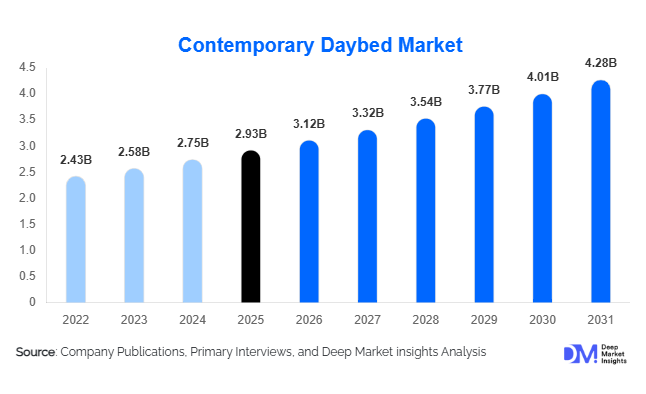
According to Deep Market Insights, the global contemporary daybed market size was valued at USD 2.93 billion in 2025 and is projected to grow from USD 3.12 billion in 2026 to reach USD 4.28 billion by 2031, expanding at a CAGR of 6.5% during the forecast period (2026–2031). The contemporary daybed market growth is primarily driven by increasing demand for multifunctional furniture, rising urbanization, growing investments in premium home interiors, and expanding adoption of space-saving furniture solutions across residential and commercial environments. Contemporary daybeds have evolved beyond traditional guest-room furniture into versatile lifestyle products that combine seating, lounging, and sleeping functions within a single design. Growing popularity of compact living spaces, luxury hospitality developments, and designer furniture collections is further accelerating market demand globally.
Key Market Insights
- Multifunctional furniture demand continues to drive market growth, particularly in urban apartments and compact residential spaces where maximizing floor space is a priority.
- Residential applications account for the largest share of the market, representing approximately 77% of global demand as consumers increasingly prioritize flexible furniture solutions.
- North America dominates the global contemporary daybed market, supported by strong consumer spending on home furnishings and renovation activities.
- Asia-Pacific is the fastest-growing regional market, led by rapid urbanization, rising disposable income, and expanding middle-class populations.
- Sustainable materials and eco-friendly furniture manufacturing are becoming key purchasing considerations among consumers and commercial buyers.
- Digital furniture retailing and augmented reality visualization technologies are transforming customer purchasing behavior and improving online furniture sales.
Contemporary Daybed Market Latest Trends
Growing Adoption of Multifunctional Furniture
Urbanization and shrinking residential floor space continue to increase demand for multifunctional furniture solutions globally. Contemporary daybeds are increasingly being used as dual-purpose furniture that serves as seating during the day and sleeping accommodation when needed. Consumers living in apartments, studio homes, and compact urban residences are prioritizing products that maximize utility without compromising aesthetics. Manufacturers are responding by introducing convertible daybeds, integrated storage systems, modular configurations, and customizable designs that address evolving lifestyle requirements. This trend is particularly prominent across North America, Europe, China, India, and Southeast Asia, where housing density and premium real estate prices continue to influence furniture purchasing decisions.
Premiumization and Sustainable Design Innovations
Consumers are increasingly investing in premium furniture products that combine modern aesthetics, durability, and sustainability. Contemporary daybed manufacturers are incorporating FSC-certified wood, recycled metals, low-emission finishes, and environmentally responsible upholstery materials into product portfolios. Luxury upholstery options such as performance fabrics, premium velvet, and eco-friendly leather alternatives are gaining popularity. Simultaneously, digital customization capabilities allow consumers to select frame materials, upholstery finishes, and dimensions tailored to individual preferences. This premiumization trend is creating opportunities for manufacturers to improve margins while meeting growing sustainability expectations among residential and commercial buyers.
Contemporary Daybed Market Drivers
Rising Demand for Space-Saving Furniture
The increasing prevalence of urban living and compact housing developments is significantly boosting demand for space-efficient furniture. Contemporary daybeds offer a practical solution by combining multiple functionalities into a single furniture piece. As urban populations continue to expand globally, consumers are seeking furniture products that optimize living space while maintaining visual appeal. This trend is particularly strong among younger homeowners, apartment residents, and individuals living in metropolitan regions where housing costs remain elevated.
Growth in Premium Home Furnishing Expenditure
Consumer spending on home improvement and interior design continues to increase globally. Following major shifts toward hybrid work models and home-centric lifestyles, homeowners are investing in furniture products that enhance comfort, functionality, and aesthetics. Contemporary daybeds have benefited from growing demand for designer furniture, luxury interiors, and personalized living environments. Premium furniture collections featuring modern designs, superior materials, and enhanced durability are increasingly attracting affluent consumers seeking high-quality home furnishings.
Expansion of Hospitality and Luxury Accommodation Sectors
The global hospitality industry remains an important demand driver for contemporary daybeds. Hotels, resorts, luxury villas, serviced apartments, and wellness retreats increasingly incorporate daybeds into guest rooms, poolside lounges, executive suites, and relaxation areas. Tourism infrastructure investments across the Middle East, Southeast Asia, and North America continue to support procurement of premium commercial-grade furniture. Customized daybeds designed specifically for hospitality environments are becoming an important source of revenue for leading manufacturers.
Contemporary Daybed Market Restraints
Raw Material Cost Volatility
Manufacturers face ongoing challenges associated with fluctuations in the prices of wood, steel, aluminum, upholstery fabrics, foam, and logistics services. Rising raw material costs can reduce profitability, particularly in highly competitive market segments where pricing flexibility is limited. Supply chain disruptions and transportation cost inflation have further intensified cost pressures across the furniture industry.
Competition from Alternative Furniture Categories
Contemporary daybeds compete directly with sofas, sofa beds, chaise lounges, recliners, sectional seating systems, and modular furniture products. In price-sensitive markets, consumers may opt for alternative furniture categories that provide similar functionality at lower costs. Manufacturers must continue differentiating products through design innovation, premium materials, and enhanced functionality to maintain competitive positioning.
Contemporary Daybed Industry Key Opportunities
Growth in Hospitality and Luxury Real Estate Development
Increasing investments in luxury hotels, resorts, vacation rentals, serviced apartments, and premium residential developments present substantial growth opportunities for contemporary daybed manufacturers. Hospitality operators are increasingly utilizing designer daybeds to enhance guest experiences and differentiate properties. Major tourism and real estate projects across Saudi Arabia, the UAE, Southeast Asia, and North America are expected to generate significant procurement demand over the coming years. Manufacturers capable of offering customized hospitality-grade products are likely to benefit from higher margins and long-term commercial contracts.
Sustainable and Circular Furniture Business Models
Sustainability is becoming a critical purchasing factor across both residential and commercial segments. Manufacturers that invest in recyclable materials, responsible sourcing practices, furniture refurbishment programs, and circular economy initiatives can gain a competitive advantage. Growing demand for environmentally certified furniture products is encouraging innovation in sustainable manufacturing processes and eco-friendly material development. Furniture leasing and refurbishment services are also emerging as new revenue streams, particularly within commercial and institutional sectors.
Report Scope
| Report Metric | Details |
|---|---|
| Market Size in 2025 | USD 2.93 Billion |
| Market Size in 2026 | USD 3.12 Billion |
| Market Size in 2031 | USD 4.28 Billion |
| CAGR | 6.5% (2026-2031) |
| Base Year for Estimation | 2025 |
| Historical Data | 2022-2024 |
| Forecast Period | 2026-2031 |
| Report Coverage | Revenue Forecast, Competitive Landscape, Supply Chain Disruption, Growth Factors, Environment & Regulatory Landscape and Trends |
| Geographies Covered | North America, Europe, APAC, Middle East and Africa, LATAM |
| Countries Covered | U.S., Canada, U.K., Germany, France, Spain, Italy, Russia, Nordic, Benelux, Rest of Europe, China, Korea, Japan, India, Australia, Singapore, Taiwan, South East Asia, Rest of Asia-Pacific, UAE, Turky, Saudi Arabia, South Africa, Egypt, Nigeria, Rest of MEA, Brazil, Mexico, Argentina, Chile, Colombia, Rest of LATAM |
Explore more data points, trends and opportunities Download Free Sample Report
Product Type Insights
Convertible daybeds represent the leading product segment, accounting for approximately 28% of the global market in 2025. Their dominance is primarily driven by rising demand for multifunctional furniture solutions that efficiently optimize space utilization, particularly in urban residential environments where compact living is increasingly prevalent. The ability of convertible daybeds to seamlessly transition between seating and sleeping configurations makes them highly suitable for apartments, studio units, and hospitality interiors that prioritize flexibility and operational efficiency. Upholstered lounge daybeds are witnessing sustained growth due to increasing consumer preference for premium aesthetics, ergonomic comfort, and interior personalization trends that emphasize soft furnishings and tactile materials. Outdoor contemporary daybeds are emerging as a high-growth category, supported by expanding investments in outdoor living spaces, luxury resort developments, and high-end residential landscaping, where lifestyle-oriented outdoor furniture is becoming an integral design component. Storage-integrated and modular daybeds are also gaining traction as consumers increasingly prioritize space-saving functionality, particularly in densely populated urban centers, further reinforcing the shift toward highly adaptable and utility-driven furniture designs.
Material Insights
Wood-frame daybeds dominate the global market with approximately 47% share in 2025, supported by strong consumer preference for durability, natural aesthetics, and compatibility with evolving interior design trends that emphasize organic and warm material palettes. The leading driver of this segment is the growing demand for premium and sustainable furniture solutions, with solid wood and engineered wood products benefiting from increasing adoption of eco-conscious purchasing behavior and certifications related to responsible sourcing. Metal-frame daybeds continue to maintain stable demand, particularly within commercial environments such as hotels, serviced apartments, and institutional settings, where structural strength, long product lifespan, and cost efficiency are critical purchasing factors. Mixed-material constructions combining wood, metal, and upholstered finishes are gaining momentum as manufacturers focus on differentiated product positioning through design innovation and enhanced functionality. Across all material categories, sustainability is emerging as a key growth catalyst, with recycled metals and responsibly sourced timber increasingly influencing procurement decisions and brand competitiveness in both developed and emerging markets.
Distribution Channel Insights
Offline retail channels account for approximately 63% of global contemporary daybed sales, driven primarily by consumer preference for tactile evaluation of furniture products before purchase, especially in higher-value and design-intensive categories. Furniture specialty stores, branded showrooms, and home furnishing retailers remain the dominant sales environment, as they provide immersive customer experiences, design consultation services, and immediate product inspection, all of which strengthen purchase confidence. The leading growth driver within this segment is the continued expansion of organized retail infrastructure in emerging economies and the premiumization of in-store shopping experiences in mature markets. At the same time, online retail is expanding rapidly, supported by advancements in augmented visualization tools, virtual room planning technologies, and improved logistics networks that enhance last-mile delivery efficiency. The rise of direct-to-consumer models is further reshaping the distribution landscape by enabling manufacturers to strengthen brand control, improve pricing efficiency, and expand geographic reach without reliance on traditional intermediaries.
End-Use Insights
Residential applications dominate the market with approximately 77% share in 2025, primarily driven by the growing adoption of multifunctional and space-efficient furniture across urban apartments, villas, vacation homes, and newly developed housing projects. The leading driver in this segment is rapid urbanization combined with evolving consumer lifestyles that prioritize flexible living spaces capable of supporting work-from-home, leisure, and guest accommodation needs within limited square footage. Consumers are increasingly investing in adaptable furniture solutions that combine comfort, utility, and aesthetic appeal. Commercial applications are expanding at a faster growth rate, particularly within hospitality, co-living spaces, student housing, healthcare facilities, and corporate lounges, where demand for durable, modular, and design-oriented furniture is increasing. Luxury hotels and premium resorts represent the fastest-growing sub-segment, supported by strong global tourism recovery, rising investments in experiential hospitality, and increased emphasis on interior differentiation to enhance guest experience. Additionally, emerging use cases in wellness centers, executive lounges, and serviced apartments are further contributing to the diversification of demand across commercial environments.
Price Tier Insights
Mid-range contemporary daybeds hold the largest share of the global market at approximately 44% in 2025, driven by their optimal balance between affordability, design quality, and functional durability. The primary growth driver in this segment is the expansion of the global middle-income population, particularly in emerging economies, coupled with rising consumer expectations for stylish yet cost-effective home furnishing solutions. Premium and luxury segments are witnessing accelerated growth as affluent consumers increasingly invest in bespoke furniture, designer collections, and high-end interior customization that reflects lifestyle status and personal aesthetics. Economy segments continue to play a critical role in price-sensitive markets, particularly in developing regions where affordability remains a key purchasing determinant and demand is concentrated in mass housing and rental accommodation. Across all tiers, brand differentiation through design innovation, material quality, and sustainability credentials is becoming increasingly important in influencing consumer choice and competitive positioning.
Explore more data points, trends and opportunities Download Free Sample Report
Contemporary Daybed Market Segmentations
By Product Type
- Standard Contemporary Daybeds
- Chaise-Style Daybeds
- Backless Daybeds
- Upholstered Lounge Daybeds
- Trundle Daybeds
- Convertible Daybeds
- Storage Daybeds
- Outdoor Contemporary Daybeds
By Frame Material
- Solid Wood Daybeds
- Metal Frame Daybeds
- Mixed-Material Daybeds
- Fully Upholstered Frame Daybeds
By Upholstery Material
- Fabric Upholstery
- Leather Upholstery
- Faux Leather Upholstery
- Velvet Upholstery
- Performance Textile Upholstery
- Outdoor Weather-Resistant Upholstery
By Functionality
- Seating-Oriented Daybeds
- Sleeping-Oriented Daybeds
- Dual-Purpose Convertible Daybeds
- Storage-Integrated Daybeds
- Smart/Modular Daybeds
By Price Tier
- Economy
- Mid-Range
- Premium
- Luxury Designer
Regional Insights
North America
North America accounts for approximately 33% of the global contemporary daybed market, positioning it as the largest regional contributor. The leading growth driver in this region is high consumer spending on home improvement and interior renovation, supported by a mature housing market and strong culture of residential customization. The United States dominates regional demand due to robust real estate activity, increasing adoption of multifunctional furniture in urban housing, and strong presence of premium furniture brands. Canada contributes significantly through rising investments in residential construction and expansion of hospitality infrastructure. Demand is particularly strong for convertible and upholstered daybeds, driven by evolving design preferences that emphasize comfort, flexibility, and modern aesthetics in both residential and commercial spaces.
Europe
Europe represents approximately 29% of global demand, with key markets including Germany, the United Kingdom, France, Italy, and Spain. The primary driver of regional growth is strong consumer emphasis on sustainability, craftsmanship, and long-term product durability, which aligns with Europe’s mature and design-conscious furniture market. Scandinavian design influence continues to play a major role in shaping demand trends, encouraging adoption of minimalist, functional, and space-efficient furniture solutions such as modular and convertible daybeds. Additionally, stringent environmental regulations and growing preference for certified sustainable materials are accelerating the transition toward eco-friendly wood sourcing and recyclable material usage across the region.
Asia-Pacific
Asia-Pacific holds approximately 28% share of the global market and is projected to register the fastest growth through 2031. The leading growth driver is rapid urbanization combined with rising disposable incomes and the expansion of the middle-class population, particularly in China and India. China remains the largest market in the region, supported by large-scale urban housing development, strong manufacturing capabilities, and increasing consumer preference for modern interior design solutions. India is expected to be the fastest-growing market globally due to rapid residential construction, expansion of organized furniture retail, and growing awareness of multifunctional home furnishing solutions. Additional growth momentum is contributed by Japan, South Korea, Australia, and Southeast Asian countries, where compact living spaces and evolving lifestyle preferences are driving strong demand for space-saving and modular furniture designs.
Latin America
Latin America accounts for approximately 6% of global demand, with Brazil and Mexico serving as the key markets. The primary growth driver in this region is ongoing urbanization combined with gradual expansion of residential infrastructure and rising adoption of modern furniture aesthetics among urban consumers. Increasing exposure to global interior design trends is encouraging demand for multifunctional and affordable contemporary daybeds. Although macroeconomic volatility and currency fluctuations remain challenges, improving retail penetration and growing middle-class consumption are supporting steady long-term market development across major urban centers.
Middle East & Africa
The Middle East and Africa collectively represent approximately 4% of global demand but demonstrate strong long-term growth potential driven by large-scale infrastructure development and increasing investment in luxury hospitality and real estate projects. The UAE and Saudi Arabia are leading regional markets, supported by ambitious tourism diversification strategies, mega-project developments, and expansion of high-end residential communities. The primary growth driver in this region is the rapid development of premium hospitality infrastructure, including luxury hotels, resorts, and serviced apartments, which require high-quality and designer furniture solutions. Increasing urbanization and rising disposable incomes in selected African markets are also contributing to gradual adoption of contemporary furniture products, particularly in metropolitan areas.