Colour Cosmetics Market Size
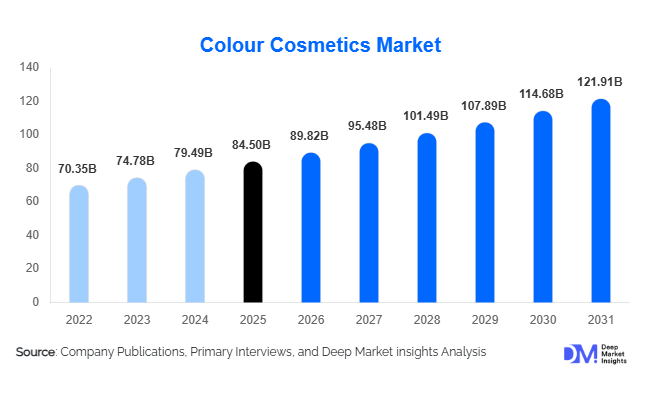
According to Deep Market Insights, the global colour cosmetics market size was valued at USD 84.5 billion in 2025 and is projected to grow from USD 89.82 billion in 2025 to reach USD 121.91 billion by 2031, expanding at a CAGR of 6.3% during the forecast period (2025–2031). The colour cosmetics market growth is primarily driven by increasing consumer expenditure on beauty and personal care products, growing social media influence on beauty trends, rising demand for premium and clean-label cosmetics, and continuous innovation in multifunctional makeup products. The market is benefiting from evolving consumer preferences toward self-expression, inclusive beauty standards, and digitally enabled purchasing experiences. Furthermore, rapid urbanisation, increasing participation of women in the workforce, and growing beauty consciousness among Gen Z and millennial consumers continue to create significant opportunities across both developed and emerging economies.
Key Market Insights
- Face makeup remains the largest product category, accounting for approximately 38% of global colour cosmetics revenue in 2025, supported by strong demand for foundations, concealers, and multifunctional complexion products.
- Asia-Pacific dominates the global market, representing nearly 43% of total revenue, driven by large consumer populations, rising disposable incomes, and strong beauty product penetration.
- Clean beauty and vegan cosmetics are gaining significant momentum, particularly across North America and Europe, where consumers increasingly prioritise ingredient transparency and sustainable sourcing.
- E-commerce and social commerce platforms are transforming distribution channels, enabling brands to engage consumers directly while accelerating product discovery and purchase conversion.
- Artificial intelligence and augmented reality technologies are reshaping beauty retail, offering virtual try-on tools, personalised recommendations, and digital shade-matching solutions.
- Emerging markets, including India, Indonesia, Brazil, Saudi Arabia, and Vietnam,m are becoming major growth engines, supported by expanding middle-class populations and increasing beauty spending.
Colour Cosmetics Market Trends
Clean Beauty and Sustainable Cosmetics Gaining Mainstream Adoption
Consumer awareness regarding ingredient safety, sustainability, and ethical sourcing has transformed the colour cosmetics industry. Demand for vegan, cruelty-free, organic, and clean-label cosmetics is increasing across all major markets. Beauty brands are investing heavily in sustainable packaging solutions, refillable products, biodegradable materials, and responsibly sourced ingredients. Consumers increasingly prefer products that align with environmental and social values, particularly among younger demographics. Major manufacturers are reformulating products to eliminate controversial ingredients while emphasising transparency and product traceability. As governments strengthen sustainability regulations and consumers become more environmentally conscious, clean beauty is expected to remain one of the most influential trends shaping the colour cosmetics market.
Digital Beauty Experiences and AI-Powered Personalisation
Technology is becoming a central component of the consumer beauty journey. Artificial intelligence, augmented reality, and machine learning technologies are being integrated into product discovery, shade matching, and personalised recommendations. Virtual try-on applications enable consumers to test products digitally before purchase, significantly improving customer engagement and reducing return rates. AI-powered skin analysis tools are also helping brands recommend tailored products based on skin tone, texture, and preferences. These innovations are particularly appealing to digitally native consumers and are driving increased investment across beauty technology ecosystems. As online beauty shopping continues expanding globally, technology-enabled personalisation is expected to become a critical competitive differentiator.
Colour Cosmetics Market Drivers
Growing Influence of Social Media and Beauty Influencers
Social media platforms have become one of the strongest growth drivers for the colour cosmetics market. Platforms such as Instagram, TikTok, YouTube, and regional social-commerce networks significantly influence consumer purchasing decisions. Beauty tutorials, product reviews, influencer endorsements, and user-generated content rapidly accelerate product awareness and adoption. Viral beauty trends frequently generate immediate demand surges, enabling brands to launch products and scale sales faster than traditional marketing channels. The increasing role of beauty influencers has shortened product innovation cycles while creating direct engagement opportunities between brands and consumers.
Rising Disposable Income and Beauty Premiumization
Growing disposable income levels across emerging economies are encouraging consumers to spend more on personal grooming and beauty products. Consumers are increasingly willing to pay premium prices for advanced formulations, luxury packaging, skincare-infused makeup, and personalised beauty solutions. The premium and prestige segments are growing faster than mass-market categories in many developed economies, supported by demand for superior performance, exclusivity, and brand reputation. This trend is particularly evident in Asia-Pacific and the Middle East, where affluent consumer populations continue expanding.
Colour Cosmetics Market Restraints
Complex Regulatory Environment
The colour cosmetics industry operates within a highly regulated environment characterised by varying ingredient standards, product testing requirements, labelling regulations, and sustainability mandates across different regions. Compliance with evolving regulatory frameworks increases research, development, and certification costs. Manufacturers often face challenges when introducing products across multiple jurisdictions due to differing regulatory requirements, extending product development timelines and increasing operational complexity.
Intense Market Competition and Brand Fragmentation
The industry faces intense competition from multinational corporations, celebrity-led brands, independent beauty companies, and digital-native startups. While competition encourages innovation, it also increases customer acquisition costs and marketing expenditures. Consumer loyalty remains relatively low within certain product categories, making it difficult for brands to maintain long-term market share. Smaller companies frequently face challenges in scaling operations and competing against established players with extensive distribution networks and marketing budgets.
Colour Cosmetics Market Opportunities
Expansion in High-Growth Emerging Markets
Emerging economies, including India, Indonesia, Vietnam, Saudi Arabia, Brazil, and Mexico, present substantial growth opportunities for colour cosmetics manufacturers. Beauty product penetration remains below levels observed in developed markets, while urbanisation, rising incomes, and digital commerce adoption continue accelerating. Consumers in these markets are increasingly seeking affordable premium products, creating opportunities for both global and regional brands. Localised product offerings tailored to regional beauty preferences are expected to play an important role in capturing market share.
AI-Enabled Beauty Retail and Personalised Cosmetics
The integration of artificial intelligence, predictive analytics, and augmented reality into beauty retail creates significant opportunities for innovation. Personalised cosmetics based on individual skin characteristics, virtual consultations, digital beauty advisors, and AI-generated product recommendations are transforming the consumer experience. These technologies improve conversion rates, enhance customer satisfaction, and create new revenue streams for beauty brands. As consumers increasingly demand customised solutions, technology-driven personalisation is expected to become a major growth avenue across the colour cosmetics market.
Report Scope
| Report Metric | Details |
|---|---|
| Market Size in 2025 | USD 84.5 Billion |
| Market Size in 2026 | USD 89.82 Billion |
| Market Size in 2031 | USD 121.91 Billion |
| CAGR | 6.3% (2026-2031) |
| Base Year for Estimation | 2025 |
| Historical Data | 2022-2024 |
| Forecast Period | 2026-2031 |
| Report Coverage | Revenue Forecast, Competitive Landscape, Supply Chain Disruption, Growth Factors, Environment & Regulatory Landscape and Trends |
| Geographies Covered | North America, Europe, APAC, Middle East and Africa, LATAM |
| Countries Covered | U.S., Canada, U.K., Germany, France, Spain, Italy, Russia, Nordic, Benelux, Rest of Europe, China, Korea, Japan, India, Australia, Singapore, Taiwan, South East Asia, Rest of Asia-Pacific, UAE, Turky, Saudi Arabia, South Africa, Egypt, Nigeria, Rest of MEA, Brazil, Mexico, Argentina, Chile, Colombia, Rest of LATAM |
Explore more data points, trends and opportunities Download Free Sample Report
Product Category Insights
Face makeup emerged as the largest product category, accounting for approximately 38% of the global colour cosmetics market revenue in 2025. The segment maintains its leadership position due to its central role in everyday beauty routines and its broad consumer appeal across all age groups and income segments. Products such as foundations, concealers, powders, blushes, bronzers, and contouring products continue to experience strong demand as consumers increasingly seek complexion-enhancing solutions that provide both cosmetic and skincare benefits. The growing popularity of hybrid products that combine makeup with SPF protection, anti-ageing ingredients, hydration benefits, and skin-tone correction is further accelerating segment growth. In addition, increasing consumer preference for long-wear, lightweight, and skin-friendly formulations has encouraged continuous product innovation among leading brands.
Eye makeup represents the second-largest product category globally, supported by rising demand for mascaras, eyeliners, eyeshadows, and brow-enhancement products. The segment benefits significantly from social media beauty trends, influencer-led tutorials, and fashion-driven product launches that encourage frequent experimentation and product replacement. Demand is particularly strong among younger consumers seeking customizable and expressive beauty looks. Lip cosmetics continue to remain a key growth contributor owing to frequent purchase cycles, seasonal fashion trends, and expanding product portfolios that include lipsticks, glosses, tints, and lip oils. The segment has also benefited from the growing popularity of long-lasting and transfer-resistant formulations. Meanwhile, nail cosmetics continue to witness steady demand growth due to increasing adoption of at-home manicure products and DIY beauty treatments. Hair colour cosmetics are among the fastest-growing categories, driven by rising consumer interest in self-expression, temporary colour applications, fashion colours, and at-home hair transformation solutions.
Consumer Segment Insights
Women remained the dominant consumer segment, accounting for nearly 74% of global colour cosmetics revenue in 2025. The segment's leadership is primarily attributed to higher product penetration rates, broader product usage across multiple categories, and greater spending on personal grooming and beauty enhancement products. Women consumers typically purchase products across face, eye, lip, and nail makeup categories, creating higher overall basket values compared to other consumer groups. Additionally, increasing workforce participation among women, rising disposable incomes, and growing beauty awareness across emerging economies continue to strengthen segment demand. The women's segment is further supported by continuous innovation in formulations, shade ranges, inclusive product offerings, and premium beauty solutions tailored to different skin types, age groups, and beauty preferences. Beauty brands continue to invest heavily in marketing campaigns targeting female consumers through social media platforms, influencers, and personalised digital experiences.
Men's cosmetics represent one of the fastest-growing consumer segments, driven by increasing acceptance of male grooming, rising awareness of appearance-focused products, and growing demand for complexion correction and grooming solutions. Furthermore, the emergence of gender-neutral and inclusive beauty products is creating additional growth opportunities as brands increasingly position products beyond traditional gender boundaries, appealing to younger consumers seeking self-expression and personalisation.
Distribution Channel Insights
Offline retail channels accounted for approximately 63% of global colour cosmetics sales in 2025, making them the leading distribution channel. The segment continues to dominate due to consumers' preference for physical product interaction, shade matching, texture evaluation, and personalised beauty consultations before purchase. Speciality beauty retailers, department stores, supermarkets, pharmacies, and branded stores remain important touchpoints within the consumer purchasing journey. The continued expansion of organised beauty retail chains across emerging economies has further strengthened offline channel performance. Premium and luxury beauty brands particularly benefit from experiential retail environments that enable product demonstrations, professional consultations, and customer engagement initiatives. Furthermore, consumers purchasing foundation, concealer, and other complexion products frequently prefer in-store testing to ensure optimal shade selection.
Although offline channels maintain market leadership, online channels are experiencing the fastest growth. E-commerce platforms, social commerce ecosystems, and direct-to-consumer websites are gaining traction due to convenience, wider product availability, personalised recommendations, virtual try-on technologies, and influencer-driven product discovery. Beauty brands are increasingly adopting omnichannel strategies that integrate both physical and digital retail experiences to maximise customer reach and engagement.
Price Tier Insights
Mass-market cosmetics remained the largest pricing segment, accounting for approximately 56% of global market revenue in 2025. Segment leadership is driven by affordability, broad product accessibility, extensive retail penetration, and strong demand from middle-income consumers across both developed and emerging economies. Mass-market products provide consumers with affordable access to a wide range of cosmetic solutions while benefiting from large-scale manufacturing efficiencies and extensive distribution networks. The segment continues to experience robust demand growth in Asia-Pacific, Latin America, Africa, and other emerging regions where value-conscious consumers represent a substantial portion of the addressable market. Additionally, many mass-market brands have successfully enhanced product quality and innovation, narrowing the performance gap between mainstream and premium offerings.
At the same time, premium and prestige cosmetics are steadily gaining market share due to increasing consumer willingness to invest in advanced formulations, skincare-infused makeup products, luxury packaging, and personalised beauty experiences. Premiumization remains one of the most significant long-term trends within the colour cosmetics industry, particularly among urban consumers, affluent millennials, and Gen Z demographics seeking higher product efficacy and brand differentiation.
Explore more data points, trends and opportunities Download Free Sample Report
Colour Cosmetics Market Segmentations
By Product Category
- Face Makeup
- Eye Makeup
- Lip Makeup
- Nail Makeup
- Hair Colour Cosmetics
By Consumer Segment
- Women
- Men
- Gender-Neutral / Unisex
By Price Tier
- Mass Market
- Mid-Premium
- Premium
- Luxury / Prestige
By Formulation Type
- Conventional
- Natural & Organic
- Vegan
- Clean Beauty / Free-From Formulations
By Distribution Channel
- Supermarkets & Hypermarkets
- Specialty Beauty Stores
- Department Stores
- Pharmacies & Drugstores
- Brand-Owned E-Commerce
- Third-Party E-Commerce Marketplaces
- Social Commerce Platforms
Regional Insights
Asia-Pacific
Asia-Pacific accounted for approximately 43% of global colour cosmetics revenue in 2025, making it the largest regional market worldwide. Regional growth is primarily driven by rising disposable incomes, rapid urbanisation, expanding middle-class populations, increasing female workforce participation, and strong beauty product penetration across major economies. China remains the largest market in the region, benefiting from sophisticated digital commerce ecosystems, extensive social commerce adoption, and strong demand for premium beauty products. Japan continues to lead in product innovation and premium cosmetics consumption, supported by a highly developed beauty industry and strong consumer focus on quality and product efficacy. India is emerging as one of the fastest-growing markets globally due to rising beauty awareness, increasing internet penetration, expanding organised retail infrastructure, and a growing young consumer population. South Korea continues to exert substantial influence on global beauty trends through K-beauty innovations, while Southeast Asian countries, including Indonesia, Vietnam, Thailand, and the Philippines,s are witnessing accelerating demand due to rising household incomes and increasing adoption of international beauty brands.
North America
North America accounted for approximately 25% of global market revenue in 2025, with the United States representing the largest individual country market globally. Regional growth is supported by high per-capita spending on beauty products, strong consumer preference for premium and prestige cosmetics, and continuous innovation from leading beauty manufacturers. Consumers in the region increasinglprioritiseze clean-label products, cruelty-free formulations, personalised beauty solutions, and sustainable packaging.
The widespread adoption of AI-powered beauty technologies, virtual try-on applications, and direct-to-consumer retail models has further accelerated market development. The United States continues to drive regional demand through strong influencer marketing ecosystems, high digital engagement, and a well-established beauty retail infrastructure. Canada contributes additional growth through increasing demand for ethical beauty products and environmentally responsible formulations.
Europe
Europe accounted for approximately 22% of global colour cosmetics revenue in 2025 and remains one of the world's most mature beauty markets. The region's growth is driven by strong consumer preference for premium cosmetics, increasing demand for sustainable beauty products, and stringent regulatory standards that encourage product quality and innovation. Germany, France, the United Kingdom, Italy, and Spain collectively represent the largest markets within the region.
France continues to serve as a global hub for luxury cosmetics and beauty innovation, while Germany remains one of the largest beauty-consuming nations in Europe. The region's leadership in clean beauty, ingredient transparency, and environmentally responsible manufacturing practices continues to drive demand for premium and organic cosmetic products. Additionally, growing consumer interest in vegan formulations and refillable packaging solutions is creating new growth opportunities across the European market.
Latin America
Latin America represents a steadily expanding market for colour cosmetics, led by Brazil, Mexico, and Argentina. Regional growth is supported by increasing urbanisation, rising beauty consciousness, expanding retail networks, and growing participation of women in the workforce. Brazil remains the largest cosmetics market in the region due to its strong beauty culture, large consumer base, and high per-capita expenditure on personal care products.
The region is witnessing increasing demand for affordable premium cosmetics that combine quality with value. Growth in digital commerce, social media marketing, and local beauty influencer ecosystems is improving product accessibility and accelerating brand penetration. Furthermore, multinational companies continue investing in regional manufacturing and distribution capabilities to capitalise on long-term growth opportunities.
Middle East & Africa
The Middle East & Africa region is among the fastest-growing colour cosmetics markets globally, led by Saudi Arabia, the United Arab Emirates, and South Africa. Regional expansion is driven by increasing disposable incomes, a young consumer demographic, growing beauty consciousness, and strong demand for luxury and prestige cosmetics. Gulf Cooperation Council countries continue to demonstrate some of the highest per-capita beauty expenditures globally, creating significant opportunities for premium international brands.
Government-led economic diversification initiatives, retail modernisation programs, and increasing investments in shopping and lifestyle infrastructure are supporting market growth across the region. The expansion of modern retail channels, e-commerce adoption, and increasing participation of women in the workforce are further strengthening cosmetics consumption. In Africa, rising urbanisation, improving retail accessibility, and growing middle-class populations are creating substantial long-term demand opportunities for both international and regional beauty brands.
Key Players in the Colour Cosmetics Market
- L'Oréal
- Estée Lauder Companies
- Shiseido
- Coty
- Puig
- Amorepacific
- Natura & Co
- KOSÉ Corporation
- Revlon
- e.l.f. Beauty
- Interparfums
- Oriflame
- Mary Kay
- Chanel Beauty
- Kryolan