Coffee Beauty Products Market Size
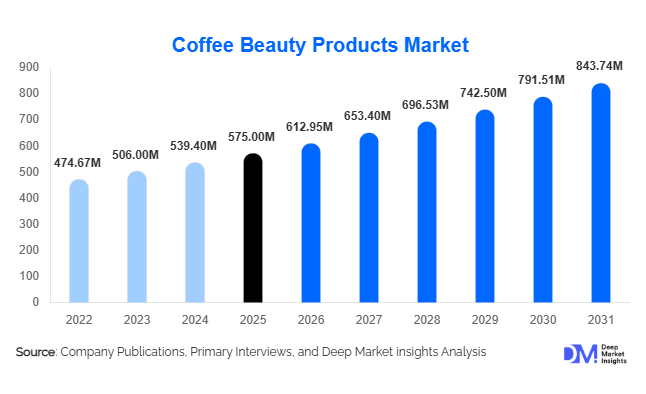
According to Deep Market Insights, the global coffee beauty products market size was valued at USD 575 million in 2025 and is projected to grow from USD 612.95 million in 2026 to reach USD 843.74 million by 2031, expanding at a CAGR of 6.6% during the forecast period (2026–2031). The coffee beauty products market growth is primarily driven by increasing consumer demand for natural skincare ingredients, rising adoption of caffeine-based cosmetic formulations, and the growing popularity of sustainable and upcycled beauty products. Coffee-derived ingredients such as caffeine, coffee oil, and green coffee extract are widely used in cosmetics due to their antioxidant, anti-inflammatory, and exfoliating properties.
Key Market Insights
- Coffee-based skincare products dominate the market, driven by demand for natural exfoliants, anti-aging formulations, and under-eye treatments containing caffeine.
- Online retail channels are rapidly expanding, with direct-to-consumer beauty brands leveraging social media and influencer marketing to reach global audiences.
- North America leads the global market, supported by strong consumer awareness of clean beauty and premium skincare products.
- Asia-Pacific is the fastest-growing region, fueled by rising disposable incomes and the expansion of skincare routines in countries such as China, South Korea, and India.
- Sustainable beauty trends are accelerating demand, particularly through the use of upcycled coffee grounds in cosmetic formulations.
- Men’s grooming products are emerging as a key demand segment, with coffee-infused shampoos, scrubs, and anti-hair fall products gaining popularity.
What are the latest trends in the coffee beauty products market?
Rise of Sustainable and Upcycled Beauty Products
Sustainability has become a defining trend in the global beauty industry, and coffee-based cosmetics are increasingly leveraging this shift. Brands are utilizing spent coffee grounds collected from cafés and coffee roasters as raw materials for skincare products. This circular economy approach reduces environmental waste while creating a sustainable ingredient supply chain for cosmetic manufacturers. Upcycled coffee ingredients are widely used in body scrubs, exfoliating masks, and cellulite treatments, enabling brands to position their products as eco-friendly alternatives to traditional cosmetics. Consumers, particularly younger demographics, are increasingly prioritizing environmentally responsible brands, encouraging manufacturers to integrate recyclable packaging, cruelty-free certifications, and transparent ingredient sourcing. As sustainability continues to influence purchasing decisions, upcycled coffee ingredients are expected to play an even larger role in product innovation.
Multi-Functional Skincare Formulations
Another major trend shaping the coffee beauty products market is the growing demand for multi-functional skincare formulations. Coffee-derived ingredients are now commonly combined with other active compounds such as hyaluronic acid, vitamin C, niacinamide, and botanical oils to create products that deliver multiple benefits simultaneously. These formulations are designed to provide hydration, exfoliation, anti-aging, and skin-brightening properties in a single product. This trend aligns with consumer demand for streamlined skincare routines that maximize efficiency and effectiveness. Premium cosmetic brands are particularly investing in research and development to formulate advanced coffee-based serums, moisturizers, and under-eye treatments. The popularity of these products has expanded the role of coffee ingredients beyond exfoliation to include skin revitalization, collagen stimulation, and anti-inflammatory benefits.
What are the key drivers in the coffee beauty products market?
Growing Demand for Natural and Clean Beauty Products
The global shift toward natural and clean beauty products is one of the primary drivers of the coffee beauty products market. Consumers are increasingly avoiding cosmetics containing harsh synthetic chemicals, favoring products made with plant-based ingredients. Coffee extracts and caffeine are widely recognized for their antioxidant and anti-inflammatory properties, making them attractive ingredients for skincare formulations. Coffee-based scrubs, face masks, and under-eye creams are particularly popular due to their ability to improve blood circulation and reduce puffiness. As the clean beauty movement continues to expand, coffee-derived ingredients are expected to gain further traction across skincare, body care, and haircare product categories.
Expansion of the Global Skincare Industry
The rapid growth of the global skincare industry has also contributed significantly to the expansion of coffee-based cosmetic products. Rising disposable incomes, increased awareness of skincare routines, and the influence of social media have encouraged consumers to invest in specialized skincare products. Coffee-based cosmetics offer unique functional benefits that differentiate them from conventional skincare products. The increasing popularity of exfoliating scrubs, anti-aging creams, and detoxifying masks has strengthened the position of coffee ingredients within the broader beauty market. As skincare continues to represent one of the fastest-growing segments of the global cosmetics industry, coffee-derived ingredients are expected to benefit from this momentum.
What are the restraints for the global market?
Limited Consumer Awareness in Emerging Markets
Although coffee-based cosmetics are gaining popularity in developed markets, awareness of their skincare benefits remains relatively limited in several emerging regions. Many consumers still associate coffee primarily with beverages rather than cosmetic ingredients. This perception can slow the adoption of coffee-based beauty products in developing markets where traditional herbal ingredients dominate skincare formulations. Cosmetic brands must invest in marketing campaigns and consumer education initiatives to increase awareness of the functional benefits of caffeine and coffee extracts.
Volatility in Coffee Raw Material Prices
The coffee beauty products market is also affected by fluctuations in coffee bean prices. Climate change, agricultural supply disruptions, and global commodity market volatility can lead to price fluctuations that impact the cost of coffee-derived cosmetic ingredients. Manufacturers relying heavily on organic coffee oils or specialty coffee extracts may face higher production costs during periods of supply shortages. This volatility can affect pricing strategies and profit margins for cosmetic brands operating in this market.
What are the key opportunities in the coffee beauty products industry?
Expansion of Men’s Grooming Products
The global men’s grooming industry presents significant growth opportunities for coffee-based cosmetics. Products such as face scrubs, beard care oils, and caffeine-infused shampoos are increasingly targeted toward male consumers seeking simple yet effective grooming solutions. Coffee ingredients are particularly attractive in this segment because they are associated with energizing and revitalizing properties. As men’s skincare routines become more sophisticated, manufacturers have an opportunity to develop specialized coffee-based product lines designed specifically for male consumers.
Integration of Coffee Ingredients in Professional Spa Treatments
The growing wellness and spa industry is creating new opportunities for coffee-based cosmetic formulations. Many luxury spas and wellness centers are introducing coffee-based body scrubs, detox treatments, and cellulite reduction therapies. These treatments utilize the exfoliating and antioxidant properties of coffee to provide rejuvenating skincare experiences. As the global spa industry continues to expand, coffee-based treatments are expected to gain popularity as premium wellness services.
Report Scope
| Report Metric | Details |
|---|---|
| Market Size in 2025 | USD 575 Million |
| Market Size in 2026 | USD 612.95 Million |
| Market Size in 2031 | USD 843.74 Million |
| CAGR | 6.6% (2026-2031) |
| Base Year for Estimation | 2025 |
| Historical Data | 2022-2024 |
| Forecast Period | 2026-2031 |
| Report Coverage | Revenue Forecast, Competitive Landscape, Supply Chain Disruption, Growth Factors, Environment & Regulatory Landscape and Trends |
| Geographies Covered | North America, Europe, APAC, Middle East and Africa, LATAM |
| Countries Covered | U.S., Canada, U.K., Germany, France, Spain, Italy, Russia, Nordic, Benelux, Rest of Europe, China, Korea, Japan, India, Australia, Singapore, Taiwan, South East Asia, Rest of Asia-Pacific, UAE, Turky, Saudi Arabia, South Africa, Egypt, Nigeria, Rest of MEA, Brazil, Mexico, Argentina, Chile, Colombia, Rest of LATAM |
Explore more data points, trends and opportunities Download Free Sample Report
Product Type Insights
Coffee-based skincare products dominate the global market, accounting for approximately 38% of total revenue in 2025. Products such as coffee face scrubs, masks, and anti-aging creams are widely used due to their exfoliating and antioxidant benefits. Coffee body care products, including body scrubs and shower gels, represent another major segment driven by demand for natural exfoliating solutions. Coffee-based haircare products are also gaining traction, particularly caffeine-infused shampoos and scalp treatments designed to stimulate hair growth and reduce hair fall. Meanwhile, coffee-infused color cosmetics and fragrances represent emerging product categories that are gradually expanding the market’s product diversity.
Application Insights
Personal care applications dominate the coffee beauty products market, accounting for more than 70% of total demand. Consumers increasingly incorporate coffee-based products into their daily skincare routines due to their perceived natural and detoxifying benefits. Professional spa and salon applications represent a rapidly growing segment, particularly for body scrubs and cellulite treatments. Dermatology clinics are also experimenting with caffeine-based formulations in topical treatments for under-eye puffiness and skin tightening. Additionally, wellness centers and aromatherapy facilities are adopting coffee-based oils and fragrances to create unique spa experiences.
Distribution Channel Insights
Online retail channels represent the fastest-growing distribution segment in the coffee beauty products market. Direct-to-consumer beauty brands have successfully leveraged e-commerce platforms and social media marketing to reach global consumers. Specialty beauty stores and cosmetic retailers continue to play an important role in product discovery and brand positioning, particularly for premium skincare products. Pharmacies and drugstores also contribute significantly to distribution, especially for caffeine-based dermatological treatments and skincare products targeting specific skin concerns.
Consumer Group Insights
Women represent the largest consumer group in the coffee beauty products market, accounting for nearly 65% of global demand. Female consumers typically spend more on skincare routines and are more likely to experiment with new cosmetic ingredients. However, the men’s grooming segment is expanding rapidly as male consumers increasingly adopt skincare products such as exfoliating scrubs and anti-hair fall shampoos. Gender-neutral skincare products are also gaining popularity, particularly among younger consumers who prefer inclusive and minimalist beauty brands.
Explore more data points, trends and opportunities Download Free Sample Report
Coffee Beauty Products Market Segmentations
By Product Type
- Coffee-Based Skincare
- Coffee-Based Body Care
- Coffee-Based Haircare
- Coffee-Based Color Cosmetics
- Coffee Fragrance and Aromatherapy
By Coffee Ingredient Type
- Ground Coffee Particles
- Coffee Extract
- Caffeine (Isolated Ingredient)
- Coffee Seed Oil / Coffee Bean Oil
- Green Coffee Extract
- Upcycled Coffee Grounds
By Formulation Type
- Cream and Lotion Formulations
- Gel Formulations
- Oil-Based Formulations
- Powder or Exfoliant Formulations
- Serum or Liquid Formulations
By Distribution Channel
- Online Retail
- Supermarkets and Hypermarkets
- Specialty Beauty Stores
- Pharmacies and Drugstores
- Professional Salon Distribution
By End-Use Application
- Personal Care / Household Beauty Use
- Professional Salon and Spa Treatments
- Dermatology and Cosmetic Clinics
- Wellness and Aromatherapy Centers
Regional Insights
North America
North America accounts for approximately 36% of the global coffee beauty products market. The United States dominates the region due to strong demand for natural and organic skincare products. Consumers in the U.S. are highly receptive to innovative beauty ingredients, and coffee-based scrubs and caffeine-infused eye creams have gained significant popularity. Canada is also witnessing growing demand for sustainable cosmetics and eco-friendly beauty products.
Europe
Europe represents nearly 28% of the global market, driven by strong demand for organic and sustainable cosmetics. Countries such as Germany, France, the United Kingdom, and Italy are leading markets for coffee-based beauty products. European consumers place strong emphasis on environmentally responsible products, encouraging manufacturers to adopt recyclable packaging and sustainable sourcing practices.
Asia-Pacific
Asia-Pacific is the fastest-growing regional market, supported by expanding middle-class populations and rising interest in skincare products. China, South Korea, Japan, and India are major contributors to regional demand. South Korea’s advanced cosmetics industry has introduced several innovative caffeine-based skincare formulations that are gaining popularity worldwide.
Latin America
Latin America accounts for a smaller share of the global market but shows steady growth potential. Brazil and Mexico are the leading markets in the region, supported by strong domestic beauty industries and increasing interest in natural cosmetic ingredients.
Middle East & Africa
The Middle East and Africa region represents an emerging market for coffee beauty products. Countries such as the United Arab Emirates and Saudi Arabia are witnessing increasing demand for premium skincare products. Rising disposable incomes and expanding beauty retail infrastructure are expected to support market growth across the region.
Key Players in the Coffee Beauty Products Market
- L’Oréal
- Unilever
- Estée Lauder Companies
- The Body Shop
- Natura & Co
- Amorepacific Corporation
- Kao Corporation
- Shiseido Company
- Beiersdorf AG
- Coty Inc.
- Avon Products
- Frank Body
- mCaffeine
- Burt’s Bees
- UpCircle Beauty