Chocolate Spread Market Size
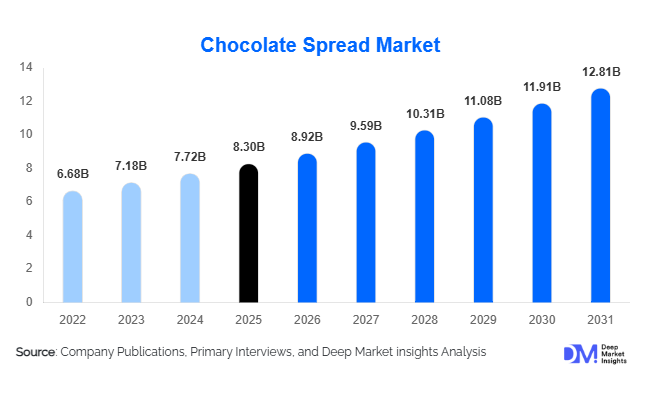
According to Deep Market Insights, the global chocolate spread market size was valued at USD 8.3 billion in 2025 and is projected to grow from USD 8.92 billion in 2026 to reach USD 12.81 billion by 2031, expanding at a CAGR of 7.5% during the forecast period (2026–2031). The chocolate spread market growth is primarily driven by increasing demand for convenient breakfast products, rising consumption of bakery and confectionery items, and growing consumer preference for indulgent yet premium cocoa-based food products.Chocolate spreads have evolved from traditional breakfast accompaniments into versatile food products widely used across desserts, bakery fillings, snacks, and foodservice applications. The growing popularity of western-style breakfast habits in emerging economies, combined with urbanization and rising disposable income, continues to support global demand. Additionally, manufacturers are increasingly introducing organic, vegan, sugar-free, palm oil-free, and protein-enriched variants to cater to changing dietary preferences and health-conscious consumers.Europe currently dominates the global chocolate spread market due to strong household penetration and high bakery consumption across countries such as Italy, Germany, France, and the United Kingdom. Meanwhile, Asia-Pacific is emerging as the fastest-growing region, driven by expanding retail infrastructure, rising middle-class populations, and increasing demand for packaged convenience foods in China and India. The rapid growth of e-commerce grocery platforms is also reshaping product accessibility and consumer purchasing behavior globally.
Key Market Insights
- Chocolate hazelnut spread dominates the global market, accounting for nearly 42% of total market revenue due to strong brand familiarity and premium consumer preference.
- Premium and clean-label chocolate spreads are gaining traction globally, particularly organic, vegan, sugar-free, and palm oil-free product categories.
- Europe remains the leading regional market, supported by established bakery culture, strong household consumption, and premium chocolate demand.
- Asia-Pacific is the fastest-growing region, driven by urbanization, westernized eating habits, and rising disposable income in China and India.
- Supermarkets and hypermarkets account for the largest distribution share, although online retail channels are witnessing the fastest expansion.
- Foodservice and industrial bakery demand are accelerating, supported by café expansion, dessert innovation, and increasing packaged bakery consumption.
- Technological advancements in cocoa processing and sustainable sourcing are improving product quality, shelf life, and environmental compliance.
Chocolate Spread Market Latest Trends
Premium and Health-Oriented Chocolate Spreads Gaining Momentum
The global chocolate spread market is increasingly shifting toward premium and health-focused product offerings. Consumers are actively seeking products with cleaner ingredient labels, lower sugar content, higher cocoa concentration, and sustainable sourcing certifications. This trend has encouraged manufacturers to launch organic, vegan, palm oil-free, gluten-free, and protein-enriched chocolate spreads that cater to evolving dietary preferences. Premium artisanal spreads featuring exotic ingredients such as almond, coconut, sea salt caramel, and dark cocoa blends are witnessing strong demand among affluent urban consumers.Health-conscious purchasing behavior is particularly prominent in North America and Europe, where consumers are willing to pay premium prices for products perceived as natural and nutritionally superior. Companies are also investing heavily in recyclable packaging, sustainable cocoa sourcing, and reduced artificial additives to align with environmental and wellness trends. Functional chocolate spreads fortified with vitamins, minerals, or protein are emerging as a niche but rapidly growing segment within the market.
Growth of E-Commerce and Digital Food Retailing
The rapid expansion of online grocery platforms and direct-to-consumer food retailing is transforming chocolate spread distribution globally. Consumers increasingly prefer online channels due to convenience, wider product availability, promotional discounts, and subscription-based delivery models. E-commerce platforms allow premium and niche chocolate spread brands to expand their reach beyond traditional retail limitations.Digital marketing, influencer campaigns, and social media-driven product discovery are also significantly influencing consumer purchasing decisions. Younger demographics are increasingly exposed to international brands and innovative flavor combinations through digital platforms. Additionally, online retail has enabled manufacturers to introduce customized packaging formats, limited-edition flavors, and premium gifting products. The growth of quick-commerce grocery delivery services in urban regions is further accelerating impulse purchases and repeat consumption of chocolate spread products.
Chocolate Spread Market Drivers
Rising Demand for Convenient Breakfast and Snacking Products
The increasing preference for ready-to-eat breakfast products is one of the primary drivers fueling the global chocolate spread market. Urban consumers are increasingly seeking convenient meal solutions that require minimal preparation while offering indulgent taste experiences. Chocolate spreads are widely consumed with bread, waffles, pancakes, biscuits, and snack products, making them highly adaptable across multiple eating occasions.The rise of dual-income households, busy lifestyles, and growing on-the-go consumption habits has further strengthened market demand. In emerging economies, westernized breakfast habits are expanding rapidly, particularly among younger populations, contributing significantly to volume growth. Manufacturers are also introducing convenient packaging formats such as squeeze bottles, sachets, and portable single-serve packs to improve accessibility and drive impulse purchases.
Expansion of Bakery and Confectionery Industries
The rapid expansion of global bakery and confectionery industries is significantly boosting demand for chocolate spreads. Bakery manufacturers widely use chocolate spreads as fillings, toppings, coatings, and flavor enhancers in pastries, donuts, cakes, croissants, cookies, and desserts. Increasing café culture and rising premium dessert consumption are further accelerating industrial demand for cocoa-based spread products.
Foodservice operators and quick-service restaurants are increasingly integrating chocolate spread-based menu items into beverages, desserts, pancakes, waffles, and milkshakes to improve menu differentiation. Industrial bakery manufacturers are also utilizing customized chocolate spread formulations for packaged snacks and frozen dessert applications, supporting large-scale commercial demand growth globally.
Chocolate Spread Market Restraints
Volatility in Cocoa and Hazelnut Prices
Fluctuations in cocoa and hazelnut prices remain a major challenge for chocolate spread manufacturers. Cocoa production is heavily concentrated in West African countries, making supply vulnerable to climate disruptions, crop diseases, geopolitical instability, and changing agricultural conditions. Similarly, hazelnut supply volatility can significantly impact production costs, especially for premium chocolate hazelnut spreads.Rising raw material costs directly affect manufacturer profit margins and pricing strategies. Smaller regional manufacturers often face greater challenges in managing supply chain disruptions and long-term procurement contracts compared to multinational food companies with vertically integrated sourcing operations.
Health Concerns Regarding Sugar and Fat Content
Growing consumer awareness regarding obesity, diabetes, and cardiovascular diseases is creating challenges for conventional chocolate spread products containing high sugar and fat levels. Regulatory pressure regarding sugar reduction, nutritional labeling, and ingredient transparency is increasing globally, particularly in Europe and North America.Consumers are increasingly shifting toward healthier breakfast alternatives such as nut butter, fruit-based spreads, protein-rich products, and low-calorie snacks. Manufacturers are therefore required to invest in reformulation strategies, clean-label ingredients, and reduced-sugar alternatives, which may increase operational and R&D costs. Balancing indulgence, affordability, and nutritional value remains a key challenge for the chocolate spread industry.
Chocolate Spread Industry Key Opportunities
Growth of Plant-Based and Functional Chocolate Spreads
The increasing popularity of plant-based diets and functional foods presents significant opportunities for chocolate spread manufacturers. Vegan and dairy-free chocolate spreads made using almond milk, oat milk, coconut ingredients, and plant-derived emulsifiers are witnessing rising demand among health-conscious and environmentally aware consumers. Functional spreads enriched with protein, vitamins, minerals, and fiber are also expanding rapidly, particularly within sports nutrition and healthy snacking categories.Consumers are increasingly seeking indulgent products that combine taste with nutritional benefits, encouraging manufacturers to innovate beyond traditional formulations. Protein-enriched chocolate spreads targeting fitness-focused consumers and low-sugar diabetic-friendly variants are expected to create high-margin niche opportunities over the forecast period.
Expansion Across Emerging Markets
Emerging economies in Asia-Pacific, Latin America, and the Middle East present substantial untapped growth opportunities for the chocolate spread market. Rapid urbanization, rising disposable income, expanding modern retail infrastructure, and growing exposure to western food habits are accelerating demand for packaged breakfast and snack products.Countries such as China, India, Indonesia, Vietnam, Brazil, and Saudi Arabia are witnessing increasing penetration of supermarkets, hypermarkets, and online grocery platforms, enabling international and regional brands to strengthen distribution networks. Manufacturers are also introducing affordable packaging formats and localized flavor innovations to target price-sensitive consumers in these developing markets. Increasing demand from bakery chains, cafés, and foodservice operators is expected to further support long-term market expansion.
Report Scope
| Report Metric | Details |
|---|---|
| Market Size in 2025 | USD 8.30 Billion |
| Market Size in 2026 | USD 8.92 Billion |
| Market Size in 2031 | USD 12.81 Billion |
| CAGR | 7.5% (2026-2031) |
| Base Year for Estimation | 2025 |
| Historical Data | 2022-2024 |
| Forecast Period | 2026-2031 |
| Report Coverage | Revenue Forecast, Competitive Landscape, Supply Chain Disruption, Growth Factors, Environment & Regulatory Landscape and Trends |
| Geographies Covered | North America, Europe, APAC, Middle East and Africa, LATAM |
| Countries Covered | U.S., Canada, U.K., Germany, France, Spain, Italy, Russia, Nordic, Benelux, Rest of Europe, China, Korea, Japan, India, Australia, Singapore, Taiwan, South East Asia, Rest of Asia-Pacific, UAE, Turky, Saudi Arabia, South Africa, Egypt, Nigeria, Rest of MEA, Brazil, Mexico, Argentina, Chile, Colombia, Rest of LATAM |
Explore more data points, trends and opportunities Download Free Sample Report
Product Type Insights
Chocolate hazelnut spread dominates the global chocolate spread market, accounting for nearly 42% of total market share in 2025. Strong brand recognition, premium flavor perception, and widespread breakfast consumption continue to support its leadership globally. Milk chocolate spreads remain highly popular among children and mainstream household consumers due to their sweeter flavor profile and affordability. Dark chocolate spreads are witnessing rapid growth as consumers increasingly seek products with higher cocoa content and perceived health benefits.Organic and vegan chocolate spreads are emerging as premium growth segments, particularly in Europe and North America. Consumers are increasingly prioritizing sustainable sourcing, clean-label ingredients, and dairy-free formulations. Protein-enriched and sugar-free variants are also gaining momentum among fitness-oriented and diabetic consumers. Manufacturers are increasingly diversifying flavor portfolios with caramel, peanut butter, coffee, almond, and coconut-infused chocolate spreads to improve product differentiation and premiumization opportunities.
Application Insights
Breakfast spread applications continue to dominate the market, accounting for nearly 35% of total market demand in 2025. Increasing household consumption of bread, pancakes, waffles, and ready-to-eat breakfast products remains the primary growth driver. Bakery applications represent another major segment, with chocolate spreads widely utilized as fillings, toppings, and flavor enhancers in cakes, croissants, pastries, cookies, and donuts.Dessert and confectionery applications are witnessing strong growth due to increasing café culture and premium dessert consumption globally. Ice cream manufacturers and frozen dessert brands are increasingly incorporating chocolate spread flavors into new product launches. Foodservice applications across quick-service restaurants, cafés, and hotel breakfast services are also expanding rapidly, particularly in urban markets. Snack manufacturers are additionally utilizing chocolate spreads in protein bars, sandwich biscuits, and packaged snack products to improve flavor and consumer appeal.
Distribution Channel Insights
Supermarkets and hypermarkets remain the leading distribution channel in the global chocolate spread market, accounting for approximately 38% of market share in 2025. Large retail chains provide strong shelf visibility, extensive product variety, and promotional opportunities that significantly influence consumer purchasing decisions. Grocery stores and convenience stores continue to support widespread household accessibility, particularly in developing regions.Online retail and direct-to-consumer channels are emerging as the fastest-growing distribution segments globally. E-commerce platforms provide access to premium, imported, and niche chocolate spread brands that may not be widely available through traditional retail channels. Subscription-based grocery models, quick-commerce delivery services, and influencer-driven digital marketing campaigns are increasingly shaping online purchasing behavior. Specialty food stores are also gaining importance for premium organic, vegan, and artisanal chocolate spread products targeting affluent urban consumers.
End-Use Industry Insights
Household consumption represents the largest end-use segment within the chocolate spread market, accounting for nearly 48% of global revenue in 2025. Strong retail penetration, rising disposable income, and increasing demand for indulgent breakfast products continue to support household demand globally. Families with children remain major consumers due to the widespread popularity of chocolate-flavored breakfast products.The bakery and confectionery industries represent significant industrial demand contributors, driven by increasing global consumption of packaged desserts, pastries, and premium bakery items. Chocolate spreads are increasingly utilized in large-scale commercial baking operations due to their versatility and flavor enhancement capabilities. Foodservice demand from cafés, restaurants, hotels, and quick-service chains is also expanding rapidly as operators introduce dessert-focused menu innovations and premium beverage offerings featuring chocolate spread-based toppings and fillings.
Explore more data points, trends and opportunities Download Free Sample Report
Chocolate Spread Market Segmentations
By Product Type
- Chocolate Hazelnut Spread
- Pure Chocolate Spread
- Dark Chocolate Spread
- Milk Chocolate Spread
- White Chocolate Spread
- Organic Chocolate Spread
- Sugar-Free Chocolate Spread
- Protein-Enriched Chocolate Spread
- Vegan / Plant-Based Chocolate Spread
- Flavored Chocolate Spread
By Application
- Breakfast Spreads
- Bakery Fillings & Toppings
- Confectionery Applications
- Dessert Preparation
- Ice Cream & Dairy Applications
- Snack Products
- Foodservice Applications
By Distribution Channel
- Supermarkets & Hypermarkets
- Convenience Stores
- Specialty Food Stores
- Online Retail / E-Commerce
- Direct-to-Consumer Channels
- Foodservice Distribution
- Wholesale & Cash & Carry
By Packaging Type
- Glass Jars
- Plastic Jars
- Squeeze Bottles
- Sachets / Single-Serve Packs
- Tubs
- Pouches
By End Use
- Household / Residential
- Bakery Industry
- Confectionery Industry
- Foodservice Industry
- Dairy & Frozen Dessert Industry
- Hotels & Restaurants
- Industrial Food Manufacturing
Product Type Insights
Chocolate hazelnut spread dominates the global chocolate spread market, accounting for nearly 42% of total m
Regional Insights
Europe
Europe dominates the global chocolate spread market, accounting for approximately 37% of total market revenue in 2025. Countries such as Italy, Germany, France, and the United Kingdom represent major consumption hubs due to strong breakfast culture, high bakery product consumption, and established premium chocolate traditions. Italy remains one of the most important markets globally due to strong household penetration and the presence of leading chocolate spread manufacturers.Consumers across Western Europe increasingly prefer organic, sustainable, and premium chocolate spread variants. Demand for clean-label and palm oil-free products is particularly strong within Germany and France. Well-developed retail infrastructure and high disposable income continue to support premium product adoption across the region.
Asia-Pacific
Asia-Pacific accounted for nearly 29% of the global market share in 2025 and is projected to be the fastest-growing regional market during the forecast period. China and India are major growth engines due to rapid urbanization, westernization of food habits, and increasing packaged food consumption. Rising middle-class populations and expanding supermarket networks are significantly improving product accessibility across urban and semi-urban markets.Japan and South Korea continue to contribute strongly through premium confectionery and café-oriented demand. E-commerce grocery platforms and quick-commerce delivery services are playing a major role in accelerating market penetration across Asia-Pacific. Manufacturers are increasingly launching affordable packaging formats and localized flavors to strengthen regional adoption.
North America
North America accounted for nearly 23% of the global market in 2025, led primarily by the United States and Canada. The region is characterized by strong demand for premium, organic, vegan, and protein-enriched chocolate spreads. Health-conscious consumers increasingly prefer low-sugar and clean-label formulations, encouraging continuous product innovation.The growing popularity of café culture, dessert chains, and gourmet bakery products continues to support industrial demand for chocolate spreads across North America. Online retail penetration and subscription-based grocery services are additionally strengthening product accessibility and repeat purchases.
Latin America
Latin America is witnessing moderate but steady growth in chocolate spread consumption, primarily driven by Brazil and Mexico. Rising middle-class income levels, increasing urbanization, and expanding retail infrastructure are supporting packaged food demand across the region. Local manufacturers are introducing economy and mid-range products in smaller packaging formats to improve affordability among price-sensitive consumers.Bakery and dessert applications are gradually expanding within Latin America as café culture and western-style snacking trends continue to gain popularity among younger demographics.
Middle East & Africa
The Middle East & Africa region is gradually emerging as a promising market for chocolate spread products. Countries such as the UAE, Saudi Arabia, and South Africa are witnessing rising demand for premium imported spreads due to increasing disposable income and expanding modern retail channels. Tourism growth and hotel industry expansion are further supporting foodservice demand across the region.Urban consumers increasingly prefer premium European chocolate spread brands, while regional manufacturers are focusing on affordable product ranges to expand mass-market penetration. Growing café culture and bakery industry development are also contributing to regional demand growth.
arket share in 2025. Strong brand recognition, premium flavor perception, and widespread breakfast consumption continue to support its leadership globally. Milk chocolate spreads remain highly popular among children and mainstream household consumers due to their sweeter flavor profile and affordability. Dark chocolate spreads are witnessing rapid growth as consumers increasingly seek products with higher cocoa content and perceived health benefits.Organic and vegan chocolate spreads are emerging as premium growth segments, particularly in Europe and North America. Consumers are increasingly prioritizing sustainable sourcing, clean-label ingredients, and dairy-free formulations. Protein-enriched and sugar-free variants are also gaining momentum among fitness-oriented and diabetic consumers. Manufacturers are increasingly diversifying flavor portfolios with caramel, peanut butter, coffee, almond, and coconut-infused chocolate spreads to improve product differentiation and premiumization opportunities.
Application Insights
Breakfast spread applications continue to dominate the market, accounting for nearly 35% of total market demand in 2025. Increasing household consumption of bread, pancakes, waffles, and ready-to-eat breakfast products remains the primary growth driver. Bakery applications represent another major segment, with chocolate spreads widely utilized as fillings, toppings, and flavor enhancers in cakes, croissants, pastries, cookies, and donuts.Dessert and confectionery applications are witnessing strong growth due to increasing café culture and premium dessert consumption globally. Ice cream manufacturers and frozen dessert brands are increasingly incorporating chocolate spread flavors into new product launches. Foodservice applications across quick-service restaurants, cafés, and hotel breakfast services are also expanding rapidly, particularly in urban markets. Snack manufacturers are additionally utilizing chocolate spreads in protein bars, sandwich biscuits, and packaged snack products to improve flavor and consumer appeal.
Distribution Channel Insights
Supermarkets and hypermarkets remain the leading distribution channel in the global chocolate spread market, accounting for approximately 38% of market share in 2025. Large retail chains provide strong shelf visibility, extensive product variety, and promotional opportunities that significantly influence consumer purchasing decisions. Grocery stores and convenience stores continue to support widespread household accessibility, particularly in developing regions.Online retail and direct-to-consumer channels are emerging as the fastest-growing distribution segments globally. E-commerce platforms provide access to premium, imported, and niche chocolate spread brands that may not be widely available through traditional retail channels. Subscription-based grocery models, quick-commerce delivery services, and influencer-driven digital marketing campaigns are increasingly shaping online purchasing behavior. Specialty food stores are also gaining importance for premium organic, vegan, and artisanal chocolate spread products targeting affluent urban consumers.
End-Use Industry Insights
Household consumption represents the largest end-use segment within the chocolate spread market, accounting for nearly 48% of global revenue in 2025. Strong retail penetration, rising disposable income, and increasing demand for indulgent breakfast products continue to support household demand globally. Families with children remain major consumers due to the widespread popularity of chocolate-flavored breakfast products.The bakery and confectionery industries represent significant industrial demand contributors, driven by increasing global consumption of packaged desserts, pastries, and premium bakery items. Chocolate spreads are increasingly utilized in large-scale commercial baking operations due to their versatility and flavor enhancement capabilities. Foodservice demand from cafés, restaurants, hotels, and quick-service chains is also expanding rapidly as operators introduce dessert-focused menu innovations and premium beverage offerings featuring chocolate spread-based toppings and fillings.
Key Players in the Chocolate Spread Market
- Ferrero Group
- The Hershey Company
- Mondelēz International
- Nestlé S.A.
- Unilever PLC
- Andros Group
- Dr. Oetker
- Hero Group
- Barry Callebaut
- Olam Food Ingredients
- Rigoni di Asiago
- Algood Food Company
- Belcolade
- Nature’s Store
- Dabur India Ltd.