Chicken Sausage Market Size
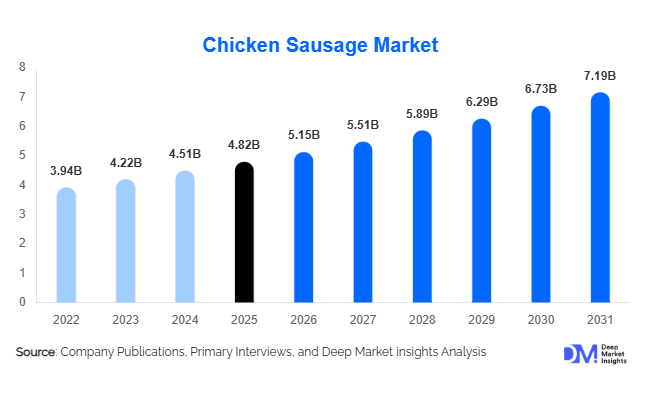
According to Deep Market Insights, the global chicken sausage market size was valued at USD 4.82 billion in 2025 and is projected to grow from USD 5.15 billion in 2026 to reach USD 7.19 billion by 2031, expanding at a CAGR of 6.9% during the forecast period (2026–2031). The chicken sausage market growth is primarily driven by increasing consumer preference for lean protein alternatives, rising health consciousness, growing demand for convenient ready-to-cook and ready-to-eat meat products, and continuous innovation in clean-label and premium poultry-based processed foods. As consumers increasingly shift away from traditional pork and beef sausages due to health and dietary concerns, chicken sausage has emerged as a preferred option across both retail and foodservice channels. Expanding cold-chain infrastructure, growing penetration of organized retail, and increasing demand for high-protein convenience foods are further supporting market expansion globally.
Key Market Insights
- Pre-cooked chicken sausage dominates the global market, accounting for approximately 42% of total market revenue due to convenience-driven consumption patterns.
- Foodservice remains the largest end-use sector, representing nearly 55% of global demand as restaurants increasingly incorporate chicken sausage into breakfast menus, sandwiches, pizzas, and ready meals.
- North America dominates the global market, accounting for approximately 38% of total revenue, supported by strong processed meat consumption and advanced retail infrastructure.
- Asia-Pacific is the fastest-growing regional market, expected to expand at over 8% CAGR through 2031, driven by rising urbanization and protein consumption.
- Clean-label, organic, and antibiotic-free products are gaining significant traction, particularly among premium consumers in North America and Europe.
- Automation and advanced packaging technologies are improving production efficiency, product shelf life, and food safety standards across the industry.
Chicken Sausage Market Latest Trends
Growing Demand for Clean-Label and Premium Poultry Products
Consumer purchasing behavior is increasingly shifting toward clean-label meat products that offer transparency, natural ingredients, and minimal processing. Manufacturers are responding by introducing chicken sausages free from artificial preservatives, nitrates, and synthetic additives while promoting antibiotic-free and organic sourcing practices. Premium product categories featuring gourmet flavors, free-range poultry, and sustainable production methods are witnessing stronger growth compared to conventional offerings. Retailers are expanding shelf space for health-focused processed meat products as consumers seek protein-rich alternatives that align with wellness-focused lifestyles. This trend is particularly prominent in North America, Western Europe, Japan, and Australia, where consumers demonstrate a higher willingness to pay premium prices for perceived health and quality benefits.
Expansion of Ready-to-Eat and Convenience-Oriented Products
The rapid growth of convenience foods continues to reshape the chicken sausage industry. Busy lifestyles, dual-income households, and increasing urbanization are driving demand for pre-cooked, ready-to-eat, and microwaveable sausage products. Manufacturers are investing in advanced packaging solutions such as vacuum-sealed and modified atmosphere packaging to improve shelf life and maintain product freshness. Foodservice operators are also incorporating chicken sausage into meal kits, breakfast sandwiches, frozen meals, and protein-based snacks. Digital grocery platforms and direct-to-consumer channels are accelerating accessibility, enabling consumers to purchase a wider variety of chicken sausage products through online retail networks.
Chicken Sausage Market Drivers
Rising Consumer Preference for Lean Protein Sources
Health-conscious consumers are increasingly reducing consumption of red meat products due to concerns regarding obesity, cardiovascular disease, cholesterol levels, and overall wellness. Chicken sausage provides a favorable nutritional profile with lower fat content, fewer calories, and higher protein density compared to many traditional sausage products. This shift toward healthier protein alternatives has significantly expanded the consumer base across developed and emerging markets. Growing participation in fitness, sports nutrition, and weight-management programs is further supporting demand for high-protein poultry products globally.
Growth of the Global Convenience Food Industry
The expanding convenience food industry continues to be a major growth catalyst for the chicken sausage market. Consumers increasingly seek meal solutions that minimize preparation time without compromising nutrition or taste. Chicken sausage serves as a versatile ingredient in frozen meals, breakfast products, snack foods, and ready-to-eat meal offerings. Growth in meal-kit subscriptions, convenience retail formats, and online grocery channels has further strengthened market demand. Foodservice establishments also benefit from reduced preparation complexity and operational efficiency when using pre-cooked chicken sausage products.
Chicken Sausage Market Restraints
Volatility in Poultry and Feed Prices
Chicken sausage manufacturers remain highly exposed to fluctuations in poultry production costs. Prices of corn, soybean meal, and other feed ingredients directly influence poultry farming economics, creating uncertainty throughout the value chain. Weather-related disruptions, geopolitical instability, and supply chain constraints can increase raw material costs, compressing manufacturer profit margins and potentially impacting product affordability.
Stringent Food Safety and Labeling Regulations
The processed meat industry operates under increasingly rigorous food safety, traceability, and labeling requirements. Manufacturers must comply with varying regulations across different countries regarding preservatives, sodium levels, nutritional claims, allergen declarations, and packaging standards. Compliance costs can be substantial, particularly for smaller manufacturers seeking international expansion. Regulatory scrutiny surrounding processed meat products may also require ongoing product reformulation and investment in quality assurance systems.
Chicken Sausage Industry Key Opportunities
Expansion into Emerging Protein Consumption Markets
Emerging economies such as India, Indonesia, Vietnam, Philippines, Mexico, and Brazil are witnessing rapid growth in protein consumption due to urbanization, rising disposable incomes, and changing dietary habits. Chicken remains one of the most affordable and culturally accepted protein sources in many of these markets, creating favorable conditions for chicken sausage adoption. Localized flavor development, strategic partnerships with retailers, and investments in regional manufacturing facilities present substantial growth opportunities for both global and domestic producers.
Integration with Foodservice and Ready Meal Categories
The growing popularity of quick-service restaurants, cloud kitchens, institutional catering, and frozen meal manufacturers creates significant opportunities for chicken sausage suppliers. Foodservice operators increasingly utilize chicken sausage due to its versatility, consistency, and consumer appeal. Strategic collaborations with restaurant chains and meal manufacturers can create long-term revenue streams while supporting product innovation. Growth in breakfast consumption, protein snacks, and convenience-oriented dining formats is expected to further strengthen demand across foodservice channels.
Report Scope
| Report Metric | Details |
|---|---|
| Market Size in 2025 | USD 4.82 Billion |
| Market Size in 2026 | USD 5.15 Billion |
| Market Size in 2031 | USD 7.19 Billion |
| CAGR | 6.9% (2026-2031) |
| Base Year for Estimation | 2025 |
| Historical Data | 2022-2024 |
| Forecast Period | 2026-2031 |
| Report Coverage | Revenue Forecast, Competitive Landscape, Supply Chain Disruption, Growth Factors, Environment & Regulatory Landscape and Trends |
| Geographies Covered | North America, Europe, APAC, Middle East and Africa, LATAM |
| Countries Covered | U.S., Canada, U.K., Germany, France, Spain, Italy, Russia, Nordic, Benelux, Rest of Europe, China, Korea, Japan, India, Australia, Singapore, Taiwan, South East Asia, Rest of Asia-Pacific, UAE, Turky, Saudi Arabia, South Africa, Egypt, Nigeria, Rest of MEA, Brazil, Mexico, Argentina, Chile, Colombia, Rest of LATAM |
Explore more data points, trends and opportunities Download Free Sample Report
Product Type Insights
Pre-cooked chicken sausage represents the largest product segment, accounting for approximately 42% of global market revenue. Consumers increasingly favor ready-to-eat and ready-to-heat products that offer convenience and consistent quality. Smoked chicken sausage remains popular due to its flavor profile and broad foodservice applications, while frozen chicken sausage continues gaining traction in retail and export markets due to extended shelf life. Fresh chicken sausage maintains strong demand in developed markets where consumers prefer minimally processed products. Ready-to-eat variants are emerging as one of the fastest-growing categories, supported by convenience-driven consumption patterns and expanding retail availability.
Flavor Profile Insights
Original or plain chicken sausage remains the leading flavor segment, accounting for approximately 35% of total market demand due to its versatility across household and foodservice applications. Herb and garlic variants continue gaining popularity among consumers seeking premium flavor experiences, while spicy and ethnic-inspired products are witnessing rapid growth in Asia-Pacific and Latin American markets. Cheese-infused and gourmet flavors are expanding within premium retail channels, enabling manufacturers to capture higher-margin opportunities. Regional flavor customization has become an important competitive strategy as companies seek to address evolving consumer preferences across different geographic markets.
Distribution Channel Insights
Supermarkets and hypermarkets dominate distribution, accounting for nearly 48% of global sales. Their extensive cold-chain infrastructure, broad product assortment, and high consumer traffic make them the preferred retail channel for chicken sausage manufacturers. Convenience stores continue benefiting from increasing demand for on-the-go food solutions, while specialty meat retailers maintain strong positioning within premium product categories. Online retail and direct-to-consumer channels represent the fastest-growing distribution segment as digital grocery adoption accelerates globally. Subscription-based food delivery platforms and meal-kit providers are also contributing to increased product visibility and consumer engagement.
End-Use Insights
Foodservice represents the largest end-use segment, accounting for approximately 55% of global chicken sausage demand. Quick-service restaurants, casual dining establishments, hotels, and institutional catering operators increasingly utilize chicken sausage across breakfast, lunch, and dinner menus. Household consumption remains a major contributor, supported by growing home cooking trends and demand for protein-rich convenience foods. The food processing industry is emerging as the fastest-growing end-use segment, driven by increasing incorporation of chicken sausage into frozen meals, ready meals, snack foods, and pizza toppings. Growth in meal-kit services and convenience food manufacturing is expected to further strengthen industrial demand.
Explore more data points, trends and opportunities Download Free Sample Report
Chicken Sausage Market Segmentations
By Product Type
- Fresh Chicken Sausage
- Pre-Cooked Chicken Sausage
- Smoked Chicken Sausage
- Cured Chicken Sausage
- Frozen Chicken Sausage
- Ready-to-Eat Chicken Sausage
By Flavor Profile
- Plain/Original
- Herb & Garlic
- Spicy/Hot
- Cheese-Infused
- Fruit-Infused
- Regional/Ethnic Flavors
By Fat Content
- Regular Fat
- Reduced Fat
- Low Fat
- Extra Lean
By Ingredient Positioning
- Conventional
- Organic
- Antibiotic-Free
- Clean Label/Natural
- High-Protein Fortified
By Form
- Links
- Patties
- Slices
- Crumbles
- Nuggets/Bites
Regional Insights
North America
North America accounts for approximately 38% of the global chicken sausage market and remains the largest regional consumer. The United States alone contributes nearly 29% of global revenues, supported by strong demand for processed meat products, high consumer awareness regarding protein nutrition, and extensive foodservice adoption. Canada continues experiencing growth in premium, organic, and clean-label chicken sausage categories. The region benefits from advanced poultry production infrastructure, established cold-chain networks, and significant investment in food processing technologies.
Europe
Europe represents approximately 27% of global market demand, with Germany, the United Kingdom, France, Italy, Spain, and Poland serving as key consumption centers. Germany remains the largest European market due to its long-standing sausage consumption culture. Consumer preference for clean-label, organic, and sustainably sourced meat products continues driving premium segment growth throughout Western Europe. Increasing regulatory focus on food quality and transparency is encouraging product innovation and reformulation among leading manufacturers.
Asia-Pacific
Asia-Pacific accounts for approximately 24% of global demand and represents the fastest-growing regional market, with expected growth exceeding 8% annually through 2031. China, India, Japan, South Korea, Indonesia, Thailand, and Australia are major contributors to regional demand. Rising disposable incomes, rapid urbanization, and increasing consumption of convenience foods are accelerating market expansion. India is expected to emerge as one of the fastest-growing country markets globally, supported by expanding modern retail infrastructure and rising poultry consumption.
Latin America
Latin America contributes approximately 7% of global market revenue, with Brazil and Mexico leading regional consumption. Brazil benefits from its position as one of the world's largest poultry producers and exporters, while increasing urbanization and processed food consumption support domestic demand growth. Manufacturers continue investing in value-added poultry processing capabilities to capture expanding consumer interest in convenience-oriented food products.
Middle East & Africa
The Middle East & Africa region accounts for approximately 4% of global demand, led by Saudi Arabia, the United Arab Emirates, South Africa, Egypt, and Qatar. Growing preference for halal-certified poultry products, rising tourism activity, and expansion of modern retail channels are supporting market growth. Increasing investments in food security and domestic poultry production across Gulf Cooperation Council countries are expected to strengthen long-term demand prospects.
Key Players in the Chicken Sausage Market
- Tyson Foods
- Johnsonville
- Hormel Foods
- Smithfield Foods
- BRF S.A.
- JBS S.A.
- Maple Leaf Foods
- Applegate Farms
- Aidells Sausage Company
- Hillshire Farm
- V.H. Group
- Al Fresco All Natural
- Shuanghui Development
- Suguna Foods
- Venky's