Chicken Gizzards Market Size
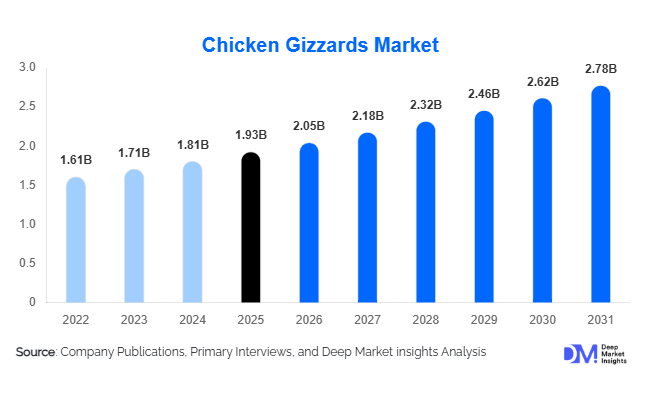
According to Deep Market Insights, the global chicken gizzards market size was valued at USD 1.93 billion in 2025 and is projected to grow from USD 2.05 billion in 2026 to reach USD 2.78 billion by 2031, expanding at a CAGR of 6.3% during the forecast period (2026–2031). The chicken gizzards market growth is primarily driven by rising global poultry production, increasing demand for affordable protein sources, expanding utilization of poultry by-products, and growing consumption of organ meats across Asia-Pacific, Africa, Latin America, and the Middle East. Increasing export trade of poultry offal, advancements in cold-chain infrastructure, and the emergence of value-added frozen and ready-to-cook gizzard products are further supporting market expansion worldwide.
Key Market Insights
- Frozen chicken gizzards account for the largest market share, representing nearly 65% of global revenue due to their longer shelf life and suitability for international trade.
- Foodservice and HoReCa channels dominate demand, contributing approximately 53% of global market value through restaurants, catering services, and institutional kitchens.
- Asia-Pacific leads the global market, accounting for approximately 45% of worldwide demand, driven by strong organ meat consumption in China, India, Thailand, Vietnam, and Indonesia.
- India is emerging as the fastest-growing country market, supported by rising poultry production, urbanization, and growing protein consumption.
- Pet food manufacturers are becoming important buyers, utilizing chicken gizzards as high-protein ingredients in premium pet nutrition products.
- Export-oriented poultry processors are investing heavily in automation and cold-chain infrastructure to maximize by-product utilization and improve profitability.
Chicken Gizzards Market Latest Trends
Growing Adoption of Value-Added and Ready-to-Cook Products
The chicken gizzards market is increasingly shifting from bulk raw product sales toward value-added offerings. Processors are introducing marinated, pre-seasoned, cooked, and ready-to-cook chicken gizzard products to meet evolving consumer preferences for convenience. Urban consumers are seeking easy-to-prepare protein options, encouraging retailers and food manufacturers to expand their frozen and refrigerated poultry by-product portfolios. Individually Quick Frozen (IQF) technology is becoming particularly important, enabling improved product quality, shelf life, and export capabilities. This trend is allowing processors to achieve higher margins while expanding customer reach beyond traditional organ meat consumers.
Expansion of Export-Oriented Poultry Offal Trade
International trade of chicken gizzards continues to grow as major poultry-producing countries seek to maximize carcass utilization. Brazil, the United States, Thailand, and China are expanding exports to demand centers in Africa, Southeast Asia, and the Middle East. Improved logistics networks, cold storage facilities, and halal-certified processing capabilities are facilitating larger export volumes. Many importing countries view chicken gizzards as an affordable protein source that supports food security objectives. As global poultry production rises, exporters are increasingly treating edible offal as a strategic revenue stream rather than a secondary by-product category.
Chicken Gizzards Market Drivers
Rising Global Poultry Production
Global poultry production continues to expand due to growing protein consumption, population growth, and the affordability of chicken compared with red meat. As poultry slaughter volumes increase, the availability of edible by-products such as gizzards also rises. Integrated poultry processors are actively investing in by-product recovery systems, advanced processing technologies, and export infrastructure to improve utilization rates and generate additional revenue streams. Countries including Brazil, China, India, Thailand, and the United States are leading capacity expansions, directly supporting long-term growth of the chicken gizzards market.
Increasing Demand for Affordable Protein Sources
Chicken gizzards offer a cost-effective source of protein, iron, zinc, and essential nutrients. Rising food inflation in many economies has encouraged consumers to seek lower-cost protein alternatives, increasing demand for poultry organ meats. This trend is particularly evident in emerging economies where affordability remains a major purchasing consideration. The growing acceptance of nutrient-dense organ meats among health-conscious consumers is also supporting broader market adoption across both retail and foodservice channels.
Growing Popularity of Ethnic and Traditional Cuisine
Chicken gizzards remain an integral ingredient in numerous traditional dishes across Asia, Africa, Latin America, and parts of North America. Increasing globalization and migration have expanded the availability of ethnic cuisines worldwide, driving greater demand through restaurants and foodservice establishments. Popular dishes featuring chicken gizzards are increasingly appearing in mainstream restaurant menus, helping expand consumer familiarity and supporting sustained market growth.
Chicken Gizzards Market Restraints
Regulatory and Trade Compliance Challenges
International trade of poultry by-products remains subject to stringent sanitary regulations, veterinary inspections, import licensing requirements, and country-specific certification standards. Exporters must comply with varying food safety regulations across different markets, increasing operational complexity and costs. Sudden trade restrictions, disease outbreaks, and changing import policies can disrupt established supply chains and create uncertainty for market participants.
Consumer Perception and Cultural Barriers
Despite widespread acceptance in many regions, organ meats continue to face perception challenges in certain developed markets. Some consumers associate poultry by-products with lower-value food products, limiting broader adoption. Overcoming these barriers requires targeted marketing initiatives, nutritional education campaigns, and product innovation that emphasizes convenience, sustainability, and premium quality. Addressing these perceptions remains critical for market expansion in higher-income economies.
Chicken Gizzards Industry Key Opportunities
Premium Pet Food Ingredient Demand
The premium pet food industry is creating significant opportunities for chicken gizzard suppliers. Pet owners increasingly prefer natural, minimally processed protein ingredients with high nutritional value. Chicken gizzards offer excellent protein content, essential minerals, and strong palatability characteristics, making them attractive ingredients for premium pet nutrition products. As global pet ownership and premium pet food spending continue to rise, processors are expected to benefit from growing demand beyond traditional human consumption channels.
Expansion of Halal-Certified Export Markets
Demand for halal-certified poultry products continues to increase across the Middle East, North Africa, and Southeast Asia. Poultry processors investing in halal-compliant production facilities and certification programs can access high-growth export markets with strong long-term demand fundamentals. Governments in several importing countries are prioritizing food security initiatives, creating favorable conditions for expanded poultry offal imports. This opportunity is expected to support sustained export growth through the forecast period.
Report Scope
| Report Metric | Details |
|---|---|
| Market Size in 2025 | USD 1.93 Billion |
| Market Size in 2026 | USD 2.05 Billion |
| Market Size in 2031 | USD 2.78 Billion |
| CAGR | 6.3% (2026-2031) |
| Base Year for Estimation | 2025 |
| Historical Data | 2022-2024 |
| Forecast Period | 2026-2031 |
| Report Coverage | Revenue Forecast, Competitive Landscape, Supply Chain Disruption, Growth Factors, Environment & Regulatory Landscape and Trends |
| Geographies Covered | North America, Europe, APAC, Middle East and Africa, LATAM |
| Countries Covered | U.S., Canada, U.K., Germany, France, Spain, Italy, Russia, Nordic, Benelux, Rest of Europe, China, Korea, Japan, India, Australia, Singapore, Taiwan, South East Asia, Rest of Asia-Pacific, UAE, Turky, Saudi Arabia, South Africa, Egypt, Nigeria, Rest of MEA, Brazil, Mexico, Argentina, Chile, Colombia, Rest of LATAM |
Explore more data points, trends and opportunities Download Free Sample Report
Product Form Insights
Frozen chicken gizzards continue to dominate the global market, contributing approximately 65% of total revenue in 2025. This leadership is primarily driven by the expansion of integrated cold chain logistics, improved freezing technologies, and the growing scale of international poultry trade. Frozen formats offer extended shelf life, reduced spoilage risk, and standardized quality, making them the preferred choice for exporters and large-scale foodservice distributors. The strong dominance of frozen products is further reinforced by rising cross-border demand from Asia-Pacific, the Middle East, and Africa, where reliable refrigeration infrastructure is increasingly supporting imports.Fresh and chilled chicken gizzards maintain stable demand in domestic and proximity markets, where efficient last-mile distribution systems and rapid consumption cycles support product viability. Individually Quick Frozen (IQF) formats are gaining strong traction as they enable portion control, reduced waste, and improved operational efficiency for retailers and foodservice operators. The fastest-growing segment remains processed, marinated, and ready-to-eat gizzard products, driven by accelerating urban lifestyles, rising disposable incomes, and the global shift toward convenience-oriented protein consumption. This trend is further supported by food manufacturers expanding value-added product portfolios to capture evolving consumer preferences.
Application Insights
Human consumption remains the dominant application segment, accounting for approximately 72% of global market value, primarily driven by long-standing culinary traditions and increasing acceptance of organ meats in global cuisine. The leadership of this segment is reinforced by expanding restaurant culture, street food consumption, and the rising affordability of poultry-based proteins compared to red meat alternatives. Growing multicultural food influence in developed markets is also contributing to broader acceptance and higher menu penetration of chicken gizzards.Processed meat products and ready-to-cook meal applications are witnessing strong expansion as food manufacturers prioritize cost-efficient protein sources that can be integrated into frozen meals and packaged foods. The fastest-growing application is pet food, supported by the premiumization of companion animal nutrition and increasing awareness of organ meats as nutrient-dense ingredients. Animal feed applications continue to provide a structurally important outlet for lower-grade by-products, supported by circular economy practices and the poultry industry's focus on full carcass utilization and waste minimization.
Distribution Channel Insights
Foodservice and HoReCa channels dominate global distribution, accounting for approximately 53% of total revenue, driven by large-volume procurement from restaurants, catering services, institutional kitchens, and quick-service chains. The leadership of this channel is supported by the continuous expansion of global dining-out culture, tourism recovery, and the proliferation of affordable protein-based menu offerings. Bulk purchasing efficiency and consistent demand cycles further strengthen HoReCa's position as the primary consumption gateway for chicken gizzards.Retail channels are expanding steadily as household consumption of organ meats rises, supported by improved cold storage availability and increased consumer willingness to experiment with traditional and ethnic protein cuts. Online meat retail platforms are gaining momentum, particularly in urban centers, driven by convenience demand and rapid digital grocery adoption. Wholesale distributors remain critical to market structure, acting as key intermediaries that connect exporters, processors, and fragmented downstream buyers across both domestic and international markets.
End User Insights
Restaurants and foodservice operators represent the largest end-user segment, accounting for approximately 45% of global demand, with growth strongly driven by the expansion of ethnic cuisine, street food culture, and cost-sensitive menu engineering strategies. The leadership of this segment is underpinned by the economic advantage of chicken gizzards as a high-protein, low-cost ingredient that allows operators to maintain margin efficiency while meeting consumer demand for flavorful dishes.Household consumption continues to expand, particularly in Asia-Pacific, Africa, and Latin America, where cultural familiarity and affordability sustain strong demand. Food processing companies are increasingly incorporating chicken gizzards into frozen and packaged food formulations to diversify product portfolios and optimize raw material utilization. The fastest-growing end-user category is pet food manufacturers, driven by the premiumization of pet nutrition, rising pet ownership, and growing demand for natural, organ-based protein ingredients in high-value formulations.
Packaging Type Insights
Bulk industrial packaging remains the leading packaging format, accounting for approximately 42% of global demand, primarily driven by large-scale procurement from foodservice operators, wholesalers, and export-oriented processors. The dominance of this format is supported by its cost efficiency, ease of handling in high-volume logistics chains, and compatibility with industrial freezing and storage systems.Vacuum packaging is experiencing steady growth due to its ability to extend shelf life, preserve texture, and reduce oxidation-related quality loss, making it increasingly attractive for both retail and foodservice applications. Modified Atmosphere Packaging (MAP) is gaining traction in premium retail segments, supported by rising demand for visually appealing, longer-lasting packaged meat products. Frozen retail packs are also expanding rapidly, driven by the growth of modern retail infrastructure and increasing consumer preference for longer storage life and reduced purchase frequency.
Explore more data points, trends and opportunities Download Free Sample Report
Chicken Gizzards Market Segmentations
By Product Form
- Fresh Chicken Gizzards
- Chilled Chicken Gizzards
- Frozen Chicken Gizzards
- Individually Quick Frozen (IQF) Chicken Gizzards
- Processed/Marinated Chicken Gizzards
- Cooked & Ready-to-Eat Chicken Gizzards
By Processing Type
- Raw Whole Gizzards
- Cleaned & Trimmed Gizzards
- Sliced/Cut Gizzards
- Seasoned/Value-Added Gizzards
- Fully Cooked Gizzards
By Application
- Human Consumption
- Processed Meat Products
- Ready-to-Cook Meals
- Ready-to-Eat Meals
- Pet Food Ingredients
- Animal Feed Ingredients
By End User
- Household Consumers
- Restaurants & Foodservice Operators
- Food Processing Companies
- Pet Food Manufacturers
- Animal Feed Processors
- Institutional Buyers
By Distribution Channel
- Foodservice & HoReCa
- Supermarkets & Hypermarkets
- Traditional Grocery Stores
- Butcher Shops & Meat Specialists
- Convenience Stores
- Online Meat Retail Platforms
- Wholesale/Bulk Distribution
Regional Insights
North America
North America accounts for approximately 13% of global demand, with the United States acting as the primary consumption and export hub. Regional growth is strongly driven by advanced poultry processing infrastructure, high operational efficiency in meat production systems, and strong integration with global export markets. The leadership of the United States is further reinforced by its role as a major supplier of poultry by-products to Asia and Africa, where demand for affordable protein remains high. Growth in the region is also supported by increasing utilization in pet food manufacturing, where premium formulations are driving higher-value consumption of organ meats.Canada and Mexico contribute steady incremental demand through expanding retail penetration and growing foodservice sectors. In particular, the rise of quick-service restaurants and value-oriented protein offerings continues to strengthen regional consumption. Additionally, increasing demand for sustainable protein utilization and full-carcass processing efficiency is supporting long-term market expansion across North America.
Europe
Europe represents approximately 18% of global market value, with demand concentrated in Poland, Germany, France, Spain, and the Netherlands. Regional growth is driven by well-established poultry processing industries, strong export-oriented production systems, and increasing emphasis on food sustainability and circular economy principles. The leadership of Poland as a major poultry producer strengthens regional supply capabilities and enhances export competitiveness across global markets.Rising multicultural populations across Western Europe are contributing to increased consumption of chicken gizzards in ethnic cuisines, while food manufacturers are incorporating organ meats into processed and value-added products to reduce waste and improve cost efficiency. Regulatory focus on sustainable food systems is further encouraging the utilization of edible by-products, supporting steady structural demand growth across the region.
Asia-Pacific
Asia-Pacific dominates the global chicken gizzards market with approximately 45% share, primarily driven by deep-rooted culinary traditions and large-scale population-driven consumption. China leads global demand with nearly 22% share, supported by strong cultural acceptance of organ meats, extensive foodservice penetration, and highly developed domestic poultry supply chains. The leading driver in the region is the combination of cultural dietary preferences and rapid expansion of organized foodservice networks.India represents the fastest-growing market, fueled by rising disposable incomes, rapid urbanization, and increasing protein consumption driven by dietary diversification. Southeast Asian countries including Thailand, Vietnam, Indonesia, and the Philippines continue to experience strong demand growth supported by street food culture and expanding tourism-driven hospitality sectors. The region also serves as the primary global import destination for poultry offal, supported by strong cold chain expansion and growing trade connectivity.
Latin America
Latin America accounts for approximately 14% of global revenue, with Brazil acting as both a leading producer and exporter. Regional growth is primarily driven by strong poultry production capacity, competitive pricing advantages, and well-developed export infrastructure. Brazil’s leadership is reinforced by vertically integrated poultry systems that enable efficient large-scale supply to global markets, particularly in Asia and the Middle East.Domestic demand is also expanding in Argentina, Chile, and Colombia, supported by increasing protein consumption and the steady growth of foodservice establishments. Investment in export-certified processing facilities and improved cold chain logistics continues to enhance the region’s global competitiveness, while growing utilization of poultry by-products is strengthening overall resource efficiency across the industry.
Middle East & Africa
The Middle East and Africa collectively account for approximately 9% of global demand and remain highly import-dependent, with growth strongly driven by population expansion, urbanization, and rising demand for affordable protein sources. Saudi Arabia, the United Arab Emirates, Egypt, Nigeria, and South Africa represent the key consuming markets, supported by expanding retail networks and foodservice development.The leading growth driver in the region is the increasing consumption of halal-certified poultry products, which underpins both import demand and regional trade flows. Nigeria is emerging as one of the fastest-growing markets due to rapid population growth and rising urban food demand, while Gulf Cooperation Council countries are experiencing sustained expansion in hospitality and quick-service restaurant sectors. Improvements in cold chain infrastructure and trade facilitation are further strengthening long-term market accessibility across the region.
Key Players in the Chicken Gizzards Market
- JBS S.A.
- BRF S.A.
- Tyson Foods Inc.
- Charoen Pokphand Foods PCL
- Wens Foodstuff Group
- New Hope Liuhe Co., Ltd.
- Perdue Farms
- Koch Foods
- Industrias Bachoco
- PHW Group
- Plukon Food Group
- Aviagen
- MHP SE
- Almarai
- Japfa Ltd.