Cheesecake Market Size
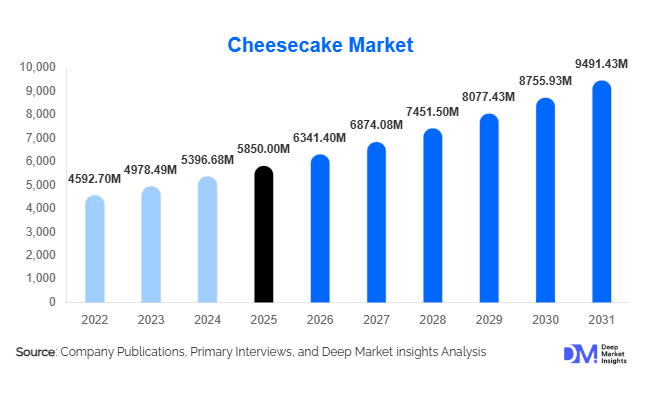
According to Deep Market Insights, the global cheesecake market size was valued at USD 5,400 million in 2025 and is projected to grow from USD 6,341.40 million in 2026 to reach USD 9,491.43 million by 2031, expanding at a CAGR of 8.4% during the forecast period (2026–2031). The cheesecake market growth is primarily driven by increasing demand for premium desserts, the rapid expansion of café culture, and rising consumer preference for indulgent yet convenient ready-to-eat bakery products across both developed and emerging economies.
Key Market Insights
- Premium and artisanal cheesecakes are gaining strong traction, driven by consumer willingness to pay for high-quality ingredients and unique flavor profiles.
- Frozen cheesecake segment is expanding rapidly, supported by improved cold chain logistics and extended shelf life benefits.
- North America dominates the global market due to established dessert consumption patterns and strong foodservice infrastructure.
- Asia-Pacific is the fastest-growing region, fueled by urbanization, westernization of diets, and rising disposable incomes.
- Online retail and food delivery platforms are reshaping distribution, enabling direct-to-consumer sales and customized offerings.
- Health-conscious innovations, including vegan and low-sugar cheesecakes, are emerging as key growth segments.
What are the latest trends in the cheesecake market?
Rising Demand for Plant-Based and Health-Oriented Cheesecakes
Consumers are increasingly shifting toward healthier dessert options, driving demand for vegan, low-fat, and sugar-free cheesecakes. Manufacturers are innovating with plant-based alternatives such as almond milk, cashew cream, and coconut-based fillings to cater to lactose-intolerant and vegan consumers. This trend is particularly prominent in North America and Europe, where clean-label and wellness-focused consumption is gaining momentum. Additionally, gluten-free variants are being introduced to cater to dietary restrictions, further expanding the consumer base.
Expansion of Frozen and Ready-to-Eat Cheesecake Formats
The frozen cheesecake segment is witnessing significant growth due to its logistical advantages and longer shelf life. Foodservice operators and retailers prefer frozen formats for ease of storage and reduced wastage. Technological advancements in freezing techniques are preserving texture and flavor, making frozen cheesecakes comparable to fresh products. Ready-to-eat slices and mini cheesecakes are also gaining popularity, especially among urban consumers seeking convenience and portion control. This trend is further supported by the growth of modern retail and online grocery platforms.
What are the key drivers in the cheesecake market?
Growth of Café Culture and Foodservice Industry
The rapid expansion of cafés, quick-service restaurants, and dessert chains globally is a major driver of cheesecake demand. Cheesecake has become a staple dessert offering in these establishments, contributing significantly to consistent consumption. The increasing number of coffee chains and dessert-focused outlets in urban areas is further accelerating market growth.
Rising Disposable Income and Indulgence Consumption
Increasing disposable incomes, particularly in emerging economies, are enabling consumers to spend more on premium desserts. Cheesecakes, often positioned as indulgent treats, are benefiting from this trend. Urban consumers are increasingly seeking high-quality, ready-to-eat desserts that offer both taste and convenience.
What are the restraints for the global market?
High Calorie Content and Health Concerns
Traditional cheesecakes are perceived as high in calories, sugar, and fat, which limits their consumption among health-conscious consumers. Despite the availability of low-fat and sugar-free variants, this perception continues to act as a barrier to broader adoption.
Logistical Challenges and Shelf-Life Limitations
Fresh cheesecakes have a relatively short shelf life, posing challenges in storage, transportation, and inventory management. While frozen alternatives mitigate these issues, they require robust cold chain infrastructure, which may not be available in all regions, particularly in developing markets.
What are the key opportunities in the cheesecake industry?
Expansion in Emerging Markets
Emerging economies such as India, China, and Brazil present significant growth opportunities due to rising middle-class populations and changing dietary habits. The adoption of western desserts is increasing, particularly among younger consumers, creating a favorable environment for market expansion. Localization of flavors, such as mango and matcha, is helping brands penetrate these markets effectively.
Digital and Direct-to-Consumer Sales Channels
The rise of online food delivery platforms and e-commerce channels is transforming how consumers purchase desserts. Cheesecake brands are leveraging digital platforms to offer customization, subscription-based services, and premium gifting options. This shift is enhancing customer engagement and expanding market reach beyond traditional retail channels.
Report Scope
| Report Metric | Details |
|---|---|
| Market Size in 2025 | USD 5850 Million |
| Market Size in 2026 | USD 6341.40 Million |
| Market Size in 2031 | USD 9491.43 Million |
| CAGR | 8.4% (2026-2031) |
| Base Year for Estimation | 2025 |
| Historical Data | 2022-2024 |
| Forecast Period | 2026-2031 |
| Report Coverage | Revenue Forecast, Competitive Landscape, Supply Chain Disruption, Growth Factors, Environment & Regulatory Landscape and Trends |
| Geographies Covered | North America, Europe, APAC, Middle East and Africa, LATAM |
| Countries Covered | U.S., Canada, U.K., Germany, France, Spain, Italy, Russia, Nordic, Benelux, Rest of Europe, China, Korea, Japan, India, Australia, Singapore, Taiwan, South East Asia, Rest of Asia-Pacific, UAE, Turky, Saudi Arabia, South Africa, Egypt, Nigeria, Rest of MEA, Brazil, Mexico, Argentina, Chile, Colombia, Rest of LATAM |
Explore more data points, trends and opportunities Download Free Sample Report
Product Type Insights
The global cheesecake market demonstrates a diverse product landscape that is increasingly shaped by evolving consumer preferences, indulgence trends, and innovation in bakery manufacturing processes. Among all product categories, baked cheesecakes continue to dominate the market, accounting for approximately 42% of the total market share. This dominance is primarily attributed to their strong association with traditional bakery craftsmanship, rich texture, and authentic taste profile that resonates strongly with consumers across both developed and emerging economies. Baked cheesecakes are widely preferred in foodservice environments such as premium restaurants, cafés, and hotels because they offer a consistent sensory experience, higher perceived quality, and a premium positioning that aligns well with dine-in dessert menus. The leading driver for this segment is the growing global demand for indulgent desserts that provide a “homemade” or artisanal experience, even in commercial foodservice settings. Additionally, the expansion of fine dining culture and Western dessert adoption in emerging markets has significantly reinforced the consumption of baked variants.Frozen cheesecakes represent the fastest-growing product segment, driven by their operational efficiency, longer shelf life, and ease of global distribution. This segment benefits strongly from advancements in cold chain logistics and frozen food retail infrastructure, which have enabled manufacturers to scale production and reach international markets without compromising product integrity. The primary growth driver for frozen cheesecakes is the rising demand for convenience-oriented dessert solutions among both foodservice operators and retail consumers. These products allow restaurants and cafés to reduce preparation time while maintaining menu consistency, making them particularly attractive in high-volume urban dining environments. Furthermore, frozen cheesecakes are increasingly being adopted in e-commerce grocery platforms, where consumers prioritize ready-to-eat desserts with extended usability. Vegan and low-fat cheesecakes, although currently a smaller segment, are rapidly emerging as a strategic category shaped by health consciousness, dietary restrictions, and ethical consumption trends. The leading driver for this segment is the global shift toward plant-based diets and functional foods, particularly in North America and Europe, where consumers are actively seeking desserts that align with wellness-oriented lifestyles without compromising indulgence.
Application Insights
The application landscape of the cheesecake market is broadly segmented into foodservice, household consumption, and institutional usage, each contributing uniquely to market expansion and product innovation. Foodservice applications currently account for the largest share, contributing nearly 55% of the global market, driven by strong demand from restaurants, cafés, hotels, bakeries, and quick-service establishments. Cheesecake has become a staple dessert offering in the global hospitality sector due to its versatility, high consumer acceptance, and ability to command premium pricing. The leading driver for this segment is the continued expansion of the global hospitality and dining-out culture, particularly in urban centers where experiential dining is increasingly valued. The rise of café chains and dessert-focused outlets has further amplified the visibility and consumption of cheesecake varieties, making them a core menu item across multiple service formats.Household consumption is emerging as a rapidly expanding segment, supported by rising disposable incomes, changing lifestyles, and the growing penetration of online food delivery platforms. Consumers are increasingly opting for indulgent desserts at home, facilitated by ready-to-eat and frozen product availability through supermarkets and digital grocery channels. The primary driver for household consumption growth is the increasing normalization of premium dessert consumption outside restaurant settings, coupled with the convenience offered by e-commerce grocery ecosystems. Additionally, urban households are increasingly influenced by social media-driven food trends, which significantly boost demand for visually appealing and premium dessert products like cheesecakes.Institutional applications, including airline catering, corporate events, educational institutions, and large-scale hospitality catering services, represent a niche yet steadily growing segment. The growth driver in this category is the rising standardization of premium food offerings in institutional settings, particularly in airline and luxury travel services where dessert quality plays a role in overall customer experience. The increasing outsourcing of catering services to specialized food manufacturers has also contributed to stable demand for pre-portioned and bulk cheesecake formats that ensure consistency and operational efficiency.
Distribution Channel Insights
Distribution channels play a critical role in shaping accessibility, pricing dynamics, and consumer reach within the cheesecake market. Supermarkets and hypermarkets continue to dominate the distribution landscape, holding approximately 40% of the total market share. Their dominance is driven by strong cold chain infrastructure, extensive product assortment, and high consumer trust in packaged dessert offerings. These retail formats allow consumers to physically evaluate products before purchase, which remains an important factor in dessert buying behavior. The leading driver for this segment is the expansion of organized retail infrastructure, particularly in emerging economies, where modern trade formats are rapidly replacing traditional grocery stores.Online retail is the fastest-growing distribution channel, fueled by the rapid digitalization of grocery shopping, increasing smartphone penetration, and evolving consumer expectations for convenience. E-commerce platforms offer a wide variety of cheesecake options, including premium, artisanal, and international brands, often accompanied by promotional pricing and home delivery services. The key driver for online retail growth is the integration of cold chain logistics with last-mile delivery systems, which ensures product freshness and expands accessibility beyond urban retail hubs. Additionally, subscription-based dessert delivery models and direct-to-consumer bakery brands are further accelerating online penetration.Specialty bakeries continue to maintain a strong presence, particularly in premium and artisanal segments where customization, freshness, and craftsmanship are key value propositions. These outlets are often perceived as providers of high-quality, handcrafted desserts, and they play a crucial role in shaping consumer perception of authenticity. The primary driver for this segment is the growing demand for personalized and premium dessert experiences, particularly in urban centers where consumers are willing to pay higher prices for artisanal quality and customization options.
Form Insights
The cheesecake market is also segmented based on form, which significantly influences consumption patterns, packaging strategies, and retail positioning. Cheesecake slices dominate the market with approximately 38% share, primarily due to their convenience, affordability, and portion control benefits. Slices are widely preferred in both retail and foodservice environments as they allow consumers to enjoy indulgence without committing to full-size portions. The leading driver for this segment is the increasing consumer preference for portion-managed indulgence, particularly among urban populations seeking balance between taste and calorie control.Whole cheesecakes remain a popular choice for celebrations, gatherings, and special occasions, where sharing and presentation are key considerations. This segment is strongly driven by cultural and social dining practices that emphasize group consumption and festive experiences. Mini cheesecakes and bite-sized formats are gaining significant traction, particularly among younger demographics and on-the-go consumers who prefer snackable dessert formats. The growth driver for this category is the increasing demand for convenience-oriented snacking combined with premium dessert experiences. Cheesecake bars are also emerging as a fast-growing retail-friendly format, offering portability, longer shelf stability, and suitability for impulse purchases in convenience stores and cafés.
Explore more data points, trends and opportunities Download Free Sample Report
Cheesecake Market Segmentations
By Product Type
- Baked Cheesecake
- No-Bake Cheesecake
- Frozen Cheesecake
- Vegan Cheesecake
- Low-Fat / Sugar-Free Cheesecake
By Flavor Type
- Plain / Original Cheesecake
- Chocolate Cheesecake
- Fruit-Based Cheesecake
- Specialty / Fusion Flavors
By Form
- Whole Cheesecake
- Cheesecake Slices
- Cheesecake Bites / Mini Cheesecakes
- Cheesecake Bars
By Distribution Channel
- Supermarkets & Hypermarkets
- Convenience Stores
- Online Retail / E-commerce
- Specialty Bakeries
- Foodservice Distribution
By End Use
- Household / Retail Consumption
- Foodservice
- Institutional
Regional Insights
North America
North America holds the largest share of the global cheesecake market, accounting for approximately 38% of global demand. The region’s dominance is largely driven by deeply ingrained dessert consumption culture, a highly developed bakery industry, and the strong presence of global and regional dessert chains. The United States, in particular, serves as the primary growth engine due to high disposable income levels, widespread café culture, and a strong preference for indulgent desserts. The leading driver for regional growth is the continuous innovation in premium dessert offerings, including seasonal flavors, artisanal formulations, and health-oriented variants such as low-sugar and gluten-free cheesecakes. Additionally, the expansion of food delivery services and frozen dessert retail channels has significantly strengthened market penetration across suburban and urban areas alike.
Europe
Europe contributes approximately 28% of the global cheesecake market, supported by its long-standing bakery tradition and strong consumer inclination toward premium and artisanal desserts. Countries such as Germany, the United Kingdom, and France lead regional demand, driven by both domestic consumption and tourism-related foodservice expansion. The key growth driver in Europe is the rising demand for high-quality, clean-label, and health-conscious dessert options, particularly vegan and low-fat cheesecakes that align with evolving dietary preferences. Additionally, the region benefits from a strong café culture and a well-established patisserie industry, which continues to innovate with seasonal and gourmet cheesecake offerings. Sustainability trends and organic ingredient sourcing are also influencing product development and consumer purchasing decisions.
Asia-Pacific
Asia-Pacific is the fastest-growing regional market, with a projected CAGR exceeding 10%. This growth is driven by rapid urbanization, rising disposable incomes, and increasing exposure to Western-style desserts. China, India, and Japan are the key contributing markets, each exhibiting unique demand dynamics. The leading driver for the region is the expansion of café culture and Western-influenced dining habits among younger consumers, particularly in metropolitan cities. The proliferation of online food delivery platforms has further accelerated cheesecake consumption by improving accessibility and affordability. Additionally, international bakery chains entering the region have significantly contributed to product awareness and adoption. The growing middle-class population and increasing willingness to spend on premium desserts further reinforce long-term growth prospects.
Latin America
Latin America is experiencing moderate yet steady growth in the cheesecake market, led primarily by Brazil and Mexico. The region is characterized by increasing urbanization, improving economic conditions, and rising exposure to international food trends. The key growth driver is the gradual expansion of premium dessert consumption in urban centers, supported by the growth of café chains and modern retail infrastructure. Although the market is still in a developing stage compared to North America and Europe, increasing disposable incomes and cultural openness to global cuisines are expected to support sustained growth. Local adaptation of cheesecake flavors incorporating regional ingredients is also contributing to market expansion.
Middle East & Africa
The Middle East & Africa region is emerging as a promising market for cheesecakes, with growth concentrated in countries such as the UAE, Saudi Arabia, and South Africa. The expansion of tourism, luxury hospitality, and high-end dining establishments is a key driver for regional demand. Cheesecake is increasingly featured in premium hotel buffets, fine dining restaurants, and international café chains operating in the region. The leading driver for growth is the rising influx of international tourists and expatriate populations, which has significantly influenced dessert consumption patterns. Additionally, increasing investment in retail infrastructure and the growing popularity of Western-style desserts among affluent consumers are expected to further support market development over the coming years.
Key Players in the Cheesecake Market
- The Cheesecake Factory Incorporated
- Kraft Heinz Company
- General Mills Inc.
- Nestlé S.A.
- Rich Products Corporation
- Conagra Brands Inc.
- Finsbury Food Group Plc
- Eli’s Cheesecake Company
- Sara Lee Frozen Bakery
- Grupo Bimbo
- Britannia Industries Ltd.
- Monginis Foods Pvt Ltd.
- Bake’n Joy Foods Inc.
- Pepperidge Farm (Campbell Soup Company)
- Dessert Holdings LLC