Canned Abalone Market Size
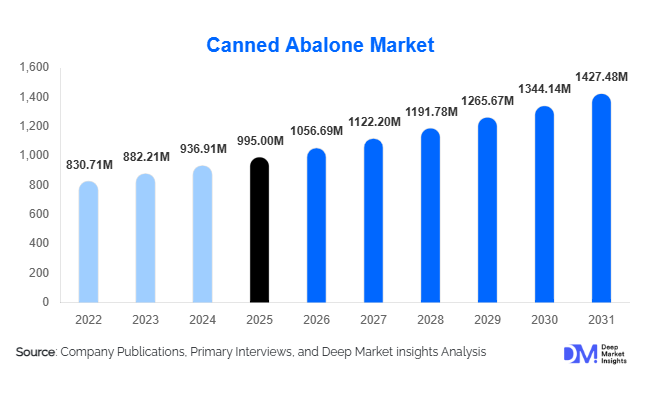
According to Deep Market Insights, the global canned abalone market size was valued at USD 995 million in 2025 and is projected to grow from USD 1,056.69 million in 2026 to reach USD 1,427.48 million by 2031, expanding at a CAGR of 6.2% during the forecast period (2026–2031). The canned abalone market growth is primarily driven by increasing demand for premium seafood products, rising consumption of luxury food items across Asia-Pacific, growing adoption of shelf-stable seafood products, and continued expansion of commercial abalone aquaculture production. Improvements in processing technologies, premium packaging formats, and cross-border e-commerce distribution channels are further supporting market expansion globally.
Key Market Insights
- Farmed abalone accounts for nearly 78% of global canned abalone production, ensuring stable supply and supporting broader market accessibility.
- China remains the largest consumer and importer of canned abalone, representing approximately 48% of global demand due to strong gifting culture and premium seafood consumption.
- Whole canned abalone dominates product demand, accounting for more than 50% of market revenue owing to its premium positioning and consumer preference.
- Asia-Pacific holds approximately 72% of the global market share, supported by strong demand from China, Japan, South Korea, Singapore, and Taiwan.
- E-commerce channels are emerging as one of the fastest-growing distribution channels, allowing premium seafood brands to directly target affluent consumers.
- Sustainable aquaculture and traceability technologies are becoming key differentiators for manufacturers targeting premium export markets.
Canned Abalone Market Latest Trends
Premium Seafood Gifting Driving Market Expansion
Canned abalone continues to benefit from its status as a luxury food product, particularly across Asian markets where premium seafood gifting remains deeply embedded in cultural traditions. Demand spikes during Lunar New Year, Mid-Autumn Festival, weddings, and corporate gifting occasions. Manufacturers are increasingly investing in premium packaging formats, customized gift sets, and limited-edition products to capitalize on this trend. The growing affluent population across China, Singapore, Malaysia, and South Korea is creating sustained demand for high-value canned abalone products. Luxury retailers are expanding dedicated seafood gifting sections, while premium canned abalone is increasingly positioned alongside luxury confectionery, imported wines, and gourmet food hampers.
Sustainable Aquaculture and Traceability Adoption
Sustainability has become a central focus within the canned abalone industry. Producers are investing in advanced aquaculture technologies including recirculating aquaculture systems, AI-driven feeding solutions, disease monitoring systems, and blockchain-enabled traceability platforms. Retailers and foodservice operators increasingly require certification regarding environmental stewardship, responsible sourcing, and product authenticity. This trend is particularly significant in Europe, North America, Japan, and South Korea, where consumers demonstrate strong preferences for sustainably sourced seafood. Traceability solutions are also helping manufacturers differentiate products in premium export markets while addressing concerns regarding seafood fraud and supply chain transparency.
Canned Abalone Market Drivers
Rising Premium Seafood Consumption
The increasing global appetite for premium seafood products is one of the primary drivers supporting canned abalone market growth. Rising disposable incomes across Asia-Pacific, expanding affluent consumer populations, and increasing awareness of abalone's nutritional benefits continue to drive consumption. Canned abalone is perceived as a prestigious food product that symbolizes prosperity and status, particularly in Chinese-speaking markets. Growing urbanization and premiumization trends across food categories are further supporting demand growth.
Expansion of Commercial Aquaculture Production
Significant investments in aquaculture infrastructure have transformed global abalone supply chains. China, Australia, South Africa, and South Korea have expanded commercial abalone farming operations, improving supply reliability while reducing dependence on wild-caught harvests. Enhanced hatchery technologies, improved breeding programs, and optimized feed management systems have increased production efficiency. This expansion has enabled manufacturers to maintain stable production volumes while supporting international trade growth.
Convenience and Extended Shelf Life
Compared with fresh and frozen abalone products, canned abalone offers superior shelf stability, easier transportation, and lower spoilage risks. These advantages make canned products particularly attractive for export markets, retail channels, hospitality operators, and consumers seeking convenient premium seafood options. The ability to store canned abalone for extended periods without compromising product quality continues to support market adoption across both developed and emerging economies.
Canned Abalone Market Restraints
Environmental Risks Affecting Aquaculture Production
Despite the expansion of farmed abalone production, aquaculture operations remain vulnerable to environmental challenges including harmful algal blooms, disease outbreaks, water quality deterioration, and climate-related disruptions. Production losses resulting from biological risks can significantly impact global supply availability and pricing stability. These risks continue to present operational challenges for producers and investors across major producing regions.
Premium Pricing Limits Mass-Market Adoption
Canned abalone remains one of the most expensive categories within the processed seafood industry. High production costs, lengthy farming cycles, and limited supply contribute to elevated retail pricing. As a result, consumption remains heavily concentrated among affluent consumers and special-occasion purchases. Economic uncertainty, inflationary pressures, and reduced discretionary spending can adversely affect market demand, particularly in export-oriented luxury food segments.
Canned Abalone Industry Key Opportunities
Expansion into Emerging Premium Seafood Markets
Emerging economies including India, Vietnam, Thailand, Indonesia, Saudi Arabia, and the United Arab Emirates present significant growth opportunities for canned abalone manufacturers. Rising middle-class incomes, increasing exposure to premium imported foods, and growing hospitality sectors are creating new demand channels. Companies that establish strong distribution partnerships and localized marketing strategies can benefit from early-mover advantages in these developing markets.
Direct-to-Consumer E-Commerce Growth
The rapid expansion of online seafood retail platforms is transforming premium food distribution. E-commerce enables manufacturers to directly engage affluent consumers, offer personalized gift packaging, and improve customer retention through subscription-based purchasing models. Cross-border digital commerce is also facilitating international market access for premium abalone brands while reducing reliance on traditional retail networks.
Sustainable Premium Branding
Consumers increasingly reward brands that demonstrate environmental responsibility and transparent sourcing practices. Companies investing in sustainability certifications, eco-friendly packaging, carbon reduction initiatives, and traceable supply chains can secure premium pricing and strengthen long-term brand loyalty. Sustainable branding is expected to become an increasingly important competitive advantage as environmental awareness continues to rise globally.
Report Scope
| Report Metric | Details |
|---|---|
| Market Size in 2025 | USD 995.00 Million |
| Market Size in 2026 | USD 1056.69 Million |
| Market Size in 2031 | USD 1427.48 Million |
| CAGR | 6.2% (2026-2031) |
| Base Year for Estimation | 2025 |
| Historical Data | 2022-2024 |
| Forecast Period | 2026-2031 |
| Report Coverage | Revenue Forecast, Competitive Landscape, Supply Chain Disruption, Growth Factors, Environment & Regulatory Landscape and Trends |
| Geographies Covered | North America, Europe, APAC, Middle East and Africa, LATAM |
| Countries Covered | U.S., Canada, U.K., Germany, France, Spain, Italy, Russia, Nordic, Benelux, Rest of Europe, China, Korea, Japan, India, Australia, Singapore, Taiwan, South East Asia, Rest of Asia-Pacific, UAE, Turky, Saudi Arabia, South Africa, Egypt, Nigeria, Rest of MEA, Brazil, Mexico, Argentina, Chile, Colombia, Rest of LATAM |
Explore more data points, trends and opportunities Download Free Sample Report
Source Insights
The farmed canned abalone segment accounted for the largest share of the global canned abalone market in 2025, representing approximately 78% of total revenue. The segment’s leadership is primarily attributed to the increasing commercialization of abalone aquaculture, which enables consistent production volumes, predictable quality standards, and year-round product availability. Compared with wild-caught abalone, farmed varieties offer greater supply chain stability, lower harvesting risks, and improved traceability, making them highly attractive to processors, distributors, and international buyers. Major aquaculture-producing countries, including China, South Africa, Australia, and South Korea, continue to invest in advanced breeding technologies, water quality management systems, and sustainable farming practices to improve yields and meet rising global demand. The expansion of export-oriented aquaculture facilities and the growing emphasis on sustainable seafood sourcing are further strengthening the market position of farmed abalone. Continuous technological advancements in recirculating aquaculture systems, disease management, and feed optimization are expected to enhance production efficiency and support long-term segment growth throughout the forecast period.Wild-caught canned abalone continues to occupy a niche yet highly valuable position within the market. The segment benefits from strong consumer perceptions regarding authenticity, rarity, and superior flavor characteristics, particularly among premium seafood buyers and luxury dining establishments. However, strict fishing quotas, environmental conservation measures, declining natural stocks, and regulatory restrictions continue to limit commercial-scale harvesting activities. As a result, wild-caught abalone products typically command premium pricing and remain concentrated within high-end retail, specialty seafood stores, and luxury hospitality channels.
Species Insights
Haliotis discus hannai emerged as the leading species segment in the global canned abalone market, accounting for approximately 45% of total revenue in 2025. The dominance of this species is supported by its extensive cultivation across China, Japan, and South Korea, where it is highly valued for its desirable texture, flavor profile, high survival rates, and efficient farming characteristics. The species has become the preferred choice for large-scale aquaculture operations due to its strong adaptability to controlled farming environments and favorable growth performance. Rising production volumes, increasing export activities, and strong consumer recognition across Asian markets continue to reinforce the segment’s market leadership. The growing demand for premium seafood products and the expansion of aquaculture infrastructure across East Asia remain key drivers supporting the growth of Haliotis discus hannai.Haliotis laevigata and Haliotis rubra maintain significant positions within the global market, particularly in premium export segments. These Australian species are recognized for their superior quality, large size, and strong acceptance in luxury seafood markets across Asia-Pacific and North America. Increasing demand for premium canned seafood products, combined with Australia's reputation for high-quality seafood exports, continues to support segment expansion. Meanwhile, Haliotis midae, predominantly cultivated and harvested in South Africa, remains one of the most sought-after abalone species in international trade. Its distinctive taste profile, strong brand recognition, and established export channels into China, Hong Kong, Singapore, and other Asian markets allow the species to command premium pricing. Growing demand for luxury seafood gifting and fine dining experiences continues to support the commercial attractiveness of this segment.
Product Format Insights
Whole canned abalone represented the largest product format segment, accounting for nearly 52% of global market revenue in 2025. The segment’s leadership is driven by strong consumer perceptions linking whole abalone products with superior quality, authenticity, and prestige. Whole canned abalone is widely preferred for gifting purposes, festive celebrations, ceremonial occasions, and premium banquet dining, particularly across Asian markets where abalone carries significant cultural and symbolic value. The product format also offers enhanced visual appeal and premium presentation, making it highly attractive to luxury retailers, hospitality operators, and corporate gifting programs. Growing demand for premium packaged seafood products and rising consumer spending on luxury food items continue to support segment growth.Sliced and diced canned abalone products are witnessing increasing adoption among foodservice operators, restaurants, and catering providers due to their convenience, reduced preparation time, and operational efficiency. These formats enable greater menu flexibility while lowering labor requirements in commercial kitchens. In addition, ready-to-serve seasoned abalone products are emerging as an important growth category, particularly among younger consumers and urban professionals seeking convenient premium seafood options. Product innovation, flavor diversification, and the growing popularity of premium convenience foods are expected to create significant opportunities within these formats during the forecast period.
Distribution Channel Insights
Supermarkets and hypermarkets accounted for approximately 34% of global canned abalone sales in 2025, making them the leading distribution channel. Their dominance is supported by extensive retail networks, strong consumer trust, broad product visibility, and the ability to offer a wide range of premium seafood products under one roof. Large retail chains increasingly allocate dedicated shelf space to premium imported seafood products, enhancing accessibility and consumer awareness. The expansion of organized retail infrastructure across emerging economies and growing consumer preference for one-stop shopping experiences continue to support the segment’s market leadership. The increasing availability of premium canned seafood products in modern retail outlets remains a key driver of segment growth.Specialty seafood retailers and gourmet food stores continue to play an important role in serving high-income consumers seeking premium and imported abalone products. These channels benefit from personalized customer service, curated product selections, and strong positioning within the luxury food segment. Meanwhile, online retail represents the fastest-growing distribution channel globally. Rising internet penetration, expanding e-commerce ecosystems, increasing consumer confidence in online grocery purchases, and the growing popularity of direct-to-consumer sales models are driving rapid channel expansion. Manufacturers are increasingly investing in proprietary e-commerce platforms, premium online marketplaces, social commerce initiatives, and digital marketing strategies to strengthen customer engagement, expand geographic reach, and improve profit margins.
End-Use Insights
Household consumers remained the largest end-use segment in the global canned abalone market, contributing approximately 41% of total demand in 2025. The segment benefits from strong cultural traditions associated with abalone consumption during festivals, family gatherings, weddings, and important celebrations, particularly across Asia-Pacific countries. Canned abalone is widely regarded as a symbol of prosperity, luxury, and social status, supporting its popularity as a premium food gift and celebratory meal ingredient. Rising disposable incomes, expanding middle-class populations, and growing consumer interest in premium seafood products continue to strengthen household demand. The increasing practice of luxury food gifting and seasonal purchasing remains the primary driver supporting the segment’s leadership position.Restaurants, hotels, and luxury hospitality establishments represent the fastest-growing end-use category. Growing consumer demand for premium seafood dining experiences, the expansion of fine dining restaurants, and increasing tourism-related spending are driving adoption across the foodservice sector. Luxury hotels, resorts, cruise operators, and airline catering providers are increasingly incorporating abalone-based dishes into premium menus to enhance customer experiences and differentiate their offerings. In addition, corporate gifting programs, executive hampers, and premium food gift baskets are emerging as attractive application areas, particularly in China, Hong Kong, Singapore, and other affluent Asian markets where premium seafood products are commonly exchanged during festive and business occasions.
Explore more data points, trends and opportunities Download Free Sample Report
Canned Abalone Market Segmentations
By Source
- Farmed (Aquaculture) Canned Abalone
- Wild-Caught Canned Abalone
By Species
- Haliotis discus hannai
- Haliotis laevigata
- Haliotis rubra
- Haliotis midae
- Haliotis fulgens
- Other Commercial Species
By Product Format
- Whole Canned Abalone
- Half-Shell Canned Abalone
- Sliced Canned Abalone
- Diced/Chunk Canned Abalone
- Abalone in Sauce/Seasoned Canned Abalone
By Processing Type
- Plain Brine Canned Abalone
- Salted Canned Abalone
- Seasoned/Flavored Canned Abalone
- Premium Ready-to-Serve Canned Abalone
By Price Tier
- Ultra-Premium
- Premium
- Mid-Range
- Economy
Regional Insights
Asia-Pacific
Asia-Pacific dominated the global canned abalone market in 2025, accounting for approximately 72% of total revenue. China alone represented nearly 48% of global demand, supported by deep-rooted cultural associations with abalone consumption, luxury gifting traditions, and a rapidly expanding affluent consumer base. Abalone remains an important component of festive meals, family celebrations, weddings, and business gifting practices throughout the region. Japan and South Korea continue to generate substantial demand through premium retail, hospitality, and foodservice channels, while Singapore, Taiwan, Malaysia, and Hong Kong serve as major import destinations due to strong consumer preference for luxury seafood products. The region also benefits from the presence of large-scale aquaculture operations, established seafood processing industries, and extensive distribution networks. Rising disposable incomes, increasing urbanization, expanding middle-class populations, growing premium food consumption, and the strong cultural significance of abalone remain the primary drivers supporting regional market growth. Asia-Pacific is expected to maintain the fastest growth rate during the forecast period owing to continued economic development and increasing demand for high-value seafood products.
North America
North America accounted for approximately 9% of the global canned abalone market in 2025, with the United States representing the largest consumer market within the region. Demand is concentrated among affluent consumers, Asian immigrant communities, gourmet food enthusiasts, luxury restaurants, and specialty seafood retailers. Growing awareness of premium seafood products, increasing consumer willingness to pay for high-quality imported food items, and the expansion of upscale retail channels continue to support market development. The rise of premium e-commerce grocery platforms and growing demand for authentic Asian culinary experiences are further contributing to market growth. Increasing multicultural food consumption patterns, expanding luxury dining establishments, and rising interest in sustainably sourced seafood products remain the key drivers supporting regional demand.
Europe
Europe represented approximately 7% of global demand in 2025, with major consumption concentrated in the United Kingdom, Germany, France, Italy, and Spain. The region benefits from a growing consumer preference for premium seafood products, increasing demand for gourmet dining experiences, and rising awareness regarding sustainable sourcing practices. European consumers increasingly seek traceable and responsibly farmed seafood products, creating favorable opportunities for certified canned abalone suppliers. The growth of high-end hospitality establishments, luxury restaurants, and specialty gourmet retailers continues to strengthen regional consumption. Rising expenditure on premium food products, growing interest in international cuisine, and increasing demand for sustainable seafood remain the primary drivers supporting market growth across Europe.
Latin America
Latin America accounted for approximately 6% of global canned abalone demand in 2025. Brazil, Mexico, and Chile are emerging as important markets for premium seafood products due to improving economic conditions, rising disposable incomes, and expanding luxury dining sectors. Although regional consumption remains comparatively smaller than that of Asia-Pacific, increasing urbanization and the growing influence of international culinary trends are encouraging demand for imported premium seafood products. The expansion of upscale restaurants, gourmet retail outlets, and premium hospitality infrastructure continues to create new opportunities for market participants. Rising consumer spending on luxury food products, growing tourism activity, and increasing adoption of premium dining experiences serve as the key drivers supporting regional growth.
Middle East & Africa
The Middle East and Africa accounted for approximately 6% of global canned abalone demand in 2025. The United Arab Emirates and Saudi Arabia represent the largest import markets within the region, supported by high-income consumer populations, expanding luxury retail sectors, and strong demand from premium hospitality establishments. The region benefits from significant investments in tourism infrastructure, luxury hotels, fine dining restaurants, and international hospitality projects. South Africa plays a unique dual role as both a major producer and exporter of canned abalone, supplying premium products to key international markets while supporting regional trade activity. Growing tourism arrivals, rising demand for luxury seafood experiences, increasing expatriate populations, and the expansion of premium foodservice establishments across Gulf Cooperation Council countries remain the principal drivers supporting market growth throughout the forecast period.
Key Players in the Canned Abalone Market
- Yumbah Aquaculture
- Abagold
- Ocean Grown Abalone
- Wando Abalone
- Zoneco Group
- Gyoren Hokko
- Jade Tiger Abalone
- Lee Kum Kee
- Tasmanian Seafoods
- Aqunion
- American Abalone Farms
- Monterey Abalone Company
- Dongshan Eastern Star Abalone
- HIK Abalone Farm
- Southern Ocean Mariculture