Brown Basmati Rice Market Size
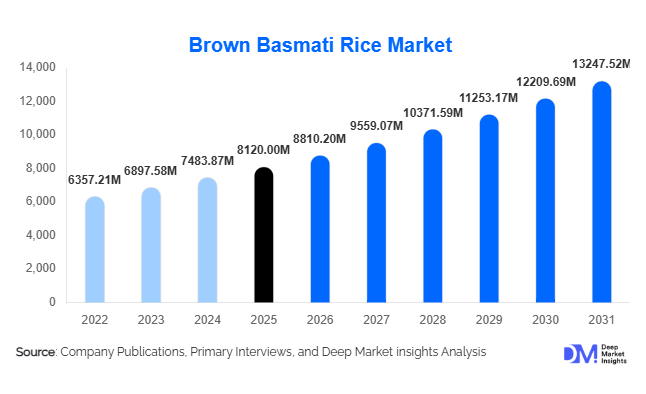
According to Deep Market Insights, the global brown basmati rice market size was valued at USD 8,120 million in 2025 and is projected to grow from USD 8,810.20 million in 2026 to reach USD 13,247.52 million by 2031, expanding at a CAGR of 8.5% during the forecast period (2026–2031). The market growth is primarily driven by increasing consumer preference for whole grains, rising awareness regarding low glycemic index foods, and the growing demand for clean-label and minimally processed staple products. Additionally, expanding export demand from Asia-Pacific to developed regions such as North America and Europe continues to strengthen global market dynamics.
Key Market Insights
- Brown basmati rice demand is shifting toward health-driven consumption, with increasing preference for fiber-rich and minimally processed grains.
- Organic brown basmati rice is gaining strong traction globally, particularly in Europe and North America, driven by premiumization trends.
- Asia-Pacific dominates global production and exports, led by India and Pakistan with extensive cultivation and export infrastructure.
- Middle East remains a key import-driven market, with high per capita consumption of basmati rice.
- E-commerce and modern retail channels are accelerating market penetration, improving product accessibility and brand visibility.
- Technological advancements in packaging and storage are enhancing shelf life and quality of brown rice products.
What are the latest trends in the brown basmati rice market?
Shift Toward Organic and Sustainable Rice Production
Consumers are increasingly prioritizing sustainability and food safety, driving demand for organic brown basmati rice. Producers are expanding organic cultivation practices, supported by government incentives and certifications. This trend is particularly strong in developed markets where consumers are willing to pay premium prices for chemical-free and environmentally sustainable products. Sustainable farming techniques, including water-efficient irrigation and reduced pesticide use, are becoming integral to production strategies, positioning organic brown basmati rice as a high-growth segment.
Growth of Value-Added and Ready-to-Eat Products
The integration of brown basmati rice into ready-to-eat meals and convenience food products is gaining momentum. Urbanization and busy lifestyles are increasing demand for quick meal solutions, leading to the development of microwaveable rice packs, pre-cooked rice bowls, and fortified rice products. Food manufacturers are leveraging brown basmati rice to enhance nutritional value, catering to health-conscious consumers. This trend is expanding the market beyond traditional consumption patterns into modern packaged food categories.
What are the key drivers in the brown basmati rice market?
Rising Health Awareness and Dietary Shifts
Increasing prevalence of lifestyle diseases such as diabetes and obesity has encouraged consumers to adopt healthier diets. Brown basmati rice, with its high fiber content and low glycemic index, is gaining popularity as a healthier alternative to white rice. This shift is particularly evident in urban populations and developed markets, where awareness of nutritional benefits is higher.
Expansion of Global Ethnic Cuisine
The global popularity of South Asian and Middle Eastern cuisines is driving demand for basmati rice varieties. Restaurants and food service providers are incorporating brown basmati rice into their offerings to cater to health-conscious customers. The growing acceptance of diverse culinary traditions is significantly boosting market growth.
What are the restraints for the global market?
Higher Pricing Compared to White Rice
Brown basmati rice is relatively more expensive due to its processing requirements and shorter shelf life. This price premium limits its adoption in price-sensitive markets, particularly in developing regions where affordability remains a key factor.
Storage and Shelf-Life Challenges
The presence of bran in brown rice makes it more susceptible to spoilage, requiring advanced storage and packaging solutions. This increases operational costs for manufacturers and poses logistical challenges, especially in export markets.
What are the key opportunities in the brown basmati rice industry?
Expansion into Emerging Markets
Emerging regions such as Africa and Latin America present significant growth opportunities due to rising urbanization, increasing disposable incomes, and growing awareness of healthy diets. Improved trade relations and logistics infrastructure are facilitating market entry for exporters.
Innovation in Packaging and Shelf-Life Extension
Advancements in vacuum packaging and eco-friendly materials are helping extend the shelf life of brown basmati rice. Companies investing in innovative packaging solutions can reduce spoilage and improve product quality, creating competitive advantages.
Report Scope
| Report Metric | Details |
|---|---|
| Market Size in 2025 | USD 8120 Million |
| Market Size in 2026 | USD 8810.20 Million |
| Market Size in 2031 | USD 13247.52 Million |
| CAGR | 8.5% (2026-2031) |
| Base Year for Estimation | 2025 |
| Historical Data | 2022-2024 |
| Forecast Period | 2026-2031 |
| Report Coverage | Revenue Forecast, Competitive Landscape, Supply Chain Disruption, Growth Factors, Environment & Regulatory Landscape and Trends |
| Geographies Covered | North America, Europe, APAC, Middle East and Africa, LATAM |
| Countries Covered | U.S., Canada, U.K., Germany, France, Spain, Italy, Russia, Nordic, Benelux, Rest of Europe, China, Korea, Japan, India, Australia, Singapore, Taiwan, South East Asia, Rest of Asia-Pacific, UAE, Turky, Saudi Arabia, South Africa, Egypt, Nigeria, Rest of MEA, Brazil, Mexico, Argentina, Chile, Colombia, Rest of LATAM |
Explore more data points, trends and opportunities Download Free Sample Report
Product Type Insights
The global brown basmati rice market is characterized by a strong preference for premium-quality grains, with extra-long grain brown basmati rice emerging as the dominant product type. Accounting for approximately 58% of the global share in 2025, this segment continues to outperform other variants due to its superior aroma, elongated grain structure, and non-sticky texture after cooking. These attributes make it particularly appealing to both household consumers and the food service industry, where presentation and sensory quality play a critical role in meal experience. Additionally, the nutritional profile of extra-long grain brown basmati rice, which includes higher fiber content and lower glycemic index compared to white rice, aligns with the growing global demand for healthier staple foods.While long grain brown basmati rice serves price-sensitive markets and contributes significantly to overall volume, it remains secondary in value terms due to lower pricing and relatively limited export preference. Nonetheless, this segment benefits from rising consumption in emerging economies where affordability is a key consideration. Over time, improvements in processing techniques and supply chain efficiencies are expected to narrow the quality gap, allowing long grain variants to capture incremental market share, particularly in domestic markets across Asia and Africa.
Application Insights
In terms of application, household consumption continues to dominate the global brown basmati rice market, contributing nearly 52% of the total market share. This dominance is primarily driven by increasing health awareness among consumers, who are actively shifting from refined grains to whole grain alternatives. Brown basmati rice, known for its nutritional benefits such as high fiber, essential minerals, and slower digestion rate, has become a staple in health-conscious households. The growing trend of home cooking, further accelerated by lifestyle changes and increased focus on dietary control, continues to support demand in this segment.Meanwhile, the food processing industry is witnessing steady growth, driven by increasing demand for ready-to-eat meals, packaged foods, and convenience products. Brown basmati rice is being incorporated into a wide range of processed food applications, including microwaveable meals, rice bowls, and health-focused snacks. This segment is expected to surpass USD 2,000 million by 2031, supported by technological advancements in food processing and growing consumer preference for nutritious convenience foods.
Distribution Channel Insights
The distribution landscape of the brown basmati rice market is evolving rapidly, with modern trade channels such as supermarkets and hypermarkets accounting for approximately 48% of the market share. The dominance of this segment is largely attributed to the expansion of organized retail networks, particularly in emerging economies, as well as the enhanced visibility and accessibility of products offered through these channels. Consumers increasingly prefer modern retail outlets due to their wide product assortment, quality assurance, and attractive promotional offers.Online retail is emerging as a high-growth distribution channel, supported by rapid digital adoption, increasing internet penetration, and the convenience of home delivery. E-commerce platforms are enabling consumers to access a wide variety of rice brands and product types, often at competitive prices. Subscription-based models and bulk purchasing options are also gaining popularity, particularly among urban consumers. The COVID-19 pandemic accelerated the shift toward online grocery shopping, and this trend is expected to persist in the long term.Traditional grocery stores continue to play a significant role, especially in rural and semi-urban areas where modern retail penetration remains limited. These stores benefit from strong local relationships and consumer trust, ensuring steady demand. Additionally, specialty stores focusing on organic and health foods are gaining traction, particularly in developed markets, as consumers seek high-quality, sustainably sourced brown basmati rice.
End-Use Insights
The household segment remains the largest end-user of brown basmati rice, driven by widespread adoption across daily diets and increasing awareness of its health benefits. Consumers are increasingly prioritizing whole grain options, leading to sustained demand within this segment. The affordability of smaller packaging sizes and the availability of diverse product variants further support household consumption.The leading driver for household dominance is the integration of brown basmati rice into regular meal plans as a healthier alternative to white rice. This shift is particularly evident in urban areas, where consumers are more exposed to nutritional information and global food trends. Government initiatives promoting healthy eating habits and balanced diets are also contributing to increased adoption.Institutional buyers, including airlines, defense organizations, and large-scale catering services, contribute to steady demand for brown basmati rice. These buyers prioritize consistent quality and bulk availability, making them important stakeholders in the market. Additionally, export-oriented consumption accounts for nearly 60% of total demand, underscoring the global nature of the basmati rice trade and the reliance on international markets for revenue generation.
Explore more data points, trends and opportunities Download Free Sample Report
Brown Basmati Rice Market Segmentations
By Grain Type
- Extra-Long Grain Brown Basmati Rice
- Long Grain Brown Basmati Rice
By Cultivation Type
- Organic Brown Basmati Rice
- Conventional Brown Basmati Rice
By Application
- Household Consumption
- Food Service Industry
- Food Processing Industry
- Institutional Buyers
By Distribution Channel
- Modern Trade
- Traditional Grocery Stores
- Online Retail/E-commerce
- Specialty & Organic Stores
- Direct/B2B Sales
Regional Insights
Asia-Pacific
Asia-Pacific dominates the global brown basmati rice market, accounting for approximately 68% of the total share in 2025. The region’s leadership is primarily driven by major producing countries such as India and Pakistan, which benefit from favorable agro-climatic conditions, fertile soil, and well-established farming practices. India alone contributes over 75% of global basmati exports, supported by strong government policies, export incentives, and investments in agricultural infrastructure.The key growth drivers in Asia-Pacific include increasing domestic consumption, rising population, and expanding middle-class income levels, which are driving demand for premium food products. Additionally, improvements in irrigation systems, adoption of high-yield seed varieties, and advancements in post-harvest processing are enhancing productivity and quality. The presence of a robust supply chain network, including efficient milling and export facilities, further strengthens the region’s position in the global market.
Middle East & Africa
The Middle East holds a significant share of approximately 14% of the market, driven by strong cultural and dietary preferences for basmati rice. Countries such as Saudi Arabia and the UAE rely heavily on imports to meet domestic demand, making them key markets for exporters. Basmati rice is a staple ingredient in traditional cuisines, ensuring consistent consumption across households and food service establishments.The primary drivers in this region include high per capita rice consumption, increasing disposable income, and a strong preference for premium-quality grains. In Africa, the market is experiencing rapid growth due to urbanization, population expansion, and changing dietary patterns. Governments in several African countries are also facilitating trade partnerships and reducing import barriers, which is improving accessibility and boosting market growth.
Europe
Europe accounts for approximately 8% of the global market share, with key markets including the United Kingdom, Germany, and France. The region’s demand is largely driven by a growing multicultural population and increasing consumer interest in ethnic cuisines. Brown basmati rice is gaining popularity among health-conscious consumers who prefer organic and minimally processed food products.Growth in Europe is supported by stringent food safety regulations and certification standards, which ensure high product quality and traceability. The rising demand for organic and sustainably sourced food products is also driving the adoption of brown basmati rice. Retail expansion, coupled with strong distribution networks, is further enhancing product availability across the region.
North America
North America represents around 6% of the global market, led by the United States. The region is characterized by increasing health awareness and a growing preference for whole grain foods. Brown basmati rice is widely consumed by health-conscious individuals and is often included in diet plans focusing on weight management and diabetes control.The key growth drivers in North America include rising multicultural demographics, which are introducing diverse culinary traditions, and the growing popularity of plant-based diets. The expansion of organic food markets and the presence of well-established retail channels are also contributing to market growth. Additionally, strong marketing strategies and brand positioning are helping to increase consumer awareness and product adoption.
Latin America
Latin America holds a relatively smaller share of approximately 4% but is emerging as one of the fastest-growing regions in the brown basmati rice market. Increasing health awareness, improving economic conditions, and expanding trade relationships with major exporting countries are driving growth in this region.The region’s growth is further supported by the gradual diversification of dietary habits and the rising influence of global cuisines. Governments are also investing in trade infrastructure and reducing import tariffs, making premium rice varieties more accessible to consumers. As urbanization continues and consumer preferences evolve, Latin America is expected to present significant growth opportunities for market players.
Key Players in the Brown Basmati Rice Market
- LT Foods Ltd.
- KRBL Limited
- Amira Nature Foods Ltd.
- Kohinoor Foods Ltd.
- Tilda Ltd.
- Matco Foods Limited
- Guard Rice Mills
- Aeroplane Rice Ltd.
- Veetee Rice Ltd.
- Unity Foods Limited
- Sarveshwar Foods Ltd.
- RiceTec Inc.
- Shree Krishna Rice Mills
- Sungold Basmati Rice
- Nature Bio Foods Ltd.